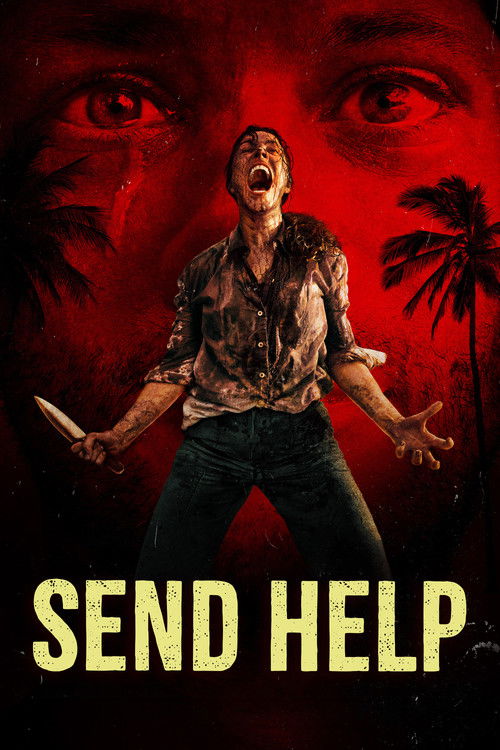
Send Help
2026 · Sam Raimi
For when you want something wicked — a nasty-fun ride that skewers your worst boss memories while still delivering real thriller tension. More gleeful than comforting; bring a dark sense of humor.
What it's about
A corporate strategist and her freshly promoted CEO boss are the only survivors when their plane goes down near a remote island in the Gulf of Thailand. Stranded together, the office power dynamic that made her life miserable gets renegotiated by sun, hunger, and necessity — and the question of who's really in charge turns dangerous.
The experience
It plays like a workplace grudge with the safety off: funny, mean, and squirmy, swinging between slapstick survival misery and genuine menace. Raimi's glee is all over it — you laugh, then wince, then check whether you should have laughed.
Performances
Rachel McAdams and Dylan O'Brien carry it as a two-hander, and McAdams in particular gets to run a full range — doormat, schemer, survivor — that the film's whole balance of power tilts on.
The craft
Sam Raimi directing a horror-comedy again means the camera itself is a prankster: whip-pans, cruel sight gags, and escalations timed like punchlines. The island setting gives the mayhem a bright, sweaty physicality that plays big on a good screen.
Why it matters
Raimi's first film as director since his Marvel detour, and a return to the unruly horror-comedy mode that made his reputation — watched closely as proof the old anarchic streak survived the blockbuster years.
Horror · Horror comedy & camp · Backwoods & survival · Psychological horror. Stranded on an island, a worker and her awful boss fight for control in a mean, slapstick survival horror-comedy with real menace.
Snapshot
Send Help is Sam Raimi's return to the horror-comedy register that made his name, and his first film as director since Doctor Strange in the Multiverse of Madness (2022). A survival thriller with a satirical spine, it strands two coworkers — corporate strategist Linda Liddle (Rachel McAdams) and her newly minted CEO boss Bradley Preston (Dylan O'Brien) — as the sole survivors of a plane crash on a remote island in the Gulf of Thailand. What the studio-facing synopsis frames as a two-hander about "past grievances" is, in the finished film, something nastier and funnier: a chamber piece about workplace power that curdles into predation, as Linda's competence turns the marooned pecking order upside down and she engineers her boss's death, conceals it, and reinvents herself as a celebrated survivor. Released by 20th Century Studios on January 30, 2026 against a reported $40 million budget, the film opened atop the domestic box office and drew strong reviews (Rotten Tomatoes reports 92% across roughly 300 critics; Metacritic 75). It reunites Raimi with a core team of career-long collaborators — cinematographer Bill Pope, editor Bob Murawski, and composer Danny Elfman — and features a photographic cameo from Bruce Campbell, signaling a deliberate homecoming.
Industry & production
Send Help was produced through Raimi Productions, with Raimi and Zainab Azizi as producers, and distributed by 20th Century Studios (now a Disney label). At roughly $40 million, its budget sits in the mid-range: larger than a microbudget genre bet but modest by contemporary studio-tentpole standards, a scale that fits a contained two-location survival story built around movie stars rather than spectacle. Principal photography ran from February 2025 to April 17, 2025, with production spanning Sydney, Los Angeles, and Thailand — the Australian and Thai components supplying the tropical island exteriors and the water work, and Los Angeles presumably anchoring stage-based and controlled-environment shooting.
The picture belongs to a recognizable strategic pattern: an established auteur returning to a lower-budget, R-rated, original genre premise after a run inside a franchise machine. For Raimi, whose recent directing credit was a Marvel property, Send Help represents a reassertion of authorship on a scale where his sensibility can dominate. For 20th Century Studios under Disney, it is a comparatively contained wager on a name-brand director and two bankable leads. The commercial outcome — a reported worldwide gross near $94 million (about $65 million domestic, $29 million international) on that $40 million budget — reads as a solid win for the model, though as with all recently released films these figures remain provisional and should be treated as reported rather than settled.
Technology
Detailed technical specifications for Send Help — camera systems, lens packages, and finishing pipeline — are not well documented in the public record at this writing, and this dossier will not invent them. What can be said with confidence bears on the kind of technology the material demanded. A survival thriller shot substantially on and around water in Thailand and Australia is, first and foremost, a logistics and safety problem: tides, weather, and performer immersion impose constraints that shape everything downstream. Cinematographer Bill Pope's participation is itself a technological signal; he is a filmmaker equally fluent in the fully controlled, effects-integrated frame (The Matrix, Spider-Man 2) and in naturalistic location work, and the film's split between real tropical exteriors and controlled setups points to a hybrid approach. Critics have singled out the film's "playfully yucky" practical effects, indicating that Raimi continued to favor tangible, in-camera gags over wholly digital gore — consistent with his lifelong preference for effects the actors can react to. Any more granular account of the capture and post workflow would be speculation.
Technique
Cinematography
Bill Pope is the most consequential craft signature here, and not a new one: he shot Raimi's Army of Darkness (1992) at the outset of his career and later lensed Spider-Man 2 (2004) and Spider-Man 3 (2007), making Send Help a reunion decades in the making. Pope's Raimi work is defined by an unusually mobile, subjective camera — the "shaky-cam" and swooping point-of-view rushes that Raimi pioneered in the Evil Dead films are, in their studio-era form, Pope's to execute. A confined island premise plays directly to those instincts: the visual grammar of survival horror rewards a camera that stalks, that adopts the vantage of an unseen threat, and that can whip from wide desolation to claustrophobic close-up. The island setting also offers Pope natural extremes of scale and light — vast empty horizons against tight, sweaty two-shots — that dramatize the characters' isolation and the shifting balance of power between them.
Editing
Bob Murawski cut the film, extending one of the most durable director-editor partnerships in American genre cinema; he has edited essentially every Raimi feature since Army of Darkness, including Drag Me to Hell and both Spider-Man 2 and Doctor Strange in the Multiverse of Madness, and won an Academy Award for The Hurt Locker. Murawski's Raimi grammar is the engine of the director's tonal control: the whiplash cutting that lets a scene pivot from dread to slapstick within a beat, the percussive shock inserts, the comic timing that depends on holding or dropping a frame at exactly the right moment. In a film reported to swing between survival tension and dark comedy, that editorial tone-management is central rather than incidental.
Mise-en-scène / staging
The film's staging problem is the two-hander confined to an island, and its dramatic architecture is a power inversion. Early scenes must legibly establish a corporate hierarchy — subordinate and boss — through blocking and physical deference, so that the collapse of that hierarchy registers spatially as Linda's competence redistributes authority. The island itself functions as a stripped stage where social rank is replaced by raw capability, and Raimi's staging exploits the contrast between the trappings of executive status and the indifference of the natural world. The Bruce Campbell photographic cameo is a mise-en-scène wink of exactly the kind Raimi favors — an authorial signature planted within the frame.
Sound
Danny Elfman's score is the film's most-remarked sonic element; reviewers described it as "cheeky," underscoring the tonal duality Raimi is after. Elfman is another long-standing collaborator — he scored Darkman, the Spider-Man trilogy, Oz the Great and Powerful, and Doctor Strange in the Multiverse of Madness — and his facility with music that is simultaneously menacing and mischievous is well suited to a horror-comedy where the audience is invited to enjoy the villainy. Beyond the score, a survival film built around water, weather, and isolation lives on its sound design: the presence or absence of ambient life, the intrusion of threat into silence. Specific sound-department credits and design choices are not richly documented in the current record.
Performance
The performances, and Rachel McAdams's in particular, drew the strongest critical attention. McAdams plays Linda as an initially sympathetic competent who reveals herself as something far darker — a rare full-blown villain turn that reviewers framed as a corrective to her frequent underuse in earlier roles. The part demands a controlled tonal high-wire: the audience must track her from underestimated subordinate to calculating predator without the film tipping into camp too early. Dylan O'Brien, as the entitled young CEO, plays the counterweight — the ostensible authority whose status evaporates once survival, not org-charts, sets the terms. Dennis Haysbert, Edyll Ismail, Xavier Samuel, and Chris Pang round out the ensemble in supporting capacities.
Narrative & dramatic mode
The dramatic mode is survival-thriller-as-satire, structured on inversion and dramatic irony. The premise promises the familiar shape of the castaway story — two antagonists forced to cooperate against nature — and then subverts it: the real predator is not the island but Linda, and the film's suspense migrates from will they survive? to what is she willing to do, and will she get away with it? The concealment plot and Linda's eventual reinvention as a wealthy, celebrated "survivor" push the narrative into the territory of the ironic anti-heroine's ascent, closer to a dark comedy of ambition than to conventional survival horror. This structure lets Raimi weaponize audience complicity: we are positioned to admire competence and root for the underdog even as those sympathies are turned toward monstrous ends. The workplace framing — the boardroom logic transplanted to a beach — supplies the satirical target throughout.
Genre & cycle
Send Help sits at the intersection of three cycles. It is a survival thriller in the lineage that includes Cast Away — a comparison critics reached for repeatedly, one memorably casting the film as Cast Away with a human companion who is himself the problem. It is a horror-comedy, the mode Raimi effectively canonized with Evil Dead II and Army of Darkness and revisited in Drag Me to Hell (2009). And it participates in a recent cycle of "eat-the-rich," corporate-satire genre films — a wave running through pictures like Ready or Not, The Menu, Triangle of Sadness, and Glass Onion — that use survival or entrapment scenarios to skewer wealth and hierarchy. The screenwriting team of Damian Shannon and Mark Swift roots the project firmly in genre craft: their credits include Freddy vs. Jason, the 2009 Friday the 13th remake, and Jason X, alongside the broad comedy of Baywatch — a pairing of slasher mechanics and comic register that maps neatly onto the film's tonal blend.
Authorship & method
The film is legible above all as a Raimi work, and its clearest authorial statement is in personnel. By reassembling Pope (camera), Murawski (edit), Elfman (score), and Campbell (on screen, however briefly), Raimi reconstitutes the collaborative unit through which his sensibility has historically been expressed — the reason critics read the film as "Raimi at his most gleeful and twisted." His method has always fused rigorous, almost mechanical craft — meticulously storyboarded camera moves, effects engineered for maximum tactile impact — with a generosity toward genre pleasure and a willingness to let horror and comedy share the same frame. The screenwriters bring their own genre pedigree, and the auteur signature lies less in the plot mechanics than in the tonal orchestration: the calibration of when to frighten, when to disgust, and when to let the audience laugh at its own complicity. It is worth stating plainly that a full account of Raimi's on-set method for this film — his specific directions to the cast, the extent of storyboarding, the balance of practical to digital gags — is not yet in the documentary record.
Movement / national cinema
Send Help is a work of mainstream American studio filmmaking, produced within the Disney/20th Century Studios apparatus, and does not belong to a formal movement. If it participates in anything larger, it is the long American tradition of the genre-auteur — filmmakers like Raimi, John Carpenter, and Wes Craven who built personal styles inside disreputable genres — and, more recently, the studio strategy of releasing mid-budget, R-rated original horror as counterprogramming to franchise product. Its international production footprint (Australia, Thailand) reflects the globalized, incentive-driven logistics of contemporary Hollywood location shooting rather than any national-cinema affiliation.
Era / period
The film is a product of the mid-2020s Hollywood landscape, and it reflects that moment on two axes. Industrially, it embodies the post-franchise-fatigue turn back toward original, star-driven genre films at contained budgets — a bet that a named director and recognizable leads can open a movie without pre-existing IP. Thematically, it is thoroughly of its era: a corporate-satire thriller about a subordinate weaponizing competence against an entitled boss, arriving amid ongoing cultural conversations about workplace power, gender, and the spin economy that lets a survivor monetize a curated version of her own story. The celebrity-of-catastrophe coda in particular reads as a comment on a media environment that rewards the well-packaged personal narrative.
Themes
The dominant theme is power and its illegibility: the film argues that institutional rank (CEO, executive, strategist) is a fiction that survives only as long as the institution does, and that stripped of it, a very different hierarchy of competence and ruthlessness emerges. A second theme is gender and underestimation — Linda's arc is built on the trap of being dismissed, and the film converts the audience's initial sympathy for the overlooked woman into unease as her capability curdles into predation. Third is the theme of narrative and self-mythology: Linda's final reinvention as a beloved survivor indicts a culture that consumes trauma-stories and cannot see the monster behind a well-told tale. Underlying all three is Raimi's career-long fascination with comeuppance and moral appetite — the pleasure and horror of watching someone take exactly what they want.
Reception, canon & influence
Critical reception was strongly positive: Rotten Tomatoes reports 92% positive across roughly 300 critics (average 7.4/10) and Metacritic a 75 ("generally favorable"), against a more mixed popular grade (a B+ CinemaScore) that suggests the film's dark, ironic turn divided general audiences more than critics. The New York Times' Jeannette Catsoulis called it "Raimi at his most gleeful and twisted" and praised its "darkly humorous tone and playfully yucky special effects"; IndieWire's Alison Foreman found it "wickedly lovable with the potential to be timeless"; and multiple reviews reached for the Cast Away comparison to describe its castaway-with-a-human-antagonist structure. The recurring throughline in the coverage was Rachel McAdams's villainous lead, widely treated as a career-recontextualizing performance. (As reception for a recently released film, these judgments remain early rather than settled.)
The influences on the film run backward through Raimi's own Evil Dead/Drag Me to Hell horror-comedy, the survival-castaway tradition epitomized by Cast Away, the slasher craft of screenwriters Shannon and Swift, and the recent eat-the-rich satire cycle. Its forward legacy cannot yet be assessed — the film is too new, and any claim about what it "shaped" would be premature. What can be said is that it functions, within Raimi's filmography, as a demonstration that his horror-comedy voice remains viable at studio scale after years inside franchise work, and, within McAdams's, as a bid to redefine her range. Whether it becomes a durable reference point for the corporate-survival-satire mode is a question only time and the films that follow it can answer.
Sources: Wikipedia: Send Help · AllMovie · 20th Century Studios · Movie Insider
A Deleuzian reading
A man is still the boss on a beach.
The full Deleuzian reading of Send Help →
Reception
Too new for a reappraisal arc — it landed in January 2026 as Raimi's first horror film in 17 years, was greeted as a gleeful return to form, and quietly overperformed with about $94M on a $40M budget.
How Send Help was received, from release to now →
How to watch Send Help: what to notice on a first viewing
- Watch who stands, who fetches, and who waits to be told. Two people are on a beach with no company left. Raimi keeps staging the office pecking order in their bodies anyway. Bradley was CEO for about five minutes before the plane went down, and he is still being deferred to. Rank is being performed by a body in a place that has never heard of rank. That gap is the film's first joke and its whole subject.
- Watch Rachel McAdams keep her face just under a threshold. Linda starts as the underestimated competent one. McAdams plays her with small shifts that keep promising something bigger without delivering it, and she refuses to tip into camp early. The restraint is the performance. You keep watching a face for the thing it has not done yet.
- Notice the low gliding shots that belong to nobody. Bill Pope shot Army of Darkness for Raimi decades ago and brings back the racing predator viewpoint. Here it whips from empty horizon to sweaty two-shot, and there is no monster on the island to own it. The stalking camera borrows the look of a horror film with nothing on the island to explain it.
- Notice how fast a scene turns from dread to slapstick. Bob Murawski has cut nearly every Raimi film since Army of Darkness. He uses percussive shock inserts and holds or drops a frame for comic timing, so terror and gag share one sequence without a seam. The collision produces a laugh you did not agree to, which is how the film keeps you enjoying things you should not.
- Listen for Danny Elfman's score being playful during unpleasant moments. Elfman writes menace and mischief in the same cue. The music keeps grinning while the situation deteriorates, and it never settles into straight survival-thriller tension. The scoring gives you permission to enjoy what you are watching.
The whole guide to watching Send Help, with the keys for a rewatch →
Influences: the films it descends from and the films it influenced
- The Evil Dead (1981) — Origin of Raimi's low, gliding subjective 'shakycam' that races through space as an unseen predator-POV — the forced-perspective mobile-camera device Bill Pope extends in Send Help.
- Evil Dead II (1987) — Codified Raimi's splatstick tonal-whiplash grammar — cutting a scream into a laugh inside a single besieged-protagonist setpiece — the frighten/disgust/laugh calibration Murawski's editing reprises.
- Army of Darkness (1992) — Prior assembly of the same craft unit — Pope's kinetic camera, Murawski's cutting, Campbell on screen, storyboarded practical creature gags — that Raimi reconstitutes here.
- Darkman (1990) — Launched the Raimi–Elfman partnership and its operatic, mischievous-menacing thematic idiom, the scoring register that underlines Send Help's villainy.
- Drag Me to Hell (2009) — Raimi's proof that his gross-out horror-comedy voice survives at studio scale after years in franchise work — the exact re-entry template Send Help follows.
- Cast Away (2000) — The single-castaway survival structure Send Help inverts by replacing the mute volleyball companion with a scheming human antagonist — the comparison critics reached for.
- Misery (1990) — The confined captor/captive two-hander built on a mid-film power inversion and sustained dramatic irony — the power-flip staging Send Help adopts.
- Pee-wee's Big Adventure (1985) — Established Elfman's carnival-esque menacing-yet-mischievous scoring idiom — the playful-sinister orchestral register he carries into Send Help.
- Gone Girl (2014) — The mid-narrative villain-turn of a woman who seizes control of her own mythology through media 'spin' and dramatic irony — the ironic anti-heroine ascent McAdams's performance echoes.
- Ready or Not (2019) — Eat-the-rich survival horror-comedy pitting a resourceful victim against wealthy predators, fusing practical blood-gags with comic timing in a closed estate.
- Parasite (2019) — Class satire built on tonal-whiplash cutting that swerves between comedy, thriller, and horror across a rich/poor power inversion.
- Triangle of Sadness (2022) — Its castaway-island act literalizes the eat-the-rich power inversion — survival strips class rank and elevates the servant into command, the same reversal two-hander Send Help stages.
- The Menu (2022) — Closed-system eat-the-rich satire trading on institutional-power illegibility and the dramatic irony of trapped elites who can't read the rules being run on them.
- Saltburn (2023) — An ironic anti-hero's ascent through wealth via concealed villainy and self-mythologizing performance — the same anti-heroine-ascent arc Send Help builds its dramatic irony around.
- Barbarian (2022) — Structural tonal-whiplash horror-comedy using subjective camera through confined space and a mid-film swerve that reframes who the antagonist is.
- Fresh (2022) — Captor/captive two-hander with a charming-villain turn and a literal eat-the-rich premise, whiplashing between rom-com and survival horror.
Similar films
- Drag Me to Hell (2009) — influence & lineage
- Triangle of Sadness (2022) — influence & lineage
- Evil Dead II (1987) — influence & lineage
- The Menu (2022) — influence & lineage
- Barbarian (2022) — influence & lineage
- Ready or Not (2019) — influence & lineage · same viewing thread
- The Cabin in the Woods (2012) — same viewing thread
- Evil Dead Burn (2026) — shared sensibility
All the films related to Send Help →
Watch it with: curated runs of related films
- Horror That's In on the Joke — A run of horror comedies that know the rules — the slasher's final girl, the cabin in the woods, the zombie survival list, the deadly family tradition — and have a blast bending them, so watching them together turns each one's genre jokes into a running conversation.