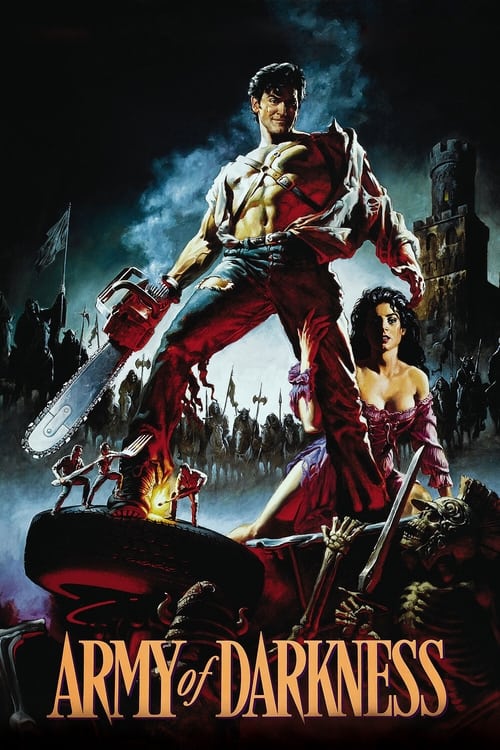
Army of Darkness
1992 · Sam Raimi
When you want to laugh at something gloriously silly with real craft behind it — a midnight-movie mood, ideal with friends and zero pretensions. All comfort, no dread.
What it's about
Ash — chainsaw for a hand, shotgun on his back, department-store name tag still on — is hurled out of his own time and into the Dark Ages, where the locals mistake him for a prophesied deliverer. To get home he has to retrieve a book of the dead, and when he flubs the magic words, he raises an entire army of wisecracking skeletons that he'll have to lead a medieval castle in fighting off.
The experience
A live-action cartoon — slapstick, swagger, and stop-motion mayhem at a dead sprint, with a hero who's equal parts action star and Three Stooges punching bag. You spend most of it grinning and quoting lines back at the screen.
Performances
Bruce Campbell gives one of the great comic physical performances in genre cinema — preening, cowardly, absurdly quotable, and willing to take endless punishment from his own possessed hand.
The craft
Sam Raimi throws his whole toybox at it: whip-crack camera moves, Harryhausen-style skeleton armies, and gag-a-minute editing that treats horror imagery as slapstick raw material. The handmade effects are half the charm — you can feel the glee in every stop-motion frame.
Why it matters
It completed Ash's transformation from horror survivor into pop-culture icon, cemented the Evil Dead series' cult immortality, and its one-liners escaped into the broader culture — echoed in video games and quoted by people who've never seen it.
Snapshot
Army of Darkness is the third Evil Dead film and the one that finally abandons horror as its governing mode. Ash Williams — the department-store clerk who survived two consecutive nights of demonic possession in a cabin in the woods — is dropped, along with his Oldsmobile, his shotgun and his chainsaw prosthesis, into a version of the fourteenth century, where he is taken for a prophesied deliverer, sent to retrieve the Necronomicon Ex-Mortis, bungles the retrieval incantation, and thereby raises the skeletal army he then has to defeat. What was a siege film becomes a quest film; what was a horror picture becomes a mock-heroic slapstick fantasy in the line of Harryhausen and the Three Stooges, with a Mark Twain premise underneath it.
The film matters for three reasons. First, it completes the transformation of Ash from victim to swaggering idiot-hero — one of the few genuinely durable characters American genre cinema produced in the period, and the template for a whole generation of wisecracking protagonists in film, comics and video games. Second, it is a late, unusually confident demonstration of pre-digital effects craft: stop-motion puppets, forced perspective, rod-and-cable articulation and optical compositing, assembled in the same eighteen-month window in which Terminator 2 and then Jurassic Park made all of it look historical. Third, it is a case study in what happened when the American studios absorbed the independent horror directors of the 1980s — Raimi arrived at Universal with a cult property and left with a shortened, PG-13-rated, studio-re-ended film that nonetheless became one of the most quoted cult objects of its decade.
It is also, by any strict account, an uneven film: broad where its predecessor was precise, and crude in its handling of its one significant female character. Its reputation rests less on formal achievement than on tone — the sustained, unembarrassed commitment to a joke about American self-regard.
Industry & production
The Evil Dead films were made outside the studio system by a Michigan-based group — director Sam Raimi, producer Robert Tapert and actor Bruce Campbell — who had financed The Evil Dead (1981) through private investors and released it through independent distribution. Evil Dead II (1987) was made with backing associated with Dino De Laurentiis's operation, a step up in resources but still outside the majors. Army of Darkness is where the operation crossed over: produced by Renaissance Pictures with De Laurentiis financing involvement, and distributed by Universal Pictures.
The consequences were immediate and are legible in the film. The budget was an order of magnitude beyond the original's — figures circulate in the low eight millions to low elevens depending on source, and I won't pin a number — and it bought a full-scale castle exterior built on Southern California location, large night shoots with hundreds of extras and puppets, an orchestral score, and a visual-effects program the earlier films could not have contemplated. It also bought studio oversight. The screenplay, by Sam Raimi and his brother Ivan Raimi, went through title changes — The Medieval Dead and Evil Dead III both circulated during development — before Universal settled on a title that dropped the franchise branding altogether, a marketing decision that has confused the series' numbering ever since.
The most consequential interference concerned the ending and the rating. Raimi's original conclusion sends Ash home via a sleeping potion, overdosed, so that he wakes in a ruined, post-apocalyptic future London — a bleak punchline in which the hero's incompetence costs him everything. Universal objected, and the American theatrical version replaces it with the S-Mart coda, in which Ash is restored to his own time, his job and his braggadocio, and gets to kill one more Deadite in the housewares aisle. Cuts were also made to secure a PG-13 in the United States, a striking outcome for a series whose first entry had been a video-nasty cause célèbre. The American theatrical cut runs roughly eighty minutes; longer international and subsequent "director's cut" versions run closer to ninety-six and restore the wasteland ending along with additional gore and connective material. The film sat on the shelf for a period after completion — it carries a 1992 date and opened in some territories that year, while the American release came in February 1993.
Theatrically it performed modestly. Its commercial life happened on video, cable and, later, on a long run of increasingly elaborate home-video editions; the specifics of its returns vary by source and are not worth asserting precisely. What matters is the shape: a studio release that underperformed in cinemas and then became a permanent catalog title.
Technology
Army of Darkness is an almost purely analog effects film made at the moment analog effects stopped being the default. Its animated skeletons descend directly from Ray Harryhausen's Dynamation work — the skeleton duel in Jason and the Argonauts (1963) above all — and the film makes no attempt to disguise the debt. That is the point: the archaism is affectionate.
The effects program mixes methods rather than committing to one. Stop-motion puppet animation carries the skeletal army's larger movements and the more extreme physical gags. Rod puppets, cable-articulated armatures and performers in costume handle skeletons in the same frame as actors during the castle battle, so that a single sequence may cut between animated, puppeteered and performed versions of the same creature. Forced-perspective staging and miniature sets provide scale. Optical compositing — including front-projection work of the kind associated with the Introvision process, with William Mesa supervising visual effects — places live actors into miniature and matte environments, most visibly in the pit sequence and in the wide shots of the assembled army.
Makeup and creature effects came from KNB EFX Group — Robert Kurtzman, Greg Nicotero and Howard Berger — with Nicotero carrying continuity from Evil Dead II. KNB's work covers the Deadite prosthetics, the decaying Evil Ash, and the film's set-piece body-horror gag: the miniature Ashes that erupt from a shattered mirror and torment their original, achieved through a combination of split-screen, forced perspective, puppetry and stop-motion. The sequence is the film's clearest statement of method — a Lilliput gag from Gulliver's Travels executed with 1930s optical logic and 1990s prosthetics.
Placed against Terminator 2: Judgment Day, released the summer before Raimi's film was completed, and Jurassic Park, released four months after its American opening, Army of Darkness reads as a deliberate holdout. Within a few years the techniques it uses would survive mainly as stylistic quotation.
Technique
Cinematography
Bill Pope shot the film, having previously photographed Raimi's Darkman (1990); he would go on to shoot The Matrix (1999) and, reuniting with Raimi, Spider-Man 2 and 3. Pope's work here is comic-book cinematography in the literal sense: very wide lenses, extreme low angles that turn Campbell into a monument, hard raking key light, saturated primaries, and compositions organized around a single dominant diagonal.
The camera is a character, as it has been since the first film. Raimi's kinetic vocabulary — the low, fast tracking shot that stands in for the unseen evil force; the "shaky-cam" rig, a camera mounted on a plank and run by two operators; the crash zoom; the whip pan; the sudden vertiginous crane — is deployed here in daylight and at scale, which changes its meaning. In The Evil Dead those moves were terrifying; in Army of Darkness they are funny, because the thing they used to announce is now something Ash can shoot. The film also leans hard on the wind-machine hero shot, the deliberately overblown low-angle portrait, and the ironic push-in — mock-heroic framing applied to a man who is manifestly not a hero.
Editing
Bob Murawski cut the film, credited alongside "R.O.C. Sandstorm," a pseudonym generally attributed to Raimi himself. It was the beginning of one of the more significant director–editor partnerships in American genre cinema: Murawski went on to cut Raimi's Spider-Man trilogy, Drag Me to Hell and Oz the Great and Powerful, and shared the Academy Award for editing The Hurt Locker.
The editorial mode is percussive. Gags are constructed as three- or four-shot bursts with hard, unmodulated cuts and no cushioning — the rhythm of a Stooges two-reeler rather than of a horror film. Montage is used comically and structurally: the arming-of-the-hero sequence, in which Ash machines his mechanical hand and retools the chainsaw from the blacksmith's stock, is a straight-faced deployment of a heroic convention for a character who has no business being heroic. In the castle battle, cutting also carries a technical burden, since it has to hide the seams between animated, puppeteered and costumed skeletons; the sequence works because it never lingers long enough for the method to resolve.
Mise-en-scène / staging
The film's spaces are storybook rather than historical: a castle, a pit, a windmill, a cemetery, a desert road. Production design is theatrical and unembarrassed about it, and the film makes no claim on period authenticity — the Dark Ages here are the Dark Ages of matinee fantasy and of A Connecticut Yankee in King Arthur's Court.
Raimi stages for depth and for physical comedy. Ash is repeatedly placed at the front of a wide frame with a crowd arranged behind him, so that a single line ("This is my boomstick") plays as a demagogue's address. The windmill sequence, with its mirror and its miniature tormentors, is the most tightly choreographed passage in the film and the most explicitly indebted to silent slapstick — the violence is entirely self-inflicted, and the space is used the way Keaton used a house. The Deathcoaster, the Oldsmobile Delta 88 refitted with a windmill blade as a chariot scythe, is a two-part joke: on Ben-Hur and on Mad Max 2.
Sound
Joseph LoDuca, composer on all three Evil Dead films, scored Army of Darkness orchestrally — a genuine break with the chamber and electronic textures of the earlier entries, and the sonic signature of the film's promotion to studio scale. The score plays the adventure straight, which is what makes the comedy land; there is very little musical winking. Danny Elfman contributed the "March of the Dead" theme for the army's assembly, a brief, macabre processional that has become the film's most recognizable musical idea.
Sound design follows the same comic-book logic as the photography: exaggerated whooshes attached to camera moves, cartoon-weight impacts, pitched-down Deadite vocals. Campbell's first-person voiceover frames the film in the register of hardboiled pulp narration, and its flatness against the events described is a running joke — the narration of a man convinced he is in a different, more dignified movie.
Performance
The film is a vehicle in the strict sense. Bruce Campbell's Ash is a full-body comic construction: the jaw, the posture, the double-take, and above all the willingness to be brutalized. Campbell plays vanity as the character's engine — Ash is a coward and a fool who has decided he is a king — and the performance's precision lies in how little it comments on itself. He also plays Evil Ash, and the doubling gives the film its clearest structural idea: the villain is the hero's self-image made literal.
Around him the register is deliberately flat. Embeth Davidtz's Sheila moves from courtly-romance object to Deadite and back, and the part is thin — the film's treatment of her is its weakest and most dated element, closer to burlesque than to character. Marcus Gilbert's Lord Arthur, Ian Abercrombie's Wiseman and Richard Grove's Duke Henry play their medieval roles without irony, which is the correct choice: the joke requires everyone else to be in a sincere fantasy film. Bridget Fonda appears as Linda in the reshot prologue, and Ted Raimi turns up in the multiple bit parts that are a family fixture.
Narrative & dramatic mode
The structure is picaresque and episodic — arrival, captivity, trial by combat, alliance, quest, transgression, siege, return — and the dramatic mode is mock-epic. The film borrows the shape of the hero's journey and installs a man who fails every one of its moral requirements. Ash is greedy, boastful, impatient and functionally illiterate about the thing he is sent to do; the entire plot of the second half exists because he cannot be bothered to remember three words.
That gag — "Klaatu barada nikto," lifted from The Day the Earth Stood Still (1951) and half-mumbled — is the film's structural pivot and its thesis. The catastrophe is not caused by evil but by American carelessness dressed as confidence. Everything after it is Ash cleaning up a mess he made by not listening.
The two endings sharpen or blunt the point. The wasteland conclusion follows the logic: the fool's shortcut destroys the world. The S-Mart coda reverses it, returning him to the aisle where he began and letting him keep the swagger. Both circulate widely, and the film is now effectively a work with two authorized meanings — a rare case where a studio-imposed ending has been absorbed as canon rather than erased.
Genre & cycle
Army of Darkness belongs to the horror-comedy cycle usually labeled splatstick, whose defining American entries are The Return of the Living Dead (1985), Stuart Gordon's Re-Animator (1985) and Raimi's own Evil Dead II. Its closest international sibling is Peter Jackson, whose Bad Taste (1987) and Braindead / Dead Alive (1992) run on the same collision of extreme gore and pure farce — the two filmmakers arrived at the mode independently and then both left it for studio fantasy.
It is simultaneously a late arrival in the sword-and-sorcery cycle that ran from Conan the Barbarian (1982) and The Beastmaster (1982) through a long tail of imitations, a cycle already commercially exhausted by 1992. Coming after the cycle's death, the film can only be a comedy about it.
And it is a franchise entry that refuses continuity of genre — an unusual move. Very few horror series change mode this radically between installments; the closest analogs are Aliens' shift to combat film and Gremlins 2's shift to metafarce.
Authorship & method
Raimi's method by this point is well established and consistent across the trilogy: the camera as an active, malicious agent; violence staged as slapstick and slapstick staged as violence; the star as a body to be abused; and a repertoire of recurring objects — the Oldsmobile Delta 88, a Ted Raimi cameo, the Book of the Dead — that function as authorial signature. The Three Stooges are the acknowledged foundation, and the film's eye-pokes, self-inflicted beatings and escalating property damage are direct citations.
The key collaborators are worth naming as a unit because most of them recur. Ivan Raimi co-wrote, as he would on Darkman and Drag Me to Hell. Robert Tapert produced, as he had since 1981, and would go on with Raimi to build the Hercules/Xena television operation — which also employed LoDuca. Bill Pope on camera and Bob Murawski in the cutting room both carried forward into the Spider-Man films, which is where this apprenticeship pays off: the comic-book grammar Raimi and Pope worked out here, at fantasy scale and on a modest budget, is the grammar of Spider-Man 2's train sequence.
Raimi's relationship with the Coen brothers is part of the same regional network — Joel Coen worked on the editing of The Evil Dead, and Raimi co-wrote Crimewave and The Hudsucker Proxy with them — and the shared taste for aggressive camera movement, cartoon violence and genre pastiche runs in both directions.
Movement / national cinema
The film is a product of American regional independent filmmaking — specifically the Michigan-based, Super-8-trained group that made The Evil Dead on investor money and midnight-movie ambition. That milieu, roughly contemporaneous with the early careers of the Coens, is one of the more important American film-historical formations of the period: a generation that learned filmmaking outside both the studios and the film schools, using horror as the one genre where an unknown could raise money.
Army of Darkness documents that milieu's absorption. By 1992 the American New Horror generation — Craven, Carpenter, Hooper, Romero, Raimi — was being drawn into studio production on studio terms, with the attendant negotiations over rating, cut and ending. The film is both the achievement and the cost of that transition.
Era / period
Three contexts bear on it. First, the effects transition: the film is among the last major American fantasy productions to build its spectacle entirely from photographic and physical techniques, made in the two-year window when digital compositing and CG creatures became viable. Second, the rating economy: the PG-13, created in 1984, had by the early 1990s become the commercially preferred category, and the cutting of an Evil Dead film to reach it is a precise index of how studio distribution reshaped genre material. Third, the home-video and cable ecology, which is what actually made the film's reputation — a theatrical underperformer that found a permanent audience through repeat viewing, and one of the clearest cases of the video era producing canon independently of the box office.
The cultural moment is worth noting without overclaiming intent. A film about a loud, heavily armed American who arrives in someone else's country, declares himself its savior, causes a catastrophe through carelessness and then leads the locals in cleaning it up, released in the immediate aftermath of the 1991 Gulf War, invites a reading it does not obviously refuse. Raimi has not, to my knowledge, framed the film in those terms, and the satire is better understood as aimed at a type — the Reagan-era action hero of Schwarzenegger and Willis, with his one-liners and his boomstick — than at a policy.
Themes
Competence and its counterfeit. Ash's authority rests entirely on possessing better technology than everyone around him. The shotgun, the chainsaw, the chemistry-textbook gunpowder: he is a bringer of civilization who has understood none of it. The film's central irony is that his one genuine task — memorizing three words — is the one thing technology cannot do for him.
Consumer capitalism as cosmology. Ash's frame of reference is retail. He is a clerk who explains the world in terms of housewares, and the S-Mart coda literalises it: the demonic and the discount aisle are the same arena. "Shop smart. Shop S-Mart" is the film's only stated moral.
The double. Evil Ash is not a possession but a fission — the hero's self-regard given a skull and an army. The mirror sequence sets it up, the miniature Ashes execute it, and the final battle is a man fighting the version of himself he has been performing since he arrived.
The body as a comic object. As in all Raimi, the body is a thing that can be split, shrunk, multiplied, decapitated and reattached without consequence, and the film's gore is a cartoon idiom rather than a horror one.
Courtly romance as farce. The Sheila material parodies the chivalric romance — the token, the rescue, the vow — through a protagonist who is transactional and boorish about all of it. The parody is legible, but the film is not much interested in Sheila as a person, and the material has aged worse than anything else in it.
Reception, canon & influence
Reception. Contemporary reviews were mixed. Critics who admired Evil Dead II frequently found the third film broader, thinner and less frightening — the loss of horror registered as a loss of tension — while others responded to the Harryhausen homage and to Campbell's performance. The film did not have a strong theatrical run in the United States. Its critical standing improved substantially over the following decade as home video, repertory screenings and the arrival of a fan press reframed it; it is now routinely treated as canonical cult cinema, and Campbell's Ash as one of the era's iconic genre performances.
Influences on the film (backward). Mark Twain's A Connecticut Yankee in King Arthur's Court supplies the premise. Ray Harryhausen — The 7th Voyage of Sinbad, Jason and the Argonauts — supplies the effects idiom and much of the skeleton choreography. The Three Stooges supply the violence. Swift's Lilliput supplies the miniature Ashes. Universal's 1930s horror cycle supplies the windmill and the graveyard. The Day the Earth Stood Still supplies the film's crucial line. The 1980s sword-and-sorcery cycle supplies the setting, and the 1980s action star supplies Ash's voice. H. P. Lovecraft supplies, loosely, the idea of the Necronomicon, though the Evil Dead book is its own invention.
Legacy (forward). The most visible line runs through the wisecracking, self-aware genre protagonist. Duke Nukem lifted "Hail to the king, baby" almost verbatim in 1996, and the quipping action hero of subsequent video games — through to the Devil May Cry line — owes a substantial debt to Campbell's delivery. In film, Edgar Wright's Shaun of the Dead and Hot Fuzz run on a directly Raimi-derived combination of kinetic camera, comic gore and genre affection; James Gunn, Eli Roth, Drew Goddard's The Cabin in the Woods, Tucker & Dale vs Evil and the Deadpool films all work in territory this film helped clear.
Within its own franchise, the afterlife has been unusually productive: comics from Dynamite Entertainment, video games including the Hail to the King line and Evil Dead: The Game, the long-running stage production Evil Dead: The Musical, Fede Álvarez's 2013 remake, Evil Dead Rise (2023), and the Starz series Ash vs Evil Dead (2015–18), which returned Campbell to the role with Raimi directing the pilot — effectively a continuation of Army of Darkness's comic register rather than of the first film's horror.
And within Raimi's own career it is the hinge. The scale, the effects supervision, the studio negotiation and the collaboration with Pope and Murawski are all rehearsal for the Spider-Man trilogy, where the same comic-book camera grammar was applied to a property large enough to make it the dominant visual idiom of the blockbuster decade that followed. Doctor Strange in the Multiverse of Madness (2022) is, in places, an Army of Darkness film made with a Marvel budget — the possessed hands, the animated skeletons, the horror gags smuggled into a fantasy adventure. The joke Raimi made in 1992 turned out to have a very long life.
A Deleuzian reading
A forge, somewhere in the fourteenth century.
The full Deleuzian reading of Army of Darkness →
Reception
Dumped by Universal in early 1993 after release delays and studio fights over the cut, it did modest business and got shrugging reviews — then home video and cable turned it into one of the most quoted cult movies of the '90s, the film that made Ash a pop-culture icon.
How Army of Darkness was received, from release to now →
How to watch Army of Darkness: what to notice on a first viewing
- Watch Ash shot from below like a knight in a painting. Pope frames him with wide lenses and extreme low angles, wind-machine hair, hard raking light, the full visual vocabulary of heroic portraiture. The camera keeps insisting he's a hero while the man himself is a clerk who got lucky.
- Listen to Ash narrate himself like a hardboiled detective. Campbell's pulp-narration voiceover stays flat and self-serious against the slapstick chaos actually happening around him. The gap between how he describes himself and what you're watching is the film's running joke.
- Count how few shots each joke needs to land. Gags arrive as hard three- or four-shot bursts with no cushioning, cut on the impact instead of a reaction shot, closer to a Stooges two-reeler than a horror film. The rhythm never gives Ash a beat to actually think, which is most of why he's funny.
- Notice the castle and windmill look like matinee fantasy, not history. Raimi builds a Dark Ages of pure storybook imagination, unembarrassed about period accuracy, closer to a fairy tale illustration than a costume drama. The film never pretends to teach you history. It wants you inside a bedtime story with a chainsaw.
- Watch Ash build his own mechanical hand at the forge. The sequence is shot with total sincerity, the same way any sword movie stages a hero preparing his weapon, no wink in the cutting anywhere. The form is a real hero's ritual. The man inside it just works in housewares.
The whole guide to watching Army of Darkness, with the keys for a rewatch →
Influences: the films it descends from and the films it influenced
- The 7th Voyage of Sinbad (1958) — Harryhausen's Dynamation skeleton duel — a stop-motion figure matted into live-action swordplay with the actor fencing against a pre-plotted empty frame — is the exact production method Raimi's animators reproduce for the Deadite army, down to blocking Campbell to fixed marks so the composite would register.
- Jason and the Argonauts (1963) — The seven-skeleton battle's choreography-first workflow (shoot the humans to a rehearsed count, then animate the skeletons frame-by-frame to match) supplies both the staging logic and the specific gag vocabulary — shields raised, heads knocked off, limbs reassembling — that Army of Darkness restages as comedy.
- Bride of Frankenstein (1935) — Pretorius's homunculi in bell jars establish the split-screen/forced-perspective grammar for putting miniature humans in frame with full-size ones, which is precisely the trick set used for the tiny Ashes on the kitchen table — plus the windmill and Kenneth Strickfaden-style graveyard iconography Raimi lifts wholesale.
- Three Little Beers (1935) — Lord's Sennett-trained escalation structure — each destruction gag topping the last, cut on the impact and punctuated by a percussive sound effect rather than a reaction shot — is the editorial engine of Raimi's windmill sequence and the whole splatstick timing scheme.
- The Incredible Shrinking Man (1957) — Oversized prop builds combined with traveling mattes to let a shrunken figure physically fight objects at wrong scale — the identical toolkit Raimi uses so mini-Ash can wield a fork and be swatted with a spoon in the same shot.
- The Evil Dead (1981) — The homemade 'shaky-cam' rig — a camera bolted to a 2x4 carried by two runners at knee height — invents the malevolent unmotivated POV that Army of Darkness reuses for the Evil Force charging the castle.
- Evil Dead II (1987) — Establishes the whole method the sequel inherits: the possessed-hand routine performed as solo silent-comedy against the actor's own body, the chainsaw prosthetic rigged to the stump, and the wide-lens extreme close-up that distorts Campbell's face into a cartoon.
- Big Trouble in Little China (1986) — Kurt Russell's Jack Burton — a swaggering hero whose bluster is undercut by incompetence, delivered in a borrowed John Wayne cadence — is the direct performance model for Ash's boastful voice, including the trick of letting the star knock himself out before the fight starts.
- The Good, the Bad and the Ugly (1966) — The crash zoom into a squinting eye, the horizon-lowering extreme low angle, and the ostinato-driven hero theme cued to a standoff are all imported straight into Raimi's coverage of Ash and into LoDuca's Morricone-inflected marching score.
- Darkman (1990) — Raimi's first studio picture is the rehearsal for scale: it taught him to run an optical-compositing pipeline and full orchestral scoring inside a studio schedule while keeping the whip-pan/canted-angle comic-book grammar intact — the exact transfer Army of Darkness completes.
- The Mummy (1999) — Takes the Harryhausen skeleton-army set piece into CG while keeping Army of Darkness's tonal solution — mock-epic scale played for gags, with a wisecracking pulp hero whose comic timing carries sequences the effects can't sell.
- Bubba Ho-Tep (2002) — Built entirely on the hardboiled first-person voiceover Campbell perfected as Ash — the weary, self-mythologizing narration that lets a low-budget genre film run on the star's delivery instead of on production value.
- Shaun of the Dead (2004) — Wright's signature whip-pan-and-smash-cut montages, with sound effects landing on the cut rather than under it, are a direct extension of Raimi's percussive gag cutting; the domestic-object weaponry beats copy the Evil Dead escalation topper.
- Spider-Man 2 (2004) — The operating-theater massacre is an Army of Darkness sequence in a blockbuster: Deadite-grade shaky-cam POV, Doc Ock's arms puppeteered as practical creature effects with rod operators, and editor Bob Murawski cutting the horror gags to the same percussive rhythm.
- Slither (2006) — Gunn builds his creature work as animatronic-and-goo practical rigs designed to be funny in motion, and lets a wisecracking protagonist narrate the carnage — the Raimi formula of playing a monster's physical grotesquerie for comic timing rather than dread.
- Drag Me to Hell (2009) — Returns to the Army of Darkness toolkit deliberately: the possessed-body slapstick of the parking-garage fight, the anvil-drop sound design on comic beats, and the mean joke of the alternate-ending structure where the punchline is the protagonist's damnation.
- Doctor Strange in the Multiverse of Madness (2022) — Reassembles the same crew grammar at Marvel scale — Murawski cutting, animated skeletons, the severed/possessed hand gag, and horror set pieces smuggled into a fantasy adventure via crash zooms and Dutch-angle chase coverage lifted from the castle sequences.
- Send Help (2026) — Prior assembly of the same craft unit — Pope's kinetic camera, Murawski's cutting, Campbell on screen, storyboarded practical creature gags — that Raimi reconstitutes here.
- Braindead (1992) — Released the same year and working the same problem — gore staged as silent-comedy choreography, with pumped practical rigs and blood volumes so absurd they read as slapstick rather than horror; Jackson's lawnmower set piece is the antipodean twin of Raimi's windmill.
Similar films
- Braindead (1992) — influence & lineage · same viewing thread
- Evil Dead II (1987) — influence & lineage
- Doctor Strange in the Multiverse of Madness (2022) — influence & lineage
- Jason and the Argonauts (1963) — influence & lineage
- Spider-Man 2 (2004) — influence & lineage
- Shaun of the Dead (2004) — influence & lineage · same viewing thread
- Dawn of the Dead (1978) — same viewing thread
- The Return of the Living Dead (1985) — same viewing thread
All the films related to Army of Darkness →
Watch it with: curated runs of related films
- The Undead, Played for Laughs — A run of horror comedy — vampire flatmates bickering over the dishes, slackers fumbling through the zombie apocalypse — set against the Romero classic they're all winking back at.