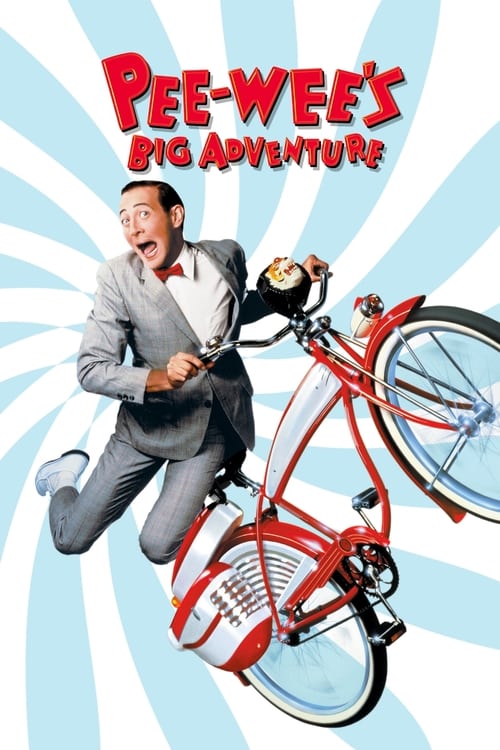
Pee-wee's Big Adventure
1985 · Tim Burton
For when you want to laugh at pure, uncynical silliness — a comfort watch for family movie night, a nostalgia hit, or any evening that needs more joy per minute. Zero challenge, all delight.
What it's about
Pee-wee Herman — a giddy, bow-tied man-child with the best bicycle in the world — wakes to find that bicycle stolen. Armed with a fortune-teller's dubious tip that it's in the basement of the Alamo, he sets off across America, hitching rides with escaped convicts, ghostly truckers, jealous bikers, and a waitress with dreams of Paris.
The experience
A live-action cartoon: bright, bouncy, and gag-dense, with sudden swerves into the gleefully spooky. It moves like a Saturday-morning serial and leaves you feeling about eight years old, in the best way.
Performances
Paul Reubens's Pee-wee is a total, seamless creation — a character performed with such commitment and precise physical comedy that the film never once winks at you from outside it.
The craft
Tim Burton's first feature already shows his whole visual imagination — toy-box production design, expressionist shadows, one legendarily creepy dream sequence — and Danny Elfman's first studio score, all circus oompah and mischief, began one of the great director-composer partnerships. It's a film where every frame is doing a bit.
Why it matters
A sleeper hit that launched Tim Burton's career, made Danny Elfman a film composer, and carried the Los Angeles alt-comedy scene into the mainstream; its gags and lines are still quoted forty years on.
Snapshot
A grown man in a too-small glen-plaid suit loses his bicycle and crosses America to get it back. That is the whole of it, and the modesty of the premise is the point: Pee-wee's Big Adventure takes a stage-and-cable comedy character, drops him into the chassis of a neorealist quest, and films the result as though it were a Chuck Jones cartoon with a budget. Released by Warner Bros. in August 1985, it was Tim Burton's first feature and Danny Elfman's first score for a major studio picture — the beginning of one of the most durable director-composer partnerships in American film — and it arrived as the commercial validation of a Los Angeles alt-comedy scene that had until then lived in improv theaters and on HBO.
What makes the film hold up is the collision inside it. Paul Reubens's Pee-wee Herman is a hermetic, entirely artificial construction, a character with no interiority to discover; Burton surrounds him with a real, dusty, sun-bleached America of truck stops, roadside dinosaurs and the Alamo gift shop. The film alternates between candy-colored suburban fantasia and genuine dread — the Large Marge jump scare remains one of the most efficient shocks in any family-rated film — and it never resolves that tension so much as accepts it as the texture of the world. It is a comedy about monomania that refuses, at every turn, to convert monomania into a lesson.
Industry & production
Reubens developed Pee-wee Herman at the Groundlings, the Los Angeles improv company, in the late 1970s, alongside collaborators including Phil Hartman. The Pee-wee Herman Show, staged at the Roxy in 1981 and taped for HBO, established the character's world — the sidekick furniture, the secret word, the deliberate infantilism performed for a mixed audience of children and stoned adults. The film exists because that stage show made the character a cult property with a proven audience, and because Warner Bros. was willing to make a modest bet on it.
Burton's hiring is the studio-lore centerpiece. He had come out of the CalArts character animation program into Disney's feature animation department, worked in a junior capacity on The Fox and the Hound and as a conceptual artist on The Black Cauldron, and made two shorts under Disney's roof: the Vincent Price–narrated stop-motion Vincent (1982) and the live-action Frankenweenie (1984). By the standard account, Reubens saw Frankenweenie and wanted its maker. That account is repeated widely enough to be treated as reliable in outline, though the granular record of who advocated for whom inside Warner Bros. is thinner than the anecdote suggests.
The screenplay is credited to Reubens, Hartman and Michael Varhol. Robert Shapiro and Richard Gilbert Abramson produced, with William E. McEuen as executive producer. The budget was modest by 1985 studio standards — reported in the neighborhood of six to seven million dollars — and the domestic gross, widely reported at roughly forty million, made it one of the year's clearer profit stories. Those figures come from trade reporting of the period rather than audited disclosure, and should be read as approximations.
Production drew on Warner's own infrastructure in a way the film eventually makes literal: the climax is a chase across the Burbank studio lot, through the sets and standing streets of the company that financed the picture. Location work took the production to San Antonio for the Alamo and to Cabazon, California, for Claude Bell's roadside concrete dinosaurs — a real piece of American folk-commercial architecture that the film absorbed so completely it now reads as a Burton set.
Technology
This is a pre-digital film and one of the last significant American comedies to be built entirely from in-camera and photochemical craft. Shot on 35mm and framed at 1.85:1, it achieves its cartoon physics through practical means: forced perspective, wire work, undercranking, oversized props, and stop-motion.
Two sequences carry the technological weight. The Rube Goldberg breakfast machine that opens Pee-wee's morning is a functioning mechanical rig, a chain-reaction contraption filmed in long takes so that the audience can verify it is real — the pleasure is in the labor, not the illusion. And the Large Marge reveal, in which the trucker's face distends into a rubbery, bug-eyed horror, is a stop-motion replacement-animation insert cut into live action for a few frames. The effect works precisely because it changes medium mid-shot: the sudden shift from photographed flesh to animated puppet is what registers as wrong. Rick Heinrichs, Burton's collaborator from Vincent, was central to the sculptural and stop-motion work, with animation executed by a small team drawn from the same Los Angeles stop-motion circles that Burton would return to throughout his career.
The film's other technological argument is negative. It refuses the era's dominant effects language — no optical compositing spectacle, no Star Wars-descended model photography — in favor of an older, handmade vocabulary. That choice is aesthetic and would become Burton's signature: the visible seam as a source of feeling.
Technique
Cinematography
Victor J. Kemper shot the film, and the choice is more pointed than it looks. Kemper was a New Hollywood veteran — Dog Day Afternoon, Slap Shot — and had already photographed a cross-country road comedy in National Lampoon's Vacation (1983). He brings journeyman competence to a first-time director's fantasia, which is exactly what it needed.
The visual scheme is high-key, saturated and frontal. Pee-wee's house and yard are lit flat and bright, staged in symmetrical compositions with the camera squared to the wall, so that the frame reads as a proscenium or a storybook page. Wide-angle lenses exaggerate the bicycle's presence and turn the suburban street into a slightly bulging toy landscape. Movement is emphatic rather than fluid: whip-fast dollies that lunge toward a reaction, tracking shots that lock onto the bike and treat it as the protagonist.
Against this, the horror interludes switch registers entirely. The clown nightmare and the Large Marge cab are low-key, gelled, canted — a compressed anthology of expressionist lighting dropped into a PG comedy. The film's cinematography is thus fundamentally bimodal, and the cuts between modes are engineered to be jarring.
Editing
Billy Weber, later the editor of Top Gun, cuts the film to animation timing rather than live-action comic timing. Gags land on impact frames; reaction shots are held one beat past comfort; the breakfast machine is assembled in a rapid, percussive montage that mimics the rhythm of a Looney Tunes chain gag. The picaresque structure — a string of discrete encounters with Large Marge, Simone, Mickey, the biker gang, Hobo Jack — is edited as a series of self-contained bits rather than a rising action, which is why the film survives out-of-order rewatching and clip circulation so well.
The most distinctive editorial gesture is tonal whiplash: the hard cut out of terror into brightness, with no transitional beat to metabolize what just happened. Burton and Weber trust that the audience will simply carry the unease forward.
Mise-en-scène / staging
David L. Snyder, an art director on Blade Runner, designed a world at the opposite end of the spectrum from that film: Pee-wee's house is a toy box, an interior of primary colors, mechanical gadgets, and objects arranged with the obsessive frontality of a child's shelf display. Aggie Guerard Rodgers's costume work fixes Pee-wee as a graphic constant — gray glen plaid, red bow tie, white shoes, a silhouette that functions like an animation model sheet and never varies across the picture.
The staging's governing idea is the contrast between constructed and found. The suburban sequences are pure set; the road sequences are pure location, and Burton lets the actual weirdness of American roadside vernacular — a dinosaur you can eat lunch inside, a shrine to a battle with no basement — do the work that a designer would otherwise have to invent. Pee-wee's costume never changes, so he becomes the fixed cartoon element pasted onto documentary backgrounds.
Sound
Elfman's score is close to continuous and operates as cartoon underscore in the classical sense: it comments, it mickey-mouses, it announces. The instrumentation is carnival and circus — calliope timbres, marimba, bells, snapping brass — and the acknowledged touchstones are Nino Rota's work for Fellini and Bernard Herrmann's for suspense. Elfman, then fronting Oingo Boingo and without formal orchestral training, worked with orchestrator Steve Bartek, a partnership that continued for decades. The main theme's galloping figure became one of the most recognizable cues in American comedy.
Diegetic music does the film's other heavy lifting: "Tequila" for the platform-shoed bar-top dance that turns a lynching into an ovation, Twisted Sister on the studio backlot. The sound design leans on cartoon foley — exaggerated bicycle sounds, impossible impacts — and on Reubens's voice itself, a high nasal instrument punctuated by that staccato laugh, which is as much a sound effect as a performance.
Performance
Reubens's Pee-wee is a total-immersion character act, sustained at the time even in press appearances, and the film is built to protect the mask. There is no scene in which Pee-wee is "really" someone else; the suit does not come off. The physical vocabulary is drawn from mime and puppetry — stiff-limbed, hinged, with sudden bursts of precision movement — and the performance is broad without being loose.
The supporting cast plays entirely straight, which is what keeps the film from collapsing into sketch. Diane Salinger's Simone, the waitress dreaming of Paris, is genuinely melancholy; Elizabeth Daily's Dottie carries real, unreciprocated feeling; Mark Holton's Francis Buxton is a spoiled tantrum given adult body. Cameos — Jan Hooks as the Alamo guide, Phil Hartman as a reporter, James Brolin and Morgan Fairchild in the closing film-within-a-film, Milton Berle as himself — are calibrated as straight-faced intrusions from a normal world.
Narrative & dramatic mode
The structure is picaresque, and its ancestor is explicit: a bicycle is stolen, a man searches, and the search becomes a tour of a society. De Sica's Bicycle Thieves supplies the skeleton, drained of economic desperation and refilled with obsession. Each episode is a closed unit with its own tone — ghost story, prison-break thriller, romance, hobo idyll — and Pee-wee passes through unchanged, which is the mode's deepest commitment.
Two structural refusals define the film. First, Pee-wee never grows: he does not learn to share, to love Dottie, or to want anything other than the bike. Second, the ending metafictionally consumes the story we have watched, as Hollywood turns Pee-wee's journey into a preposterous action vehicle and the real characters watch it at a drive-in. The film ends not with resolution but with narration being taken away from its subject — and Pee-wee, characteristically, leaves before the credits because he's already lived it.
Genre & cycle
The film sits at the intersection of three mid-eighties cycles. It belongs to the improv-troupe-to-studio-vehicle pipeline that had recently produced Ghostbusters and would continue through the decade. It belongs to the road comedy cycle, which by 1985 had a durable template of episodic Americana. And it belongs to the emergent man-child comedy, a genre it arguably codified in its purest form, since Pee-wee's arrested development is presented without pathology, apology, or redemptive arc.
It also functions, quietly, as a horror-comedy — one of the first American family films to use genuine genre shock as a comic instrument, a strategy Burton would refine in Beetlejuice.
Authorship & method
The auteurist reading of Pee-wee's Big Adventure is complicated by the fact that it is, first, an author's vehicle for someone else. Reubens owned the character, co-wrote the script, and had already defined the world; Burton was hired into an existing intellectual property at twenty-six.
And yet almost the entire Burton signature is present: the outsider protagonist whose strangeness is never cured; the suburb as bright, hostile stage set; gothic dread admitted into children's forms; stop-motion as an emotional rather than technical device; production design as the primary carrier of meaning. The film is better understood as a fusion in which two compatible sensibilities — Reubens's Groundlings surrealism and Burton's Disney-gothic — reinforced each other.
The collaborator list is a map of Burton's future. Elfman would score nearly every subsequent Burton film. Rick Heinrichs would become his art director and production designer through Edward Scissorhands and Sleepy Hollow. Kemper and Weber, both hired studio veterans, provided the professional floor that let a first-timer take risks. Hartman's contribution as co-writer — and as one of the character's original architects — is often underweighted in Burton-centric accounts.
Movement / national cinema
The film is a product of two distinctly Southern Californian institutions: the CalArts character animation program that fed Disney and then dispersed into live-action filmmaking, and the Groundlings improv theater that fed Saturday Night Live and then dispersed into features. It is Hollywood studio product made by people trained in animation and improv rather than film school narrative.
Its stated European debts run to Tati's Hulot — the tall, silent-adjacent figure whose body is out of scale with modern space — to Fellini and Rota's carnival grotesque, and to De Sica's premise. Its domestic debts run to Frank Tashlin, Keaton, Warner Bros. animation, and to 1950s children's television: Pee-wee's checked suit and hyperactive address to camera descend from performers like Pinky Lee, and the Playhouse aesthetic that followed is openly a resurrection of that era's kids' TV grammar.
Era / period
1985 was a year of American fifties nostalgia — Back to the Future opened the same summer — and Pee-wee's Big Adventure participates while sitting slightly askew to it. Its retro material is not period-accurate memory but the residue of consumer objects: toys, roadside attractions, novelty shops, cereal, chrome. The America it crosses is one whose commercial folk culture is already becoming kitsch, and the film treats that decay affectionately rather than satirically.
In an era of high-concept blockbusters and increasingly corporate studio filmmaking, it also stands as a document of what a modestly budgeted studio picture could still be: eccentric, handmade, and unconcerned with demographic breadth.
Themes
Obsession as identity. The bicycle is not a MacGuffin standing in for something else. Pee-wee's love for it is the film's sincere emotional center, and no scene invites us to find it small.
The dignity of arrested development. The character is childish without being childlike-in-the-sentimental-sense, and the film neither cures him nor punishes him. His refusal of Dottie — "I'm a loner, Dottie. A rebel." — is played as self-knowledge rather than evasion, and has long grounded queer readings of the character, whose camp affect and disinterest in heterosexual resolution were unusual for a 1985 studio comedy.
America as archive. The road is a catalog of the country's discarded enthusiasms — a fortune teller, a battle shrine, concrete dinosaurs, a hobo on a freight car — presented as genuinely marvelous.
Innocence adjacent to menace. The film's most persistent formal idea is that the bright world and the terrifying one occupy the same frame.
Who gets to tell the story. The closing film-within-a-film argues that the industry converts lived eccentricity into generic product — a joke made on the lot of the studio that produced it.
Reception, canon & influence
Contemporary reviews were divided. A portion of the 1985 press found the character grating or the film thin, while others singled out its visual invention and its refusal of conventional comic structure. The critical record here is genuinely uneven and less thoroughly documented than for Burton's later work; there is comparatively little sustained scholarship on the film relative to Edward Scissorhands or Batman, and claims about a unified critical verdict in either direction should be treated skeptically. Commercially the result was unambiguous: a modest budget returned a substantial multiple, and Burton became a director studios would finance.
Backward, its influences are legible and largely acknowledged: Bicycle Thieves for the premise, Tati and Keaton for the body, Fellini and Rota for the tone and score, Warner and MGM animation for the physics and cutting rhythm, and 1950s American children's television for the character's entire surface.
Forward, its consequences are large. It made Pee-wee's Playhouse (CBS, 1986–1990) possible, a Saturday-morning show that carried the film's design sensibility into five seasons and won a shelf of Emmys while functioning as genuinely avant-garde children's television. It launched Burton toward Beetlejuice (1988) and Batman (1989), and with them a dominant strain of American gothic-pop production design. It established Elfman as a film composer. It seeded a lineage of meticulously art-directed, frontally composed, deadpan-quirk comedy that later filmmakers — Wes Anderson's symmetrical dioramas among the most cited — extended in their own directions, though the influence there is atmospheric rather than documented. And it anchored the man-child comedy that dominated American film for the following two decades, usually in cruder form.
The character's later history complicates the legacy without diminishing the film. Reubens's 1991 arrest interrupted Pee-wee's public life for years; the character returned via a 2010 Broadway revival of The Pee-wee Herman Show and Pee-wee's Big Holiday (2016), and Reubens's death in July 2023 prompted a broad reassessment of his work. The 1985 film has outlasted all of it, playing as a repertory perennial and as the rare studio comedy whose formal ideas — cartoon staging, tonal violence, the fixed graphic protagonist — remain more radical than most of what followed it.
A Deleuzian reading
Breakfast first.
The full Deleuzian reading of Pee-wee's Big Adventure →
Reception
Critics in 1985 largely shrugged it off as kids'-show silliness, but it quietly became a sleeper hit — and it's since been fully canonized as one of the great directorial debuts, the film where Tim Burton's whole sensibility arrived fully formed.
How Pee-wee's Big Adventure was received, from release to now →
How to watch Pee-wee's Big Adventure: what to notice on a first viewing
- Notice how squarely the camera faces the walls in Pee-wee's house. Burton and cinematographer Victor Kemper light the house flat and bright, in symmetrical compositions, so each room reads like a storybook page or a stage set. The frame is built like a child's shelf display, every object placed on purpose for you to find.
- Watch how the wide lens bulges the suburban street and bike. Wide-angle lenses exaggerate the bicycle's size and curve the edges of ordinary streets into a slightly toy-like landscape. The world is shaped like a cartoon before anything cartoonish happens in it.
- Notice that Pee-wee's suit never changes across the whole trip. Gray glen plaid, red bow tie, white shoes: the same silhouette in the suburb, the desert, and every stranger's world he passes through. He is a fixed cartoon figure pasted onto real, changing backgrounds, and the contrast is the joke.
- Listen for the calliope and marimba underscoring almost every scene. Danny Elfman's score is nearly continuous, circus-toned, and comments on the action the way classic cartoon music does, announcing each gag. The music keeps telling you this is a cartoon, even in the scenes that are not funny.
- Count how many strangers Pee-wee meets and then simply leaves. Each stop, the waitress, the biker gang, the hobo, is a closed episode with its own tone, and Pee-wee passes through changed by none of it. The trip is a string of separate worlds held together only by the fact that one man crossed them.
The whole guide to watching Pee-wee's Big Adventure, with the keys for a rewatch →
Influences: the films it descends from and the films it influenced
- Bicycle Thieves (1948) — Supplies the entire narrative armature — a stolen bicycle converts the protagonist's day into an episodic city-wide search built from dead-end encounters, including the pawn/black-market lead and the closing ride — which Reubens, Hartman and Burton lift beat-for-beat and rescore as farce.
- Mr. Hulot's Holiday (1953) — Establishes the fixed-uniform, never-psychologized protagonist as a single silhouette and gait, with gags staged in wide deep-focus long shot and carried by exaggerated post-dubbed sound effects instead of dialogue — precisely how Pee-wee's body and its squeaks are shot and mixed.
- Playtime (1967) — Frontal, architecturally symmetrical compositions in which the set delivers the joke and the gag may occur anywhere in the frame — the staging logic behind Pee-wee's breakfast kitchen, the bike shop, and the Alamo tour.
- The Scarecrow (1920) — Keaton's pulley-and-swinging-condiment breakfast room, performed with an unreacting face, is the direct model for Pee-wee's Rube Goldberg breakfast rig, where the gag is timed to the mechanism's beats rather than to the performer's reaction.
- La Strada (1954) — Nino Rota's circus-band palette — calliope, tuba, snare, waltz-time brass — attached to a childlike outsider; Elfman's debut score is an explicit transposition of that instrumentation, and it imports Rota's pathos-under-clownery register with it.
- Fast and Furry-ous (1949) — Warner gag architecture: frame-counted timing, straight-line repetition with escalating variation, and Stalling/Treg Brown impact sounds punctuating each hit — Burton cuts Pee-wee's chases and pratfalls on cartoon beats rather than live-action ones.
- Bad Luck Blackie (1949) — MGM's law of unmotivated escalation, objects obeying drawn rather than physical mass, and hit-for-hit mickey-moused scoring — the exact grammar governing Pee-wee's bike, the dinosaur diorama, and Large Marge's punchline.
- The Cabinet of Dr. Caligari (1920) — Painted non-orthogonal sets and hard directional light used to render a mind rather than a place — the model for the expressionist interludes (Large Marge's cab, the Simone dream, the clown-surgeon nightmare) that puncture the film's pastel comic surface.
- Tulips Shall Grow (1942) — Codifies replacement animation — swapping sculpted heads frame by frame instead of re-posing one armature — the specific technique the Chiodo brothers use for Large Marge's bulging eyes, routed to Burton through the Rankin/Bass specials that inherited Pal's Puppetoon method.
- Frankenweenie (1984) — Burton's own live-action rehearsal with the same Disney-trained collaborators (Rick Heinrichs on design): the bright hostile suburb built as a stage set, horror-film lighting and framing imported wholesale into a children's register, and an outsider whose strangeness is never cured.
- The Pee-wee Herman Show (1981) — Delivers the character fully built — Groundlings total-immersion act, live-audience call-and-response timing, and a 1950s kids'-TV surface of primary-color playhouse set and adult double-entendre — leaving the film only the task of giving that fixed performance a picaresque to travel through.
- Willy Wonka & the Chocolate Factory (1971) — Paul Reubens constructed Pee-wee Herman through years of stage performance before the film, then pre-specified the character's costume and internal logic as a condition of his participation — directly inheriting Wilder's methodology of the self-designed character whose performer-authority over the role exceeds the director's.
- Beetlejuice (1988) — Industrializes the toolkit: Elfman's calliope-and-brass carnival scoring, stop-motion and practical creature gags deployed as tonal-whiplash punctuation inside a comedy, and production design promoted to the primary carrier of meaning.
- Edward Scissorhands (1990) — Takes the pastel suburb-as-stage-set and the fixed graphic protagonist — one costume, one silhouette, near-mute, uncured — from comic device to tragic one, with Heinrichs and Elfman continuing the design and scoring roles they first held on Pee-wee.
- The Nightmare Before Christmas (1993) — Scales the Burton/Heinrichs/Elfman pipeline that Pee-wee assembled to feature length, keeping stop-motion as an emotional register rather than a spectacle effect and writing songs in the same march-and-waltz carnival idiom.
- Ace Ventura: Pet Detective (1994) — Inherits Pee-wee's central bet — build a studio comedy on a total-immersion, cartoon-physical character act with fixed costume and non-naturalistic voice, shot as though the performer were animated — the man-child model Pee-wee proved bankable, here coarsened.
- Rushmore (1998) — Extends the planimetric frontal tableau, proscenium blocking, and meticulously art-directed props-as-character, with a uniformed protagonist treated as a graphic emblem and the comedy played deadpan against the design rather than through reaction.
- Elf (2003) — The sincere branch of the descent: a naive fixed-costume innocent picaresquing through a hostile adult city, opening with a hand-built stop-motion prologue that quotes the Rankin/Bass replacement-animation idiom Pee-wee had already reactivated.
- But I'm a Cheerleader (2000) — Burton's storybook, candy-colored, deliberately fake production design (a cited touchstone for Babbit) authorizes her use of dollhouse artificiality where every prop looks handmade and unreal.
- The Mitchells vs. the Machines (2021) — The collaborator debt: Mark Mothersbaugh's playful Devo-inflected synth-and-orchestra scoring vocabulary, reprised as Mitchells' sonic signature.
- Send Help (2026) — Established Elfman's carnival-esque menacing-yet-mischievous scoring idiom — the playful-sinister orchestral register he carries into Send Help.
- Stranger Than Paradise (1984) — A parallel mid-80s solution to the same formal problem: static frontal single-take tableaux separated by blackout cuts, deliberately non-reactive deadpan performance, and an episodic drift across kitsch roadside America where set dressing and landscape do the comic work.
- Hairspray (1988) — Shares the television-derived visual system — flat high-key light, primary-and-pastel saturation, proscenium-frontal blocking — applied to a protagonist whose refusal of adult body norms is played as fact rather than pathology.
Similar films
- Beetlejuice (1988) — influence & lineage
- Edward Scissorhands (1990) — influence & lineage
- PlayTime (1967) — influence & lineage · same viewing thread
- Sherlock Jr. (1924) — same viewing thread
- Coyote vs. Acme (2026) — same viewing thread
- Toy Story (1995) — shared sensibility
- The Princess Bride (1987) — shared sensibility
- Back to the Future (1985) — shared sensibility
All the films related to Pee-wee's Big Adventure →
Watch it with: curated runs of related films
- Sight Gags and Soft Hearts — Watch these when you want comedy built from movement, timing, and architecture rather than punchlines — a gentle soul politely adrift in a bustling, beautifully machined world.