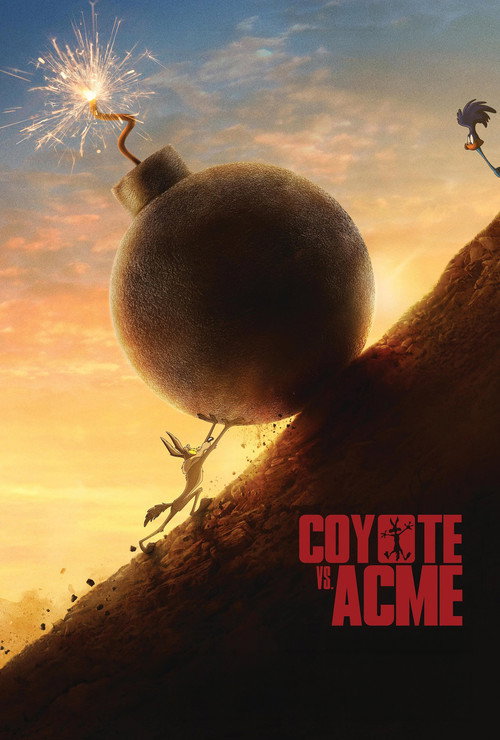
Coyote vs. Acme
2026 · Dave Green
For family movie night or when you need to laugh at something gloriously absurd — zero homework, all payoff. Pure comfort, clever enough that the adults in the room get the better jokes.
What it's about
After decades of Acme products blowing up in his face mid-pursuit of the Roadrunner, Wile E. Coyote does the only sensible thing left: he hires a strip-mall billboard lawyer and sues the Acme Corporation. A cartoon canine and a human attorney nobody respects take on a corporate legal machine in an actual courtroom, and an unlikely friendship forms across the species line.
The experience
A one-joke premise played completely straight, which is exactly why it's funny — deadpan legal procedure colliding with cartoon physics. It's fast, silly, and warmer than you expect, with real underdog feeling under the slapstick.
The craft
The premise comes from Ian Frazier's 1990 New Yorker humor piece 'Coyote v. Acme,' a pitch-perfect parody of a product-liability complaint, and the film's craft challenge is sustaining that deadpan at feature length while blending live actors with a classic hand-drawn-style cartoon character in CGI. The slapstick set pieces are built to play big and loud.
Why it matters
Famous before anyone saw it: completed in 2023, shelved by its studio in a cost-cutting write-off, and fought back to release — it became a rallying point in the argument over whether finished films belong to audiences or to balance sheets.
Snapshot
A live-action/animation hybrid in which Wile E. Coyote, having survived one catastrophic Acme purchase too many, retains a strip-mall attorney and takes the Acme Corporation to court. The premise is not original to the film: it adapts Ian Frazier's 1990 New Yorker humor piece "Coyote v. Acme," a deadpan pastiche of a personal-injury complaint written in flawless brief-ese, which lent its title to Frazier's 1996 collection and won the first Thurber Prize for American Humor. The joke Frazier found — that seventy years of cartoon slapstick constitutes, read soberly, an actionable pattern of product-liability failure — is the whole engine, and the film's task is to sustain it at feature length.
Its more consequential identity, at least for now, is as a case study in studio economics. Completed in 2023 for Warner Bros. and its streaming service, it was shelved that November as a tax write-down rather than released, becoming the third and most publicly contested of the Warner Bros. Discovery cancellations after Batgirl and Scoob!: Holiday Haunt. The backlash — from the filmmakers, from crew, from guilds still raw from the 2023 strikes — was sharp enough that the studio permitted the film to be shopped; after a long stall, the independent distributor Ketchup Entertainment acquired it in 2025 and brought it to theaters in 2026. A film about a plaintiff seeking redress from an indifferent corporation had to be rescued from an indifferent corporation. No press campaign could have manufactured that.
Industry & production
The picture originated inside Warner Bros. Pictures Animation as part of the studio's periodic effort to make its library characters commercially current — the same impulse behind Space Jam: A New Legacy (2021) and the Looney Tunes feature program generally. Trade reporting placed the production budget in the vicinity of $70 million and the eventual write-down at roughly $30 million; those figures circulated widely but originate in trade sourcing rather than disclosed accounts, and should be held loosely.
The mechanism that killed it is specific to its moment. Under U.S. tax treatment of film assets, a distributor that abandons a completed, unreleased title can recognize the loss immediately rather than amortize it against uncertain revenue. For a company carrying the debt load Warner Bros. Discovery assumed after the 2022 merger, a finished family comedy with modest streaming upside and real marketing costs was, on a spreadsheet, worth more destroyed than distributed. That the film had reportedly tested well only sharpened the objection: the decision was not a judgment about the movie.
What followed was unusual. Director Dave Green and others went public; the story was picked up far beyond the trades, and the phrase "tax write-off" entered general conversation about Hollywood. Warner Bros. Discovery reversed far enough to let the filmmakers seek a buyer, and bidders emerged, but the studio's asking price — reported as high enough to cover the forgone write-down — stalled the sale for more than a year. Ketchup Entertainment, a small distributor that had already taken on another Warner orphan in The Day the Earth Blew Up: A Looney Tunes Movie (2025), closed the deal in 2025; its reported purchase price circulated in the $50 million range and, again, is trade-sourced. The release date moved more than once before the film reached screens in 2026.
Two structural facts follow. First, the film arrived three years old, its release strategy owned by a company with a fraction of the marketing capacity that made it. Second, it established that a studio orphan can be exhumed — a precedent with consequences for how future cancellations are contested.
Technology
The film's central technical problem is old and unsolved: how to put a drawn character, whose body obeys comic rather than physical law, inside a photographed world that obeys neither. Who Framed Roger Rabbit (1988) answered with optical compositing, painstaking hand-animated shadow and tone passes, and a live-action camera disciplined into moves the animators could match. The modern answer is CG characters rendered to read as drawings — stylized shading, line-weight simulation, deliberate frame-rate stepping to imitate animation "on twos" — composited with digitally tracked plates that free the camera entirely.
Coyote vs. Acme takes the stylized-CG route, giving Wile E. a dimensional body and fur while preserving the Chuck Jones silhouette and the specific eye-and-brow vocabulary on which the character's entire performance depends. The interesting engineering question is not resolution or lighting but selective physics: the film must let the Coyote squash, stretch, flatten, and disregard conservation of mass, while the humans beside him cannot. Every shot has to negotiate which rule set governs where — a problem of art direction as much as software, and one the picture inherits rather than solves outright.
A further technological note is inadvertent. Shelved films do not get finished twice. The picture's visual effects, grade, and mix are those of a 2023 production released into 2026, a small preserved sample of where hybrid-animation craft stood before three more years of iteration. That is an artifact of the distribution story, not of any creative decision.
Technique
Cinematography
Publicly available credit detail on the below-the-line crew is thin relative to the attention paid to the film's business history, and this account will not guess at names. What can be described is the strategy. Hybrid animation constrains the camera: handheld coverage and long lenses complicate tracking, while the gag construction of a Road Runner cartoon depends on clean geometry — a flat horizon, a road receding to vanishing point, a cliff edge legible as a line. The film's staging inherits Maurice Noble's layout logic from the shorts, where the Southwest was never a location but a diagram: mesa, sky, road, drop. Courtroom material inverts this into interior symmetry and shot-reverse-shot, and the comedy of the film's design is the friction between those two visual systems — a character built for infinite empty space confined to a gallery bench.
Editing
The Road Runner shorts are among the most tightly cut comedy ever made, built on a pattern of anticipation, execution, failure, and a held beat on the Coyote's face before the payoff. That held beat — the pause in which the character registers his own doom directly to camera — is the form's signature and its hardest element to scale. At six minutes, the loop is self-renewing; at feature length, repetition becomes structure rather than rhythm, and the cutting must alternate gag sequences with dialogue scenes that have no equivalent metronome. The film's editorial task is essentially one of alternation and escalation: protecting the classical timing inside each set piece while sustaining a legal plot between them.
Mise-en-scène / staging
Acme is the film's best design opportunity. In the shorts, the company exists only as cardboard — a box arriving from nowhere, stenciled with a product name that is itself the joke. Giving that company a lobby, a boardroom, a brand identity, and a legal department converts a running gag into a satirical object, and the production design is doing the heavy interpretive work: Acme rendered as a recognizable contemporary corporate campus makes the liability premise land, while Acme rendered as midcentury industrial whimsy protects the cartoons. The choice between those registers is the film's aesthetic thesis.
Sound
The sound design has an inheritance it cannot ignore. Treg Brown's effects work for Warner — the whistle-and-puff of a distant impact, the ricochet, the anvil — is as recognizable as the characters, and Carl Stalling's scoring practice of mickey-mousing every gesture to the frame established the comic grammar of the whole studio. A modern feature score cannot sustain Stalling's density across ninety minutes, so the likely design is zoned: orchestral cartoon scoring inside the set pieces, conventional comedy underscore outside them, with the classic effects library used as a citation. Detailed information about the music and sound crew is not well established in the public record.
Performance
Will Forte's attorney carries the picture's dialogue, and the casting implies the tone: Forte's comic register — earnest men with poor judgment, sustained past the point of comfort — suits a lawyer whose confidence exceeds his competence. John Cena plays the opposing force on Acme's side, deploying the deadpan-heavy persona that James Gunn, a producer on this film, had already refined in Peacemaker. Lana Condor rounds out the human cast.
The structurally interesting performance is the one without a voice. Wile E. is a pantomime character; if the film keeps him silent, his attorney must speak for him, which turns the courtroom into a ventriloquist act and makes translation itself the comic device. It is the Harpo problem, and it is also good legal comedy: a plaintiff who cannot testify is the purest test of an advocate.
Narrative & dramatic mode
The mode is underdog courtroom comedy grafted onto an anarchic gag film — My Cousin Vinny crossed with a Chuck Jones short, with the trial structure of Miracle on 34th Street (1947), the film that established the format of adjudicating an impossible premise with total procedural seriousness. The trial gives the picture what the shorts conspicuously lack: consequence. Frazier's original text supplies the crucial tonal instruction — the funniest possible delivery is the flattest one, the complaint recited without a wink.
The adaptation's real difficulty is characterological. Wile E. Coyote is defined by non-progression. Chuck Jones liked to describe him by way of Santayana's definition of a fanatic — someone who redoubles his effort having forgotten his aim — and the character's dignity is in the futility. A feature needs an arc; an arc implies the Coyote learns something, which risks curing the condition that makes him funny. The film's chosen solution is to displace the arc onto the lawyer, who has his own failure to redeem, leaving the client constant. That is a sound structural instinct, and it explains why the human is the protagonist of a movie named for the coyote.
Genre & cycle
The picture belongs to the hybrid live-action/animation feature, a form nearly as old as animation itself — McCay's Gertie, the Fleischers' Out of the Inkwell, Disney's Alice Comedies — but which as a studio tentpole category begins with Roger Rabbit and proceeds through Space Jam (1996), Looney Tunes: Back in Action (2003), Enchanted (2007), and the 2010s–20s cycle of CG-character features built on legacy properties: Detective Pikachu, Peter Rabbit, the Sonic films, Chip 'n Dale: Rescue Rangers. The commercial logic is consistent — a known character, a live-action frame to widen the audience.
Within that cycle, Joe Dante's Back in Action is the essential predecessor and cautionary case: a Looney Tunes feature made by a genuine partisan of the shorts, which failed commercially and effectively ended the theatrical Looney Tunes line for a generation. Coyote vs. Acme takes the opposite tack — one coyote, one premise, no roll call of characters — which is the more disciplined idea.
Authorship & method
Dave Green came to the film from Earth to Echo (2014) and Teenage Mutant Ninja Turtles: Out of the Shadows (2016), a résumé of exactly the right kind: both are films about human performers acting against creatures that do not exist, and both are aimed at family audiences without condescension. Green's public advocacy after the shelving also made him, involuntarily, the film's most visible author.
The writing credits reflect a long development: a story by Jon and Josh Silberman, with screenplay work attributed in trade reporting to Samy Burch — whose May December suggests an interest in the comedy of people performing sincerity — and to Isaac Aptaker and Elizabeth Berger, whose television background is in warm ensemble dramedy. The blend is legible in the premise: absurdist conceit, conventional emotional spine.
James Gunn produced, alongside Chris DeFaria. Gunn's involvement predates his elevation to DC Studios and connects the film to his particular strength — sincere feeling extracted from nakedly ridiculous material. Detailed, reliable attribution for the cinematography, editing, and music departments is not well established in accessible sources, and rather than assign credit speculatively this dossier notes the gap.
Movement / national cinema
This is American studio filmmaking in the most literal sense, and it descends from a specifically American animation tradition. The Warner cartoon unit at "Termite Terrace" — Jones, Freleng, Avery, Clampett, with Michael Maltese writing and Mel Blanc voicing — built a comic idiom defined against Disney's: faster, flatter, more violent, more urban in wit even when set in a desert. Jones's Road Runner films are the most formally rigorous product of that idiom, governed by the self-imposed rules he later published in Chuck Amuck (1989): the Road Runner never leaves the road, no dialogue beyond "beep beep," all products from Acme, gravity as the Coyote's ultimate enemy, and the Coyote humiliated more by his own devices than by his prey.
The film also sits inside a narrower and more contemporary American formation: the consolidated-streaming era, in which the U.S. studio is a division of a debt-servicing conglomerate and a finished film is an accounting position. That context is not incidental to the picture's identity; it is arguably its primary one.
Era / period
The film was made in 2022–23, shelved in November 2023, and released in 2026 — a span covering the streaming contraction, the WGA and SAG-AFTRA strikes, and the industry-wide retreat from growth-at-any-cost. The strikes matter to its reception: the shelving landed weeks after they ended, into a workforce already arguing that its labor was being treated as disposable inventory. That a comedy about corporate indifference was itself disappeared for tax reasons gave the argument an unusually clean illustration.
Its rescue belongs to a second, smaller development: the emergence of distributors whose business is acquiring studio castoffs. Ketchup Entertainment's handling of both The Day the Earth Blew Up and this film suggests a genuine niche — finished, orphaned, brand-recognized pictures available below their cost.
Themes
Liability. The film's real subject is the gap between what a product promises and what it does. Acme's catalog is an unbroken chain of implied warranties, all breached. Read this way the shorts become a consumer-protection parable, and the film joins a lineage of American corporate-negligence narratives running from Class Action and The Rainmaker through Erin Brockovich and Michael Clayton — with the significant difference that its plaintiff has no standing, no voice, and no credibility.
Persistence and its cost. The Coyote's defining quality is that he will not stop. The shorts play this as existential comedy; a legal framework reframes it as damages — seventy years of injury, itemized. The film's most genuinely interesting move is to treat cartoon violence as harm that accrues.
Brand loyalty as pathology. He keeps buying from Acme. Nothing in the record explains why he does not choose another vendor, and that unexamined fidelity is the sharpest satirical point available to the material.
The advocate. A silent client needs someone to speak for him, and the lawyer's arc is about becoming worthy of that trust — which is also, unavoidably, a description of what the filmmakers spent three years doing on the film's behalf.
Reception, canon & influence
Influences on the film (backward). Chuck Jones and Michael Maltese's Road Runner shorts beginning with Fast and Furry-ous (1949), and specifically Jones's rule-bound formalism; Maurice Noble's graphic layouts; the talking, self-styled "super genius" Wile E. of Operation: Rabbit (1952), which establishes that the character can be given language without violating canon. Ian Frazier's 1990 text is the direct source. Who Framed Roger Rabbit supplies the hybrid template and the notion that cartoon characters can be litigated over as persons. Miracle on 34th Street supplies the absurd-premise trial. The visual idea of the billboard attorney descends from decades of American legal advertising and, more immediately, from Better Call Saul's canonization of the strip-mall lawyer as a figure of both comedy and pathos.
Critical reception. The film's settled critical record is not something this account can responsibly summarize; its theatrical release falls at or beyond the edge of what is verifiable here, and to characterize reviews or box office would be invention. What can be stated is the pre-release condition, which was unusual: a film with several years of accumulated public sympathy, a small distributor's marketing budget, and the near-impossible task of being received as a movie rather than as a verdict on its own rescue. Films that arrive freighted with their production stories are rarely evaluated cleanly.
Influence (forward). Its most durable effect is already achieved and lies outside the frame. The shelving made a specialized accounting practice legible to the general public and demonstrated that concerted pressure from filmmakers, crew, and press can reverse it — a lesson now available to anyone whose finished work is threatened the same way. Whether that hardens into a norm, a contractual protection, or simply a memory is unsettled. Within the Looney Tunes line, the film tests a proposition the studio had not previously tried: that these characters can support a single-premise satire for adults and children at once, rather than a nostalgia parade. If it holds, the Warner library has a second life as material rather than merchandise. Either way, the picture's place in the atlas is fixed — the film that had to sue its way out of the vault.
Reception
For three years this was less a movie than a cause: Warner Bros. shelved the finished film in 2023 as a tax write-off, the backlash made it a symbol of everything wrong with studio accounting, and Ketchup Entertainment's rescue turned its 2026 release into a victory lap before anyone had seen a frame.
How Coyote vs. Acme was received, from release to now →
Influences: the films it descends from and the films it influenced
- Fast and Furry-ous (1949) — Establishes the rule-bound gag grammar the film runs on — a fixed desert horizon with a single vanishing point, the Acme parcel as the delivery mechanism for every setup, and the held reaction beat in which the Coyote looks at camera before gravity is permitted to resume.
- Operation: Rabbit (1952) — Gives Wile E. speech and a calling card ('super genius'), licensing the self-narrating, credential-brandishing register that a deposition or cross-examination requires without breaking the character's canon.
- Duck Amuck (1953) — Invents the structural move of a cartoon character filing grievance against the off-screen authority that draws and abuses him, with the apparatus itself — brush, eraser, frame line — put in the dock.
- Duck Dodgers in the 24½th Century (1953) — Maurice Noble's flat graphic layouts — color-field planes and diagrammatic perspective standing in for depth — plus Carl Stalling's mickey-moused cues and Treg Brown's hard-edged effects cutting, the exact sound-and-layout vocabulary the film reconstructs in CG.
- Sherlock Jr. (1924) — The deadpan pantomime protagonist whose comedy depends on machines failing with calibrated, real-world physics — Jones's repeatedly stated model for the Coyote, and the reason the film's 'selective physics' only bends where the gag is loaded.
- Anchors Aweigh (1945) — The first sustained solution to matched eyelines, contact shadow and floor contact between a live performer and a drawn partner, which fixes the rule that the human must play the blocking straight for the toon to exist in the shot.
- Miracle on 34th Street (1947) — The absurd-premise trial: a court that never questions the fiction but adjudicates it under ordinary rules of evidence, letting procedural correctness supply the comedy instead of mockery of the premise.
- Playtime (1967) — Corporate-modernist geometry as comic staging — glass grids, deep focus and a clean vanishing point with the gag placed in the architecture rather than the cut, performed by a silent protagonist who never explains himself.
- Who Framed Roger Rabbit (1988) — The hybrid template in full: motion-control plates re-run for interactive light and shadow on the animated figure, rig-displaced props so the toon moves real objects, and the legal premise that a cartoon character is a person with standing and property.
- The Hudsucker Proxy (1994) — The invention company rendered as deco geometry — symmetrical lobbies, a boardroom staged on the vanishing point, product-development absurdity as the film's engine — the direct architectural model for the Acme corporate campus.
- The Rainmaker (1997) — The billboard-and-bus-bench attorney played for pathos rather than contempt, paired with the rookie-versus-corporate-defense structure in which discovery of an internal document, not a speech, turns the case.
- Looney Tunes: Back in Action (2003) — The precedent for Warner satirizing Warner from inside the library — the Tunes as contracted studio employees with grievances — and for compositing hand-drawn-silhouette characters into location plates rather than built sets.
- Enchanted (2007) — Drops a character governed by cartoon causality into live Manhattan and plays the mismatch as law rather than joke, keeping her animation timing and squash-and-stretch intact against actors working in real time.
- Spider-Man: Into the Spider-Verse (2018) — Makes CG animate on twos deliberately — stepping the frame rate and layering graphic linework and halftone over the render — which is the technique that lets a modern pipeline reproduce Termite Terrace cadence instead of smoothing it away.
- Sonic the Hedgehog (2020) — Builds speed and impact gags on tracked location plates where the CG character alone is exempt from consequence, the working definition of selective physics in a contemporary live-action cartoon feature.
- Space Jam: A New Legacy (2021) — The immediate technical precedent for CG Looney Tunes — volumetric fur and dimensional modeling constrained to preserve the 2D silhouette — and the nostalgia-parade assembly the film's single-premise construction is built against.
- Chip 'n Dale: Rescue Rangers (2022) — Uses render style as biography, letting 2D, CG and live-action characters share a frame while each one's format states its history in the studio, and turns the parent company's own back catalog into the object of the satire.
- Barbie (2023) — Demonstrates that a corporate-owned property can carry a single-premise satire aimed at adults and children simultaneously, with the owner's headquarters staged as a symmetrical comic set and the corporation written as antagonist.
Similar films
- Who Framed Roger Rabbit (1988) — influence & lineage
- Sherlock Jr. (1924) — influence & lineage · same viewing thread
- PlayTime (1967) — influence & lineage · same viewing thread
- Minions & Monsters (2026) — same viewing thread
- Wallace & Gromit: Vengeance Most Fowl (2024) — same viewing thread
- The Sheep Detectives (2026) — same viewing thread
- Wallace & Gromit: The Curse of the Were-Rabbit (2005) — same viewing thread
- Hundreds of Beavers (2024) — shared sensibility
All the films related to Coyote vs. Acme →
Watch it with: curated runs of related films
- Sight Gags and Soft Hearts — Watch these when you want comedy built from movement, timing, and architecture rather than punchlines — a gentle soul politely adrift in a bustling, beautifully machined world.