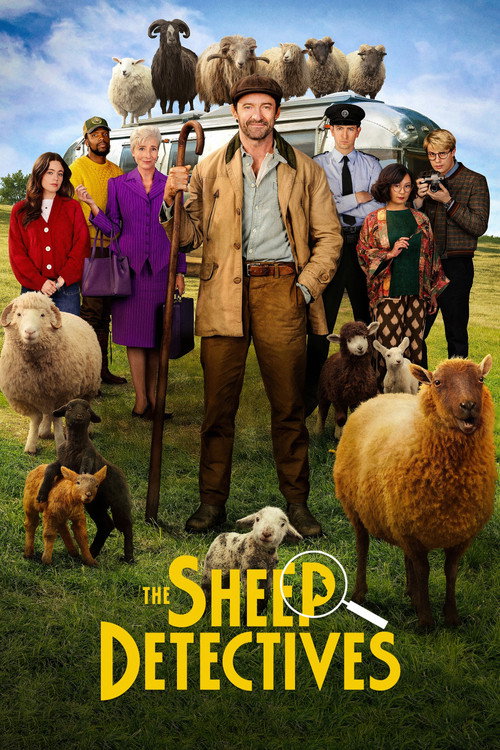
The Sheep Detectives
2026 · Kyle Balda
For a gentle family evening or when you want a mystery that hugs you instead of haunting you — pure comfort, with just enough puzzle to keep everyone guessing. Stay through the credits.
What it's about
George Hardy is a shepherd who reads detective novels aloud to his flock every night, never suspecting they understand every word. When a mysterious incident shatters the calm of the farm, the sheep put their pulp education to work — following clues, sizing up human suspects, and running their own woolly investigation. A proper whodunnit, solved by the last detectives anyone would suspect.
The experience
Warm, daft, and quietly clever — cozy-mystery pleasures wrapped in talking-animal comedy, with genuine sleuthing underneath the silliness. It's funny for kids and slyly witty for the adults playing along at home.
The craft
Kyle Balda, a veteran of big studio animated comedy, knows how to wring character out of creatures who can't explain themselves to humans — the gap between what the sheep know and what they can communicate is the engine of both the comedy and the mystery. The whodunnit structure is played straight enough to actually satisfy.
Why it matters
Part of a small, sturdy tradition of adapting beloved cozy-crime novels for family audiences — proof the murder mystery can be genuinely all-ages without losing its shape.
Snapshot
The Sheep Detectives is a 2026 comedy-family-mystery feature directed by Kyle Balda, written by Craig Mazin, and adapted from Leonie Swann's 2005 novel Three Bags Full. Its conceit is deceptively simple: a shepherd, George Hardy (Hugh Jackman), reads detective fiction aloud to his flock each night in the belief that the ritual is meaningless to them. When Hardy is found dead outside his trailer near the English village of Denbrook, the sheep — who have in fact been absorbing every plot, every deduction, every red herring — put that education to use and investigate the death themselves. The premise wears its irony on its sleeve: the animals humans regard as the very emblem of witlessness turn out to be the sharpest minds on the property. That inversion, at once a joke and a thesis, is the engine of the film.
The film is not pure animation but a live-action/CG hybrid: a flesh-and-blood human cast led by Jackman shares the frame with a flock of fully computer-generated sheep created by Framestore and voiced by an ensemble including Julia Louis-Dreyfus, Bryan Cranston, Chris O'Dowd, and Patrick Stewart. Running 109 minutes, it opened theatrically in the United States in May 2026 to strongly positive notices and solid family-audience business, reaching Prime Video on June 24 and disc on August 25.
Industry & production
Kyle Balda is a career animation filmmaker most closely identified with Illumination, where he co-directed The Lorax (2012) and Minions (2015), directed Despicable Me 3 (2017), and directed Minions: The Rise of Gru (2022). The Sheep Detectives marks his move from that fully animated mode into hybrid filmmaking, while remaining squarely inside the commercial register his career defined: a four-quadrant, high-concept family comedy built on an ensemble of appealing creatures.
The production itself is an Anglo-American arrangement. Amazon MGM Studios distributed in the United States and Canada, with Sony Pictures Releasing International handling the rest of the world. Principal photography ran in June and July of 2024 across Buckinghamshire, Hertfordshire, Oxfordshire, and Surrey — including Ivinghoe, White Pond Farm, and Shepperton Studios — on a budget of $75 million. The visual effects, centered on the sheep, were the work of Framestore with Clear Angle Studios. The release pattern was characteristic of Amazon MGM's theatrical-to-streaming model: advance previews, a May theatrical run, and a Prime Video debut roughly seven weeks later.
Commercially, the film earned $132.9 million worldwide, split almost evenly between a $66.1 million domestic gross and $66.9 million internationally, after a $15.1 million opening weekend in fourth place — a steady, leggy family-audience run rather than a front-loaded one.
Technology
The central technical problem of The Sheep Detectives is the one its premise dictates: making fully digital sheep hold the screen beside live actors in real English locations. Framestore's animators grounded the work in observation, studying extensive footage of real sheep to build the body performances, and the production imposed a strict naturalism on the creatures — the sheep remain quadrupedal throughout, with no hind-leg walking and no opposable-thumb gestures. Character has to emerge through face, posture, and timing rather than anthropomorphic cheats.
Fleece was the signature challenge. Visual effects supervisor Oliver Armstrong located the difficulty in the fine detail of the wool — the tiny twists and curls of individual fibers that make a digital groom read as soft, dense, and alive under natural light. Critics split on the results in instructive ways: Muhammad Suhayb in Dawn found the effects excellent at holding photographic realism while allowing comic expression, while David Jenkins in Little White Lies detected a glowing digital sheen that made him nostalgic for the analog animal-wrangling of Babe. That disagreement — seamless to one eye, synthetic to another — is itself a snapshot of where hybrid creature work stood in 2026.
Technique
Cinematography
Cinematographer George Steel faced the particular discipline of hybrid photography: every frame had to be composed for characters who were not yet there. Working with production designer Suzie Davies, Steel organized the film's visual grammar around the sheep's point of view — lowered sightlines that bring the camera down to flock height, which in turn made floors, ground textures, and the lower reaches of the sets carry unusual expressive weight. The approach literalizes the film's thesis: to take the sheep seriously as investigators, the lens must occupy their world, with the human characters looming above it. Reviewers registered the payoff in the film's pastoral texture — Suhayb responded to a warm, peaceful countryside look, and Tara Brady in the Irish Times found that the sight of CG sheep in a photographed pastoral landscape recalled Babe.
Editing
The film was cut by a three-editor team: Martin Walsh, Paul Machliss, and Al LeVine. The editorial shape of the picture, however, was substantially determined before the cameras rolled. Balda has described preparation as the real making of the movie — storyboarding, building the animatic, editing story reels — and on The Sheep Detectives he carried that animation discipline into hybrid production, assembling complete animatics before the shoot that combined iPhone footage of the actual locations with storyboard overlays. The plan gave the production a fixed spine from which to pivot on the day, and it meant the live-action material arrived on the editors' timelines already shaped around the digital performances to come.
Mise-en-scène / staging
The farm is the film's world, and its staging logic is the contrast between two registers occupying one space: the mundane, sunlit pastoral of agricultural life and the clue-strewn crime scene the sheep learn to read across it. Davies's production design serves both registers, dressed and detailed with the low camera in mind. The governing rule of the staging — articulated by the filmmakers as an absolute — is that the humans never treat the sheep as anything but sheep: the animals' investigation proceeds entirely beneath human notice, and the blocking of every shared scene preserves that asymmetry. The ensemble problem of individuating a flock is solved through silhouette, behavior, and voice, so that a crowd becomes a cast — a crime-loving ewe, a memory-keeper ram, a loner — and physical comedy flows from the animals' bodies within naturalistic limits, as in Brady's example of a plump sheep wedged in a tire swing.
Sound
Sound carries the premise's structural burden: the film must sustain the convention of sheep who converse fluently with one another while remaining, to every human ear, merely bleating livestock. The shepherd's voiced nighttime readings are both the flock's education and the story's founding sonic ritual. Christophe Beck's score binds the two registers together, blending orchestral themes with folk-inspired textures — the investigative and the pastoral in one musical fabric, suited to a mystery that unfolds in meadows.
Performance
Performance here runs on three tracks: live actors, voice actors, and animators. On set, the eyeline problem — actors playing scenes opposite creatures added later — was solved with craft rather than tennis balls: puppeteer Tom Wilton operated articulated sheep puppets as in-camera stand-ins, which executive producer Tyson Hesse credited with giving the cast something genuinely alive to play against, and which Jackman singled out for praise. Jackman anchors the human side as George Hardy, the well-meaning reader whose condescension is the film's founding irony; the live ensemble around him includes Nicholas Braun, Nicholas Galitzine, Molly Gordon, Hong Chau, Tosin Cole, Kobna Holdbrook-Smith, Conleth Hill, and Mandeep Dhillon, with Emma Thompson as a caustic lawyer. Brady observed that the human characters are drawn more broadly than the animals — a telling inversion of the usual hierarchy.
The flock is the film's true repertory company. Julia Louis-Dreyfus leads as Lily, the crime-loving ewe, in a performance Brady credited with real comic authority and Balda praised for its clarity, intelligence, and vulnerability; Chris O'Dowd brings a lilting melancholy to Mopple, the memory-keeper; Bryan Cranston supplies gravitas as a brooding ram, with Patrick Stewart adding further weight, alongside Regina Hall, Bella Ramsey, Rhys Darby, and Brett Goldstein.
Narrative & dramatic mode
The film's dramatic mode is the comic detective story, and its structure is inherited from the mystery genre it both parodies and honors. The inciting disruption is George Hardy's death: a local reporter, Elliot Matthews, suspects murder and presses Officer Tim Derry to investigate, and the official inquiry concludes Hardy was poisoned. In parallel, the sheep — led by Lily, with Mopple and the loner Sebastian — launch their own investigation, taking their methods directly from the detective novels Hardy read them. That metafictional device lets the film function simultaneously as a mystery and as a knowing commentary on mysteries. The dramatic irony is total and load-bearing: the audience and the sheep share knowledge the human characters lack, and much of the comedy and suspense flows from that asymmetry. It is a fair-play whodunit refracted through a fable's inversion of intelligence and status — though critics disagreed about the mechanism's rigor, with Jenkins finding the whodunit machinery the film's least committed element.
Genre & cycle
The Sheep Detectives sits at the intersection of two durable strains: the talking-animal family comedy and the light comic mystery. Its most direct cultural neighbors are Aardman Animations' sheep — Shaun the Sheep and the sheep-rustling caper of A Close Shave (1995) — which established a grammar of clever farm animals outwitting oblivious humans, and whose Wallace & Gromit films married that grammar to the mystery-caper form; Jenkins explicitly heard vintage Aardman, and Chicken Run in particular, in the film's tone. The animal-detective lineage runs deeper still, through Disney's Holmesian The Great Mouse Detective (1986) and the broader tradition of animal sleuths in children's literature. But the film's hybrid form pulls it toward a second lineage the critics named repeatedly: Babe (1995), the touchstone for photographed farmyards inhabited by speaking animals, invoked by both Brady and Jenkins as the standard of comparison. Against all these reference points, The Sheep Detectives differentiates itself by choosing the animal least associated with cunning — the sheep as proverbial follower — and making it the detective, so that the genre premise and the joke are one and the same.
Authorship & method
Balda's filmography supplies the clearest interpretive lens on the finished film: a director fluent in ensemble comedy built around semi-verbal creatures (the Minions above all), skilled at physical gag construction and at making a crowd of similar figures read as distinct personalities. A flock of sheep is a natural extension of the Minion problem, and Balda's method on this film was explicitly to import animation practice into live action — exhaustive storyboarding and complete pre-shoot animatics built over location footage, so that the hybrid shoot executed a film already designed shot by shot. He has framed the project's emotional core plainly as grief and loss, a register well beyond his Illumination work. Around him, the principal authorship is unusually distinguished for a family film: Craig Mazin's screenplay adapts Swann's novel; George Steel shot it; Suzie Davies designed it; Christophe Beck scored it; Walsh, Machliss, and LeVine cut it; and Framestore's creature team, under Armstrong, effectively co-authored the cast.
Movement / national cinema
The film belongs to no avant-garde movement; it is mainstream industrial family filmmaking, financed and distributed through the American studio system (Amazon MGM domestically, Sony internationally). Its craft base and its setting, however, are thoroughly English: shot in the Home Counties and at Shepperton, set in an English village, animated by the London house Framestore, and steeped in the British Aardman tradition of clever-animal comedy. The result is a recognizably English pastoral idiom delivered at American studio scale.
Era / period
As a 2026 release, The Sheep Detectives is a product of a mature family-film market in which high-concept talking-animal premises and four-quadrant comedy are the prevailing commercial strategy, and in which the streamer-studio hybrid economy shapes distribution — a theatrical run followed within weeks by a Prime Video debut. It also arrives at a moment when photoreal digital creatures are an established baseline rather than a spectacle in themselves, which shifts competitive pressure onto premise, comic voice, and character — precisely the terrain a high-concept sheep mystery stakes out, and precisely where its reviews concentrated their praise.
Themes
Beneath the comedy runs a genuine and legible theme: the underestimation of intelligence, and the condescension embedded in it. The founding gesture — a man reading to animals he assumes cannot understand — is a small parable about who we credit with an inner life, and the plot is the sustained refutation of that assumption. But the released film's emotional center of gravity sits somewhere the premise alone would not predict: Balda has described the story as being about grief and loss, and critics took it that way. Brady read it as three things at once — a cozy murder mystery, a witty genre deconstruction, and a meditation on loss — and credited it with a Watership Down-like sensitivity in presenting death to young viewers; even the skeptical Jenkins conceded that it reaches deeper than surface comedy, landing a couple of genuinely moving sheep's-eye existential moments. Around that core cluster the familiar motifs: the value of attention and observation, collective problem-solving by a flock rather than a lone genius, and a quiet celebration of reading itself, since the sheep make sense of a real death with tools learned from fiction.
Reception, canon & influence
The film opened to a strongly positive critical consensus: a 95% approval rating on Rotten Tomatoes from 216 critics with a 7.5/10 average, a Metacritic score of 72 from 37 critics, and an A- CinemaScore from opening audiences. Within that consensus the disagreements were real but narrow. Brady's Irish Times review ranked it among the most disarming farmyard films since Babe; Suhayb's Dawn review praised its warmth and the credibility of its creatures. The principal dissent came from Jenkins at Little White Lies, who found the digital aesthetics an uneasy hash beside the analog tradition it evokes and judged the mystery plotting an afterthought. Commercially, the $132.9 million worldwide gross against a $75 million budget, built on a modest $15.1 million opening, reflects the word-of-mouth pattern its CinemaScore predicted.
Its influences backward are clear: the Aardman clever-farm-animal tradition, the Babe lineage of photographed talking-animal pastoral, the animal-detective line running through The Great Mouse Detective, the fair-play cozy whodunit, and Balda's own career-long practice of building ensemble comedy from crowds of similar creatures. Its influence forward — whether it seeds successors in the talking-animal mystery vein, or whether its hybrid method of puppet-assisted eyelines and animatic-first production becomes a model — is a question for the longer historical record, which at five months out is only beginning to form.
A Deleuzian reading
Start with the ritual.
The full Deleuzian reading of The Sheep Detectives →
Reception
Arrived in May 2026 looking like disposable streamer fodder — a talking-sheep murder mystery from Amazon MGM — and instead became the season's word-of-mouth surprise: a 95% on Rotten Tomatoes, an A– CinemaScore, and a $131M worldwide theatrical run nobody saw coming.
How The Sheep Detectives was received, from release to now →
How to watch The Sheep Detectives: what to notice on a first viewing
- Notice how low the camera sits. George Steel brings the lens down to flock height, so floors, ground textures, and the lower reaches of Suzie Davies's sets carry unusual weight while the humans loom above. Every frame was composed for sheep who were not yet there. To take the sheep seriously as detectives, the camera has to live in their world first.
- Listen for the bleat the humans hear when the sheep talk. The sheep converse fluently with each other; to every human ear they are bleating livestock. Christophe Beck's score ties the two registers together, orchestral themes braided with folk textures, the investigative and the pastoral in one fabric. One soundtrack tells two stories to two audiences, and the whole comedy sits in the gap.
- Watch the humans treat the sheep as nothing but sheep. The filmmakers set this as an absolute rule, and the blocking of every shared scene keeps the asymmetry: the investigation proceeds beneath human notice. Tara Brady noted the humans are drawn more broadly than the animals. The dramatic irony is total; you and the flock know what no person on the farm does.
- Count how many sheep you can tell apart. Framestore's flock is individuated by silhouette, behavior, and voice: Julia Louis-Dreyfus's crime-loving Lily, Chris O'Dowd's melancholy memory-keeper Mopple, Bryan Cranston's brooding ram, the loner Sebastian. Physical comedy stays within what a sheep's body can do, like a plump sheep wedged in a tire swing. A crowd becomes a cast without a human face to act with; the bearing does the work.
- Watch the nightly readings and who is listening. Hugh Jackman's George Hardy reads detective novels to the flock each evening, sure the ritual means nothing to them. The sheep take in every plot, deduction, and red herring, and that is the method they will use. The detectives work from the genre the film inhabits, so the mystery comments on mysteries while being one.
The whole guide to watching The Sheep Detectives, with the keys for a rewatch →
Influences: the films it descends from and the films it influenced
- A Close Shave (1995) — Establishes the Aardman template the film inherits directly: fingerprinted claymation, gadget-driven sight gags, and — via the original Shaun — a flock of sheep deployed as a comic ensemble inside a silent-sleuth caper.
- Shaun the Sheep Movie (2015) — Proves you can give a mass of near-identical sheep individuated personalities through pantomime, silhouette and body-acting alone, with no dialogue — the exact 'crowd of similar creatures reads as distinct' problem the film solves.
- Chicken Run (2000) — Builds a plot from a coop of interchangeable farm birds differentiated by prop, posture and running gag rather than by face — the ensemble-of-a-flock construction method.
- The Great Mouse Detective (1986) — The animal-Holmes template: transposes Baker Street deduction, the climactic reveal set-piece and a Moriarty-figure into an animated animal world.
- Sherlock Hound (1984) — Anthropomorphic-animal Sherlock built as gentle chase-comedy, pairing rigorous detective mechanics with pursuit-gag choreography.
- Minions (2015) — Balda's own signature method: generating both comedy and legible character from a crowd of small, near-identical, semi-verbal creatures — the Minion problem the sheep restate.
- Despicable Me 2 (2013) — Balda's crowd-choreography and physical-gag timing across the Minion mass, the ensemble-blocking craft carried into the flock.
- Wallace & Gromit: The Curse of the Were-Rabbit (2005) — The Aardman feature-length comic mystery, marrying Ealing-style whodunit plotting to a farm/village setting and clay sight-gag comedy.
- Murder by Death (1976) — The comic whodunit parody that lampoons detective archetypes while still honoring fair-play clue mechanics — the tonal recipe for a farmyard Holmesian spoof.
- Clue (1985) — Farce-paced single-location ensemble mystery built on running gags and a rapid-fire comic reveal montage of how-it-was-done.
- Shaun the Sheep Movie: Farmageddon (2019) — Extends the wordless flock-ensemble into an investigative genre plot (tracking an alien), the nearest precedent for turning the sheep-collective into a detective unit.
- Zootopia (2016) — Stages a genuine fair-play procedural — clue-by-clue deduction, planted red herrings, a retraceable solution — entirely with talking animals, the modern proof-of-concept for the animal whodunit.
- Knives Out (2019) — The contemporary cozy fair-play revival: clues planted for the audience, a comic detective whose logic can be retraced, and reveal structured as retrospective montage.
- Fantastic Mr. Fox (2009) — Meticulously choreographed farm-animal heist ensemble in which each animal is a distinct comic type within a rural caper — animal-collective plotting as precision comedy.
- Isle of Dogs (2018) — An animal pack piecing together a conspiracy through investigation, staging deduction via group dynamics among near-interchangeable creatures.
- The Bad Guys (2022) — Animal-ensemble caper that choreographs a team of distinct anthropomorphic types through heist-and-reveal beats, extending the talking-animal comic-crime form contemporaneously.
Similar films
- Wallace & Gromit: The Curse of the Were-Rabbit (2005) — influence & lineage · same viewing thread
- Zootopia (2016) — influence & lineage
- Fantastic Mr. Fox (2009) — influence & lineage
- Isle of Dogs (2018) — influence & lineage
- Wallace & Gromit: Vengeance Most Fowl (2024) — same viewing thread
- Coyote vs. Acme (2026) — same viewing thread
- Zootopia 2 (2025) — shared sensibility
- Remarkably Bright Creatures (2026) — shared sensibility
All the films related to The Sheep Detectives →
Watch it with: curated runs of related films
- Sight Gags and Soft Hearts — Watch these when you want comedy built from movement, timing, and architecture rather than punchlines — a gentle soul politely adrift in a bustling, beautifully machined world.