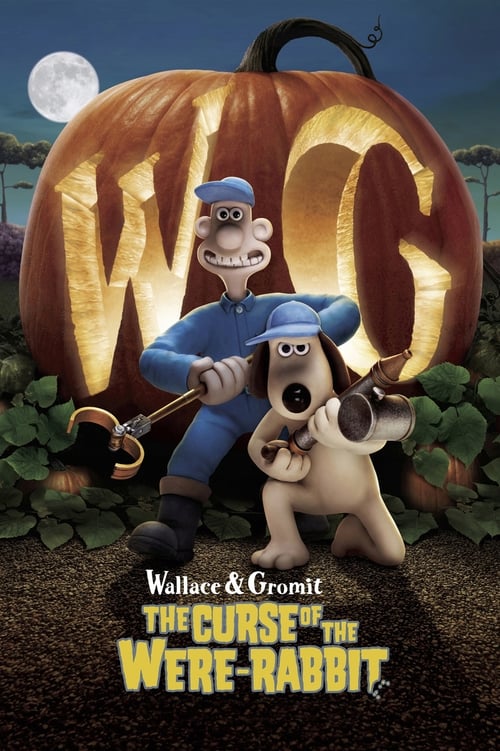
Wallace & Gromit: The Curse of the Were-Rabbit
2005 · Steve Box
For when you need guaranteed cheering up, or a film every age in the room will genuinely love — comfort viewing with craftsmanship to spare.
What it's about
Wallace, a cheese-loving inventor, and Gromit, his silent and far smarter dog, run a humane pest-control business protecting their village's prize vegetables in the run-up to the annual giant-vegetable contest. Then something enormous and ravenous starts demolishing gardens by moonlight, and the pair must catch a monster that hits uncomfortably close to home.
The experience
Pure delight — a gentle, gag-dense romp that plays a monster movie completely straight while stuffing every frame with puns and sly background jokes. It's cozy and silly and impossibly charming.
Performances
Peter Sallis's warm, daft Wallace is one of animation's great voice performances, and Ralph Fiennes and Helena Bonham Carter have a ball as a preening hunter and a kindly aristocrat.
The craft
Handmade stop-motion at its most ambitious: every raindrop, fingerprint-dimpled face, and monster rampage was posed frame by frame in clay, and the tactile imperfection is the charm. The Hammer-horror pastiche — fog, moonlight, torch-wielding villagers — is lovingly precise.
Why it matters
Won the Oscar for Best Animated Feature and brought Aardman's most beloved characters to feature length, proving painstaking clay animation could carry a full-scale family blockbuster in the CG era.
Snapshot
The Curse of the Were-Rabbit is the first feature-length outing for Nick Park's plasticine inventor and his silent, long-suffering dog, arriving after three Oscar-decorated shorts (A Grand Day Out, 1989; The Wrong Trousers, 1993; A Close Shave, 1995) had made the pair a fixture of British popular culture. Co-directed by Park with Steve Box — Box's first feature credit as director, after years as an Aardman animator — it is a stop-motion monster movie in miniature: a Universal-horror pastiche transposed to an English village where the ultimate stake is a giant marrow at the annual vegetable competition.
The film matters on at least three counts. It is the most technically ambitious sustained clay animation production undertaken to that point, in terms of shot count, set volume, and crew size. It is the highest-profile product of Aardman's partnership with DreamWorks, a co-financing relationship that briefly placed a Bristol studio's handmade aesthetic inside a Hollywood distribution machine at the exact moment computer animation was consolidating its dominance. And it won the Academy Award for Best Animated Feature, in a category then only four years old, over CG competition — a result that reads retrospectively as one of the last moments when a hand-built animated feature could win on equal terms in a mainstream field.
Its lasting significance is partly as a demonstration and partly as a warning. It proved that a comic register built on ten-minute shorts — the double-take, the Rube Goldberg contraption, the pun buried in a shop sign — could sustain eighty-five minutes without dilution. It also proved how expensive that proof was.
Industry & production
Aardman Animations, founded in Bristol in 1972 by Peter Lord and David Sproxton, spent two decades as a commercials-and-shorts house before Nick Park's Wallace and Gromit films gave it an international profile. In 1997 the studio entered a multi-picture arrangement with DreamWorks SKG, then a new studio with its own animation ambitions. Chicken Run (2000), directed by Lord and Park, was the first fruit and a substantial commercial success — for many years cited as the highest-grossing stop-motion feature ever made. Were-Rabbit was the second.
The partnership's terms shaped the film in visible ways. DreamWorks handled worldwide distribution and marketing and had input on the title: the film was released in some territories with the fuller Wallace & Gromit: The Curse of the Were-Rabbit branding, and the studio's concern that international audiences might not know the characters is reflected in a marketing campaign that leaned hard on the monster-movie premise. Aardman retained creative control in Bristol, and the film's Englishness — the vegetable competition, the Women's Institute social order, the vicar, the class comedy of Tottington Hall — was not sanded down for export. That is a genuinely unusual outcome for a studio-financed animated feature of the period, and it is the single most consequential production fact about the film.
Production ran for years at Aardman's Bristol facilities with a crew in the hundreds, a scale that made the studio briefly one of the largest employers of animators in Britain. The film's budget was substantial by stop-motion standards — reported figures cluster around the $30 million range, though published production budgets for animated features are notoriously unreliable and should be treated as approximate. Box office was solid rather than spectacular: the film performed respectably worldwide and won its Oscar, but did not replicate Chicken Run's commercial breakout.
A grim postscript belongs here. In October 2005, shortly after the film's release, a fire destroyed an Aardman warehouse in Bristol containing sets, props, and models from the studio's back catalog. The models used in Were-Rabbit itself were largely not lost — much of the destroyed material was archival — but the fire became inseparable from the film's release narrative. Aardman's public response, noting the disaster's triviality next to the Kashmir earthquake days earlier, was widely reported and did the studio's reputation no harm.
The DreamWorks partnership ended after Flushed Away (2006), a CG film Aardman made under the deal. Aardman subsequently partnered with Sony and then StudioCanal. The arc — an independent studio absorbed into a Hollywood release schedule, producing its finest work under it, then leaving — is a compact case study in the economics of animation in the 2000s.
Technology
Were-Rabbit is a plasticine stop-motion film in the most literal sense: characters built over armatures and surfaced in modeling clay, animated frame by frame on physical sets under physical lights. Aardman's house term for the material approach is "claymation" in the loose sense, though the studio has generally avoided the trademarked word.
The scale is where the technology story lives. The production ran dozens of shooting units simultaneously across multiple stages, each unit a separate set with its own animator, camera, and lighting rig — the standard stop-motion solution to the medium's brutal arithmetic, in which a skilled animator produces a few seconds of finished footage per day. Thousands of mouth shapes and replacement parts were manufactured for the principal characters, since Wallace's dialogue is delivered through swapped-in clay mouths and brows rather than mechanical rigs alone.
Digital tools entered at the margins and in the cleanup, not at the core. Frame-grabbing and playback software let animators check motion in progress rather than waiting for rushes — a change from the shorts era that materially improved throughput. Rig removal, wire removal, and seam painting were done digitally in post, freeing the animators to use supports that would once have been unusable. Some effects work — smoke, atmospheric elements, occasional set extension and crowd multiplication — is digital, and the film's climactic aerial sequence combines practical animation with digital compositing. The production also worked from a digital pipeline for editorial and color.
The philosophical position is worth stating plainly, because it is the film's aesthetic spine: digital technology was used to remove obstacles to hand animation, never to replace it. Fingerprints in the clay were left visible. Park has consistently framed the visible evidence of handmaking as the point rather than a defect, and the film's texture — slightly uneven surfaces, the faint wobble of a lit plasticine face — is a deliberate retention.
Technique
Cinematography
Dave Alex Riddett, Aardman's long-standing director of photography and a collaborator on Park's shorts, shot the film. The visual strategy is pastiche executed straight: the film borrows the lighting grammar of Universal horror and Hammer gothic and applies it to sets a few feet across. Night exteriors use hard low-key sources, long shadows thrown across cobbles, moonlight cutting through window mullions. Torch-bearing mob sequences are lit by their own torches. The lighting is genuinely dramatic rather than parodic — the joke is the incongruity between the treatment and the subject, and the joke only works if the treatment is committed.
Camera movement is more mobile than in the shorts, which were largely locked-off or built on simple motion-control moves. Motion control and rigged dollies allow tracking shots, crane-like reveals, and handheld-feeling shakes, all of which have to be executed a frame at a time. Wide-angle lenses and low camera positions are used constantly, exaggerating the scale of sets that are physically small and giving Gromit-level shots a dog's-eye authority.
The camera is also a storytelling instrument in a way it must be, given the film's central constraint: Gromit does not speak. Close-ups on his brow, reaction cutaways timed to the beat, and point-of-view shots that make his reading of a situation legible do the work dialogue would otherwise do.
Editing
David McCormick and Gregory Perler are credited on the edit. Stop-motion editing is a strange discipline, because the material is expensive enough that most cutting decisions are effectively made at storyboard and animatic stage — you do not shoot coverage you might discard. The film was extensively storyboarded and previsualised, and the finished cut follows that plan closely.
Within that constraint the cutting is brisk and precise. Comic timing in Aardman's tradition depends on the length of a held reaction, and the film is full of two-and-three-frame decisions that determine whether a gag lands. The chase and monster sequences cut faster and more aggressively than anything in the shorts, borrowing action-film rhythm. The running time — around eighty-five minutes including credits — is notably short for a feature, and that concision is a deliberate carry-over of the shorts' discipline: the film does not pad.
Mise-en-scène / staging
This is the film's richest technical dimension. Every frame is dense with detail that rewards freeze-framing: shop names built on puns, book spines, product labels, wallpaper patterns, the accumulated clutter of 62 West Wallaby Street. Aardman's sight-gag density is a house style and here it reaches its most elaborate expression, sustained across a feature's worth of sets.
The staging is essentially theatrical-in-miniature. Sets are built as practical spaces with working doors, mechanisms, and lighting; Wallace's contraptions — the Bun-Vac 6000, the automated bedroom-to-breakfast machinery inherited from the shorts — are staged as extended physical routines with beginning, complication, and disaster, in the tradition of silent slapstick. The Anti-Pesto van, Tottington Hall, the allotments, and the village high street are all constructed to be moved through rather than merely photographed.
Character design carries the same load. Wallace's grin, Gromit's mute expressiveness achieved entirely through brow and posture, Victor Quartermaine's teeth and hair, Lady Tottington's coiled topiary of a hairdo — each design is a joke that keeps paying across the film.
Sound
The sound design does a great deal of the horror-pastiche work: creaking doors, wind, distant howls, the wet mechanical noises of the Mind Manipulation-O-Matic. Foley for a plasticine world is a creative rather than a documentary act, and the film's sound is stylized toward the storybook.
Julian Nott, who scored the Wallace and Gromit shorts, composed with Hans Zimmer credited alongside him on the feature — a pairing that reflects the DreamWorks relationship as much as anything, with Zimmer's involvement bringing orchestral scale to Nott's established themes. The score is knowingly overwrought where the genre demands it: full orchestral horror stings, tremolo strings, brass swells applied to a rabbit. Nott's familiar Wallace and Gromit theme anchors the pastiche to the characters.
Performance
Peter Sallis voiced Wallace, as he had since 1989 — a continuity that matters enormously, since Sallis's warm, unhurried Yorkshire delivery is the character's defining feature and the animation is built to match its rhythm. Ralph Fiennes plays Victor Quartermaine and Helena Bonham Carter plays Lady Campanula Tottington, both cast against their prestige-dramatic profiles and both leaning into caricature. Peter Kay's PC Mackintosh and Nicholas Smith's Reverend Hedges fill out the village.
The animators are the other performers, and Aardman's convention of crediting them as such is not merely courteous. Gromit's entire characterization — skepticism, exasperation, loyalty, the slow burn — is animated performance without voice, closer to Keaton or Harry Langdon than to conventional voice-driven cartoon acting. The film's best sustained sequences are Gromit's: he carries them alone.
Narrative & dramatic mode
The film runs a monster-movie plot at village scale. Wallace and Gromit operate Anti-Pesto, a humane pest-control business, and their catch-and-release ethics produce a house full of rabbits. Wallace's attempt to solve the problem at source — brainwashing rabbits out of their appetite for vegetables — produces instead a giant were-rabbit terrorizing the allotments in the run-up to Lady Tottington's Giant Vegetable Competition. The dramatic mode is comic gothic: horror structure played for laughs but with the structure intact.
The transformation plot follows werewolf convention closely — the moon, the involuntary change, the beloved figure revealed as the monster, the hunt, the silver bullet (here, gold) — and the film's central reveal is telegraphed enough to be a matter of dramatic irony rather than surprise. Gromit works out the truth well before the human characters, and the tension comes from watching him protect Wallace from a truth Wallace does not yet know about himself.
The stakes are deliberately, comically small. A vegetable competition is the axis of a plot that borrows the emotional apparatus of catastrophe. This is not merely a joke: the film treats the villagers' investment in their marrows and their prize as entirely serious within its own frame, and refuses to condescend to it. That refusal is what keeps the pastiche affectionate rather than smug.
Genre & cycle
Were-Rabbit sits at the intersection of several traditions. Most obviously it is horror-comedy in a specifically British lineage — the Ealing comedies' village communities and gentle social observation crossed with Hammer's gothic iconography, with a knowing debt to The Curse of the Werewolf (1961) in its very title construction. The gentleman-hunter villain, the mob with torches, the great house and its lady, the ineffectual vicar: these are stock figures deployed with full awareness of their stockness.
It also belongs to the family-adventure animation cycle of the 2000s, and its position there is oppositional. Released in the years when DreamWorks Animation's own CG comedies were establishing a house voice built on pop-culture reference and celebrity vocal casting, Were-Rabbit is conspicuously not that film. Its references are to Universal horror and English social comedy, not to contemporary celebrity; its humor is visual and constructed rather than verbal and topical.
Within stop-motion specifically, the film is a landmark in a small cycle — Selick's The Nightmare Before Christmas (1993) and James and the Giant Peach (1996), Aardman's own Chicken Run, later Laika's Coraline (2009) and Anderson's Fantastic Mr. Fox (2009) — that kept the form commercially viable through a period when it had every reason to disappear.
Authorship & method
Nick Park is the film's originating author in the fullest sense: the characters are his, developed from his student work at the National Film and Television School, and the sensibility — northern English, gadget-obsessed, fundamentally kind — is his. Steve Box, sharing the director credit, came up through Aardman as an animator on the shorts and brought the darker, more gothic register; the horror pastiche is closer to Box's instincts, and the partnership is a genuine division rather than a courtesy credit.
The screenplay is credited to Park, Box, Bob Baker, and Mark Burton. Baker had co-written A Close Shave and had a long television writing history; Burton brought comedy-writing craft. The multi-writer credit reflects a development process in which the script grew from gag ideas and storyboards rather than being written and then illustrated — Aardman's method inverts the usual order, and the film's structure shows it, built from set pieces outward.
Dave Alex Riddett (photography) and Julian Nott (music) are the crucial continuity hires, both veterans of the shorts, both responsible for the fact that the feature feels like an expansion rather than a reboot. Editorial was handled by David McCormick and Gregory Perler. Peter Lord and David Sproxton produced with Claire Jennings and Carla Shelley, with DreamWorks' involvement on the executive side.
The method itself is the authorship. Aardman is a studio in the old sense — a stable of animators trained in a house style, working in one place, over years — and the film's consistency of tone across hundreds of hands is a management achievement as much as a directorial one.
Movement / national cinema
The film is British to a degree unusual in studio-financed animation. Its England is a specific one: northern-inflected in Wallace's speech, southern-village in its setting, and firmly of an imagined mid-century — a world of allotments, church fêtes, tank-topped inventors, and unlocked front doors that had substantially vanished by 2005 and possibly never existed as depicted. This is deliberate nostalgia, closer to the Ealing comedies of the late 1940s than to any contemporary reality.
It belongs to a strand of British animation running from Halas & Batchelor through the Channel 4-funded animation boom of the 1980s, which was the ecosystem in which Aardman's early work was made and in which Park's shorts found their first audiences. That public-service funding context is central to how Aardman came to exist at all: Britain built a small, well-supported animation culture in the 1980s, and Were-Rabbit is its most visible commercial product.
The film's international success posed a question British cinema has faced repeatedly — whether specificity travels — and answered it affirmatively. Nothing in it was made generic for export, and it won an American award anyway.
Era / period
2005 sits at a hinge. Pixar had released The Incredibles the year before and would release Cars the next; DreamWorks Animation had gone public in 2004 and committed fully to CG; traditional hand-drawn feature animation at Disney had effectively been shut down after Home on the Range (2004). The industry consensus of the moment was that computer animation had won and everything else was heritage craft.
Against that, a plasticine film about a man and his dog won the Academy Award for Best Animated Feature. The award category itself was new — established for the 2001 ceremony year — and still finding its shape; Were-Rabbit's win, following Chicken Run's commercial success, briefly suggested that the field would remain plural.
It did not, entirely. Aardman's next film under the DreamWorks deal, Flushed Away, was CG, made at considerable cost, and underperformed; the partnership ended. Stop-motion survived, but as a specialist prestige mode — Laika's business model, Anderson's occasional excursions — rather than as a mainstream commercial option. Were-Rabbit is therefore both a peak and a boundary marker.
Themes
The film's most substantial theme is appetite and its management. Wallace's cheese obsession, the rabbits' hunger, the villagers' competitive horticultural pride, and the Were-Rabbit's insatiability are the same drive at different scales. The monster is not an invader; it is Wallace's own appetite, externalized and enlarged. The transformation plot is, at bottom, about a man who cannot stop consuming and the friend who has to manage the consequences.
Running alongside is a genuine ethical argument about how to treat the unwanted. Anti-Pesto's humane methods are the film's moral premise, set against Victor Quartermaine's shotgun. The mob's demand for killing and Lady Tottington's resistance to it structure the third act, and the film's sympathies are unambiguous: the monster deserves to be saved, not shot. That the monster turns out to be the protagonist makes the argument personal rather than abstract.
Class is present but handled lightly. Tottington Hall and its lady, Victor's assumption of entitlement to both the estate and its owner, the villagers' deference and their capacity to turn — this is the social architecture of English comedy, observed rather than attacked. Lady Tottington's choice of the eccentric inventor over the well-born hunter is the film's quiet verdict.
Finally, friendship. Gromit's loyalty is the film's emotional engine, and its expression — silent, practical, endlessly patient — gives the film a sincerity its pastiche surface might otherwise undercut. The comedy is broad; the relationship is not.
Reception, canon & influence
Critical reception was strongly favourable. Reviewers on both sides of the Atlantic praised the craft, the density of visual invention, and the successful expansion of the shorts' register to feature length; the film holds a high standing in aggregate review measures and appeared on numerous year-end lists. The most common critical reservation concerned pacing — whether a sensibility perfected at thirty minutes was stretched even at eighty-five — but this was a minority position. The Academy Award for Best Animated Feature, plus the BAFTA in the equivalent category, confirmed the consensus.
The influences on the film are legible and acknowledged. Universal's monster cycle of the 1930s and 1940s and Hammer's gothic revival supply the plot machinery and the lighting. Ealing comedy supplies the village and its social texture. Silent comedy — Keaton above all, in the machine-driven set pieces and the deadpan reactive protagonist — supplies the physical grammar; Gromit is a Keaton figure with fur. Ray Harryhausen's stop-motion, which Park has cited as formative, supplies the conviction that hand-animated creatures can carry dramatic weight. Beyond cinema, there is the tradition of British comic drawing and the boys'-magazine inventor, plus the specifically British genre of the eccentric-hobbyist competition.
Forward, the film's legacy is mixed and interesting. Its immediate effect was to validate stop-motion as a feature-length proposition at a moment of maximum doubt, and the studios that followed — Laika above all, founded in 2005 and releasing Coraline in 2009 — worked in a space Were-Rabbit and Chicken Run had kept open. Wes Anderson's move into stop-motion with Fantastic Mr. Fox (2009) drew on Aardman personnel and on the demonstrated viability of the form; Aardman animators have circulated through most significant stop-motion productions since.
The characters themselves continued: A Matter of Loaf and Death (2008) returned to the short format with considerable success, and Wallace & Gromit: Vengeance Most Fowl (2024) brought Wallace and Gromit back to feature length under a Netflix and BBC arrangement, with Ben Whitehead having taken over the voice of Wallace following Peter Sallis's death in 2017. That return, two decades on, is itself evidence of the durability Were-Rabbit established.
The deeper influence is tonal. The film demonstrated that a family animated feature could be built on craft density and affectionate genre knowledge rather than on topical reference and star vocal casting, and that audiences would follow. That lesson has been more admired than imitated — the economics remain punishing — but it remains available, and the film remains the clearest demonstration of it.
Reception
An Oscar-winning hit on arrival (it beat Corpse Bride and Howl's Moving Castle for Best Animated Feature), yet its middling US box office helped sour the DreamWorks–Aardman deal — and it's since settled in as a beloved comfort classic rather than a footnote in that fallout.
How Wallace & Gromit: The Curse of the Were-Rabbit was received, from release to now →
How to watch Wallace & Gromit: The Curse of the Were-Rabbit: what to notice on a first viewing
- Look at shop signs and shelf labels in the background. Aardman packs puns and sight gags into product labels, book spines, and wallpaper across every set, from the high street to 62 West Wallaby Street. The density rewards close attention and gives the film a second, quieter comic track running under the plot.
- Watch Gromit's brow and eyes, not his mouth. Gromit never speaks; his skepticism, exasperation, and loyalty are built entirely from small shifts in his eyebrows and posture. This is silent-film acting inside a stop-motion body, closer to Keaton than to cartoon voice work.
- Notice how night scenes are lit like a horror film. Hard low-key sources, long shadows on cobbles, and moonlight through window mullions treat the village with the same gravity Universal gave its monsters. The joke depends on the lighting being played completely straight against a small, comic subject.
- Listen for full orchestral horror stings under ordinary moments. Tremolo strings and brass swells, scored by Julian Nott with Hans Zimmer, arrive with the weight of real monster-movie music, aimed at a rabbit and a marrow contest. Overwrought scoring on tiny stakes is the film's central comic engine, not decoration.
- Track a Wallace contraption from setup to disaster. Machines like the Bun-Vac 6000 are staged as full physical routines with a beginning, a complication, and a breakdown, in the tradition of silent slapstick. The gadgets are miniature narratives on their own, built to pay off across a whole sequence.
Influences: the films it descends from and the films it influenced
- The Wrong Trousers (1993) — Establishes the entire toolkit the feature scales up — replacement-mouth plasticine sculpts cut to Peter Sallis's dialogue, Dave Alex Riddett's low-key noir key-lighting on miniature interiors, and Julian Nott's genre-pastiche scoring; the van chase in Were-Rabbit is a restaging of its motion-controlled model-railway climax.
- A Close Shave (1995) — Bob Baker's co-written structure — contraption prologue, mistaken-identity mystery, mechanical chase finale — becomes the feature's skeleton, along with the sheep-as-deformable-mass gag vocabulary and Preston as prototype for machinery turned antagonist.
- Chicken Run (2000) — Proved plasticine-over-armature puppets could sustain 80-plus minutes, and built the Aardman feature pipeline — parallel shooting units, dozens of simultaneous sets, digital removal of rigs and thumb-seams — that Were-Rabbit inherited intact, including the Rube Goldberg escape-machine set piece.
- The Wolf Man (1941) — Supplies the plot machinery wholesale: the full-moon involuntary transformation, the folk-rule weapon, and the monster who is also the sympathetic protagonist — Wallace's changes are staged as clay-modelled lap dissolves in direct quotation of Universal's cross-dissolve method.
- Bride of Frankenstein (1935) — Model for the comic-gothic braid — arch village humor running alongside genuine monster pathos without collapsing into parody — and for the torch-lit mob converging on the great house, which Were-Rabbit shoots as a low-angle wide with practical flame on a miniature.
- The Curse of the Werewolf (1961) — Hammer's color gothic lighting grammar — hard raking side-key on the beast, gelled moonlight, deep unfilled shadow in period interiors — reproduced by Riddett at 1:12 scale across Tottington Hall, with the title itself lifted.
- King Kong (1933) — Willis O'Brien's demonstration that a frame-by-frame animated creature can carry pathos and scale rather than read as effect; the Were-Rabbit's silhouette reveals and rooftop staging follow Kong's practice of establishing a giant via low-angle framing against miniature architecture.
- Jason and the Argonauts (1963) — Harryhausen, cited by Park as formative — the Dynamation discipline of animating a creature frame-by-frame to a pre-planned, repeatable camera move is the direct precedent for the film's motion-control passes on the giant rabbit.
- The General (1926) — Gromit's performance grammar entire: a mute, deadpan, reactive protagonist who solves problems through visible mechanical cause-and-effect in real space, with gags escalated by machinery rather than by dialogue or reaction shots.
- The Ladykillers (1955) — Ealing's genteel-macabre calibration and its central device — the unflappably proper elderly Englishwoman whose manners anchor escalating mayhem — is the working model for Lady Tottington and the comedy of her manor.
- The Titfield Thunderbolt (1953) — Ealing's color village-as-ensemble, organized around an eccentric hobbyist collective and its committee politics — the structural template for the Giant Vegetable Competition and the townsfolk's parochial factions.
- A Matter of Loaf and Death (2008) — Carries the feature's pastiche method back into the thirty-minute form, swapping Universal horror for Hitchcock — Vertigo-style blocking, Psycho-derived suspense construction — while keeping the same replacement-mouth workflow and Nott's straight-faced orchestral quotation.
- Wallace & Gromit: Vengeance Most Fowl (2024) — Direct continuation of the method: same hand-sculpted replacement-mouth library and deliberately visible thumbprints in the plasticine, with rig removal and multi-pass compositing extended; Ben Whitehead performs into the mouth-shape vocabulary built for Sallis.
- Fantastic Mr. Fox (2009) — Shot by Aardman lighting cameraman Tristan Oliver and staffed with Aardman-trained animators, importing the wide-angle low-angle miniature-set photography and the insistence on hand-visible material texture — fur rippling frame to frame rather than being smoothed away.
- Coraline (2009) — Laika industrialized Aardman's replacement-part principle, substituting rapid-prototyped 3D-printed replacement faces for hand-sculpted replacement mouths — the same discrete-performance logic at a scale only made financeable by Chicken Run and Were-Rabbit proving the feature market.
- The Pirates! In an Adventure with Scientists! (2012) — Aardman's last plasticine feature, extending Were-Rabbit's density of background sight gags per frame and its habit of building sequences outward from an over-engineered contraption rather than from dialogue scenes.
- Shaun the Sheep Movie (2015) — Were-Rabbit co-writer Burton pushes the storyboard-first, gag-outward construction to its endpoint — a feature with no dialogue at all, structured purely as Keaton-style physical problem-solving in miniature sets.
- The Sheep Detectives (2026) — The Aardman feature-length comic mystery, marrying Ealing-style whodunit plotting to a farm/village setting and clay sight-gag comedy.
- Frankenweenie (2012) — Stop-motion built as scrupulous rather than mocking Universal-monster pastiche — black-and-white low-key lighting, windmill finale, monster-as-pet sentiment — making the same wager that affectionate genre literacy, not topical gags or star voices, can carry a family animated feature.
- Minions & Monsters (2026) — Carries a near-wordless loyal sidekick whose entire performance is eyeline and mime, married to an affectionate were-monster plot — the same fusion of silent physical comedy and monster-comedy this film attempts.
Similar films
- Wallace & Gromit: Vengeance Most Fowl (2024) — influence & lineage · same viewing thread
- Fantastic Mr. Fox (2009) — influence & lineage
- Coraline (2009) — influence & lineage
- The Sheep Detectives (2026) — same viewing thread
- Coyote vs. Acme (2026) — same viewing thread
- Paddington 2 (2017) — same viewing thread
- Monty Python and the Holy Grail (1975) — same viewing thread
- The Tale of the Fox (1941) — shared sensibility
All the films related to Wallace & Gromit: The Curse of the Were-Rabbit →
Watch it with: curated runs of related films
- Sight Gags and Soft Hearts — Watch these when you want comedy built from movement, timing, and architecture rather than punchlines — a gentle soul politely adrift in a bustling, beautifully machined world.