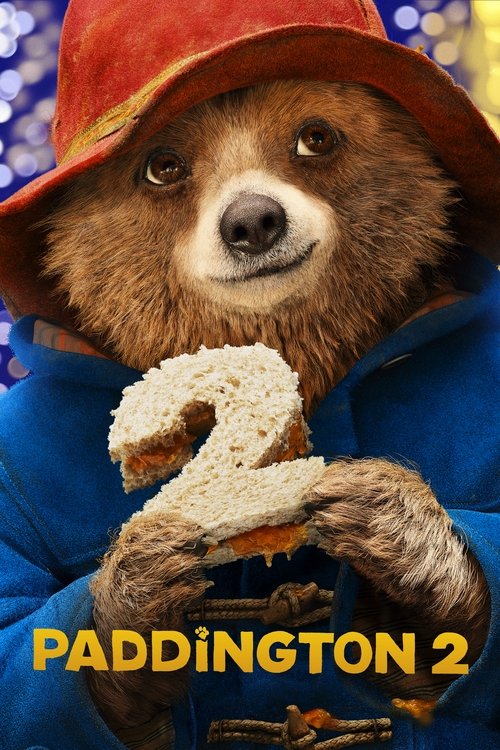
Paddington 2
2017 · Paul King
For when you need the cinematic equivalent of a marmalade sandwich — a guaranteed mood-lifter for a family afternoon, a rough week, or anyone who claims they don't cry at movies. Comfort viewing of the highest order.
What it's about
Paddington, the unfailingly polite Peruvian bear now settled with the Brown family in London, takes on odd jobs to buy his Aunt Lucy the perfect hundredth-birthday present: a beautiful antique pop-up book of London. When the book is stolen and Paddington is framed for the theft, he ends up behind bars while the real culprit — a vain, faded actor with schemes of his own — remains at large, and the Browns set out to clear his name.
The experience
Pure warmth engineered with clockwork precision — genuinely funny slapstick, a plot that clicks together like the pop-up book at its center, and a sincerity about kindness that sneaks up on you. It's the kind of film that has grown adults misty-eyed by the end without ever feeling manipulative.
Performances
Hugh Grant is gloriously funny as Phoenix Buchanan, a preening ham of an actor, in a late-career reinvention that lets him send up his own image with total commitment. Ben Whishaw's gentle voice work makes Paddington's decency feel real rather than saccharine, and Brendan Gleeson is a delight as a fearsome prison cook.
The craft
Paul King directs with storybook invention — sequences that unfold like pop-up pages, candy-colored production design, and visual gags built with silent-comedy precision. The CGI bear is seamlessly woven into live action, and the physical comedy is choreographed rather than chaotic. It looks handmade in the best way, and the big set pieces reward a proper screen.
Why it matters
Widely hailed as that rarest thing, a sequel better than the original, it became a benchmark for modern family filmmaking and proof that sincerity and craft can beat cynicism at the box office and with critics alike.
Snapshot
Paddington 2 is the rare family sequel that surpasses its predecessor and, in doing so, quietly reasserted a whole tradition of British screen comedy. Directed and co-written by Paul King, it takes Michael Bond's marmalade-loving Peruvian bear — now domesticated within the Brown household in Windsor Gardens — and drops him into a wrong-man crime plot: framed for the theft of an antique pop-up book he had meant to buy for his Aunt Lucy's hundredth birthday, Paddington is imprisoned, while the true thief, a vain and faded actor named Phoenix Buchanan, pursues the fortune the book secretly maps. The film fuses picture-book whimsy with the mechanics of silent slapstick, the wrong-man thriller, and the prison-redemption comedy, all wrapped in a sincere civic argument about kindness. It became one of the most acclaimed films of the decade, briefly the best-reviewed feature on aggregator records, and the launching pad for King's subsequent move into large-scale studio musical fantasy.
Industry & production
The film is a StudioCanal production developed through David Heyman's Heyday Films, the same producing partnership behind the 2014 Paddington and the Harry Potter franchise. StudioCanal, the French-owned studio that controls the Paddington screen rights, positioned the property as a flagship family brand for the international market, and the sequel arrived on that mandate: to consolidate a durable, exportable British franchise around a character with more than half a century of literary goodwill behind him.
Michael Bond, who created Paddington in 1958 and appeared briefly in the first film, died in June 2017, months before the sequel's release; the film is dedicated to him, which lends its themes of legacy and remembrance an unplanned poignancy. The production was mounted in and around London and at British studio facilities, drawing on the deep bench of UK crafts talent — production design, costume, miniatures, and the London visual-effects house Framestore, which had built the photoreal CG bear for the first film and returned to animate him here. The film was a substantial commercial success worldwide; I would rather not cite a precise gross from memory, but its performance was strong enough to underwrite the franchise's continuation and King's elevation to bigger projects.
Technology
Paddington himself is a fully computer-generated character composited into live-action plates, the work of Framestore, whose animators and fur/simulation pipeline had to make an anthropomorphic bear read as physically present, tactile, and emotionally legible alongside human actors. The technical burden is less spectacle than credibility: eyeline matching, contact shadows, interaction with liquids and props (marmalade, water, bathwater), and micro-expression in the face. The film pairs this high-end digital character work with a deliberately handmade aesthetic elsewhere — most famously the pop-up book sequence, which visualizes Paddington guiding Aunt Lucy through a storybook London rendered as an animated miniature diorama, blending physical model-making sensibility with digital execution so that the seams feel intentional and tender rather than slick. That contrast — invisible photoreal VFX for the bear, visibly crafted artifice for the book — is the film's signature technological choice. The film was shot digitally; I am not certain of the exact camera package and will not invent a model number.
Technique
Cinematography
Erik Wilson, King's regular collaborator, photographs the film in a bright, saturated, storybook register. Windsor Gardens is staged as an idealized, slightly heightened London — a place of warm brick, primary colors, and clean geometry — and the camera favors centered, frontal, symmetrically balanced compositions that give scenes the poised quality of book illustrations. This ordered visual grammar has drawn frequent comparison to Wes Anderson, and the comparison is fair as description even if the sensibility differs: where Anderson's symmetry is often ironic, Wilson and King use it for sincerity and legibility, so that a small bear is always clearly readable within a busy frame. The camera is also willing to move with balletic precision for the film's set pieces, executing sweeping developing shots that track cause-and-effect chains of physical comedy in continuous or near-continuous motion.
Editing
Cut by Mark Everson and Jonathan Amos, the film is a study in comic timing across two very different rhythms. The domestic and prison scenes are edited for warmth and performance, holding on reaction and letting jokes breathe. The action-comedy set pieces — the window-cleaning sequence, the barbershop mishap, the fairground and train climax — are cut to the logic of physical farce, where the pleasure depends on the audience clearly tracking geography and escalating consequence. Amos's background in kinetic action comedy is felt in these sequences, which chain gags with the momentum of a Rube Goldberg machine while never losing spatial clarity. The pop-up book sequence is edited as a lyrical interlude, a change of pace that resets the film's emotional temperature.
Mise-en-scène / staging
Gary Williamson's production design builds a London that is real enough to ground the story and stylized enough to feel like a children's book come to life. Locations and sets are dressed with dense, legible detail — Mr Gruber's antique shop, the Browns' house, and above all the prison, reimagined after Paddington accidentally dyes the inmates' uniforms pink, transforming a grim institution into a candy-colored refuge. That pink prison is the clearest example of the film's method: staging that turns an accident into a visual thesis, in which Paddington's good nature literally recolors a hostile environment. Costume and color coding do heavy narrative work, distinguishing the warm Brown world from Buchanan's theatrical vanity.
Sound
Dario Marianelli's score is central to the film's tone, moving between playful pizzicato mischief, adventure-serial propulsion, and genuine warmth, with a recurring theme that carries the film's emotional throughline about family and belonging. The sound design supports the slapstick with the crisp, exaggerated cause-and-effect cues of classic physical comedy, while the film's use of song — including a musical flourish tied to Phoenix Buchanan's theatrical self-regard — reinforces character. Marianelli's music is one of the primary reasons the set pieces land as delight rather than mere spectacle.
Performance
Ben Whishaw voices Paddington with an unforced sincerity — polite, earnest, gently bewildered — that anchors the entire film; the performance never winks, which is precisely why the character's decency reads as moral rather than cute. The live-action ensemble is deep: Hugh Bonneville and Sally Hawkins as the anxious-then-loyal Mr and Mrs Brown, with Julie Walters, Madeleine Harris, and Samuel Joslin completing the household; Jim Broadbent as Mr Gruber; Brendan Gleeson as the gruff prison cook Knuckles McGinty, whose softening under Paddington's influence is one of the film's emotional engines; and Peter Capaldi as the disapproving neighbor Mr Curry. Imelda Staunton and Michael Gambon voice Aunt Lucy and Uncle Pastuzo. The performance most singled out is Hugh Grant's Phoenix Buchanan, a preening, has-been actor who plays multiple disguises within the film — a role Grant attacked with gleeful, self-satirizing relish, widely regarded as a late-career highlight and capped by an end-credits musical number.
Narrative & dramatic mode
The screenplay, by Paul King and Simon Farnaby (from a story by King and Jon Croker), is built on a clean and durable dramatic architecture: a wrong-man plot in which an innocent is framed and must be vindicated, braided with a caper (Buchanan's pursuit of the hidden fortune) and a prison-redemption arc (Paddington civilizing his fellow inmates). The dramatic mode is essentially comic and sentimental in the best sense — it earns feeling through structure rather than asserting it. The pop-up book functions as both MacGuffin and emotional object: a stolen treasure map to the villain and a gift of love to Aunt Lucy for the bear, so that plot mechanics and emotional stakes are the same object. The film's controlling idea, voiced through Aunt Lucy — that if you are kind and polite, the world will be right — is tested by injustice and vindicated by the collective action of the community Paddington has quietly transformed.
Genre & cycle
Paddington 2 sits at the intersection of the family adventure-comedy and a distinctly British lineage of gentle social comedy. It belongs to the modern cycle of live-action/CG hybrid family films built on beloved literary or heritage characters, but it distinguishes itself by reaching back to older forms: the silent slapstick two-reeler, the Ealing comedy's affectionate portrait of community, and the wrong-man thriller. It is also part of a small, self-aware cycle of prestige family films that adults take seriously — movies that use the family frame to make an unashamed moral argument. Within the franchise, it is the middle and to date most celebrated installment, the one that fixed the series' identity as sincere, crafted, and civic-minded.
Authorship & method
Paul King is the decisive authorial presence. His formation on the surreal British comedy series The Mighty Boosh gave him a feel for handmade whimsy and theatrical artifice, which he channels here into disciplined, illustration-like compositions and a controlled tonal blend of the fantastical and the emotional. King's method is to treat a children's-property sequel with the formal ambition of an auteur film — bespoke set pieces, motivated color, precise comic staging — while keeping sincerity, not irony, as the organizing value. His key collaborators form a tight, recurring craft unit: co-writer Simon Farnaby (also a supporting performer in the film); cinematographer Erik Wilson, who realizes the storybook look; composer Dario Marianelli, whose score supplies the emotional and comic scaffolding; editors Mark Everson and Jonathan Amos, who calibrate the two-speed rhythm of tenderness and slapstick; production designer Gary Williamson; and the Framestore animation team who make the central character live. The result is unusually unified for a franchise product — the authorship is genuinely collaborative but clearly governed by King's sensibility.
Movement / national cinema
This is emphatically a work of British national cinema, and self-consciously so. It celebrates an idealized, multicultural, neighborly London — a place defined by immigrants, corner shops, and small kindnesses — and it draws on the Ealing tradition of comedies that locate national character in community rather than institutions. Paddington himself, a migrant welcomed into a family and a street, makes the film a soft-spoken statement about British identity as hospitality, a reading that gained cultural resonance in the years around its release. Its craft ecosystem — StudioCanal's UK operation, London VFX, and a who's-who of British stage and screen actors — is likewise a showcase for the national industry's strengths in exportable, character-driven family filmmaking.
Era / period
Made and released in 2017, the film reflects a moment when the family-film marketplace was dominated by CG spectacle and franchise IP, and it answers that context by competing on craft and feeling rather than scale. Its handmade textures and its faith in old comic forms read partly as a corrective to the era's slicker offerings. Culturally, its warm cosmopolitanism landed in a period of sharpened debate about borders and belonging, and much of the commentary around the film treated its gentleness as quietly political. Within its director's career it marks the pivot point between his idiosyncratic television-comedy roots and his subsequent move into major studio filmmaking.
Themes
The film's central theme is that kindness is a practical force, not a naïve one: Paddington's unwavering politeness measurably changes the people around him — the hardened inmates, the suspicious neighbors — and it is that accumulated goodwill, not heroics, that ultimately rescues him. Adjacent themes cluster around family (both the found family of the Browns and the remembered family of Aunt Lucy and Peru), belonging and hospitality toward the outsider, and the difference between authentic community and hollow vanity, embodied by Buchanan's narcissistic performance of himself. Memory and legacy run underneath — the birthday gift, the pop-up book of a London Aunt Lucy longs to see, the film's own dedication to Michael Bond — giving a children's comedy an unexpectedly elegiac undercurrent about honoring those who shaped us.
Reception, canon & influence
Critically, Paddington 2 was received with something close to unanimity, praised for its wit, warmth, craftsmanship, and Hugh Grant's performance; it was for a period cited as the best-reviewed film on major aggregator records, a distinction that itself became part of its cultural story (and later a running joke when a single dissenting notice ended its perfect score). It earned significant awards attention in the UK, including BAFTA recognition, with Grant's turn frequently singled out. Its critical standing has hardened into a minor canonical status: it is routinely invoked as evidence that the family film can be a serious artistic form.
Looking backward, the film's influences are legible and honored rather than hidden. The physical comedy descends directly from silent-era masters — Chaplin and Keaton — in its clockwork set pieces and its faith in the visual gag; the community comedy owes to the Ealing tradition; the framed-innocent and chase mechanics nod to the wrong-man thriller associated with Hitchcock; the symmetrical, storybook compositions invite comparison to Wes Anderson; and the whole rests on Michael Bond's decades of source material. King's own Mighty Boosh background supplies the handmade surrealism.
Looking forward, the film's legacy is both industrial and cultural. It became a byword — sincerely and as internet lore — for the idea that a "kids' movie" can be a great movie, and its vision of Paddington as an emblem of British welcome fed directly into the character's later ceremonial cultural prominence. For its makers, it functioned as a proof of concept: Paul King carried its blend of handcrafted spectacle, musical flourish, and earnest feeling into his subsequent large-scale fantasy filmmaking, and Hugh Grant's reinvention as a character actor of relish traces in significant part to Phoenix Buchanan. The franchise it secured has continued beyond it. Its most lasting influence, though, may be tonal: it made unironic kindness feel like a defensible aesthetic and moral position at a moment when few films dared it.
Reception
Adored on release, but its legend only grew: in 2021 it briefly dethroned Citizen Kane as Rotten Tomatoes' best-reviewed film ever after a decades-old negative Kane review resurfaced — a joke that became a genuine critical talking point.
How Paddington 2 was received, from release to now →
Influences: the films it descends from and the films it influenced
- The Kid (1921) — Establishes the pathos-plus-slapstick fusion King works in — a sentimental innocent whose physical comedy is inseparable from emotional appeal, so the gag and the tear land in the same beat.
- Sherlock Jr. (1924) — Model for Paddington's clockwork set pieces: gags engineered as real physical mechanisms shot in wide, unbroken framing so the audience reads the cause-and-effect of the machinery rather than a cut hiding the trick.
- Modern Times (1936) — Direct blueprint for the prison act — the guileless outsider who mechanizes labor (Chaplin's feeding-machine / assembly line) and reforms his fellow inmates through sweetness, which Paddington restages as the marmalade-sandwich softening of the prison canteen.
- The Lavender Hill Mob (1951) — Ealing template for treating meticulous heist/theft mechanics as genteel whimsy, the caper choreographed for cozy comic precision rather than menace — the register of the pop-up-book book-theft sequence.
- The Ladykillers (1955) — Supplies the Ealing 'community of eccentrics' architecture — a fixed neighborhood of gently exaggerated character types (Windsor Gardens' shopkeepers) whose collective decency is the film's moral ground.
- The 39 Steps (1935) — Wrong-man engine: an innocent framed for a crime he witnessed, propelled through chase-and-escape set pieces while the real culprit hides in plain sight — the structural spine of Buchanan's frame-up of Paddington.
- The Red Shoes (1948) — British antecedent for motivated storybook Technicolor — color deployed as emotional and theatrical statement rather than realism, the lineage behind the saturated pink prison and Erik Wilson's illustration-like palette.
- Paddington (2014) — The immediate predecessor that solved the core problem — Framestore's photoreal CG bear integrated into live action with weight and eye-contact, plus the two-speed tenderness/slapstick rhythm the sequel refines.
- The Grand Budapest Hotel (2014) — Shared symmetrical, frontally-planed compositions and pastel motivated color, plus the comic-prison-break sequence built from handcrafted miniatures and diorama-like dollhouse staging.
- Wonka (2023) — King ports the exact toolkit forward at larger scale — handcrafted musical set pieces, motivated candy-colored palette, symmetrical staging, and unironic sincerity as the organizing value.
- Paddington in Peru (2024) — Inherits and continues the established franchise grammar — Framestore's photoreal bear, storybook adventure staging, and the earnest tonal contract — extending King's template under a new director.
- Amélie (2001) — Parallel storybook-city aesthetic — heightened saturated palette, whimsical wide framing, and a benevolent-trickster plot mechanism where a lone innocent quietly re-engineers a community's happiness.
- Hugo (2011) — Cognate craft: a clockwork railway-station world rendered as production-design spectacle around a lost innocent, staged as an explicit homage to silent cinema's mechanical-gag tradition.
- Fantastic Mr. Fox (2009) — Kindred handling of a tweed-clad anthropomorphic animal through tactile, handmade British texture and symmetrically composed tableaux, prioritizing craft artifice over photorealist naturalism.
- Chicken Run (2000) — Aardman's handmade British comedy built explicitly as a prison-break picture — escape plots delivered through clockwork practical-gag choreography — the same genre fusion Paddington 2 stages in its jail act.
- Anna Karenina (2012) — Showcases collaborator Dario Marianelli's method of a score that scaffolds overt theatrical artifice — music timed to choreographed stagecraft — the compositional approach he brings to Paddington 2's comic-emotional cues.
- Heretic (2024) — The hinge of Grant's late-career reinvention as a preening, theatrical villain, weaponizing his charm into menace — the performance pivot Heretic escalates into full predatory register.
Similar films
- Wonka (2023) — influence & lineage
- Fantastic Mr. Fox (2009) — influence & lineage
- The Grand Budapest Hotel (2014) — influence & lineage
- The Sheep Detectives (2026) — same viewing thread · often watched together
- Sherlock Jr. (1924) — influence & lineage · same viewing thread
- Wallace & Gromit: Vengeance Most Fowl (2024) — same viewing thread
- Wallace & Gromit: The Curse of the Were-Rabbit (2005) — same viewing thread
- Toy Story 5 (2026) — shared sensibility
All the films related to Paddington 2 →
Watch it with: curated runs of related films
- Sight Gags and Soft Hearts — Watch these when you want comedy built from movement, timing, and architecture rather than punchlines — a gentle soul politely adrift in a bustling, beautifully machined world.