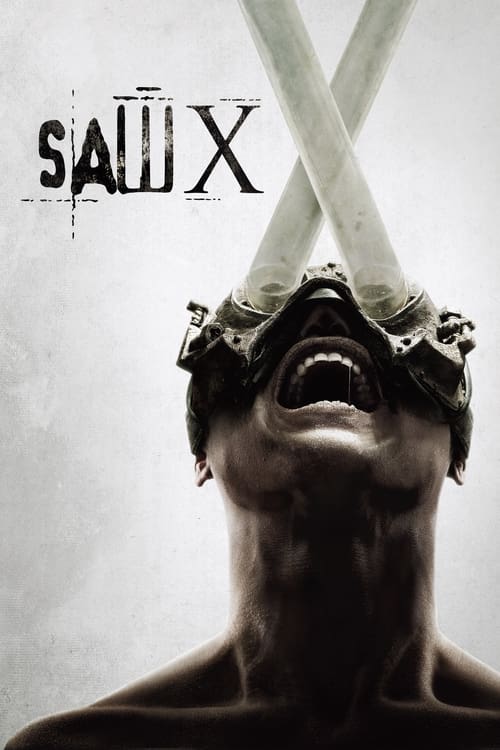
Saw X
2023 · Kevin Greutert
For horror fans in the mood for grisly, watch-through-your-fingers set pieces with a revenge-story spine — and for lapsed Saw viewers curious whether the series can still surprise. Not a starter horror film; it earns its rating.
What it's about
Dying of cancer and out of options, John Kramer travels to Mexico City for an experimental miracle cure — and discovers the clinic is an elaborate scam preying on desperate terminal patients. The con artists picked the wrong mark. Set between the first two Saw films, it follows Kramer as he turns his lethal brand of moral accounting on the people who sold him false hope.
The experience
Slower and more deliberate than you'd expect from this series — it takes real time with its dying protagonist before the traps arrive, so when the gore comes it lands with actual stakes. Still wince-inducing, still gleefully nasty, but with an emotional undertow the franchise rarely attempts.
Performances
Tobin Bell, finally given a full film to carry rather than flashbacks, is quietly remarkable — frail, wry, and genuinely mournful, he makes a serial killer's conviction feel disturbingly human. Shawnee Smith's return adds a welcome charge.
The craft
Director Kevin Greutert, longtime editor of the series, paces it like a character drama that happens to contain torture devices, and the practical trap effects are as tactile and grueling as the franchise has ever managed. The Mexico City setting gives it a grainy, sunburnt texture distinct from the series' usual grimy warehouses.
Why it matters
Widely received as the best Saw film in over a decade, it proved a ten-entries-deep horror franchise could reinvigorate itself by slowing down and centering character instead of escalating gimmicks.
Horror · Splatter & gore · Serial-killer thriller. A dying man's revenge on con artists: patient character drama, then grueling practical-effects traps with a mournful, nasty edge.
Snapshot
Saw X is the tenth installment in the Saw franchise and, structurally, its most unusual: rather than pushing the timeline forward, it burrows backward, slotting itself chronologically between the events of the original Saw (2004) and Saw II (2005). That placement is the film's organizing gambit. By returning to the period when John Kramer was still a comparatively fresh and functional agent of his own ideology, the film reframes a series long defined by convoluted timelines and rotating protagonists around a single, sustained character study of its founding figure. Tobin Bell, who had for nearly two decades appeared mostly in flashback, archival footage, and posthumous voice, is here restored to the center of the frame as a living, ailing, motivated man. The result is a horror sequel that reads, unusually, as a character-driven drama about desperation and vengeance with the traps as its rhetorical instrument rather than its whole reason for being. Directed by Kevin Greutert — an editor turned director deeply embedded in the franchise's DNA — Saw X was widely received as one of the strongest and most coherent entries in a series that had grown notorious for diminishing returns.
Industry & production
Saw X was produced by Twisted Pictures, the company that has shepherded the franchise since its inception, and distributed by Lionsgate, the studio whose commercial fortunes in the mid-2000s were materially shaped by the Saw pictures. The franchise is one of the most durable low-budget horror properties in modern American cinema, built on a model that pairs modest production costs with reliable theatrical returns — a model that made Saw a fixture of the Halloween release corridor throughout the 2000s. Saw X was made on a budget in the low tens of millions, consistent with the series' economics, and performed strongly at the box office relative to that outlay, extending the franchise's reputation as a dependable earner. (Exact grosses should be verified against trade reporting rather than taken on assertion here.)
The project also functioned as a course correction. The immediately preceding entry, Spiral: From the Book of Saw (2021), had attempted to reboot the property as a police procedural with Chris Rock and Samuel L. Jackson and met a mixed reception. Saw X returned the series to its origins — literally, in its timeline, and figuratively, in its emphasis on John Kramer and the machinery of the traps. The screenplay was written by Josh Stolberg and Peter Goldfinger, the writing team responsible for Jigsaw (2017) and Spiral, giving the film continuity of authorship at the script level. Filming took place substantially in Mexico City, matching the narrative's relocation of Kramer to Mexico in pursuit of an experimental cancer cure.
Technology
Saw X is a digitally originated and digitally finished production, consistent with contemporary studio horror practice. The franchise's technological signature has never been about capture format so much as the physical engineering of its traps: the Saw films depend on practical special-effects makeup, animatronics, and built mechanical rigs to sell the gruesome physicality of their set pieces. Saw X continues that lineage, favoring tangible prosthetics and on-set mechanical devices over digital gore where possible, with visual effects deployed to extend or clean up practical work rather than replace it. This practical bias is both an aesthetic and an economic choice — it is cheaper, and it reads as more visceral — and it is central to why the series' violence retains a tactile, wince-inducing quality that purely computer-generated horror often lacks.
Technique
Cinematography
The film's photography leans into a warmer, more saturated palette than the desaturated blue-green industrial grade that became a cliché of the early sequels. Its Mexico City setting invites daylight, color, and texture, and the film uses that environment to soften the franchise's familiar dungeon aesthetic in its first act before descending, inevitably, into the clinical and subterranean spaces where the traps are staged. The cinematography was handled by Nick Matthews. The camera work generally favors legibility over the frenetic, over-cut chaos that marked some earlier entries, giving the trap sequences a clearer spatial logic so that the audience can read the mechanics of each device — a crucial component of the Saw contract, in which the horror depends on understanding exactly what a victim must do to survive.
Editing
Editing has always been the franchise's formal signature — its rapid, percussive cutting during "reveal" montages, synchronized to Charlie Clouser's score, is one of the most recognizable rhythmic devices in 2000s horror. That inheritance is especially pointed here because director Kevin Greutert began his relationship with the series as its editor, cutting the first several films. Saw X deploys the trademark accelerated montage at its climactic reveals but is, on the whole, more patient than its predecessors, allowing scenes of dialogue and character to breathe before the mechanisms engage. The specific credited editor should be confirmed against the film's official credits rather than asserted here.
Mise-en-scène / staging
The production design divides cleanly between two registers: the deceptively bright, hopeful world of the fraudulent clinic — clean surfaces, medical whites, the promise of cure — and the decayed industrial interiors where Kramer stages his reckoning. This contrast is thematically loaded: the film sets the false sanctuary of a medical scam against the "honest" brutality of Kramer's traps, and the staging insists on that irony. The traps themselves are designed with the series' characteristic sadistic ingenuity, each built around a bodily sacrifice keyed to the specific transgression of its occupant.
Sound
Sound design in the Saw films is dominated by the mechanical: the ratcheting of gears, the click of triggers, the hiss and grind of devices, all foregrounded to heighten the audience's dread of the machines. Saw X maintains this emphasis, using the sonic texture of the traps to build tension in the beats before they activate. Over all of it sits Charlie Clouser's score.
Performance
Performance is where Saw X most decisively departs from its predecessors. Tobin Bell, freed from the constraint of playing a man who is mostly a memory, delivers the most extended and interior performance of his tenure as John Kramer — weary, ill, righteous, and frighteningly calm. Shawnee Smith returns as Amanda Young, Kramer's apprentice, restoring one of the franchise's most important secondary figures to a substantial role. The film's principal antagonist, Cecilia Pederson — architect of the medical fraud — is played by Synnøve Macody Lund. The ensemble's grounded playing is a large part of why critics judged the film more dramatically substantial than the series norm.
Narrative & dramatic mode
Saw X operates in a hybrid mode that fuses the franchise's puzzle-box thriller structure with the shape of a revenge drama. Its first act is nearly a con-artist tragedy: a dying man travels to Mexico, submits to a miracle procedure, believes himself cured, and then discovers the entire enterprise is a scam preying on the terminally ill. Only after this emotional setup does the film pivot into recognizable Saw mechanics. This is a significant departure from the series' usual cold open into carnage. The dramatic engine is unusually clean by franchise standards — the audience is invited to side with Kramer, whose targets are unambiguous predators — which lends the trap sequences an uncomfortable moral clarity and a satisfaction the series more typically withholds or complicates. The signature twist architecture remains, but it is deployed in service of character reversal rather than sheer disorientation.
Genre & cycle
The film belongs to the "torture horror" or so-called "torture porn" cycle that Saw itself, alongside Hostel (2005), did more than any other property to define in mid-2000s American horror. By 2023, that cycle had long since crested, and Saw X arrives as a late, self-aware entry in a franchise that outlived the moment it helped create. Its critical success is partly a function of adapting the sub-genre's tropes to a more character-forward, dramatically legible template — closer in spirit to the disciplined original than to the baroque excess of the middle sequels. As mystery-horror, it retains the series' fondness for reveals and reversals; as a franchise film, it is notably concerned with continuity and lore, rewarding long-term viewers with connections to the earliest chapters.
Authorship & method
Kevin Greutert is, in a real sense, the franchise's institutional memory. He edited the first several Saw films before directing Saw VI (2009) — often cited as one of the strongest sequels — and Saw 3D / Saw: The Final Chapter (2010). His return to direct Saw X placed the series in the hands of someone who understands its rhythm from the inside, at the level of the cut. This lineage matters: the Saw aesthetic is fundamentally an editorial one, and a director-editor is unusually well positioned to control it.
Greutert works from a screenplay by Josh Stolberg and Peter Goldfinger, the writers who had by this point become the franchise's steadiest narrative custodians, having scripted both Jigsaw and Spiral. The single most important continuity of authorship across the entire series, however, is composer Charlie Clouser, the former Nine Inch Nails member who has scored every Saw film. Clouser's industrial, mechanized score — anchored by the recurring "Hello Zepp" theme that plays over the films' climactic reveals — is arguably the franchise's most consistent artistic through-line, and its presence in Saw X is a load-bearing element of the film's identity. Cinematographer Nick Matthews rounds out the principal creative team. Above the line, the guiding creative-producorial hands of the property, franchise co-creators Leigh Whannell and James Wan, remain associated with the series as producers, though they were not the film's day-to-day authors.
Movement / national cinema
Saw X is a work of mainstream American studio horror, produced within the Lionsgate/Twisted Pictures ecosystem that has defined the franchise from the start. It does not belong to any art-cinema movement; its significance is industrial and generic rather than avant-garde. That said, the film's substantial production in Mexico City, and its plot's engagement with cross-border medical tourism and the exploitation of the desperate, give it a geographic and thematic texture unusual for the series, even if it remains an American genre product in authorship, financing, and distribution.
Era / period
The film is a product of the early-2020s horror landscape, a period marked by the commercial resurgence of legacy horror franchises and "requel" strategies that revisit and recontextualize beloved properties (Halloween 2018, Scream 2022, and others). Saw X fits this moment precisely: it is a franchise revival that reaches back to origins, courts nostalgia through the restoration of its original star, and positions itself as a corrective return to form after a divisive reboot attempt. Its release also reflects the continued theatrical viability of mid-budget horror in an era when much of Hollywood had migrated toward tentpole spectacle and streaming.
Themes
The film's central preoccupation is the exploitation of the desperate and the dying — the medical scam that defrauds terminally ill people of money and hope. This gives Saw X a thematic coherence the franchise had often lacked, because Kramer's ideology (that people must be forced to value their own lives) is here aimed at victims whose guilt is unambiguous. The film revisits the series' foundational concern with the moral worth of life, survival, and self-preservation, but sharpens it into a study of vengeance: Kramer is not merely testing sinners but avenging a specific, personal deception. Illness, mortality, and the false promise of a cure run throughout, lending the horror an undertone of genuine pathos rooted in Kramer's terminal condition. The film also interrogates its own protagonist's self-justification more directly than usual, asking whether righteous motive redeems monstrous method.
Reception, canon & influence
Critically, Saw X was received as a high point for the franchise — widely regarded as among its best-reviewed entries, with particular praise directed at Tobin Bell's central performance and the decision to build the film around character rather than spectacle. Reviewers frequently noted that the film succeeded precisely because it slowed down, invested in motivation, and treated Kramer as a protagonist worth understanding. Even critics historically hostile to the series' violence tended to acknowledge its dramatic ambition.
Its influences flow backward to the franchise's own origins: the film consciously emulates the tighter, more contained construction of the 2004 original and the character-forward instincts of Greutert's own Saw VI, while restoring continuity threads — Amanda Young, the early period of Kramer's "work" — that anchor it in the series' foundational mythology. More broadly, it inherits the torture-horror grammar codified by Saw and Hostel.
Looking forward, Saw X reset the commercial and creative trajectory of the property, demonstrating that the franchise's future might lie in the past — in mining the timeline around John Kramer's living years rather than manufacturing new successors. Its success reaffirmed both the enduring bankability of the Saw brand and the value of Tobin Bell as its irreplaceable center, and it strengthened the case, within contemporary horror, for legacy-sequel strategies that prioritize character and continuity over escalation. As of this writing the franchise's subsequent direction continues to unfold, and claims about specific later installments should be checked against current reporting.
Reception
After Spiral stumbled, nobody expected the tenth Saw film to be the franchise's redemption — but Saw X landed as the best-reviewed entry in the series' history, and two years on it's still the consensus pick for 'the good one' alongside the 2004 original.
How Saw X was received, from release to now →
How to watch Saw X: what to notice on a first viewing
- Watch how warm and sunny Mexico City looks at first. The film opens in bright daylight and saturated color, a much warmer palette than the blue-green industrial grade of the earlier sequels, before descending into darker spaces. The warmth makes the eventual descent into the traps feel like a real fall, not just a setting.
- Listen for gears and clicks building before each device fires. Sound design foregrounds the mechanical: ratcheting, triggers, and hissing hydraulics, all audible well before a trap actually engages. The dread here is mostly acoustic, built in your ears before anything happens on screen.
- Notice the clean, bright clinic against the decayed industrial rooms. Production design splits sharply between the hopeful, sterile world of the fraudulent medical clinic and the corroded spaces where Kramer stages his reckoning later. The contrast argues that the honest brutality is the traps, not the smiling scam in white.
- Watch how weary and calm Tobin Bell plays Kramer. Freed from years of flashback and voiceover, Bell gets a full, interior performance built on stillness and fatigue rather than theatrical menace. The calm makes Kramer legible as a dying, righteous man rather than a monster.
- Notice the camera holds steady so you can read each trap. The film favors clear, legible staging over the frantic over-cutting of earlier entries, letting you actually see what a victim must do to survive. Understanding the mechanism is the whole game here, so the camera gives you the information straight.
The whole guide to watching Saw X, with the keys for a rewatch →
Influences: the films it descends from and the films it influenced
- Saw (2004) — Establishes the single-room chamber piece resolved by a third-act flashback montage cut to Clouser's 'Hello Zepp' — the corpse-on-the-floor rug-pull whose editorial grammar Saw X reprises almost as homage.
- Saw VI (2009) — Greutert's own directorial template: trap mechanisms engineered as moral arithmetic (insurance-adjuster culpability decides who survives), the character-forward, motivation-first construction he scales up here.
- Se7en (1995) — Codifies the killer-as-moralist who stages didactic murder-tableaux forcing victims to enact their own sin — the ideological-executioner architecture Jigsaw inherits wholesale.
- Hostel (2005) — Co-defines torture-horror's clinical dungeon spaces and unflinching practical-prosthetic mutilation, the industrialized-cruelty aesthetic Saw X's warm-lit surgical-clinic staging descends from.
- Cube (1997) — The lethal-mechanism-as-set-piece: strangers must decode a room's engineered logic to survive, the survival-puzzle device that gives Saw its trap dramaturgy.
- The Abominable Dr. Phibes (1971) — Ornate, individually-themed mechanical death-devices engineered around one man's personal grievance — the boutique revenge-apparatus tradition Kramer's traps extend.
- Les Diaboliques (1955) — The engineered climactic reveal that retroactively reframes the whole plot, the twist-architecture blueprint the Saw films weaponize into a house style.
- The Silence of the Lambs (1991) — Centers the narrative on the incarcerated killer as a magnetic, philosophizing lead — the sympathetic-antagonist-as-protagonist move Saw X makes by handing the film to Tobin Bell.
- The Collector (2009) — Written by Saw scribes Dunstan and Melton, it exports the elaborately booby-trapped-house design into home-invasion, extending the trap-architect villain outside the parent series.
- Escape Room (2019) — Mainstreams the lethal survival-puzzle-room into a PG-13 studio franchise, inheriting Saw's decode-the-mechanism-or-die set-piece logic stripped of the gore.
- The Belko Experiment (2016) — Stages a forced kill-or-be-killed social experiment governed by a disembodied controller's rules — the coerced-moral-game premise Jigsaw's mythology seeded.
- Jigsaw (2017) — Scripted by the same custodians Stolberg and Goldfinger, it pioneers the interquel timeline sleight-of-hand around Kramer's chronology that Saw X refines into a full prequel.
- Spiral (2021) — Same writing team, same Clouser score and reveal-montage grammar, transposing the trap-and-twist engine onto a police procedural as a franchise-continuity experiment.
- Halloween (2018) — The legacy-requel playbook Saw X shares: ignore later sequels, return the irreplaceable iconic performer, and mine character and continuity over escalation.
- Ready or Not (2019) — Builds a single-location deadly-game with legible spatial staging and practical splatter, a contemporary cousin to the trap-house survival ordeal.
- Terrifier 2 (2022) — Carries the practical-effects, in-camera-mutilation banner of torture-horror into the 2020s, sharing Saw X's commitment to tactile prosthetic gore over CGI.
Similar films
- Saw (2004) — influence & lineage
- Ready or Not (2019) — influence & lineage · same viewing thread
- Saw II (2005) — same viewing thread
- X (2022) — same viewing thread
- Scream (2022) — same viewing thread
- Scream VI (2023) — same viewing thread
- Terrifier 3 (2024) — same viewing thread
- Malignant (2021) — same viewing thread
All the films related to Saw X →
Watch it with: curated runs of related films
- Fresh Blood: 2020s Studio Horror — A run of the decade's mainstream fright machine — abduction shockers, franchise revivals, and one arthouse throwback — best watched back-to-back to feel how modern horror hunts its prey.
- Blood by the Bucketload — A run of horror that treats gore as showmanship: elaborate death set-pieces, practical effects by the gallon, and the giddy, squirming fun of watching it with a crowd, from Jigsaw's traps and Final Destination's chain reactions to Ready or Not's wedding-night bloodbath and The Substance's body-horror finale.