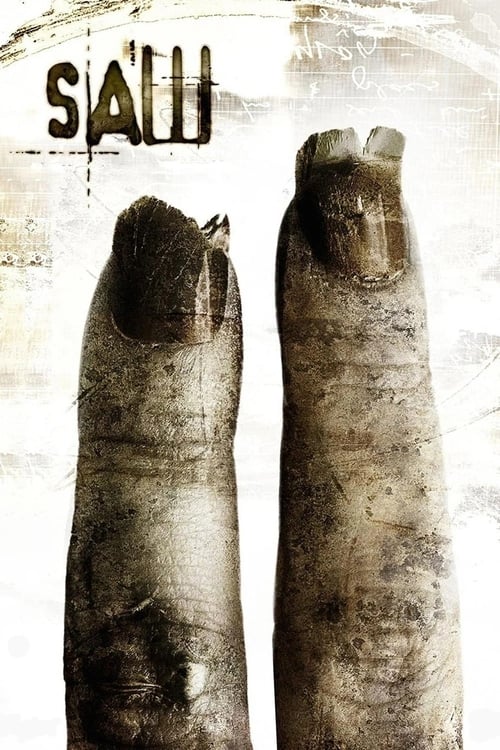
Saw II
2005 · Darren Lynn Bousman
For when you're craving something nasty and propulsive — a late-night, strong-stomach watch for horror fans who want traps, twists, and dread rather than subtlety. Challenge, not comfort.
What it's about
A detective discovers that the Jigsaw killer has locked a group of strangers — including someone the detective loves — inside a booby-trapped house filling with nerve gas, with survival hinging on a series of gruesome tests. Catching Jigsaw turns out to be the easy part; the real game is playing out on a bank of monitors, on a clock.
The experience
Relentless and grimy, cutting between the house's ticking-clock ordeals and the interrogation-room chess match until the pressure never lets up. It's punishing, pulpy, and built to make you flinch — with a rug-pull sensibility that keeps you second-guessing.
Performances
Tobin Bell's Jigsaw is the reason the franchise has a face: a dying man delivering moral lectures in a gravelly whisper, he turns what could be a stock boogeyman into a genuinely unnerving screen presence, and his long interrogation scenes are the film's best.
The craft
Bousman's cross-cutting between the house, the cops, and Jigsaw's game is the film's real machinery — the trap set-pieces get the notoriety, but the structure is what generates the tension. The grungy, green-tinted look and industrial sound design defined the visual language of an entire horror cycle.
Why it matters
The film that turned a scrappy sleeper into an annual Halloween institution, consolidating the trap-movie formula and helping define the mid-2000s wave of extreme American horror.
Horror · Splatter & gore · Serial-killer thriller · Psychological horror. Strangers in a gas-filled, booby-trapped house face gruesome tests on a clock while a detective plays the killer's game. Grimy, cruel.
Snapshot
Saw II is the film that turned a scrappy 2004 sleeper into a franchise machine. Where James Wan and Leigh Whannell's original Saw was a two-hander built around a single locked bathroom, the sequel widens the aperture: a houseful of victims, a police procedural running in parallel, and an expanded role for Tobin Bell's Jigsaw, who is now less a shock reveal than a philosophy-spouting antagonist with a genuine screen presence. Directed by first-time feature director Darren Lynn Bousman and released only a year after its predecessor, the film consolidated the "trap movie" formula — a cross-cut structure of ticking-clock ordeals intercut with an investigation — and set the annual-Halloween release cadence that would define the series. It is a foundational text of the mid-2000s "torture" cycle and, commercially, one of the most efficient horror sequels of its era.
Industry & production
The production history of Saw II is unusually well documented in the film's own paratext and interviews, and it is a genuine case of a sequel assembled at speed to capitalize on a surprise hit. The original Saw, made cheaply and released by Lionsgate in October 2004, was a substantial financial success relative to its cost, and Twisted Pictures — the production company run by Mark Burg and Oren Koules — moved quickly on a follow-up.
Bousman had independently written a horror screenplay, widely reported under the title The Desperate, centered on a group of strangers trapped in a house full of lethal traps. Unable to get it financed on its own, he brought it to Twisted Pictures / Lionsgate, and the project was reworked into a Saw sequel, with the Jigsaw mythology grafted onto Bousman's existing structure. Leigh Whannell, co-creator and writer of the original, came aboard to integrate the material into the continuity and shares screenplay credit with Bousman; Whannell and Wan are also credited as executive producers, giving the sequel a line of authorial continuity even as directing duties passed to a newcomer.
The shoot was fast and low-budget by studio standards — filmed in Toronto over a compressed schedule (commonly cited as roughly three to four weeks) on a modest budget. Released in late October 2005, it opened strongly, topping the domestic box office in its debut weekend and, on its small outlay, returned a large multiple of its cost worldwide. (Exact grosses vary by source; the reliable point is that it was a major commercial success and out-earned the first film.) That result did two things: it confirmed Saw as an annual franchise, and it made Lionsgate's Halloween slot a fixture for years. Bousman would return to direct Saw III (2006) and Saw IV (2007), making him the most prolific director of the series' original run.
Technology
Saw II is a product of the mid-2000s transitional moment in horror production, and its technical profile reflects a low-budget, fast-turnaround aesthetic more than any single innovation. The film's look — grimy, high-contrast, desaturated toward sickly greens and yellows — was achieved largely through production design, lighting, and a color-timed grade rather than novel capture technology. Digital intermediate color grading was by 2005 a standard finishing tool, and the series' distinctive jaundiced palette is one of its clearest applications of the technique.
The franchise is also notable for its practical, mechanical approach to its central set pieces. The traps are engineered as physical props and gore effects rather than digital constructions, which suited both the budget and the horror-of-tangibility that the series trades on. Where the record is thin — the specific rigs, on-set safety engineering, and the balance of practical versus optical effects on individual traps — I won't invent detail; but the overall commitment to practical effects is a consistent and well-attested feature of the production.
Technique
Cinematography
Cinematographer David A. Armstrong, who shot the original Saw and would remain the series' defining visual author across multiple entries, returns here and is central to the film's identity. His style for Saw II is aggressively handheld and restless, favoring close, unstable framings, hard side- and top-lighting, and a palette pushed toward industrial greens, sodium yellows, and cold shadow. The result reads as deliberately unpleasant — grubby surfaces, sweat, rust — a visual grammar that treats environment as a source of menace. Armstrong's camera tends to crowd its subjects, denying comfortable establishing geography inside the trap house, which reinforces the sense of disorientation the victims experience.
Editing
Editing is arguably the sequel's most important formal element, and Kevin Greutert — the series' regular editor, who would later direct Saw VI and Saw 3D — is the key craftsman here. The film's architecture is built on cross-cutting: the ordeal inside the nerve-gas house is intercut with Detective Eric Matthews's confrontation with the captured Jigsaw at the police facility. Greutert's cutting sustains two clocks at once and stages the film's late reversal — the discovery that the house footage and the interrogation are not synchronous — as an editorial trick as much as a screenwriting one. The franchise's signature rapid-fire "reveal montage," a stroboscopic burst of quick cuts that recontextualizes the plot at the climax (scored to Charlie Clouser's theme), is a Greutert hallmark and appears here in developed form.
Mise-en-scène / staging
The production design centers on the decaying house — a labyrinth of rooms rigged with traps and slowly filling with a lethal nerve agent — and on the clean, fluorescent counter-space of the room where Matthews faces Jigsaw. This spatial opposition (chaotic, organic decay versus sterile institutional order) is the film's governing staging idea. Individual set pieces are designed as discrete, legible puzzles: the needle pit, the burning-furnace and hand-in-blades style devices, the "key behind the eye" apparatus. Each is staged as a self-contained moral test with a visible mechanism and a visible cost, which is the series' core theatrical unit.
Sound
Charlie Clouser, the former Nine Inch Nails member who scored the original film, returns and is essential to the franchise's sonic signature. His industrial-electronic score — grinding textures, distorted percussion, and the recurring "Hello Zepp" theme that accompanies each film's climactic revelation — gives Saw II a propulsive, mechanical pulse that matches the trap-machinery imagery. Sound design leans on close, visceral detail (metal, breath, wet impact) to sell the practical gore, and the reveal cue functions almost as a Pavlovian marker that the audience learns to anticipate across the series.
Performance
Tobin Bell is the film's anchor. Where the original used Jigsaw as a withheld twist, Saw II foregrounds him: much of the runtime is a two-hander between Bell's calm, sententious John Kramer and Donnie Wahlberg's volatile, compromised Detective Matthews. Bell's performance — quiet, deliberate, morally certain — is what elevates the character from gimmick to franchise icon, and the film's success is inseparable from his expanded presence. Wahlberg supplies the aggression and desperation the structure needs. Shawnee Smith returns as Amanda Young, the first film's rare survivor, in a role that the film's ending repositions significantly; her performance carries the emotional and plot weight of that reversal. The ensemble of trapped victims (including Franky G, Glenn Plummer, Emmanuelle Vaugier, and Beverley Mitchell) functions largely as a rotating cast of test subjects, staged for attrition rather than depth.
Narrative & dramatic mode
The film operates in a dual mode: a survival-horror ordeal narrative inside the house and a detective/interrogation thriller outside it, braided by cross-cutting. Its dramatic engine is the puzzle-box reversal inherited from the original — the audience is invited to read the two timelines as concurrent, and the climax reveals a temporal sleight of hand that reframes everything (Matthews's search, Jigsaw's compliance, the fate of his son). This is a mode of storytelling in which plot mechanics are the horror: the pleasure and dread come from the withheld structural truth as much as from the graphic ordeals. Thematically, each trap is framed as a moral proposition — Jigsaw insists his victims are being given a chance to "appreciate" life through suffering — so the narrative continually pairs bodily jeopardy with a rhetoric of judgment and redemption.
Genre & cycle
Saw II sits at the center of the mid-2000s American horror cycle that critic David Edelstein would soon (in early 2006) label "torture porn," a grouping that also includes the original Saw and Eli Roth's Hostel (2005). The cycle is characterized by extended, physically explicit ordeal sequences and a preoccupation with confinement, bodily violation, and moral culpability. Saw II is one of the cycle's commercial linchpins: its success proved the model was repeatable and franchisable, and it helped make the annual "trap movie" a genre unto itself. It also draws on older strains — the closed-room slasher, the "deadly game" thriller, and the serial-killer procedural — recombining them into the series' distinctive template.
Authorship & method
The most interesting authorship question in Saw II is that its identity is genuinely collaborative and slightly hybrid. Darren Lynn Bousman, directing his first major feature, brought the core "house of traps" premise from his own unproduced script and would go on to direct the next two installments, making him the series' formative directorial voice; his later filmography (Repo! The Genetic Opera, Mother's Day, and the 2021 franchise entry Spiral) shows a continued interest in grotesque, moralized spectacle. Leigh Whannell (co-writer) and James Wan (executive producer), the original's creators, supplied the mythology and continuity, tethering Bousman's material to the established Jigsaw universe. On the craft side, three returning collaborators define the film's texture: cinematographer David A. Armstrong, whose desaturated handheld style became the franchise look; composer Charlie Clouser, whose industrial score and "Hello Zepp" motif became its sonic brand; and editor Kevin Greutert, whose cross-cut construction and reveal-montage technique became its structural signature (and who later graduated to directing within the series). Saw II is thus best understood as a house style forged by a repertory crew, with Bousman as its energetic new director.
Movement / national cinema
The film is a product of American commercial horror, though its physical production is North American in the cross-border sense typical of the period: an American studio genre picture (Lionsgate / Twisted Pictures) shot in Toronto for cost reasons. It belongs to no art-cinema "movement" in the traditional sense; its relevant lineage is industrial rather than national — the low-budget, high-margin genre pipeline that Lionsgate cultivated in the 2000s. If it has a movement, it is the "torture" cycle itself, a market phenomenon more than a coherent aesthetic school.
Era / period
Saw II is emblematic of mid-decade 2000s Hollywood horror. Its release lands in a moment defined by the commercial dominance of hard-R genre product, the studio embrace of low-budget/high-return models, and a broader post-9/11 cultural climate that critics have repeatedly connected to the era's fixation on confinement, interrogation, and bodily torment. Whether one accepts the geopolitical reading, the industrial reading is unambiguous: this is a film of the DVD-boom, annual-tentpole-horror era, when a franchise could be sustained on modest budgets and reliable Halloween grosses.
Themes
The film's explicit theme is Jigsaw's warped ethic of redemption through suffering: his victims are people he judges to be squandering their lives, and his traps are framed as tests offering "rebirth" at a physical price. Around this sits a cluster of related concerns — culpability and complicity (Detective Matthews is no innocent, and the film insists on his corruption), the illusion of control, and the moral symmetry Jigsaw draws between his victims and himself. The dual-timeline structure gives these themes a formal correlate: the film is about not seeing the whole picture, about acting on partial information and paying for it. Fatherhood and the threat to a child (Matthews's son) supply the emotional stakes that the abstract moral scheme otherwise lacks.
Reception, canon & influence
Critically, Saw II received a mixed-to-negative response typical of the cycle: reviewers frequently acknowledged Tobin Bell's magnetism and the efficiency of the trap-thriller construction while objecting to the emphasis on graphic ordeal, and the film became a frequent reference point in the broader critical debate over "torture porn" that crystallized shortly after its release. Its reputation with critics has never been high, but its historical importance is not seriously disputed.
Looking backward, the film draws on the original Saw's puzzle-box template, the deadly-game and closed-room traditions, and the serial-killer procedural, all filtered through the low-budget practical-gore sensibility that Wan and Whannell established. Bousman's imported "house of victims" premise also connects it to the survival-horror ensemble film.
Looking forward, Saw II is the pivot on which the entire franchise turns. It proved the series could survive the loss of its creators as directors, established the crew (Armstrong, Clouser, Greutert) and formal devices (cross-cut ordeals, the reveal montage, the annual Halloween release) that would carry through many sequels, and expanded Jigsaw from a twist into a durable horror icon anchored by Tobin Bell. Its commercial success reinforced Lionsgate's low-budget horror strategy and helped sustain the mid-2000s torture cycle. The franchise it secured has continued for well over a decade across numerous films, making Saw II — more than the original in some respects — the film that turned Saw into an institution.
A Deleuzian reading
A man wakes with an iron mask hinged open around his throat and is told the key is behind his own eye.
The full Deleuzian reading of Saw II →
Reception
Critics wrote it off in 2005 as a cash-in emblem of the 'torture porn' wave, but it opened #1 on Halloween weekend and locked in the franchise's annual October ritual — and the recent Saw renaissance has fans re-ranking it as one of the series' best sequels.
How Saw II was received, from release to now →
How to watch Saw II: what to notice on a first viewing
- Watch how close and unsteady the camera stays inside the trap house. Armstrong's handheld camera crowds bodies and rarely shows a full room, so you never get a clean map of the space. The disorientation you feel matches what the trapped victims feel; the camera denies you safety too.
- Notice the color change between the house and the interrogation room. The house is grubby green and sodium yellow; the room where Matthews faces Jigsaw is sterile fluorescent white. The color split stages the film's core opposition: decaying appetite versus institutional order.
- Listen for the industrial score and the recurring musical cue. Clouser's grinding electronic score builds a mechanical pulse, and one theme returns at turning points in the plot. The recurring cue gives the score a memory you can learn to hear.
- Watch how each trap shows its mechanism, rule, and cost. Every set piece, the needle pit, the key behind the eye, is staged as a discrete puzzle with a visible device and a visible price. Each trap functions as its own self-contained scene, the modular unit the franchise is built on.
- Follow how calm Jigsaw stays while Matthews grows more frantic. Bell keeps John Kramer quiet and deliberate throughout; Wahlberg's Matthews escalates into shouting and threats as the interrogation goes nowhere. The contrast marks who actually holds power in the room, regardless of who is restrained.
The whole guide to watching Saw II, with the keys for a rewatch →
Influences: the films it descends from and the films it influenced
- Saw (2004) — Established the puzzle-box template, the reverse-chronology reveal montage cut to Clouser's 'Hello Zepp,' and the single-room practical-trap climax that Saw II directly reworks.
- Se7en (1995) — Supplied the desaturated, grime-soaked palette and the moralized serial-killer-as-designer whose victims are staged to embody their sins, plus the withheld-mastermind structure Jigsaw inherits.
- Cube (1997) — Strangers sealed in a lethal geometric space of industrial booby-traps, picked off one by one — the ensemble death-house architecture Saw II adopts for its 'house of victims.'
- The Silence of the Lambs (1991) — The immobilized, all-knowing captive killer conducting a psychological duel with his investigator is the direct model for Tobin Bell's static Jigsaw-versus-Detective-Matthews interrogation.
- The Usual Suspects (1995) — The final-minute reveal montage that retroactively recontextualizes the entire narrative is exactly Kevin Greutert's structural signature in the film's twist.
- And Then There Were None (1945) — A self-appointed moral executioner lures a group of the secretly guilty into a house to be killed one at a time for past transgressions — the culpability-driven closed-group format.
- The Abominable Dr. Phibes (1971) — Elaborately themed, morally-coded death-trap set pieces staged as theatrical spectacle by a vengeful designer prefigure Jigsaw's practical apparatus dramaturgy.
- The Texas Chain Saw Massacre (1974) — Grimy grindhouse 16mm texture and the survival-horror ensemble trapped in a house of death feed the franchise's low-budget practical-gore sensibility.
- Saw III (2006) — Bousman with the repertory crew (Armstrong, Clouser, Greutert) carries forward the cross-cut ordeals and reveal-montage grammar Saw II codified.
- Saw VI (2009) — The editor who authored the cross-cut/reveal-montage technique graduates to director, extending his own structural signature into the franchise's direction.
- The Collector (2009) — Saw sequel writers Dunstan and Melton spin the booby-trapped house of practical, ordeal-based traps into a standalone home-invasion variant.
- Repo! The Genetic Opera (2008) — Bousman's authorial signature — grotesque, moralized spectacle scored to industrial music — carried out of the franchise into a rock-opera register.
- Spiral: From the Book of Saw (2021) — Bousman returns to extend the Jigsaw trap-thriller template — cross-cut moral ordeals and reveal structure — into a police-procedural framework.
- Escape Room (2019) — Directly inherits the deadly-game puzzle-room seed: strangers must solve intricately themed lethal chambers designed by a hidden moral architect.
- Final Destination (2000) — Parallel deadly-game craft of intricate practical death-machine set pieces governed by an unseen moral/cosmic reckoning, engineered for suspense-of-mechanism rather than a slasher.
- Hostel (2005) — The definitive same-year entry in the mid-2000s hard-R 'torture porn' cycle, sharing the emphasis on prolonged captivity and practical mutilation spectacle.
- Wolf Creek (2005) — Applies the same desaturated handheld naturalism to extended captivity-and-abuse horror within the identical mid-decade hard-R cycle.
- The Devil's Rejects (2005) — Shares the sun-bleached, desaturated grindhouse palette and unrepentant hard-R brutality that defined the 2005 horror moment.
Similar films
- Saw (2004) — influence & lineage
- The Texas Chain Saw Massacre (1974) — influence & lineage
- Final Destination (2000) — influence & lineage
- Final Destination Bloodlines (2025) — same viewing thread
- Saw X (2023) — same viewing thread
- Malignant (2021) — same viewing thread
- The Texas Chainsaw Massacre Part 2 (1986) — shared sensibility
- Scream (2022) — shared sensibility
All the films related to Saw II →
Watch it with: curated runs of related films
- Blood by the Bucketload — A run of horror that treats gore as showmanship: elaborate death set-pieces, practical effects by the gallon, and the giddy, squirming fun of watching it with a crowd, from Jigsaw's traps and Final Destination's chain reactions to Ready or Not's wedding-night bloodbath and The Substance's body-horror finale.