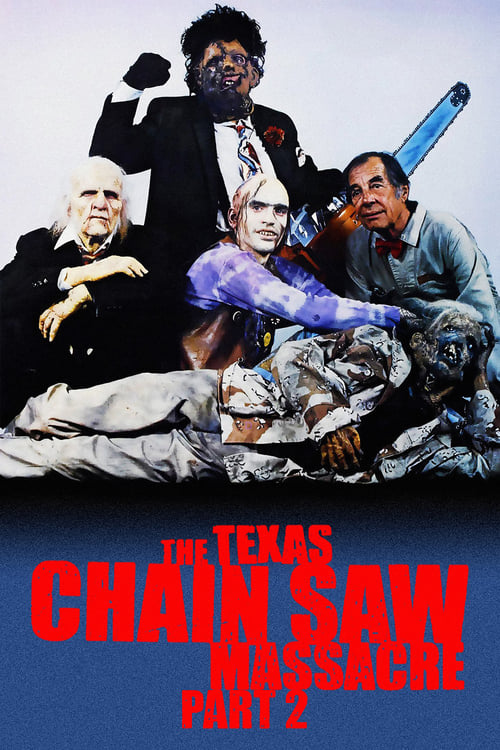
The Texas Chainsaw Massacre Part 2
1986 · Tobe Hooper
For a rowdy late-night watch with friends who like their horror gonzo — when you want excess, not subtlety. Pure midnight-movie energy; come for the chainsaws, stay for the chili jokes.
What it's about
Twelve years after the original massacre, a late-night Texas DJ named Stretch accidentally records a chainsaw killing live on air — and the tape pulls her into the path of the cannibal clan, now living beneath an abandoned amusement park and winning chili cook-offs with their secret recipe. Hunting them is Lefty, an obsessed ex-lawman with saws of his own and a personal score to settle.
The experience
Loud, grotesque, and deliberately unhinged — Tobe Hooper swaps the original's grim terror for cackling black comedy and splatter, and the film careens between genuinely gnarly and laugh-out-loud absurd. It's an endurance test and a party at the same time.
Performances
Caroline Williams is a ferocious, funny final girl as Stretch, Dennis Hopper goes gloriously over the top as the vengeance-crazed Lefty, and Jim Siedow's prize-winning cannibal cook is a deranged comic creation.
The craft
Hooper leans into carnival-colored lighting and elaborate production design — the family's underground amusement-park lair is one of horror's great sets — with gleefully excessive gore effects by makeup legend Tom Savini. It's maximalist filmmaking in every department, best experienced loud.
Why it matters
Baffling to audiences expecting a straight sequel in 1986, it's since been rehabilitated as a cult classic and a key example of a director blowing up his own legend rather than repeating it.
Snapshot
Twelve years after The Texas Chain Saw Massacre (1974), Tobe Hooper returned to the cannibal family he had created with Kim Henkel. He did not try to repeat the original's grim, documentary-like terror. He made a loud, grotesque, deliberately excessive black comedy instead. Late-night disc jockey Vanita "Stretch" Brock (Caroline Williams) happens to record an on-air chainsaw killing. That draws her into the orbit of Lefty Enright (Dennis Hopper), a former lawman and uncle of the original film's victims Sally and Franklin Hardesty. He has spent years hunting the family. The trail leads to an abandoned Texas amusement park, where the clan lives underground. Drayton Sawyer, "the Cook" (Jim Siedow), has become a prize-winning chili caterer, Leatherface (Bill Johnson) is confused by an infatuation with Stretch, and a new brother, the Vietnam veteran Chop Top (Bill Moseley), cackles through the chaos.
Cannon Films released the film unrated in 1986. Critics were split, and fans who wanted a second dose of the original's dread were baffled. Over the following decades it was steadily reappraised as a satire of Reagan-era America, and as one of the strangest sequels a major horror director ever made to his own landmark.
Industry & production
The film was the last of three pictures Hooper made for Cannon Films under a multi-picture arrangement with Menahem Golan and Yoram Globus. The first two were the science-fiction spectacle Lifeforce (1985) and the remake Invaders from Mars (1986). Both were expensive and did poorly commercially. By most accounts that put pressure on the third picture to be a cheaper, more reliable genre title built on a recognizable brand.
Cannon was then at the peak of its aggressive expansion. It produced action vehicles, exploitation titles, and occasional prestige films, often sold to foreign buyers before a frame was shot. Part 2 fits that model: a famous title, a modest budget by studio standards, and a fixed release window. Production accounts consistently describe a rushed schedule, shooting in and around Texas in the first half of 1986 for a late-summer release. Reported budget figures vary, and the record is thin enough that no single number should be treated as definitive.
The screenplay is credited to L.M. Kit Carson, who had co-written the adaptation behind Wim Wenders's Paris, Texas (1984) and Jim McBride's Breathless remake (1983). Hiring a writer from the art-house and independent world was itself a signal that the film would not be a conventional slasher sequel.
The MPAA indicated the film would receive an X rating for its violence. Cannon chose to release it unrated, which limited some theatrical and advertising outlets. Abroad the film ran into censorship. It was refused or kept off the market in some territories for years, Australia most notably. The exact dates and terms of those bans are best checked against the classification bodies' own records.
Cannon's marketing leaned into the comedy. The best-remembered poster parodies the group pose of The Breakfast Club (1985), with the Sawyer family standing in for the teenagers. It tells you the tone the studio was selling.
Technology
The film was shot on 35mm with conventional studio-independent equipment of the mid-1980s. Its technological interest lies mainly in practical makeup effects, which Tom Savini supervised. Savini was then the best-known gore-effects artist in American horror, through his work with George A. Romero (Dawn of the Dead, 1978; Day of the Dead, 1985) and on Friday the 13th (1980). His work here includes:
- the opening bridge killing, in which a car-roof decapitation and chainsaw mutilation are shown in explicit detail
- the flaying of L.G. McPeters (Lou Perryman), whose face Leatherface then places over Stretch
- the desiccated Grandma corpse and the nearly mummified Grandpa
- Chop Top's exposed metal skull plate, which he heats a coat hanger to scratch
The original film was famous for how little gore it showed. Part 2 goes the other way, making its graphic effects the point. That mirrors the effects-driven horror market of the early-to-mid 1980s.
Sound recording technology is also part of the plot. Stretch's radio station tapes the dying phone call of the two victims, and Lefty has the tape broadcast to lure the family. The recording becomes the bait that pulls the killers toward her.
Technique
Cinematography
Richard Kooris shot the film, and the look is a deliberate break from Daniel Pearl's grainy 16mm images in 1974. The visual signature is saturated, theatrical color, especially in the underground lair: reds, oranges, and greens fall across walls encrusted with bones, Christmas lights, and garbage. The camera often treats the lair like a funhouse or ghost-train ride. It tracks through tunnels and frames figures against cluttered, crowded backgrounds. The opening bridge sequence, by contrast, uses night exteriors and car interiors in a more conventional thriller grammar. The shift from road movie to carnival underworld is built into the photography.
Editing
Alain Jakubowicz edited the film, which has a lurching, uneven rhythm. Commentators have often put this down to the compressed schedule. Set pieces run long: the radio-station attack, Drayton's set-piece monologues, the dinner scene. Connective material is abrupt. Some critics took the unevenness as a flaw. Others saw it as part of the film's manic, overloaded style. The cross-cutting between Lefty's descent and Stretch's ordeal in the lair builds to the climactic chainsaw duel, though without the relentless forward pressure of the 1974 film.
Mise-en-scène / staging
Production designer Cary White built the film's most memorable environment: the family's den beneath "Texas Battle Land," a derelict Civil War–themed amusement park. The space is a maximalist collage of bones, kitsch, holiday lights, and junk. It extends the bone-furniture of the original farmhouse into an underground carnival. The staging is consistently operatic and comic:
- Lefty test-swings chainsaws in a hardware store, slicing through a log display like a gunfighter choosing a pistol.
- Leatherface menaces Stretch with his chainsaw at crotch level, making explicit a sexual subtext the original only implied.
- Drayton's chili wins a regional cook-off. That he sells human meat to the public is presented as small-business enterprise.
- The finale restages the original's last image. Stretch, now the one holding the chainsaw, spins and swings it atop the amusement-park structure, echoing Leatherface's famous dawn dance.
Sound
The score is credited to Tobe Hooper and Jerry Lambert, continuing the musique-concrète drones and textures Hooper co-created (with Wayne Bell) for the original. The soundtrack album added rock material, with The Cramps' contributions the most often noted. Radio is the sound-world that frames the story. Stretch's station, her listeners' requests, and the recorded phone call make sound both the medium and the evidence. The chainsaw itself is used as relentless, nearly continuous noise, and the shrieking and shouting of the family is often pitched as comic cacophony.
Performance
The performances are mostly broad and deliberately exaggerated. Dennis Hopper plays Lefty as an obsessive, almost Old Testament avenger who preaches and roars as he saws through the lair's supports. This came the same year as his much-discussed turns in Blue Velvet and Hoosiers. Caroline Williams gives the film's most sustained and physically demanding performance. Stretch is a resourceful, wisecracking heroine in sustained terror rather than a passive victim. Jim Siedow, the only principal returning from 1974, expands the Cook into a ranting, put-upon small businessman who complains about taxes and competition. Bill Moseley's Chop Top is the film's breakout creation, a skittering, catch-phrase-spouting hippie-veteran grotesque. Bill Johnson's Leatherface is less a force of nature than a lovesick, overgrown child, which recasts the character in sympathetic, absurd terms.
Narrative & dramatic mode
The structure moves in three stages:
1. a highway prologue, in which two drunk yuppies harass motorists and are killed on a bridge 2. an investigation and lure in town, around the radio station and Lefty's obsession 3. a long descent into the underworld lair, ending with Lefty's chainsaw duel, Drayton's and Lefty's deaths in a grenade blast, and Stretch's escape
The film's dramatic mode is black comedy laced with horror. Hooper and Carson pitch it as satire, using the family's monstrous domesticity to parody American entrepreneurialism and family values. The original's suggestion of horror as a nightmarish social allegory becomes explicit, loud, and comic. Some viewers took that as a loss of nerve. Others took it as a conscious decision not to reproduce something that could not be reproduced.
Stretch's arc follows the "final girl" model that Carol J. Clover would later theorize in Men, Women, and Chain Saws (1992). Clover discusses this film explicitly. She points to Stretch's appropriation of the chainsaw and to Leatherface's displaced sexual interest as moments where the slasher's gender dynamics come unusually close to the surface.
Genre & cycle
The film belongs to the 1980s horror sequel cycle, when franchises like Friday the 13th, A Nightmare on Elm Street, and Halloween produced regular installments with escalating effects and increasingly self-aware humor. Part 2 also belongs to a smaller strand of mid-1980s horror-comedy that mixed gore with satire and slapstick. Contemporaries include The Return of the Living Dead (1985), Re-Animator (1985), and Sam Raimi's Evil Dead II (1987).
What sets it apart is that it is the original creator's sequel. It deliberately overturns the formal strategy of a film already established as a genre classic. It was later followed by Leatherface: The Texas Chainsaw Massacre III (1990, New Line), Texas Chainsaw Massacre: The Next Generation (1995, written and directed by Kim Henkel), and later remakes and reboots. Most of these returned to a straighter horror register.
Authorship & method
Tobe Hooper had become a genre director with industry connections after The Texas Chain Saw Massacre, The Funhouse (1981), and Poltergeist (1982). Part 2 returns to the funhouse imagery of his 1981 film and to the rural Texas grotesquerie of 1974. Hooper often said the original contained black humor many viewers missed, and that Part 2 foregrounded it. The film is often read as his comment on his own legend: it restages and parodies its signature images rather than reproducing them.
L.M. Kit Carson (screenplay) brought an independent-film sensibility and a satirical interest in American mythology. His script frames the family as an absurd mirror of 1980s commerce, consumerism, and Texan identity.
Richard Kooris (cinematography) supplied the saturated, stagey visual design. His work is less discussed than Pearl's 1974 photography, and the critical record on his specific contributions is limited.
Cary White (production design) built the underground amusement-park lair, widely cited as the film's most impressive achievement.
Tom Savini (special makeup effects) supplied the explicit gore that distinguishes the film from its predecessor.
Alain Jakubowicz (editor) cut the picture under tight time pressure. He worked on several Cannon productions.
Tobe Hooper and Jerry Lambert (music) continued the industrial-drone approach of the first film, mixed with a rock soundtrack.
Movement / national cinema
The film is a product of American commercial genre cinema, specifically the Cannon model of the 1980s: an Israeli-led independent producer working in Hollywood's margins, making American genre films for international distribution. It also belongs to what is loosely called Texas regional cinema. Austin and its surroundings became a production center after the original Texas Chain Saw Massacre. Several crew members on both films came from the Texas filmmaking community, and the region's later prominence (Richard Linklater, Robert Rodriguez) is sometimes traced back to this lineage.
Era / period
The film was made in the mid-1980s, during Ronald Reagan's second term. Its satire targets that period directly. The opening victims are yuppies. Drayton is a small businessman who complains about taxes and competition while selling cannibal chili. Chop Top is a Vietnam veteran turned into a ranting cartoon. A grotesque family stands for the era's appeals to "family values." Commentators routinely read the film against the political climate of 1986, and Carson's script supports that reading. The film also belongs to the home-video era: much of its eventual audience found it on VHS, where its unrated status and reputation for gore were marketing assets.
Themes
- Family and commerce. The cannibal family runs a business. Drayton's prize-winning chili turns cannibalism into a metaphor for American commerce and consumption.
- Revenge and obsession. Lefty's crusade runs parallel to the family's violence. In the end he too wields a chainsaw and preaches like a mad prophet, blurring the line between avenger and monster.
- Gender and sexuality. Leatherface's displaced sexual attraction to Stretch and her appropriation of the chainsaw at the climax bring to the surface the gender dynamics later critics found in slasher cinema.
- Media and evidence. Radio, recording, and broadcast drive the plot. The "evidence" Stretch holds becomes the means of luring the killers.
- Memory and the past. The Civil War–themed amusement park, the Vietnam veteran, and the decaying elders tie the family to a buried, rotten American history.
- Self-parody. The film's restaging of its predecessor's famous final image makes it one of the more direct cases of a director re-examining his own legend.
Reception, canon & influence
Critical reception. Reviews in 1986 were mixed to negative. Many critics, and many fans of the original, were puzzled or put off by the shift to comedy and explicit gore. Some reviewers recognized the film's satirical ambition, and a minority praised it outright. Its unrated release and censorship troubles abroad gave it a lasting reputation as a "forbidden" film. Box-office performance is generally described as disappointing relative to expectations. Reported figures vary, and precise numbers should be checked against reliable trade sources.
Influences on the film (backward). The most obvious source is the 1974 original, which the film quotes, inverts, and parodies. Hooper's The Funhouse (1981) anticipated its carnival-underworld setting. The broader satirical tradition behind it includes the black comedy of 1960s and 1970s American cinema. Commentators have also linked it to the political horror-comedy of the period and to Romero's social allegories. Hopper's casting carried the counterculture associations of Easy Rider (1969), which give his avenger a layer of irony.
Legacy (forward). The film's reputation has risen steadily since the 1990s. Carol J. Clover's discussion in Men, Women, and Chain Saws gave it a place in academic horror studies. Bill Moseley's Chop Top became a cult figure and led directly to his casting by Rob Zombie as Otis Driftwood in House of 1000 Corpses (2003) and The Devil's Rejects (2005). Those films' carnivalesque, garishly lit rural-family horror owes a clear debt to Part 2. Caroline Williams has become a fixture of horror conventions and retrospectives, and the film has received collector's-edition home video releases with extensive supplements.
Today The Texas Chainsaw Massacre Part 2 is generally seen as a cult film rather than a failed sequel. It is a strange, flawed, deliberately excessive satire, and an important document of mid-1980s horror and of Tobe Hooper's ambivalent relationship to his own most famous creation.
Influences: the films it descends from and the films it influenced
- The Texas Chain Saw Massacre (1974) — Part 2 restages the original's set pieces as parody: the dinner-table torment of the captive girl, the hitchhiker's razor mania turned into Chop Top's plate-scratching, and Leatherface's sunset chainsaw dance, which the final girl Stretch now performs.
- Eaten Alive (1976) — Hooper's first try at a soundstage-bound, red-and-green gelled rural grotesque is the template for Part 2's artificial, carnival-colour lighting, which drops the 1974 film's documentary daylight.
- The Funhouse (1981) — Hooper's carnival underworld, with its malformed son hidden in the machinery of an amusement ride, anticipates Cary White's underground Texas Battle Land lair strung with fairground lights and dead attractions.
- Two Thousand Maniacs! (1964) — Lewis set gore inside a festive Southern community event played for broad comedy, a model for Drayton Sawyer's prize-winning chili cook-off made from human meat.
- Spider Baby (1967) — Hill's cannibal family is a squabbling, regressive household played for black comedy, the comic family dynamic that Carson's script gives the bickering Sawyers.
- Motel Hell (1980) — Its rural family runs a human-meat food business and the film ends in a chainsaw duel, the same two devices Part 2 uses: cannibalism as small-business commerce and a climactic saw-against-saw fight between avenger and family.
- Play Misty for Me (1971) — It established the late-night radio DJ whose broadcast booth and call-in line draw in a killer, the setup Stretch's station and on-air phone call borrow.
- Blow Out (1981) — A recording that accidentally captures a murder becomes the plot's engine and a lure to the killers, the device Part 2 reuses when Stretch's tape of the phone-call killing is played on air to draw out the family.
- Dawn of the Dead (1978) — Its pairing of Tom Savini's explicit appliance gore with consumerist satire is the direct precedent for Savini's work on Part 2, where the gore serves a joke about American commerce.
- Parents (1989) — It makes cannibalism a satire of Reagan-era middle-class consumption, using saturated period colour and meat-as-status gags in the vein of Drayton's chili.
- Leatherface: Texas Chainsaw Massacre III (1990) — It keeps Part 2's version of the family as a comic, talkative clan with a showman patriarch, and its chainsaw-against-chainsaw confrontation, rather than going back to the 1974 film's silence.
- The People Under the Stairs (1991) — An underground maze lair of trapdoors and passages hides a grotesque family, played as broad Reagan-era class satire, which extends Part 2's descent into a subterranean funhouse.
- Braindead (1992) — It escalates Part 2's chainsaw-and-Savini mix of comedy and gore into a garden-tool massacre climax, treating excess as the punchline.
- Texas Chainsaw Massacre: The Next Generation (1994) — The original's co-writer continues Part 2's self-parodic sequel mode, restaging the dinner scene as camp and pushing the family's performances into deliberate absurdity.
- House of 1000 Corpses (2003) — Zombie cast Bill Moseley as Otis because of Chop Top and rebuilt Part 2's design: a garish roadside murder-ride attraction, saturated carnival lighting, and a comic cannibal family run as a business.
- The Devil's Rejects (2005) — Sheriff Wydell's fanatical revenge on the family echoes Dennis Hopper's chainsaw-wielding Lefty, the obsessed lawman who becomes as monstrous as the clan he hunts.
- Day of the Dead (1985) — Made the year before, it shows the same Savini shop's peak in latex anatomy and arterial gags, carried straight into Part 2's peeled-face and exposed-skull effects.
- Re-Animator (1985) — An unrated splatter film that plays practical gore as deadpan comedy, the same mid-80s horror-comedy approach Part 2 takes.
- Evil Dead II (1987) — Another director turning his own grim original into a slapstick gore sequel, restaging its key images as comedy, much as Hooper does with his 1974 film.
Similar films
- The Texas Chain Saw Massacre (1974) — influence & lineage
- Evil Dead II (1987) — influence & lineage
- Eaten Alive (1976) — influence & lineage
- House of 1000 Corpses (2003) — influence & lineage
- The Funhouse (1981) — influence & lineage
- Dawn of the Dead (1978) — influence & lineage
- Halloween II (1981) — shared sensibility
- The Slumber Party Massacre (1982) — shared sensibility
All the films related to The Texas Chainsaw Massacre Part 2 →