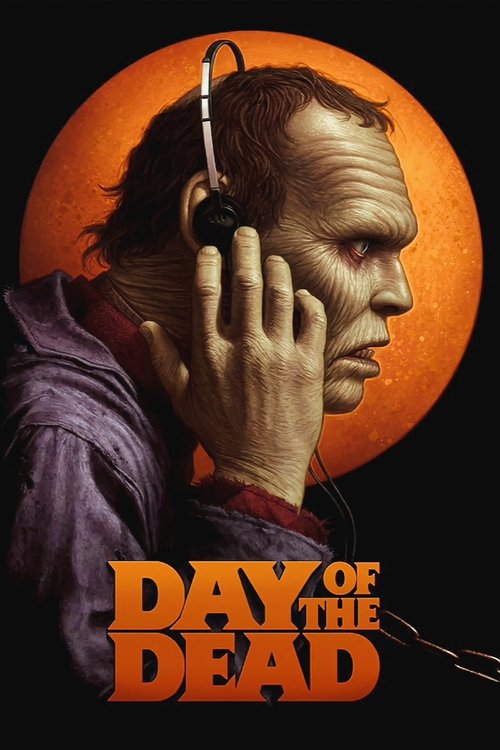
Day of the Dead
1985 · George A. Romero
When you're craving serious horror with teeth — bleak, confrontational, no comfort offered. Not the one for a fun party scare; it's the one for when you want the genre at its most uncompromising.
What it's about
The zombie apocalypse is essentially over, and humanity has lost. In an underground Florida bunker, a dwindling band of scientists and soldiers argues over what to do with the undead world above — study the creatures, or abandon the mission entirely — while their fragile chain of command rots from within. The real danger isn't just outside the fence; it's what the last people on earth do to each other in the dark.
The experience
Claustrophobic, talky, and relentlessly grim, punctuated by some of the most visceral practical gore ever put on film. It's a pressure cooker — the dread comes less from the zombies than from watching trapped people turn on each other, and it leaves a bruise.
Performances
Joseph Pilato's Captain Rhodes is one of horror's great hateful authority figures, Richard Liberty is unexpectedly touching as the obsessive Dr. Logan, and Sherman Howard makes Bub — a zombie showing flickers of memory — the film's strange, sad heart.
The craft
Tom Savini's makeup effects are a landmark of practical craft, still unmatched for sheer physical conviction, and the underground mine location gives the film a genuinely oppressive texture. Romero writes the apocalypse as chamber drama — long, combustible arguments in concrete rooms — and the sound design makes the bunker feel like it's closing in.
Why it matters
Dismissed on release as the lesser third chapter, it has been steadily revalued as the darkest and most uncompromising of Romero's Dead films, and its sympathetic zombie and militarized-bunker scenario echo through decades of later apocalypse stories.
Snapshot
The third and bleakest of George A. Romero's Dead films, Day of the Dead strands a dozen surviving humans — scientists, soldiers, and two civilian technicians — in a Florida underground storage complex while a functionally extinct species argues itself to death overhead ground it no longer controls. Where Night of the Living Dead (1968) staged the collapse of the nuclear family and civil authority in a single farmhouse, and Dawn of the Dead (1978) turned a shopping mall into a satire of consumer appetite, Day narrows further: the apocalypse is over, humanity has lost, and the only remaining drama is what the last people do to each other in the dark. It is the most claustrophobic, the most verbal, and by a wide margin the most misanthropic entry in the cycle — and, in Tom Savini's makeup effects, one of the most extravagant achievements of practical gore in American cinema. Received unevenly in 1985 and overshadowed commercially by the summer's rival zombie picture, it has since been widely reappraised as the trilogy's most conceptually ambitious film, largely on the strength of Bub, the domesticated zombie who becomes the first of the undead in film history to be granted an interior life.
Industry & production
Day was produced by Laurel Entertainment, the Pittsburgh-based company Romero ran with producer Richard P. Rubinstein, and distributed by United Film Distribution Company, the theatrical arm associated with the United Artists Theatre Circuit that had also handled Dawn of the Dead. The commercial logic that shaped the film is the single most consequential fact of its production: Romero had written a far larger script — an epic of zombie armies, mass training programs, and a much wider canvas — and the financing available for that version was contingent on delivering an R-rated cut. Romero, who had released Dawn unrated rather than accept the MPAA's commercially fatal X for violence, declined the trade. The budget was roughly halved (figures around $3.5 million are the ones consistently reported, against something near double that for the unrestricted version), and Romero rewrote the film downward into the bunker chamber piece that exists.
That constraint is legible in the finished work, and it is not simply a loss. The reduction converted a war movie into a hothouse, and the hothouse is what gives Day its peculiar dramatic pressure. The film retains its unrated release, which meant limited bookings in chains that would not play unrated product and restricted newspaper advertising — a structural disadvantage in a summer dominated by rated franchise horror. Principal photography used the Wampum mine complex in Lawrence County, Pennsylvania — a converted limestone mine used for underground storage — for the subterranean sequences, with exteriors shot in Florida around Fort Myers and Sanibel Island, and additional interiors built on stages in Pittsburgh. The Pennsylvania/Florida split is invisible on screen and quietly typical of Romero's regional practice: a Florida-set apocalypse assembled almost entirely from western Pennsylvania infrastructure.
The film opened in the United States in July 1985. Precise gross figures vary across sources and I will not assign one here; what is not in dispute is that it did not approach Dawn's commercial performance, and that its reputation was made subsequently on cable, videocassette, and successive disc editions.
Technology
The dominant technological story of Day is prosthetic. Savini — already established through Dawn, Friday the 13th, Maniac, The Burning, and Creepshow — treated this as his most complete showcase, and it is routinely cited as the high-water mark of pre-digital American gore. The work is built from foam latex appliances, gelatin, bladder rigs, pumped stage blood, false torsos with articulating viscera, and prosthetic limbs designed to be pulled apart on camera in continuous takes. The finale's dismemberments — the evisceration of Captain Rhodes chief among them — depend on the mechanical honesty of the technique: because nothing is composited, the camera can hold, and the horror comes from duration rather than cutting.
Equally important, and less discussed, is the makeup design of the zombie extras. Savini graded the undead by stages of decomposition, so that the horde reads as a population with a history rather than a uniform mass — some recently turned, some skeletal, one famously reduced to a head. The corralled zombies in the mine's holding pen and the mass of bodies pouring through the tunnels in the third act required makeup logistics on a scale that the halved budget barely accommodated.
The score is the film's other period-specific technology: John Harrison composed on the synthesizers and drum machines of the mid-1980s, and the electronic timbre dates the film precisely in a way that Dawn's library cues and Goblin material do not.
Technique
Cinematography
Michael Gornick, Romero's cinematographer on Dawn, Knightriders, and Creepshow, faced a problem the earlier films did not pose: an enormous, genuinely dark space with no natural light and no way to cheat depth. His solution gives Day its signature look — long tunnels receding into blackness, punctuated by distant work lamps and vehicle headlights that establish scale without illuminating it. The palette underground runs cold and sour: gray stone, sodium and greenish practicals, the sickly institutional white of the lab. Against this, two exceptions carry the film's emotional argument. The Florida prologue is blown-out and sun-bleached, an empty street of blowing paper and abandoned money that is arguably the most beautiful sequence Romero ever shot. And "the Ritz" — the trailer with a picket fence and warm lamplight that John and McDermott have built inside the cave — is lit like a home, the only warm interior in the film. Gornick, who would go on to direct Creepshow 2, is doing thematic work with light: the film's entire moral position is encoded in the difference between the lab's fluorescence and the Ritz's table lamps.
Editing
Pasquale Buba's cutting is patient to the point of provocation for two acts. Day is structurally front-loaded with talk: briefings, arguments, insults, and demonstrations, held in medium shots that let ensembles overlap and escalate. The film accumulates pressure rather than incident. When the release comes, Buba shifts to aggressive intercutting across three simultaneous collapses — the breach of the corral, the flight to the helicopter, and Rhodes's retreat through the tunnels — so that the last twenty minutes feel like a different film breaking through the surface of the first hour. The strategy divided contemporary viewers and remains the most common complaint against the film; it is also what makes the climax land as rupture rather than routine.
Mise-en-scène / staging
The bunker is organized as a diagram of a failed society, and Romero stages it that way. Three zones, three factions: the laboratory (science, useless), the soldiers' quarters (force, degenerating), and the Ritz (withdrawal, humane but complicit). Blocking is territorial — characters hold ground, cross into hostile space at their peril, and the film's power shifts are marked by who is standing where. The zombie corral, a walled pen entered by cattle-prod, literalizes the film's central perversion: the last humans are running a livestock operation on the dead. Dr. Logan's lab, with its opened skulls and reward-based conditioning apparatus, is staged as a Frankenstein workshop, a reading the film makes explicit by having the soldiers nickname him Frankenstein.
Sound
Sound design is the film's most underrated element and, in credit terms, one of the thinner parts of the historical record — detailed accounts of the sound crew's process are not well documented. What the finished track does is clear enough. The moaning of the corralled dead runs as a near-continuous ambient bed, so that the underground never achieves silence; the humans are always audibly outnumbered. Enclosed rock amplifies shouting, and the performances are pitched to match, which produces the film's abrasive acoustic texture. Harrison's score works in deliberate contradiction: a lilting, almost tropical synthesized main theme that suggests the vacation-Florida world the survivors have lost, set against dissonant electronic figures for the lab material. The prologue's use of amplified voice calling into an empty street — a megaphone hailing a town with no one left in it — became one of the most sampled sounds in the film's afterlife.
Performance
Day is performed loud, and this was the most common contemporary objection. Joseph Pilato's Captain Rhodes is an operatic authoritarian, played without a naturalist safety net; Gary Howard Klar and Ralph Marrero pitch the enlisted men as sneering caricature. Against them, Lori Cardille's Sarah is deliberately unglamorous and exhausted — one of the first genuinely central female protagonists in the series, and written as a professional rather than a survivor-by-luck. (Cardille is the daughter of Pittsburgh broadcaster Bill Cardille, who appeared as the reporter in Night of the Living Dead, a piece of local lineage that is entirely characteristic of Romero's practice.) Terry Alexander's John, the helicopter pilot, delivers the film's thesis speeches with a lightness that keeps them from becoming lectures, and Jarlath Conroy's McDermott supplies its only humor. Richard Liberty's Logan is a study in cheerful monstrousness.
The performance that carries the film's reputation is Sherman Howard's Bub — a wordless part built from gesture, tempo, and the slow reassembly of learned behavior. Handed a razor, a telephone receiver, a book, headphones, Bub does not remember what they are so much as remember that he used to know. When he salutes Rhodes, the joke and the tragedy arrive in the same beat.
Narrative & dramatic mode
Structurally, Day is a siege film in which the siege has already been lost. The external threat is settled in the first reel — the survivors' own estimate of the ratio of dead to living is astronomical, and there is no reinforcement, no cure, no evacuation. What remains is a chamber drama of institutional breakdown: the scientists cannot produce results, the military cannot produce order, and the two technicians who keep the machines running have opted out of the project of civilization entirely. The dramatic mode is closer to a pressure-cooker stage play — argument, humiliation, escalating coercion — than to horror as the 1980s market understood it, which is precisely why it disappointed audiences arriving for Dawn's kinetic pleasures.
Romero frames the whole with a dream. Sarah's opening nightmare — a blank calendar, arms bursting through a wall — establishes that the film's real subject is psychological captivity, and the closing beach scene, with its return to marking days on a calendar, answers it with the film's single concession to hope: survival, but only for those who abandoned the mission.
Genre & cycle
Day sits at a hinge in horror history. It is the terminal entry of Romero's original trilogy (later extended by Land of the Dead, 2007's Diary of the Dead, and Survival of the Dead), and it arrived into a market that had moved decisively toward franchise slashers and toward the ratings-and-video economy that unrated horror could not easily navigate. Its nearest generic sibling is not another zombie film but John Carpenter's The Thing (1982): an isolated, largely male outpost, a scientific problem no one can solve, paranoia metastasizing into violence, and virtuoso practical creature effects as the film's central spectacle. Both were commercial disappointments and both were substantially re-evaluated later.
The cycle context is unusually pointed. Weeks after Day opened, Dan O'Bannon's The Return of the Living Dead arrived — a film made possible by the division of rights after Night of the Living Dead, in which Romero retained "Dead" and his former collaborator John Russo retained "Living Dead." O'Bannon's punk comedy, with its talking, brain-craving corpses, was the more commercially attuned proposition, and the two films together define the fork the subgenre took: zombie-as-philosophical-problem versus zombie-as-party. Meanwhile the Italian cycle that Dawn had ignited — Fulci's Zombi 2 and its many descendants — was running down. Day effectively closed the first great zombie boom; the second would not begin until the early 2000s.
Authorship & method
Day is a textbook of Romero's regional-independent method. He wrote the screenplay, worked outside Hollywood in and around Pittsburgh, cast largely unknown and locally sourced actors, and drew on a standing repertory of collaborators: producer Rubinstein, cinematographer Gornick, effects artist Savini, composer Harrison (who had worked as assistant director on Dawn and scored Creepshow), editor Buba, and Martin lead John Amplas in a supporting role. This is not a director-plus-crew arrangement so much as a company, and the continuity of that company across a decade of features is what allowed Romero to make ambitious films at budgets that should not have supported them.
His authorial signature is visible in the film's argumentative texture — Romero's characters talk, at length, in overlapping ensembles, and his allegories are carried by dialogue rather than image alone. He is also, consistently, a filmmaker of institutional critique rather than individual monstrousness: the villain of a Romero film is almost always a chain of command. Notably, on Day he ceded editing to Buba, having cut Night and Dawn himself; the resulting rhythm is more conventional in its dialogue passages and more conventionally propulsive in its climax than the jagged assembly of the earlier films.
Movement / national cinema
The film belongs to the American regional independent tradition — horror produced outside the studio system by companies rooted in a specific place, with local crews, non-union economics, and self-arranged distribution. Romero's Pittsburgh is the exemplary case, alongside Tobe Hooper's Texas and the low-budget East Coast operations that fed the same drive-in and grindhouse circuits. Day also marks a partial retreat from the transatlantic financing that shaped Dawn, which had been made with Italian involvement through Dario Argento and carried Goblin's score into its European cut; Day is a domestically financed picture, and its sound and sensibility are correspondingly more American.
Era / period
Made and released in the middle of the Reagan presidency, Day is saturated in the period's anxieties: a rearmament culture, civil-defense fantasies of underground continuity-of-government, an unresolved post-Vietnam distrust of the military, and the beginnings of the AIDS epidemic's language of contagion and quarantine. The film's underground facility — a government installation full of records no one will ever read again, defended by soldiers who no longer answer to anyone — is a precise inversion of the era's bunker imagination. It also reflects horror's own institutional moment: the MPAA's effective ban on commercially viable extreme violence, the UK "video nasties" panic, and the migration of the genre's real audience from theaters to home video, where Day eventually found it.
Themes
The film's governing opposition is knowledge against force, with both discredited. Logan's science is real — he demonstrates that the dead can be conditioned — but it is pursued past any conceivable use, and his methods (feeding Bub the remains of his own colleagues) are indistinguishable from atrocity. Rhodes's authority is legitimate in form and purely coercive in substance; his only argument is a gun. Sarah, caught between, spends the film trying to make either faction behave rationally and fails at both.
Around this Romero builds a set of secondary arguments. Domestication and behaviorism: Bub's conditioning raises the question the series had avoided for seventeen years — whether the dead retain selfhood — and answers it affirmatively, which retroactively makes every zombie killing in the trilogy morally ambiguous. Hierarchy and communication: nobody in the bunker listens, and the film's violence is always a failure of speech first. Withdrawal as ethics: John's counter-proposal — abandon the bunker, find an island, plant something, and refuse the whole project of reconstructing the world that produced this — is the only position the film endorses, and it is explicitly a rejection of both science and the state. Frankenstein: named in the dialogue and structurally exact, down to the creature who kills his maker's tormentor. And running beneath everything, the racial and class geometry of the ensemble: the two men who build a functioning domestic life inside the cave are the Black pilot and the Irish technician, the only characters with no stake in command.
Reception, canon & influence
Contemporary reception was mixed and often hostile. Critics who had championed Dawn's energy found Day airless, shrill, and unpleasant, and the loud, near-caricatural performances of the military characters drew particular objection; even sympathetic reviewers tended to isolate Savini's effects as the achievement and treat the surrounding drama as a vehicle for them. The unrated release limited its exposure, and The Return of the Living Dead captured much of the season's zombie audience.
Reappraisal came steadily through home video and successive restorations, and the film now sits comfortably in the horror canon — frequently ranked above Dawn by critics interested in the trilogy's ideas rather than its set pieces. Romero himself repeatedly indicated in interviews that it was his favorite of the Dead films, a judgment that has become part of the standard account.
Backward. The trilogy's foundation remains Richard Matheson's I Am Legend, whose premise of a lone survivor in a world of the changed underlies Night; the EC Comics tradition supplies the moral-punishment structure and the relish for grotesquerie. Day's specific configuration inverts the 1950s science-fiction template of The Thing from Another World and Them!, in which scientists and soldiers eventually cooperate against a threat: here the cooperation never comes and the threat is incidental. Shelley and Whale's Frankenstein is invoked directly. And the siege architecture descends, as Romero often acknowledged of Night, from the Hawksian holdout picture.
Forward. Day's influence is disproportionate to its original reception, and runs along three lines.
The first is Bub. Every subsequent sympathetic or cognitively intact zombie descends from him: Big Daddy in Romero's own Land of the Dead, the chained-and-domesticated Ed at the end of Shaun of the Dead (2004), Fido (2006), Warm Bodies (2013), and the entire "zombie with a point of view" strand in television. Bub converted the zombie from an environmental hazard into a character, which is the precondition for most of the subgenre's twenty-first-century development.
The second is the underground research facility run by an unaccountable authority — a template visible across the survival-horror videogame tradition, most obviously in Resident Evil's subterranean corporate laboratories. The connection is more than atmospheric: Capcom engaged Romero to direct a television commercial for Resident Evil 2 in Japan, an explicit acknowledgment of the debt. The Last of Us, with its quarantine authority and its research facility that must be reached at any cost, works the same territory.
The third is the film's thesis that the soldiers are worse than the dead — restated almost programmatically in the third act of 28 Days Later (2002), and central to The Walking Dead in both comic and television form, whose creator has described the project as an attempt to make a Romero zombie film that never ends. Edgar Wright and Simon Pegg's homage was returned in kind when Romero cast them as zombies in Land of the Dead.
The film's cultural presence extends past cinema: its dialogue has been sampled in popular music, most famously the prologue's unanswered hail into an empty street. It has been remade twice — Steve Miner's Day of the Dead (2008) and Day of the Dead: Bloodline (2018) — and adapted as a television series in 2021, none of which registered critically. Savini's effects work remains the film's most durable technical legacy, cited routinely by practical-effects artists as the standard against which the discipline measures itself, and its reputation has if anything grown as digital gore has made the physical kind rarer.
Reception
In 1985 it landed as the disappointing little sibling to Dawn of the Dead — grim, talky, and a box-office letdown. Decades on it's been thoroughly reappraised, with plenty of horror fans (and Romero himself, who called it his favorite of the Dead films) ranking it as the trilogy's secret masterpiece.
How Day of the Dead was received, from release to now →
How to watch Day of the Dead: what to notice on a first viewing
- Watch for a room lit by warm lamps, not fluorescents. Gornick lights the lab and tunnels in cold fluorescent and sodium light, while one trailer inside the cave, the Ritz, glows with table lamps like a home. The film's moral position is encoded in light: which rooms get warmth, and which do not.
- Listen for the moaning that never fully stops. A near-continuous bed of groans from the caged dead runs under nearly every scene in the bunker, so silence never quite arrives. The humans are always audibly outnumbered, whether or not a zombie is on screen.
- Notice which of three zones each scene takes place in. Romero blocks the bunker as a lab, a soldiers' barracks, and a homemade trailer called the Ritz, and every shift of power is marked by who crosses into whose territory. The geography is a diagram of a society falling apart, one zone at a time.
- Notice how loud and unnaturalistic the soldiers' shouting is. Joseph Pilato plays Captain Rhodes as an operatic authoritarian, pitched louder than a documentary would allow, and the enlisted men around him match his register instead of grounding it. The volume is a choice: this is a chain of command coming apart, not a documentary.
- Look for zombies at different stages of decay in the same shot. Savini graded the makeup on background zombies by how long they have been dead, so the horde reads as a population with its own history rather than a uniform mass. Even the extras carry a timeline, proof of how much craft went into the film's practical gore.
The whole guide to watching Day of the Dead, with the keys for a rewatch →
Influences: the films it descends from and the films it influenced
- Frankenstein (1931) — Logan's lab — articulated apparatus, restraint table, a strapped creature being rewarded for compliance — restages Whale's laboratory and tutelage scenes, and Bub's recognition beats (razor, telephone, salute) are built Whale's way: hold on the creature's face and let the audience read intent before the humans do.
- The Last Man on Earth (1964) — The blown-out daylight survey of an emptied Florida town and the unanswered megaphone hail descend from Matheson-via-Ragona's sun-flattened scavenging of a depopulated city, and Logan's autopsy-and-serum bench work continues its scientist-protagonist who dissects the dead instead of only fleeing them.
- Them! (1954) — The flashlight-and-muzzle-flash descent into a lightless tunnel system, where depth of field is surrendered to blackness, is the storm-drain climax re-shot by Gornick — except Romero withholds the scientist/soldier cooperation the 1950s template guaranteed.
- The Thing from Another World (1951) — Sealed-outpost ensemble staged with overlapping cross-talk, a scientist arguing to study what the soldiers want exterminated; Day keeps the blocking and the argument and deletes the truce, so Logan and Rhodes annihilate each other before the dead arrive.
- Rio Bravo (1959) — The holdout architecture Romero repeatedly named: a fixed defensible interior, a closed roster blocked by professional function (pilot, radioman, surgeon), and tension generated by who is failing at their assigned job rather than by the siege outside.
- Night of the Living Dead (1968) — The chamber-siege grammar in which the real antagonism is internal — Ben versus Cooper over a cellar becomes Sarah versus Rhodes over a silo — with the outside world admitted only as radio and broadcast noise, and authority killing the survivor at the close.
- Dawn of the Dead (1978) — Direct predecessor for method: Savini's latex-and-viscera set pieces held in unbroken takes rather than cut around, a functional building read as a social diagram, and survivor quarters dressed with looted domestic comfort as the visible sign of denial.
- The Crazies (1973) — Romero's own prototype for the military as the actual catastrophe — containment authority intercut with the civilians it is supposedly protecting — a two-location cross-cut structure Day compresses into a single facility with the command post one corridor from the corral.
- Assault on Precinct 13 (1976) — Hawksian siege reduced to a concrete box and scored with a spare pulsing synthesizer figure — the working model for how John Harrison's minimal electronic cues have to carry corridor sequences in which there is nothing yet to see.
- 28 Days Later (2002) — Reproduces Day's thesis structurally rather than thematically: the third act sets the infected aside so the garrison becomes the antagonist, with an operatic officer's authority curdling into sexual coercion — the Rhodes function — after an opening walk through a depopulated capital that is the megaphone hail without the megaphone.
- Resident Evil (2002) — The subterranean facility run by an unaccountable authority, entered by an armed squad on flashlights into a laboratory that is itself the antagonist — a template that reached the screen via Capcom's games, whose debt was explicit enough that Romero was hired to direct their Resident Evil 2 commercial.
- Shaun of the Dead (2004) — Quotes Day twice: David's disembowelment through the window is a Savini set piece rebuilt practically and held on screen, and Ed chained in the garden shed with a game controller is Logan's conditioning of Bub replayed as domestic punchline.
- Land of the Dead (2005) — Romero extends Bub himself: Big Daddy's tool use, vocal signaling and command of a group convert one conditioned subject into an organized class, and the finale again cross-cuts an advancing dead with human factions finishing each other off.
- Fido (2006) — Takes the Bub experiment as premise — collar-conditioned zombie installed as household member — and plays Logan's reward-and-training beats as suburban satire, keeping the sympathetic reaction shot on the creature as the film's basic unit of meaning.
- The Girl with All the Gifts (2016) — The Logan/Bub relationship expanded to feature length: a cognitively intact subject taught and tested on a military base by a scientist who intends to dissect her, with soldierly contempt and scientific obsession set against each other in the same corridors-and-cells geography.
- 28 Weeks Later (2007) — Template for the militarized-bunker scenario where the soldiers' containment apparatus turns more monstrous than the infected — the Green Zone command structure descends from its underground base.
- Colony (2026) — The sealed military-science silo where the researcher's containment project and the officers' discipline are the actual antagonists — institutional failure staged as two chains of command competing for the same underground rooms.
- The Thing (1982) — The same wager on practical effects as argument: a paranoid chamber drama in a sealed installation where the creature work (Bottin there, Savini here) is staged in sustained, adequately lit takes so the audience must watch flesh behave impossibly, with synth minimalism holding the dead air.
- The Return of the Living Dead (1985) — Arrived the same season with the parallel invention reached from the comic side — a zombie that speaks and reasons, interrogated as a half-corpse strapped to a table — against Bub's mute conditioning, both films tracing the outbreak to military containment gone wrong.
- Re-Animator (1985) — Contemporary lab horror on the same effects economy: reanimation staged as bench work in a cluttered, brightly lit laboratory, gore delivered in long takes as demonstration rather than as a shock cut, with the scientist's contempt for oversight driving the disaster.
Similar films
- Dawn of the Dead (1978) — influence & lineage
- Night of the Living Dead (1968) — influence & lineage
- The Return of the Living Dead (1985) — influence & lineage
- The Thing (1982) — influence & lineage
- Re-Animator (1985) — influence & lineage
- Shaun of the Dead (2004) — influence & lineage
- Resident Evil (2002) — influence & lineage
- 28 Days Later (2002) — influence & lineage