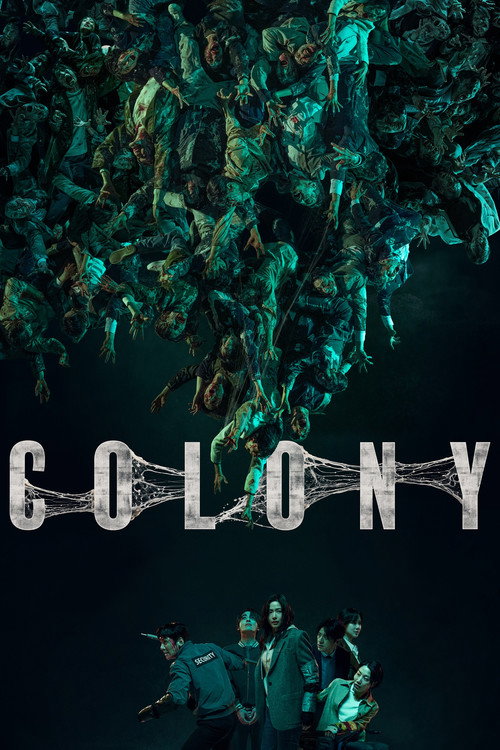
Colony
2026 · Yeon Sang-ho
The Train to Busan director became Netflix Korea's genre engine (Hellbound, Jung_E), central to arguments about whether streaming is empowering or strip-mining Korean genre cinema.
When you're craving a full-throttle survival nightmare — sweaty palms, no breathing room — and you like your horror with a streak of anger at the system. Strap-in viewing, not a wind-down watch.
What it's about
A mutating virus gets loose in the middle of a biotech conference, and the authorities' answer is to seal the building with everyone still inside. Professor Se-jeong and a scraped-together band of survivors are trapped in the corridors as the infected transform into something worse by the hour. The fight isn't just against the creatures — it's against the decision, made from outside, that everyone in the building is expendable.
The experience
Relentless and claustrophobic — the walls never open up, the threat keeps changing shape, and the film tightens like a fist. It's visceral zombie horror with a bitter undercurrent: the dread of being abandoned by the people who were supposed to help.
The craft
Yeon Sang-ho, the director who redefined the modern zombie thriller aboard a speeding train, here does the opposite: he locks the action inside a sealed building and turns confinement itself into the engine. The mutating infected give the horror escalating stages rather than one repeated scare, and the tight-quarters action is built for a big screen and a loud room.
Why it matters
A decade after his breakout contagion thriller helped put Korean genre cinema on the global map, this marks Yeon's return to the form that made his name — an event for fans of Korean horror-action.
Snapshot
A decade after Train to Busan (2016), Yeon Sang-ho returns to the contagion film and inverts its governing figure. Where the earlier film was built on forward motion — a KTX train that could not stop, a nation streaming past the windows — Colony is built on arrest. A biotech conference, a mutating pathogen released inside it, and an external authority that responds by sealing the doors. Professor Se-jeong and a improvised group of survivors are left to negotiate a building that has been converted, by decision rather than by accident, into a container.
That decision is the film's real premise. In Yeon's cinema the monster is rarely the subject; the subject is what institutions do when the monster arrives, and what the people inside the perimeter become once they understand they have been written off. The synopsis supplies the genre; Yeon's fifteen-year body of work supplies the argument.
One caveat governs this dossier. Colony is recent enough that its below-the-line credits, production history, and critical reception are not reliably available to me. I have not invented them. Where I describe the film's likely procedures, I am reasoning from Yeon's documented method and from the traditions the premise places it in, and I say so.
Industry & production
The Korean film industry Yeon is working in now is not the one that produced Train to Busan. That film arrived at the crest of a theatrical decade — the vertically integrated studio system built by CJ ENM, Lotte, Showbox and NEW, sustained by the screen quota and by an audience that went to the cinema at among the highest per-capita rates in the world. Train to Busan was made on a budget modest by international tentpole standards and returned one of the largest domestic grosses of its decade; I will not quote figures I cannot verify, but the scale of the return is not in dispute, and it made a certain kind of film financeable for years afterward.
The pandemic broke that arrangement. Admissions collapsed in 2020, recovered only partially, and the mid-budget genre film — precisely Yeon's register — was squeezed hardest. Streaming absorbed the displaced production. Yeon has been the most legible figure in that migration: Psychokinesis (2018) reached the world through Netflix; Hellbound (2021, with a second season in 2024), Jung_E (2023), Parasyte: The Grey (2024) and Revelation (2025) were all platform commissions. The Ugly (2025), a smaller and stranger picture, moved in the other direction, back toward the festival circuit.
Read against that history, a single-location outbreak film is a rational proposition on both sides of the ledger. One principal set, an ensemble rather than a star vehicle, effects work that can be front-loaded into prosthetics and choreography, and a scale that can be dialled to whatever the financing supports. It is also, structurally, a piece of intellectual property: Yeon's career-long habit is to build clusters rather than one-offs — the animated Seoul Station preceding Train to Busan and the live-action Peninsula following it; the Hellbound webtoon feeding the series; The Cursed extending from series to feature. Whether Colony is conceived as the first node of such a cluster, I cannot say. That it would be characteristic, I can.
Technology
Korean genre production has been fully digital for two decades, with the Arri Alexa family the workhorse for this kind of shooting, and the country's post and effects infrastructure — Dexter Studios, 4th Creative Party and their peers — now carries loads that used to be exported. Studios have also built LED-volume stages, though a film set inside a real conference centre has less use for virtual environments than for practical corridors.
The technologically interesting question in Colony is the phrase "horrific transformations." Mutation is a different effects problem from infection. An infected body is a performance problem: Train to Busan's undead were designed by a choreographer working with dance-trained performers rather than delegated to a visual-effects vendor, and the film's most frightening images — the joint-snapping tangle of bodies, the ripple of a crowd — were achieved in camera. A transforming body is a hybrid problem, requiring prosthetic build, on-set puppeteering or animatronics, and digital simulation to carry the moments no appliance can hold. The lineage here runs from Rob Bottin's work on Carpenter's The Thing (1982) through Chris Walas on Cronenberg's The Fly (1986) to the creature design of Sweet Home (2020), which solved the same problem on a Korean streaming budget by keeping its monsters partly in shadow and partly in code.
Yeon's animation background bears on this. He does not treat effects as coverage to be fixed later; he draws. A director who storyboards comprehensively is a director who knows, before the day, exactly how much of a transformation the camera will be asked to see.
Technique
Cinematography
Yeon's live-action grammar is unusually legible for a horror filmmaker. His camera prefers the medium and the medium-long to the smothering close-up; it holds bodies in relation to architecture; it is scrupulous about geography. In Train to Busan the audience always knows which carriage, which direction, which door. That clarity is what makes the terror arithmetic rather than atmosphere: you can count the obstacles between a character and safety.
A sealed facility offers the same grammar a vertical rather than a linear axis — floors, stairwells, service corridors, airlocks, the glass atrium that makes a conference centre look like a terrarium. The likely visual argument is transparency turned against its occupants: a building designed so that professionals can see and be seen, now a set of sightlines along which something else is watching.
Editing
Train to Busan was cut by Yang Jin-mo, who went on to Parasite and Squid Game — a useful reminder that the Korean genre film's rhythmic intelligence has been the work of a small, very good pool of hands. The structural signature of Yeon's set-pieces is rule-based: each sequence establishes a constraint (the infected hunt by sound; they cannot see in darkness; a tunnel means blackout) and then plays the constraint out to exhaustion before the next scene revises it. The cutting escalates by clarifying rules, not by obscuring them, which is why his action reads as suspense rather than chaos. In a fixed location, that method must generate variation from the building itself — this floor, this door, this rule.
Mise-en-scène / staging
The setting is the film's sharpest choice. A biotech conference is a space of professional class display: lanyards, keynote stages, branded booths, a hierarchy of who is on the panel and who is in the audience. Yeon has spent his career staging institutions that fail their members — the school in The King of Pigs (2011), the church in The Fake (2013), the broadcast-cult apparatus of Hellbound, the corporate laboratory of Jung_E, the militia state of Peninsula (2020). Placing the outbreak at the conference locks the makers of the thing inside with the thing. The staging premise is moral before it is spatial.
Sound
Sound is the load-bearing element of Yeon's horror. Train to Busan made hearing the mechanism of the plot — the infected drawn by noise, whole sequences built on the discipline of silence — and the film's most sophisticated passage uses a mobile phone's ringtone as a murder weapon. Korean sound post is world-class and long-established; the score for Train to Busan is credited to Jang Young-gyu, a composer central to the modern Korean genre film's sonic identity. Colony's specific sound team I cannot verify. What the premise invites is a score working against enclosure: a sealed building is an acoustically dead space, and dead space is where a designer can place the small wet sounds of a body changing.
Performance
Yeon casts ensembles in which a recognisable lead is surrounded by character actors given real weight — Gong Yoo and Ma Dong-seok in Train to Busan, Yoo Ah-in and Kim Hyun-joo in Hellbound, Ryu Jun-yeol in Revelation. His protagonists are frequently complicit professionals: the fund manager of Train to Busan is implicated in the crisis he is fleeing. A professor at a biotech conference sits squarely in that tradition — an expert whose expertise is part of the causal chain. The other performance register is physical: the infected are played, not generated, and the quality of the film's dread will rest substantially on whoever is asked to move like that.
Narrative & dramatic mode
Colony is a siege narrative, and the siege is Yeon's structural inversion of himself. Train to Busan and Peninsula are both road films; their dramatic engine is passage through territory. A locked facility removes passage and substitutes duration. The classical model is unity of place and time — Night of the Living Dead (1968), The Thing, [REC] (2007), The Mist (2007) — where the tension migrates from "can we get there" to "what do we become while we wait."
The dramatic mode remains melodrama, in the precise rather than pejorative sense. Korean genre cinema runs on legible moral stakes, escalating sacrifice, and an emotional climax that pays in grief; Train to Busan's ending is unashamed about this and is stronger for it. Yeon's later work has cooled — Hellbound and Revelation are colder, more ironic, more interested in belief as a social pathology than in redemption. Where Colony sits between the two temperatures is the most interesting open question about it.
Genre & cycle
The film belongs to two overlapping cycles. The first is the Korean infection cycle that Yeon effectively inaugurated: Seoul Station and Train to Busan (2016), Rampant (2018), Kingdom (2019– ), #Alive and Peninsula (2020), All of Us Are Dead (2022), plus the confined-building variants Sweet Home (2020) and Happiness (2021), the latter a quarantined apartment block that is Colony's nearest domestic relative. Korean cinema did not invent the zombie; it industrialised it, and did so by grafting it onto class allegory and state critique.
The second is the manufactured-pathogen strain of the outbreak film, where the origin is a laboratory rather than a mystery: The Crazies (1973), Resident Evil (2002– ), 28 Days Later (2002), and behind them Cronenberg's Shivers (1975), in which a self-contained modern building becomes a closed ecology for a designed parasite. Setting the release at a biotech conference moves the cycle decisively into that strain. And the emphasis on transformation rather than simple infection recruits body horror proper — The Thing, The Fly, and the Japanese lineage of Hitoshi Iwaaki's Parasyte, which Yeon himself adapted in 2024. The title's ecological register — a colony as an organism's collective form — suggests the mutation is being framed as an emergent society rather than a disease.
Authorship & method
Yeon Sang-ho came to features by an unusual route: fine-art training, then independent animation — the shorts and the features The King of Pigs, which carried Korean animation to the Directors' Fortnight, and The Fake — before crossing to live action in 2016. He writes his own scripts, draws and co-authors webtoons (notably with the artist Choi Kyu-seok), storyboards extensively, and moves between animation, film, series and comics with a fluency that is now the Korean industry's dominant production logic rather than an eccentricity.
The method produces a consistent authorial temperature: a fundamentally bleak view of collective behaviour, a precise eye for how institutions launder cruelty, and — intermittently, and more movingly for being rationed — an insistence that sacrifice remains available to individuals even when it is unavailable to systems.
I cannot verify Colony's cinematographer, editor, composer or co-writers, and I decline to guess. What the record does establish is the calibre of the collaborators Yeon has drawn: Yang Jin-mo's cutting on Train to Busan, Jang Young-gyu's score, and the choreographic approach to the infected that the film's crew devised in place of digital crowd work. Those are the reference points against which the new film's craft should be measured.
Movement / national cinema
Yeon is a late-generation inheritor of the Korean New Wave — the post-1996 flowering that followed the abolition of censorship and the arrival of chaebol finance, and that established genre as the national idiom rather than an alternative to it. Park Chan-wook, Bong Joon-ho, Na Hong-jin and Kim Jee-woon made the case that a thriller could carry political weight; Yeon's generation took it as settled.
His specific contribution is the animation-and-webtoon route into feature direction, which has since become a pipeline: Korean genre cinema now draws its material from comics at least as readily as from original screenplays. And his films sit inside the particular Korean political substrate of state abandonment. Train to Busan was received, widely and not unreasonably, against the memory of the Sewol ferry disaster of 2014 — the terror of being told to stay where you are by an authority that will not come. Colony's premise of a facility sealed by the authorities reactivates that reading directly. Quarantine in Korean cinema has always been a question about who is inside the line and who drew it.
Era / period
A 2026 outbreak film cannot be innocent about 2020. The genre's central images — sealed doors, official announcements, the calculus of containment — stopped being fantastical and became procedural memory. The effect on the form has been to shift its affect from spectacle toward recognition, and to make audiences considerably more literate about, and more cynical about, the institutions doing the sealing.
The biotech-conference setting also places the film inside the decade's argument about engineered pathogens, gain-of-function research and the credibility of expertise — an argument that has curdled, in most countries, into generalised distrust. And it arrives in a Korean industry still contracting theatrically, negotiating streaming's retrenchment, and absorbing the labour anxieties that generative tools have introduced into production. The film's context is precarious on every axis its story dramatises.
Themes
The dominant theme is complicity. If the protagonist is a professor at the conference where the pathogen is released, the film's moral problem is not innocence besieged but expertise trapped inside its own product — the Yeon protagonist who must survive a crisis he helped make possible.
Around it cluster the concerns his filmography has worked and reworked: containment as a euphemism for abandonment; the hierarchies that reassert themselves within a trapped group faster than solidarity does; the body as commodity, which a biotech setting literalises; and the mutation as an image of what markets and institutions do to the people inside them — not killing them, but converting them into something more efficient and less human. Against all of this, Yeon reliably sets a small, unsentimental counter-argument: someone chooses to spend themselves for someone else, and the film declines to call that choice naïve.
Reception, canon & influence
I have no reliable critical reception, festival record, or box-office data for Colony, and I will not manufacture any. What can be established is the field it enters.
Backward. The film's antecedents are unusually traceable: Romero for the siege and the group that destroys itself; Cronenberg's Shivers for the sealed modern building as an incubator; Carpenter's The Thing for transformation as an epistemological crisis inside a closed group; Boyle and Garland's 28 Days Later for the laboratory origin and the state's hard perimeter; Bong Joon-ho's The Host (2006) and Kim Sung-su's The Flu (2013) for the Korean grammar of quarantine and official incompetence. Closer to home, Sweet Home and Happiness both established, on Korean streaming, the sealed-building variant that Colony now brings back to the feature. And Yeon's own Parasyte: The Grey gave him direct experience of staging a body that becomes something else.
Forward. The forward record belongs, for now, to Train to Busan, whose influence is documented and large: it was among the films that made Korean genre cinema globally legible several years before Parasite's Oscar, it seeded the domestic zombie cycle almost single-handedly, it demonstrated to Netflix and its competitors that Korean horror-action could travel without adaptation, and an English-language remake has been in development for years. Colony's own legacy cannot be assessed at this distance. The question worth tracking is whether Yeon can do to the locked room what he did to the train — take a form that was fully worked out fifty years ago and find in it one more mechanism nobody had noticed.
A Deleuzian reading
In *Train to Busan* a phone rings in a crowded carriage and the ringtone works as a murder weapon.
The full Deleuzian reading of Colony →
Reception
Premiered in Cannes' Midnight Screenings to mixed, 'no Train to Busan' reviews — but audiences shrugged and showed up, pushing it past $50M on a ~$12M budget.
How Colony was received, from release to now →
Influences: the films it descends from and the films it influenced
- Night of the Living Dead (1968) — Establishes the barricade economy Colony runs on — the floorplan (boarded windows, front room, cellar door) is laid out in the first reel so every later shot reads as a position on a known map, and the fatal damage is done by the group's internal argument over who controls which room, not by the things outside.
- Shivers (1975) — Turns a modern building's own circulation system — elevator shafts, laundry chutes, corridors, the pool — into the pathogen's distribution network, so the architecture performs the epidemiology and the parasite's spread is legible as a route through a floorplan.
- The Thing (1982) — The blood-serum test is the template for the rule-based setpiece: a procedure announced aloud, executed in a fixed order on seated, bound subjects, so suspense derives from the audience knowing the rule and the protocol's sequence rather than from concealment.
- Alien (1979) — Ash is the ur-text for the complicit professional — a science officer whose deference to a company directive (crew expendable) is played as calm procedural competence — inside a sealed vessel mapped by deck, duct and airlock so pursuit is always spatially readable.
- The Andromeda Strain (1971) — Stages outbreak as pure procedure: the Wildfire lab's descending sterile levels are named and numbered in dialogue before anyone is threatened, and the self-destruct protocol converts the facility's own safety architecture into the film's clock.
- Day of the Dead (1985) — The sealed military-science silo where the researcher's containment project and the officers' discipline are the actual antagonists — institutional failure staged as two chains of command competing for the same underground rooms.
- 28 Days Later (2002) — Fixes the laboratory-origin prologue (activists open the wrong cage) and then makes the state's hard perimeter the second and worse containment; redesigns the infected as sprinting athletic performance directed for speed rather than shambling makeup.
- The Host (2006) — Supplies the Korean quarantine grammar Colony inherits — family melodrama forced through decontamination tents, press conferences and hazmat cordons, with the creature traced to a documented act of official negligence rather than to mystery.
- The Flu (2013) — The sealed district: stadium triage staged as administration, a physician pressured to falsify a diagnosis to protect her child, and crowds blocked as an object being processed by officials rather than as panicking extras.
- [REC] (2007) — Closes the perimeter from the outside midway through — the authorities seal the apartment block with the characters inside — then works the building floor by floor upward, ending with the penthouse lab that reframes the plague as manufactured.
- Seoul Station (2016) — Yeon's animated dry run for the same outbreak logic, where the storyboard method is visible in its purest form — spatial diagram drawn first, bodies then routed through it — and the station's levels and underpasses function as a movement puzzle before he had live-action coverage to fall back on.
- Train to Busan (2016) — Yang Jin-mo's carriage-by-carriage cutting and Park Jae-in's choreography of the infected as a movement company rather than a CG crowd, with each setpiece built on a stated rule (they hunt by sound, they cannot see through the dark tunnel) the audience can play along with.
- Sweet Home (2020) — Establishes the Korean sealed-building variant on streaming — Green Home's lobby, stairwell and corridor geography is the entire map for the run, and each monster is designed out of a specific tenant's psychology so the building becomes a case index.
- Happiness (2021) — The quarantined high-rise whose class stratification — subsidized rental floors versus owned floors — supplies the conflict the pathogen merely detonates, with the lockdown administered by residents' committee vote rather than by soldiers.
- All of Us Are Dead (2022) — Webtoon adaptation that locks the outbreak inside one school and derives every setpiece from the building's fixtures (science-lab cages, broadcast room, roof-to-annex gap), with the virus manufactured by a teacher for a private, personal reason.
- A Quiet Place (2018) — Makes sound the governing rule and then hands the mix to the plot — the sound design is the diagnostic instrument both characters and audience use, so silence, a dropped object or a hearing aid's feedback are plot events rather than atmosphere.
Similar films
- Train to Busan (2016) — influence & lineage
- The Host (2006) — influence & lineage
- [REC] (2007) — influence & lineage
- Resident Evil (2026) — shared sensibility
- Snowpiercer (2013) — shared sensibility
- Hope (2026) — shared sensibility
- Alien: Romulus (2024) — shared sensibility
- Night in Paradise (2020) — shared sensibility