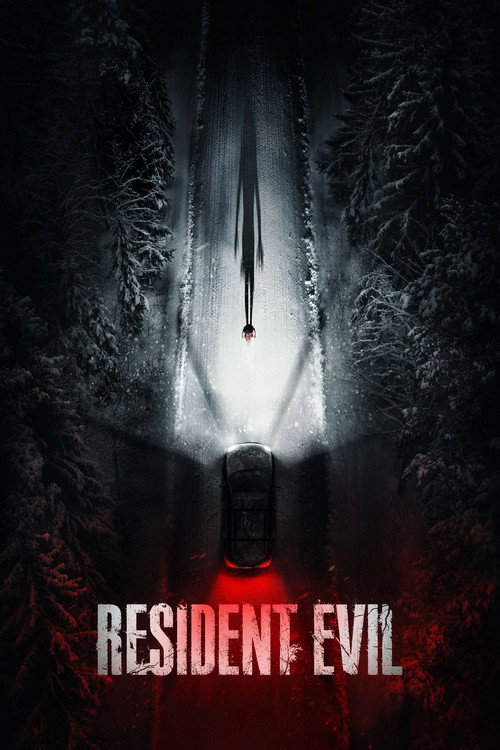
Resident Evil
2026 · Zach Cregger
Barbarian's don't-spoil-it marketing and Weapons' blockbuster horror opening made him the name in the "original horror is the last original blockbuster" conversation; studios' bidding war for Weapons was itself reported like a sports trade.
For when you're craving a real scare and want to be run ragged — a loud, sweaty, survive-the-night ride, not a cozy watch. Reach for it with the lights off and a friend to grab.
What it's about
A medical courier named Bryan is out on what should be a routine delivery when the night around him starts to come apart — an outbreak turns a city run into a fight to stay alive until morning. It's a ground-level reboot of the survival-horror world born from the Capcom games: zombies, body horror, and one ordinary working guy with no training and no way out. The scale is deliberately small — not soldiers or scientists, just a man, a job, and one catastrophic night.
The experience
Built to be a pressure cooker: one night, escalating chaos, dread that keeps tightening into panic and body-horror shock. Expect relentless forward momentum rather than slow-burn atmosphere — the kind of horror that makes you grip the armrest and check the runtime only when it's over.
The craft
Zach Cregger arrives at this franchise as the most trusted new name in American studio horror, and the smart move is visible in the premise itself: throwing out the lore-heavy mythology for one courier, one night, one collapsing city. That stripped-down design promises practical creature horror and sustained tension engineered for a big screen and loud speakers.
Why it matters
This is the reboot of horror's biggest video game franchise — a thirty-year screen lineage handed to a new director at the peak of his momentum, and a test case for whether game adaptations can work as lean, grounded horror instead of action spectacle.
Snapshot
A dossier entry written at the threshold: Sony and Screen Gems dated Zach Cregger's Resident Evil for September 2026, which places this account at or immediately before the film's release. Nothing here should be read as a report on the finished object. What can be traced with confidence are the lines running into it — Capcom's survival-horror franchise and its thirty-year screen history, Constantin Film's long custody of the rights, and Cregger's own two-film ascent from sketch comedian to the most commercially trusted new horror director working in American studios. What the film does with those inheritances is, at this writing, unverifiable, and this dossier marks each such gap rather than papering over it.
The premise as released by the studio is unusually modest for the property: a medical courier named Bryan, one night, collapsing into chaos. That is not the plot of any Resident Evil game. It is a compression — unity of time, a low-status protagonist, a job that involves carrying biological material across a city — and it signals the same strategy that has governed Cregger's features so far: begin in a recognizable, slightly humiliating contemporary reality, then let the floor give way.
Industry & production
The corporate spine of this film is older than its director's career. Constantin Film, the Munich-based producer-distributor, acquired screen rights to Resident Evil in the late 1990s and has been attached to every live-action iteration since. Paul W. S. Anderson's six-film cycle with Milla Jovovich (2002–2016) is widely reported to have grossed more than a billion dollars worldwide, which for most of its run made it the highest-grossing film series adapted from a video game — a record built almost entirely on international theatrical and home video rather than domestic acclaim. Johannes Roberts's Resident Evil: Welcome to Raccoon City (2021) attempted a reboot closer to the first two games' plots and did not perform; Netflix's live-action series (2022) was cancelled after a single season. The property has also sustained a parallel Japanese CG feature line (Degeneration, 2008; Damnation, 2012; Vendetta, 2017; Death Island, 2023) and the anime series Infinite Darkness (2021).
Cregger arrived at this apparatus through two films. Barbarian (2022), produced with Vertigo Entertainment and released by 20th Century Studios under Disney, was a genuine sleeper — a low-budget picture that expanded on word of mouth. Weapons (2025), for New Line and Warner Bros., was the subject of a widely covered spec-script auction in 2024; trade reporting at the time emphasized both the size of the bidding and Cregger's insistence on terms protecting his cut and a theatrical release, which he received. It opened in August 2025 to substantial commercial success. That sequence — original horror hit, contested spec, second original horror hit — is precisely the profile studios now convert into IP stewardship.
Sony's hiring of Cregger was reported in 2024, before Weapons had opened, which is itself notable: the studio was betting on Barbarian and a screenplay rather than on a track record. Vertigo's Roy Lee and Miri Yoon, producers on both of Cregger's prior features, have been reported as producers here alongside Constantin's continuing involvement. Beyond this, the production record is thin in the public domain — shooting locations, schedule, and budget have not been documented in a form I can responsibly summarize, and I decline to estimate them.
Technology
The franchise's screen history is, unusually, a history of technology adoption. Resident Evil: Afterlife (2010) was among the first live-action features after Avatar to shoot with the Cameron–Pace Fusion 3D camera system, and the Anderson films generally treated digital compositing, wire work and speed-ramping as the native grammar of the material. This is worth stating plainly because it is the tradition Cregger's film is positioned against: his two features are built from long lenses, sustained takes and practical space, with digital work used to conceal rather than display itself.
The games' own technology is the more interesting influence. Capcom's original 1996 title used pre-rendered backgrounds with fixed camera angles — a constraint borrowed from Alone in the Dark (1992) that produced, by accident of hardware, a deeply cinematic idiom: the camera cuts to a new fixed vantage as the player crosses a threshold, withholding what lies ahead. Resident Evil 4 (2005) replaced this with the over-the-shoulder third-person camera that subsequently reorganized action cinema's own framing conventions. Resident Evil 7 (2017) moved to first person on Capcom's RE Engine, using photogrammetry and full VR support to rebuild the series' dread on the body of the player. Any filmmaker adapting this property inherits three distinct camera philosophies, each with a corresponding affect: the withheld cut, the following shoulder, the trapped eye.
Which of these Cregger's film adopts, and on what format it was captured, I do not know. The public record does not establish the shooting format, and I will not guess at one.
Technique
Cinematography
Cregger has worked with two cinematographers: Zach Kuperstein on Barbarian and Larkin Seiple on Weapons. Kuperstein — whose calling card was the monochrome The Eyes of My Mother (2016) — gave Barbarian a patient, gliding camera that treats architecture as the antagonist: the long descent into the rental house's basement, the tunnels photographed as near-total darkness with the frame edge doing the work a monster usually does. Seiple, coming from Swiss Army Man and Everything Everywhere All at Once, brought a more mobile, wide-angle suburban clarity to Weapons, where the horror is daylit and communal rather than subterranean. The through-line is a refusal of the shaky handheld convention: Cregger's camera is composed, often slow, and derives tension from how much of the frame it declines to explain. The cinematographer on Resident Evil is not something I can confirm.
Editing
Joe Murphy cut both prior features, and the cutting logic in each is structural rather than local: long scenes held past comfort, then abrupt tectonic breaks — the mid-film protagonist swap in Barbarian, the chapter partitions in Weapons. Cregger's suspense is rarely built in the cut; it is built in the withholding of one, then broken by a hard reset of the film's entire premise.
Mise-en-scène / staging
The most consistent element of Cregger's authorship. Barbarian is a film about a house that has an under-house that has an under-that; Weapons is about a neighborhood whose ordinary interiors turn out to be continuous. Both stage horror as a problem of floor plans — the viewer is made to understand a space, then shown that their understanding was partial. This is the single strongest argument for the hire: Resident Evil is, at its origin, an architecture game. The Spencer Mansion is a puzzle-box of locked doors and keys shaped like emblems, and the series' best passages have always been navigational.
Sound
Barbarian's underground sequences depend on reverberant off-screen sound and on silence that the audience is trained to distrust; Weapons deployed a narrating voice as a framing device, a storybook register set against the material. The Holladay Brothers (Ryan and Hays Holladay) scored both features with textures closer to sustained electronic dread than to conventional orchestral stinging. Their attachment to Resident Evil is not something I can confirm.
Performance
Trade reporting at the time of casting identified Austin Abrams in the lead — an actor known from Euphoria and Chemical Hearts whose register is nervous, unarmored, young, and notably not action-heroic. That casting is consistent with Cregger's practice of using performers whose ordinariness makes the tonal breaks land: Barbarian worked because Georgina Campbell played genuine competence and Justin Long played genuine cowardice, both without genre inflection. The fuller ensemble should be checked against the release credits rather than against this dossier.
Narrative & dramatic mode
Cregger's distinguishing formal habit is the structural rupture. Barbarian abandons its protagonist roughly forty minutes in for a second story, then reverses a further thirty years for a third, and the three only resolve at the level of the building they share. Weapons distributes a single inciting event across named chapters with overlapping timelines, a communal Rashomon in which each perspective withholds the piece the previous one needed. In both, the audience's experience of genre is itself the subject: you are made to commit to a mode, then charged for having committed.
The announced logline — one courier, one night — reads as a compression of that method into unity of time. A single night is the classic survival-horror frame (Romero's farmhouse, Carpenter's precinct) and it accommodates a braided structure without requiring flashback. Whether Cregger uses it that way is speculation, offered here as an inference from method rather than as knowledge.
Genre & cycle
The film sits at the intersection of two live cycles. The first is the rehabilitated video-game adaptation, which turned in roughly 2020: Sonic the Hedgehog (2020), The Super Mario Bros. Movie (2023), Five Nights at Freddy's (2023), A Minecraft Movie (2025) in features, and on television The Last of Us (2023) and Fallout (2024). The lesson the industry drew was not fidelity but tonal alignment — matching the adaptation's register to the source's rather than to a presumed four-quadrant audience.
The second is the studio practice of handing established horror IP to directors bred in festival and low-budget horror: Fede Álvarez on Alien: Romulus (2024), Andy Muschietti on It (2017), the post-Hereditary generation generally. Resident Evil under Cregger is a clean instance of both cycles converging.
Behind all of it sits the zombie lineage proper: Romero's Night of the Living Dead (1968) and Dawn of the Dead (1978), which gave the games their consumer-capitalist substrate; the Italian cycle, Fulci's Zombi 2 (1979) especially; and the crucial hinge, Capcom's Sweet Home (1989), a Famicom game produced as a tie-in to Kiyoshi Kurosawa's film of the same name, on which Shinji Mikami worked and from which Resident Evil's mansion, its item management and its multiple-survivor structure are directly descended. The franchise is therefore already a film adaptation adapting itself back into film.
Authorship & method
Cregger's path is genuinely unusual. He came from The Whitest Kids U' Know (IFC, 2007–2011), a sketch troupe, and co-directed the studio comedy Miss March (2009) with the late Trevor Moore — a film he has spoken about candidly as a failure. His turn to horror after a decade of comedy is not a reinvention so much as a transfer of the same skill: the sketch writer's instinct for a premise that escalates past its own logic, and for the beat where an audience's laugh curdles. He has described working without an outline, writing toward surprises he has not planned — a method that explains both the pleasures and the seams of Barbarian's three-part construction. Interviews around Weapons connected its concerns with loss and community blame to the death of Moore in 2021; the film's grief is not decorative.
The key collaborators on the prior features — Kuperstein and Seiple in photography, Murphy in the cut, the Holladay Brothers in score, with Cregger himself as sole credited writer on both — form a small and consistent unit. Which of them carried over to a studio production of this scale, and whether Cregger has sole screenplay credit on Resident Evil, are matters for the release credits; I cannot confirm them.
Movement / national cinema
This is an American studio horror film adapting a Japanese property under German production auspices, and each of those national inflections is real. The source is a Capcom title whose Japanese name, Biohazard, and whose debts to Kiyoshi Kurosawa and to Japanese horror's architecture of domestic dread were partly sanded off in Western localization — the same sanding that governed the Hollywood J-horror remake wave of the early 2000s. Constantin's involvement places it within the long tradition of European co-financed genre production aimed at the international market, the commercial logic that sustained the Anderson films when domestic critical response was uniformly hostile. Cregger's own production history includes the runaway model — Barbarian was shot in Bulgaria, standing in for Detroit — which is now the default economics of mid-budget American horror rather than an exception.
Era / period
The 2020s made horror the last reliably theatrical genre. After the pandemic contraction, horror's combination of low budgets, opening-weekend front-loading and young audiences made it the category studios could still bank, and the release calendar reorganized around it — the September corridor, opened by It (2017), is now a premium horror window rather than a dumping ground, and a September date for this film is a statement of confidence, not of doubt. The 2023 writers' and actors' strikes narrowed the development pipeline and increased the premium on directors who arrive with finished scripts and proven openings, which is exactly the leverage Cregger held in the 2024 Weapons auction. Thematically, the decade's horror has been unable to avoid the epidemiological: quarantine, transmissibility, institutional failure and the pharmaceutical state are no longer metaphors requiring translation.
Themes
The property's own thematic materials are unusually durable: Umbrella Corporation as the biotech firm whose research is indistinguishable from weapons development; the body as corporate property, mutating under license; the city abandoned and sterilized by the institutions responsible for it. Cregger's own preoccupations rhyme rather than repeat — Barbarian is about domestic space as predation and about men who do not believe women; Weapons is about a community that metabolizes an inexplicable loss into suspicion of its neighbors, and about the adults who fail the children in their care.
The logline offers one legible convergence. A medical courier is a person paid, precariously, to carry biological material through a city — the gig economy's version of a vector. Contagion narratives have always needed a patient zero who is innocent of what they carry; making him a delivery worker binds the franchise's corporate biopolitics to the era's labor arrangements, where the risk of the substance is externalized onto whoever is paid least to hold it. This is a reading the premise supports, not a description of the film.
Reception, canon & influence
The critical record for this film does not yet exist at the time of writing, and I will not manufacture one. No review consensus, no box-office figure, and no audience response can honestly be reported here. What can be stated is the reception context: the Anderson cycle was critically dismissed and commercially durable, Welcome to Raccoon City was neither, and Cregger's two features were both well reviewed and profitable — so the film enters with a reputational asymmetry between its director and its franchise.
The influences running into it are legible. Backward: Romero's social zombie, Fulci's viscera, Carpenter's Assault on Precinct 13 and The Thing for siege and bodily distrust, Alien for the industrial corridor and the corporation that regards its workers as expendable, Cronenberg for infection as transformation rather than death. From the games: Sweet Home's mansion, Alone in the Dark's fixed vantage, Resident Evil 4's over-the-shoulder proximity, Resident Evil 7's claustrophobic first-person turn. From the recent screen record: 28 Days Later (2002) and 28 Years Later (2025) for the kinetic infected, and The Last of Us for the proof that a survival-horror property can be treated as authored drama.
Forward influence cannot be assessed and should not be asserted. The stakes, however, are describable. If the film succeeds, it ratifies a specific industrial thesis — that the right response to a devalued game property is not fidelity to its plot but the transplant of an author's method into its world — and Constantin's thirty-year custody will have produced its second distinct commercial model. If it fails, Resident Evil becomes the rare property rebooted twice within five years to diminishing returns, and the auteur-transplant thesis loses its cleanest test case. Which of those the record shows is, as of this writing, unwritten.
A Deleuzian reading
There's a corridor in *Barbarian* that gives you almost nothing.
The full Deleuzian reading of Resident Evil →
Reception
Too new for a reappraisal — it opens September 18, 2026 — but it's already flipped the script on a franchise whose films were critic-proof punching bags: early reviews call it the first Resident Evil movie to actually capture the games, and Cregger's best pure horror ride yet.
How Resident Evil was received, from release to now →
Influences: the films it descends from and the films it influenced
- Sweet Home (1989) — The direct source text: Kurosawa shoots the Mamiya mansion as a closed inventory of rooms entered in a fixed order, and its Capcom tie-in game converted that room-by-room, item-gated floor plan into the grammar the Spencer Mansion inherits — so the seed's puzzle-box staging descends from a film before it descends from a game.
- Night of the Living Dead (1968) — Romero teaches the house's geography through labor — the audience learns which doors, windows and cellar stairs matter by watching them boarded — which is the method the seed uses to make a mansion legible without exposition, alongside the load-bearing rule that the dead are slow and the living are the failure point.
- Assault on Precinct 13 (1976) — Carpenter's siege is staged in locked-off anamorphic wides that hold the doorway or window several beats before anything enters it, making the empty part of the frame the threat — the anti-handheld, withheld-frame discipline the seed adopts in place of shaky-cam coverage.
- Halloween (1978) — Cundey's compositions park the Shape in unremarked background depth with no cut, push-in or sting to point at him, so the viewer sees before the character does; that plus Carpenter's own minimal synth pulse is the template for the seed's withheld cut and its electronic score's refusal to announce.
- Alien (1979) — The Nostromo was built as contiguous, walkable corridor sets rather than flyaway walls, so screen direction stays consistent and the crew's route is trackable — the industrial-corridor spatial contract behind the seed's floor-plan horror, along with the corporation that prices its workers as expendable.
- Zombi 2 (1979) — The splinter-to-the-eye shot is an editing principle, not a gag: Fulci holds the cut past the point of comfort and forces the viewer to stay in the frame, which is the exact withheld-cut aggression the seed uses on its viscera.
- The Shining (1980) — The Overlook is mapped by Steadicam at carpet height until the audience believes it holds a memorized plan, then the plan is quietly falsified — the puzzle-box architecture that lets a house become an antagonist, which the Spencer Mansion staging runs on.
- The Thing (1982) — Bottin's transformations play in wide, practically, with the surrounding survivors blocked in the same frame, so the body horror and the group's distrust are one composition rather than two scenes — the model for staging infection as a spatial problem instead of a cutaway.
- Pulse (2001) — Kurosawa's static long shots let a figure resolve out of far-depth darkness at the edge of the frame with no reframe and no score cue, and his offscreen sound carries reverberant room tone from spaces we never see — the two devices the seed's withheld frame and hallway dread are built from.
- 28 Days Later (2002) — Boyle and Dod Mantle choreographed the infected as sprinters and shot them on consumer DV at low frame rates so the smear reads as speed the eye can't parse — the kinetic-infected physical vocabulary the seed inherits even as it rejects the handheld image that delivered it.
- Resident Evil (2002) — The laser-corridor sequence is the prior cycle's one genuinely game-native piece of craft — a spatial puzzle set up, diagrammed and solved in legible geometry — and it marks the model the seed is explicitly replacing: set-piece logic in place of architecture.
- Barbarian (2022) — Cregger's own basement is the seed's prototype: Kuperstein's slow lateral pans and unmotivated tilts explore a floor plan ahead of the character, and the film's hard structural rupture — abandoning a protagonist mid-story for a new timeline — is the narrative device carried into the mansion.
- It Follows (2014) — Gioulakis's slow 360° pans and deep-focus wides make the audience scan the background for a walker the characters haven't clocked, and Disasterpeace's synth score swells on geography rather than event — the sibling case for anti-handheld dread plus electronic scoring in a stalking-horror frame.
- Green Room (2015) — Saulnier's whole plot is a floor plan — one door, one corridor, one window — and his leads are untrained bodies who hold weapons wrong and lose fights badly; that unarmored non-action performance register is what the seed wants from a survivor who is not an action star.
- Hereditary (2018) — Pogorzelski shoots the house as a lit diorama, opening on a model that becomes a real room, and then leaves figures standing unremarked in dark corners of static wides for the audience to find — the same contract between architecture and the withheld frame the seed signs.
- Skinamarink (2022) — The camera is fixed at impossible vantages — ceiling corners, floor level, pointed at doorframes — and the entire threat lives in reverberant offscreen sound bleeding from rooms never shown, which is the purest screen realization of the fixed-camera, pre-rendered-background vantage the seed borrows from the games.
- The Last of Us (2023) — The adaptation's method — keep the property's world and spatial logic, discard beat-for-beat plot fidelity, and stage the result as authored character drama with a tailing over-the-shoulder camera held close behind the survivor — is the industrial thesis the seed is testing on a devalued property.
Similar films
- Resident Evil (2002) — influence & lineage
- Barbarian (2022) — influence & lineage
- 28 Days Later (2002) — influence & lineage
- Night of the Living Dead (1968) — influence & lineage
- [REC] (2007) — shared sensibility
- Colony (2026) — shared sensibility
- Evil Dead Burn (2026) — shared sensibility
- Train to Busan (2016) — shared sensibility