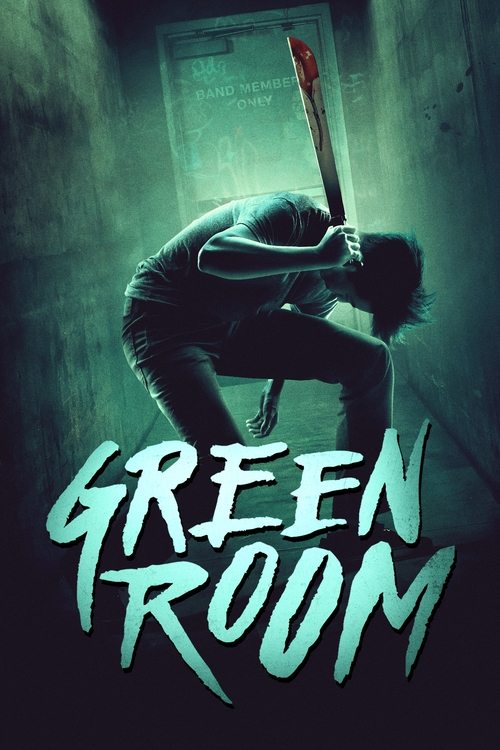
Green Room
2016 · Jeremy Saulnier
For when you're craving a white-knuckle thriller that doesn't flinch — a pick for genre fans who want their pulse raised and don't need anyone to make it home safe. Absolutely a challenge watch, not a comfort one.
What it's about
A broke touring punk band takes a last-minute gig at an isolated club in the Oregon backwoods and discovers, too late, that it's a neo-Nazi hangout. After they see something in the dressing room they weren't supposed to see, they're locked in a small green room while the men who run the place decide what to do about them. What follows is one night, one building, and a door between two groups of people who both want this over.
The experience
Almost unbearably tense — a slow, coiled first act and then sustained pressure with bursts of sudden, clumsy, realistic violence that lands like a slap. It's lean, fast, and merciless; you watch a lot of it through your fingers.
Performances
Patrick Stewart is chilling precisely because he underplays it — a soft-spoken, managerial villain who treats murder as logistics. Anton Yelchin gives the band its scared, decent, improvising heart.
The craft
Jeremy Saulnier writes violence the way it actually works: nobody is good at it, plans fail, and injuries matter — which makes every confrontation twice as frightening. The film wrings maximum dread from a single grimy location, and the punk-show sound and pounding quiet are half the tension.
Why it matters
A festival breakout that cemented Saulnier as a leading voice in stripped-down American genre filmmaking, and a modern touchstone for how to stage screen violence with real physical stakes.
Snapshot
A broke punk band takes a last-minute gig at a backwoods club outside Portland, discovers a body in the dressing room, and spends the rest of the night trying to get out of a building owned by people who cannot let them leave. That is the whole film. Green Room is a siege picture stripped to its load-bearing walls: one location, one night, a door, and a shrinking number of people on either side of it.
What distinguishes it from the dozens of films with the same skeleton is the register Jeremy Saulnier chooses. Nobody in Green Room is good at violence. The band members are frightened, indecisive, and physically unprepared; their captors are equally clumsy, and more importantly they are bored, tired, and working a shift. Saulnier's third feature completes a run of films — after Murder Party (2007) and Blue Ruin (2013) — preoccupied with the gap between the competence violence requires and the competence ordinary people actually have. The result is a film that is genuinely frightening less because of its gore, which is severe, than because of its administrative calm: the antagonists are solving a logistics problem, and the protagonists are the problem.
Released by A24 in April 2016 after a 2015 premiere in the Directors' Fortnight at Cannes, it was received as a near-perfect execution of a small, hard genre exercise. Two months after its US release, Anton Yelchin died, which permanently altered how the film is watched.
Industry & production
Green Room is a product of the mid-2010s American independent ecosystem at the moment when genre films became a viable route to festival prestige rather than a detour from it. Saulnier's path is the relevant context: Murder Party was a self-financed horror comedy shot around Brooklyn; Blue Ruin was made cheaply outside the system, partly with crowdfunded money, and won the FIPRESCI prize in the Directors' Fortnight at Cannes in 2013. That prize converted Saulnier from an unknown who paid his bills shooting commercial work into a director who could raise several million dollars for an original screenplay with no stars attached at the script stage.
The film was financed through Broad Green Pictures and produced with Film Science, the company of Anish Savjani; Neil Kopp, whose producing credits run through the Oregon-set independent cinema of Kelly Reichardt, was also among the producers. That lineage is not incidental — it helps explain why a hardcore-punk siege thriller was shot in Oregon, using the Pacific Northwest infrastructure built up around a very different kind of American indie film. A24 handled the US theatrical release, expanding from a limited opening in April 2016. Commercially it performed modestly; it was never a wide-release proposition, and its real life has been on home video and streaming, where it became a durable word-of-mouth title. I would rather not quote budget or gross figures here, because the reported numbers vary across sources and precision would be false; the honest summary is that it was made cheaply, released small, and has substantially outlived its theatrical footprint.
Casting was the film's leverage. Patrick Stewart's presence as the club's proprietor gave a low-budget genre film immediate legitimacy and an unusual marketing hook, and Stewart's own stated wariness about the material — reported widely in press around the release — became part of the film's public identity. The rest of the ensemble was drawn from the working end of American independent film: Anton Yelchin, Imogen Poots, Alia Shawkat, Joe Cole, Callum Turner, Mark Webber, Eric Edelstein, and Macon Blair, Saulnier's childhood friend from Alexandria, Virginia, and the lead of both his previous features.
Technology
Detailed technical documentation of the shoot is thinner than for comparably discussed films of its year, and I will not assert a capture format or camera package I cannot verify. What can be described is the set of problems the production had to solve, all of which are legible on screen.
The dominant constraint is confinement. Most of the film occurs in rooms too small to light conventionally, which forces a dependence on sources that exist within the frame — bare fixtures, the club's stage wash, work lights, headlights, a phone screen. The film is consistently underexposed by commercial-thriller standards, with deep, slightly muddy shadow and a color palette pushed toward sick greens and flat institutional whites, punctuated by the red of blood and the sodium of exterior night.
The second problem is the physical effects work. The film's injuries — the forearm wound delivered through a doorway is the notorious one — are built as practical, in-camera prosthetics, and the film's credibility rests on them. Digital augmentation is minimal and, crucially, invisible; the gore has the wet, badly-lit, unglamorous quality of real trauma rather than the clean articulation of CG. The trained dogs used as weapons compound the staging difficulty: sequences involving animals, actors, and blood require choreography that severely limits how long a take can run and how close the camera can get, and the film's editing patterns around those scenes reflect it.
Technique
Cinematography
Green Room marks a specific break in Saulnier's method: he shot Murder Party and Blue Ruin himself, and here handed the camera to Sean Porter, whose other work of the period — Kumiko, the Treasure Hunter (2014), 20th Century Women (2016) — suggests a sensibility more attuned to texture and human observation than to genre spectacle. That is exactly what the film uses. The camera is patient and slightly detached, favouring medium shots that keep bodies whole and legible in space. There is almost no coverage of the kind that manufactures excitement — no whip pans, no shutter-angle brutalism, very little handheld agitation during violence.
The consequence is that the audience always knows the geography, which is what makes the siege comprehensible and therefore tense. When someone controls the door, we understand precisely what that means. Violence, when it arrives, is often framed too wide or too flatly for comfort; the film denies the viewer the close-up that would let an injury become an effect rather than an event. Light is used as information: the green room's sour cast, the corridor's darkness, the stage lights that expose the band to a room of people who want to hurt them.
Editing
Julia Bloch, who also cut Blue Ruin, is central to the film's effect. The editing withholds. Long stretches of the film consist of characters waiting, arguing in whispers, and failing to agree on a plan, and Bloch lets those scenes run past the point of conventional comfort so that the eruptions land as ruptures rather than beats. Deaths arrive on the wrong syllable — mid-sentence, off-rhythm, before the audience has finished assessing the danger. There is no reaction-shot montage to metabolize them; the film simply continues, and the survivors must absorb the loss in real time.
The second editorial principle is informational asymmetry. Cuts between inside and outside the green room parcel out what each group knows, and the audience is often given slightly more than the trapped characters and slightly less than the men in the corridor. Suspense is generated almost entirely by that gap rather than by scoring or shock cutting.
Mise-en-scène / staging
The film is a dramaturgy of thresholds. Its architecture — dressing room, corridor, stage, back exit, the woods beyond — functions like a board on which every position has a value, and the plot is essentially a series of moves to occupy or deny a space. Props behave like scarce resources in a survival game: one firearm, a box cutter, a fire extinguisher, a length of gaffer tape, a fluorescent tube.
Production design does the ideological work without exposition. The club is dressed with the visual grammar of white-power subculture — flags, patches, boot-lace codes, distro merchandise — presented as banal commerce rather than as gothic menace. It looks like a business, because it is one. Similarly, the band's world is rendered through the unromantic materials of low-level touring: a dying van, siphoned gas, floor sleeping, a merch table, a fanzine interview.
Sound
Sound design is the film's most underrated instrument. It is a film about a locked room, and therefore about hearing what you cannot see: muffled conversation through a wall, footsteps in a corridor, dogs, the dull hydraulic sound of a body being moved. The score by Brooke and Will Blair, who also scored Blue Ruin, is largely low synthesized drone and pulse — deliberately dissociated from the diegetic punk, so that the film's music and the film's mood never collapse into each other.
The most cited use of music is diegetic and dramaturgical: the band opens its set with a cover of the Dead Kennedys' "Nazi Punks Fuck Off," an act of provocation that establishes their politics, their nerve, and their catastrophic misreading of the room in a single gesture. It is also a piece of exact subcultural history — the song exists because this conflict is old.
Performance
The ensemble is directed toward flatness and hesitation rather than intensity. Yelchin's Pat is the film's central proposition: a soft-spoken, physically unremarkable young man who is not secretly capable and never becomes so. His fear reads as bodily — shallow breathing, stalling, deference — and his few effective actions are improvised and lucky. Poots plays Amber with an affectless practicality that makes her the group's most dangerous member precisely because she is the least invested in the ritual of negotiation. Blair's Gabe is the film's most original creation: a middle-manager in a hate movement, tired, decent-adjacent, and utterly compromised, who mostly wants the night to end so he can go home.
Stewart's Darcy is a deliberate anti-performance. He never raises his voice, never monologues about ideology, never enjoys himself. He speaks in operational instructions and cost-benefit assessments, and his authority is entirely procedural. The choice reframes the film's antagonists: their menace lies in organization, not fanaticism.
Narrative & dramatic mode
The film observes near-unities of time and place. There is no backstory, no cutaway to families, no parallel investigation. Character is established through behavior and through a running conversational motif — the "desert island band" question — that reveals posture, taste, and eventually sincerity more efficiently than biography would.
Its dramatic engine is inversion of competence. Conventional siege narratives grant the trapped party an escalating mastery: they improvise weapons, discover resolve, become effective. Green Room grants them only attrition. Plans are half-formed, arguments go nowhere, and the decisive turns are frequently accidents. Correspondingly, the antagonists' cruelty is procedural rather than sadistic — the film's chilling insight is that the men outside are not enjoying this either, which removes the comfort of monstrousness.
Crucially, the inciting killing turns out to be entangled with the organization's illicit business rather than with doctrine. The band is not being murdered for what it believes; it is being murdered because it is a liability to an operation. Ideology in this film is the branding of a criminal enterprise, which is a colder and more plausible account than most genre treatments of the subject.
Genre & cycle
Green Room belongs to the American siege thriller: the lineage running from Rio Bravo (1959) through Night of the Living Dead (1968) and Assault on Precinct 13 (1976), with the rural-menace strain of Straw Dogs (1971), Deliverance (1972), and Southern Comfort (1981) supplying its landscape and its class anxiety. Saulnier's contribution is tonal rather than structural: he keeps the architecture and removes the heroism.
It also sits squarely inside the 2010s American indie-genre cycle — You're Next, The Guest, It Follows, The Witch, Bone Tomahawk, Don't Breathe — and inside A24's construction of a house identity in which horror could be treated as authorship. It is worth resisting the "elevated horror" label often attached to that cohort: Green Room is not a metaphorical or allegorical horror film. It is unashamedly pulp, made with art-cinema patience. Its seriousness is in the craft and the moral attention, not in a substituted subtext.
Authorship & method
Saulnier's authorship is unusually consistent across a small filmography. He writes his own scripts, works with a closed circle of collaborators, and returns obsessively to a single question: what actually happens when unprepared people try to kill each other. His own background — a Virginia childhood making Super 8 horror films with Macon Blair, adjacency to the Washington, D.C. hardcore scene, years of commercial and camera work funding his features — accounts for both the punk verisimilitude and the technical discipline.
The key collaborators here form a stable unit: Porter on camera (the notable outsider, and a deliberate hand-off of Saulnier's own former role), Bloch cutting, the Blairs scoring, Macon Blair on screen. The method is craft-first and pre-planned; the film's tension depends on spatial coherence that cannot be discovered in the edit.
Saulnier's subsequent work extends the same interests with varying success: Hold the Dark (2018) and Rebel Ridge (2024) for Netflix, plus the opening episodes of the third season of True Detective (2019), which he directed before departing the production. Green Room remains the most concentrated statement of his method.
Movement / national cinema
The film is American regional independent cinema in a very literal sense: financed outside the studios, shot in Oregon using a production community associated with the Pacific Northwest's naturalist indie tradition, and validated first at a European festival sidebar rather than by domestic industry channels. That route — Cannes Directors' Fortnight as the legitimizing venue for a low-budget American genre film — was a defining feature of the period, and Saulnier had already used it with Blue Ruin.
There is also a subcultural nationality to the film. Its punk milieu is specifically American hardcore: the touring economy of unpaid gigs, the ethical seriousness about authenticity, and the long, real history of antifascist confrontation inside that scene. The film's fidelity here is why its premise reads as reportage rather than as a screenwriter's contrivance.
Era / period
Green Room is a film of post-recession precarity. Its protagonists have no money, no institutional recourse, and no visibility — a plot point made explicit when they boast about staying off social media, and thereby ensure that nobody knows where they are. The self-erasure that certifies their authenticity is also what makes them disposable.
Its release timing gave it an afterlife nobody planned. Arriving in spring 2016, and depicting organized white nationalism as a functioning American business with a hierarchy, a revenue stream, and a recruitment pipeline, it was quickly re-read after the political events of 2016 and 2017 as unnervingly well-observed. Critics returning to it after Charlottesville in August 2017 tended to note that the film's refusal to portray its antagonists as exotic monsters was the source of that prescience.
The film is also, unavoidably, marked by Anton Yelchin's death in June 2016, weeks after the US release. It stands as one of the last and best showcases of a performer whose specialty was precisely the unshowy, anxious interiority the role required.
Reception, canon & influence
Critical reception was strongly positive from the Cannes premiere onward, with reviewers consistently singling out the tension architecture, the practical violence, Stewart's against-type restraint, and Saulnier's refusal of catharsis. The most common reservation was that the film is a brilliantly executed machine with limited ambitions beyond survival — a criticism that its admirers regard as a description of the genre rather than a fault.
Backward. The film's debts are legible and largely acknowledged in critical discussion: Carpenter's Assault on Precinct 13 for the structure, Peckinpah's Straw Dogs for the moral queasiness of a besieged outsider, the 1970s rural-threat cycle for the landscape, and Walter Hill for the economy. Behind those sits the hardcore-punk documentary and photographic record — the visual texture of vans, basements, and flyers — and Saulnier's own Blue Ruin, which is effectively the same thesis about incompetent violence conducted at the scale of one man.
Forward. Its measurable legacy is threefold. It consolidated A24's reputation as a home for director-driven genre work and helped normalize the festival-to-boutique-distributor path for hard-R thrillers. It established Saulnier as a name director with access to streaming-scale financing. And it became the default reference point in critical writing for two things: violence staged without competence fantasy, and the depiction of American white-power organization as a mundane commercial enterprise. Later siege thrillers and confined-space horror films are routinely compared to it, though direct causal influence on specific titles is difficult to substantiate and I would not claim it.
Its canonical position is secure but specific. Green Room is not usually argued as one of the decade's major films in the sense that Moonlight or The Tree of Life are argued; it is argued as one of the decade's most perfectly built ones — a small, mean, exactingly made thriller that turned out to have been looking directly at something the rest of American cinema had not yet noticed.
Reception
It premiered at Cannes' Directors' Fortnight in 2015 to strong reviews but barely registered at the box office when A24 released it in 2016. Since then it's hardened into a modern cult classic — its punks-vs-neo-Nazis premise felt grimly prophetic within a year of release, and Anton Yelchin's death just two months after it opened gave it a permanent ache.
How Green Room was received, from release to now →
How to watch Green Room: what to notice on a first viewing
- Watch how clearly you can always find the door. Sean Porter shoots mostly in patient medium shots that keep bodies whole in space, with almost no whip pans or handheld shake even during violence. Knowing exactly who controls the door is what makes the siege tense instead of merely chaotic.
- Listen for what happens on the other side of the wall. The sound design carries muffled conversation, footsteps, and dogs through walls and doors, so the band, and you, learn most of what is happening by ear. A locked room turns into a film about hearing danger you are never shown directly.
- Notice which objects the band picks up and holds onto. A box cutter, a fire extinguisher, a length of gaffer tape, a fluorescent tube: the staging treats ordinary objects as scarce resources in a survival game. What a character is holding tells you their odds better than anything they say.
- Watch how quietly Patrick Stewart gives every instruction. Stewart plays Darcy without raised voice or speeches, speaking only in operational instructions and cost-benefit terms, his authority entirely procedural rather than theatrical. His menace comes from organization, not fanaticism, which is a colder and more plausible threat.
- Listen for the song the band opens their set with. They open with a cover of the Dead Kennedys' 'Nazi Punks Fuck Off' to a room full of the people the song is aimed at. One song establishes their politics, their nerve, and how badly they have misread the room.
The whole guide to watching Green Room, with the keys for a rewatch →
Influences: the films it descends from and the films it influenced
- Night of the Living Dead (1968) — Establishes the boarded-threshold grammar Green Room runs on — the entire dramaturgy is doors, windows and who controls the latch, with the besieging mass held offscreen as sound pressure rather than shown.
- Straw Dogs (1971) — Blocks the siege by mapping the house as a tactical floorplan before the assault so escalation reads as geography, and pins the queasiness on an outsider discovering he will do worse than his attackers.
- Deliverance (1972) — Codifies the rural-menace rule that terrain is the antagonist — no road out, no authority in reach — and that city bodies handle weapons with visible, fatal clumsiness.
- The Texas Chain Saw Massacre (1974) — Documentary-grade location grime and offscreen sound design (generator hum, rooms you hear but never see) do the work that lighting effects would do in a studio horror film.
- Dog Day Afternoon (1975) — Invents the negotiation-through-a-doorway staging Green Room reuses for the 'we're going to let you out' parley — the barricade becomes a talking interface and both sides are audibly improvising policy.
- Assault on Precinct 13 (1976) — The structural blueprint: unity of time and place, a scratch alliance of strangers with no shared history, and wide anamorphic staging that keeps every sightline legible so the audience always knows which door is next.
- Southern Comfort (1981) — Hill's economy — characters defined by one function and one line of behavior, no backstory, and an attrition order determined strictly by who is least competent.
- The Decline of Western Civilization (1981) — The flat, unromantic photographic record of hardcore club logistics — flyer, van, merch table, bored promoter, cash box — is the exact production-design vocabulary that lets Green Room render the venue as a workplace.
- Reservoir Dogs (1992) — The wound-as-clock: a body bleeding out in real time in a single room becomes the film's timer, while the killing itself is brief, ugly and largely offscreen.
- Murder Party (2007) — Saulnier's first pass at a subculture as a lethal machine, with Macon Blair on screen and the load-bearing joke already in place — the perpetrators are bad at murder and the plan degrades faster than the victim.
- Blue Ruin (2013) — The same thesis at one-man scale: practical-source lighting, a single wound treated as a real-time logistical problem, and violence performed by someone who has plainly never done it before.
- Evil Dead (2013) — Inherits the confined-space sustained-ordeal suspense and unflinching practical grisliness, wringing terror from a group sealed in one location with no exit.
- I Don't Feel at Home in This World Anymore (2017) — Blair directing the shop method he acted in — mundane escalation from a small grievance, avengers with no aptitude, and wounds that behave like wounds rather than plot beats.
- Rebel Ridge (2024) — Runs the Green Room siege logic in reverse — a genuinely competent protagonist against procedural evil rendered as municipal paperwork and asset-forfeiture policy, with the same insistence on legible geography over cutting.
- You're Next (2011) — Runs the same scarce-prop economy — the besieged house is inventoried as usable objects (blender, meat tenderizer, nail board) and the film's turns come from who reads that inventory first.
- Bone Tomahawk (2015) — Off-rhythm violence taken to its limit — long procedural stretches of talk broken by a single unstylized act held in one unbroken, unmusicked shot.
- Free Fire (2016) — A single-warehouse gunfight whose entire comic and tactical engine is inverted competence: nobody can shoot, everybody is crawling, and the drama is pure floorplan attrition.
- Don't Breathe (2016) — Opens by teaching the audience the house's floorplan with a mapping camera move, so the later blackout sequence stays spatially legible — the Green Room lockdown inverted, with the antagonist sightless instead of the victims.
- The Descent (2005) — Runs the same confined-space siege with escalating ensemble attrition and a human dual-antagonist, wringing dread from a locked, shrinking geography rather than gore.
- Dinner in America (2020) — Sibling in treating the hardcore-punk idiom with craft precision rather than pastiche — authentic scene texture, real basement-show sound design, and formal control applied to genuinely abrasive material.
- The Rip (2026) — Saulnier teaches the audience the complete geography of a purpose-built structure before any violence, so escalation is generated by spatial knowledge and door-by-door attrition rather than by cutting — the same unity-of-place engineering as The Rip's stash house.
- Resident Evil (2026) — Saulnier's whole plot is a floor plan — one door, one corridor, one window — and his leads are untrained bodies who hold weapons wrong and lose fights badly; that unarmored non-action performance register is what the seed wants from a survivor who is not an action star.
Similar films
- Reservoir Dogs (1992) — influence & lineage
- Night of the Living Dead (1968) — influence & lineage
- Colony (2026) — shared sensibility
- [REC] (2007) — shared sensibility
- Train to Busan (2016) — shared sensibility
- When Evil Lurks (2023) — shared sensibility
- Bugonia (2025) — shared sensibility
- The Running Man (2025) — shared sensibility