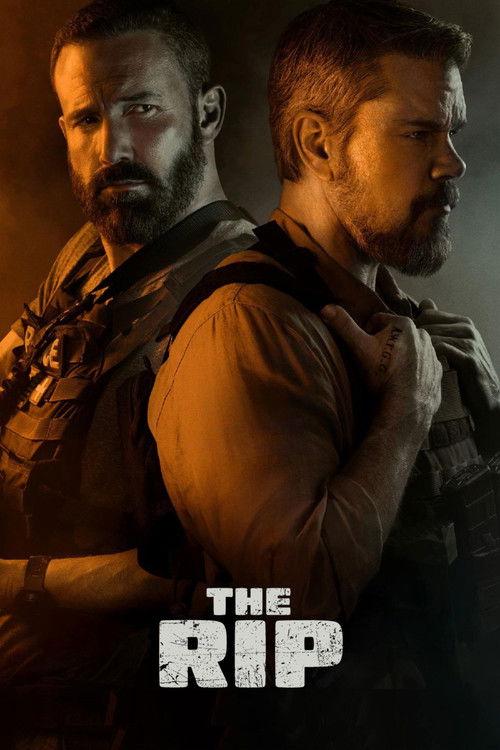
The Rip
2026 · Joe Carnahan
When you want a gritty, grown-up crime picture for a night in — something to watch with one eyebrow raised, guessing who's dirty. A challenge to your read on people more than your nerves.
What it's about
A Miami narcotics unit raids a run-down stash house and finds millions in cash — far more than anyone expected, and far more than anyone can quite report. From the moment the money is counted, every cop in the room becomes a suspect to every other, and the unit's loyalties start to fray under surveillance, federal attention, and the growing certainty that someone intends to take a cut. Matt Damon and Ben Affleck play the two partners at the center of the unraveling.
The experience
A slow-tightening vise: less about action set pieces than about watching trust curdle in real time, with paranoia doing most of the work until the violence arrives. Tense, talky, and mean in the way good cop thrillers are.
Performances
Matt Damon and Ben Affleck bring decades of shared history to the two partners, and the ensemble around them — Steven Yeun, Teyana Taylor, Catalina Sandino Moreno, Kyle Chandler — is unusually deep for a genre picture of this size.
The craft
Joe Carnahan wrote and directed, and his specialty is exactly this: hard-edged crews under pressure, dialogue that crackles, and a Miami that feels humid and compromised. The film builds through interrogation-room logic rather than spectacle, so the shootouts land harder when they come.
Why it matters
A high-profile pairing of Damon and Affleck under their own Artists Equity banner, and a return to the dirty-cop thriller pitched at a global streaming audience.
Snapshot
The Rip is a 113-minute crime thriller written and directed by Joe Carnahan, produced by Artists Equity, and released globally on Netflix on 16 January 2026. Matt Damon plays Lieutenant Dane Dumars and Ben Affleck plays Detective Sergeant J.D. Byrne, partners in a Miami-Dade narcotics unit whose raid on a derelict stash house turns up an implausible quantity of cash — and, with it, the certainty that at least one person in the room intends to take some of it. The supporting unit is unusually deep for a genre picture of this scale: Steven Yeun as Detective Mike Ro, Teyana Taylor as Detective Numa Baptiste, Catalina Sandino Moreno as Detective Lolo Salazar, with Kyle Chandler as a DEA agent, Scott Adkins as an FBI agent and Affleck's on-screen brother, Néstor Carbonell as the unit's major, and Sasha Calle in a civilian role.
The film's engine is procedural rather than melodramatic. Because the money must be counted and inventoried on scene before anyone can leave, the plot acquires a classical unity of place almost by accident: the characters are legally obliged to remain inside the building with the object that is destroying them. Carnahan has described the design as a haunted-house film in which the haunting is done by the money — a formulation that names the picture's genre allegiance more precisely than "heist" or "police thriller" does.
Commercially it was Netflix's most consequential original film of the year: 41.6 million views in its first three days, the platform's biggest feature opening since Happy Gilmore 2, roughly 80 million views across its first two reporting weeks, and three separate weeks atop the global chart. Critically it landed in respectable territory rather than in acclaim — 77% on Rotten Tomatoes across 159 reviews with a 6.5/10 average, 63 on Metacritic from 32 critics. Its budget has been widely reported at $100 million.
Industry & production
The Rip matters to industrial history more than most action pictures of its size, and the reason has nothing to do with what is on screen.
The project was announced in June 2024 with Damon and Affleck attached, shopped, and acquired by Netflix that July. It was produced through Artists Equity, the company Affleck and Damon founded in late 2022 on an explicit premise: that the people who make a film should participate in its success, not merely be paid a fee for their weeks. Streaming had made that premise nearly unenforceable. Netflix's standard model buys out participation entirely — a larger check up front in exchange for no back end, which is precisely why the platform can absorb a $100 million film without a box-office window to recoup against.
Artists Equity negotiated an exception. Netflix agreed that all 1,200 cast and crew would receive performance-based bonuses if the film hit defined viewership benchmarks within 90 days of release. It hit them, and the bonuses were paid out in May 2026. This is, so far as the public record shows, the first time Netflix has agreed to a back-end structure covering an entire below-the-line crew, and it arrived alongside a first-look deal between Artists Equity and Netflix signed in March 2026. Whether the arrangement becomes precedent or remains a bespoke concession extracted by two of the few stars with the leverage to extract it is the open question the film leaves behind.
The production itself was lean by the standards of its budget. Principal photography ran 3 October to 11 December 2024 in Los Angeles — Harbor City and Long Beach standing in for South Florida — with additional work in New Jersey that November and some Miami photography. Carnahan has put the shoot at 36 days and treats that compression as a method rather than a constraint, arguing that momentum is itself a directorial resource. The stash house and a Jersey garage were built.
Damon has spoken publicly about the script notes the streaming context generated — a request for a large set piece inside the first five minutes, and for the plot to be restated three or four times over the running time. He framed it as a description of how a film is watched on a platform where attention is divided and the remote is in someone's hand. Whatever one makes of the resulting film, that is an unusually candid account of streaming dramaturgy from someone inside it.
Technology
The public technical record on The Rip is thin — camera package, capture format and aspect ratio have not been documented in the trade or craft press in any detail I can verify, and I will not guess at them. What is documented is a governing methodological choice that is technological in its consequences.
Carnahan and cinematographer Juan Miguel "Juanmi" Azpiroz committed to a pre-planned, deliberately restricted camera rather than the multi-camera saturation coverage that has become default on contemporary action productions. Carnahan's phrase for the approach is writing with the camera: the shot is decided before the day, and the day executes it. On a 36-day schedule this is less an aesthetic luxury than a scheduling instrument — coverage-by-accumulation is the expensive method, and its absence is what buys the time.
The other technology worth naming is measurement. The Rip's success exists entirely as a Netflix "view," a unit derived by dividing total hours viewed by runtime, published weekly, and unaudited by any external body. Its 41.6 million opening views are the reason 1,200 people received bonus checks. A metric wholly controlled by the buyer became, under the Artists Equity deal, the trigger for the crew's compensation — which makes the film a live test of whether platform-defined viewership can function as a labor standard.
Technique
Cinematography
Azpiroz has shot Carnahan's last three features — Boss Level (2020), Copshop (2021), and now this — and the partnership has settled into a recognizable register: hard, contrast-forward, unfussy, willing to let interiors go genuinely dark. Carnahan has said the two spent significant preparatory time on color scheme and on how the camera would move, and the discipline shows in a picture that resists the roving handheld idiom the material would ordinarily attract.
The photographic problem The Rip sets itself is that a stash house has no vistas. Everything must be found in a small number of rooms, in bad light, with the same faces. Azpiroz's answer is to make the cash itself a light-and-texture event — the money is the object the camera keeps returning to, and the film's visual logic treats it the way a horror film treats a presence in the corner of the frame. That the Miami of the title was largely manufactured in Long Beach and Harbor City is itself a photographic achievement of a modest, unglamorous kind: the film declines the pastel-and-neon Miami of the Miami Vice inheritance in favour of humidity, mildew and fluorescent tube, a palette that happens to be portable.
Editing
Kevin Hale, Carnahan's editor on Boss Level and Copshop and a collaborator of decades' standing, cuts. Carnahan's account of Hale's method is worth recording because it is unusually specific: Hale looks for "the heart of a scene" and insists that "there's a thesis to every scene" — an argumentative rather than rhythmic conception of the cut. Reviewers largely credited the film's tension-building as organic and cumulative rather than imposed, which is the compliment that method aims at. The dissent ran the other way: Travis Andrews in The Washington Post, awarding two and a half stars out of four, found the action sequences over-extended and the genre furniture familiar. At 113 minutes with a large ensemble and a premise that must periodically restate itself, both readings are defensible from the same footage.
Mise-en-scène / staging
This is the film's strongest formal claim. The counting requirement converts a police procedure into a dramatic device of some elegance: the characters cannot leave, cannot separate, and cannot stop handling the thing they are contemplating stealing. Every conversation happens in the presence of the temptation and in earshot of everyone else. Staging in the stash house therefore does most of the work that dialogue would normally do — who stands where, who can see whom, who has drifted into another room.
The set was purpose-built, which is what makes that geometry legible rather than approximate. Carnahan has noted that nothing constructed went unused, a remark that reads as production economy but is also a statement about how tightly the space was designed against the script. The production designer's contribution is central here and I have not been able to verify the credit; the record on the film's below-the-line design team is genuinely thin.
Sound
Clinton Shorter scores, his third feature for Carnahan after Boss Level and Copshop, and a career built on percussive, low-register genre writing since District 9 (2009). Detailed information on the sound design and mixing teams has not surfaced in the accessible record. The dramatic problem the soundtrack must solve is the same one the staging faces — sustaining dread in a static location — and reviewers describing the film as closer in spirit to John Carpenter than to the standard crime thriller were responding, in part, to a score-and-atmosphere strategy that operates by pressure rather than by punctuation.
Performance
The casting is the film's commercial premise and, by most accounts, its best asset. Damon and Affleck have shared screen time before — Good Will Hunting (1997), Dogma (1999), The Last Duel (2021) — but The Rip is their first joint lead as adversaries rather than allies, and it exploits a specific piece of extra-textual knowledge: the audience's certainty that these two men like each other. Carnahan has described trading on Damon's star persona precisely to subvert expectation, and the film's suspense depends on the viewer's inability to decide which of two enormously familiar faces is lying.
Around them the ensemble is deliberately over-qualified for the genre — Yeun, Taylor, Sandino Moreno, Chandler, Carbonell — because the paranoia only works if every suspect is plausible. Jonathon Wilson's characterization of the leads as "proper actors, not necessarily action stars" identifies the casting logic exactly: the film needs performers who can hold a close-up in silence while doing arithmetic.
Narrative & dramatic mode
The Rip is a chamber tragedy wearing an action film's clothes. Its dramatic mode is the moral pressure test — a fixed group, a fixed location, an object of temptation, and a clock — and its ancestry runs to The Treasure of the Sierra Madre (1948) far more than to the contemporary heist picture. Nobody plans anything; the money simply appears, and character is revealed by proximity to it.
The film is drawn from an actual case. Carnahan developed the story with Michael McGrale, working from an account he heard directly from a friend involved in the events, and it is publicly linked to Miami-Dade Captain Chris Casiano's 2016 narcotics raid on a Miami Lakes residence that uncovered some $20 million. Damon's character carries a grief that is not fictional in origin: Casiano's son, Jake William Casiano, died of leukemia in 2021, and Carnahan has said he sought permission before folding that loss into the film, wanting to give the family "a totem" rather than to exploit a child's memory. The Casiano name is given to a peripheral federal agent, a small act of attribution inside the fiction.
That documentary substrate produced a legal consequence. On 7 May 2026, two Miami-Dade Sheriff's deputies, Jonathan Santana and Jason Smith, sued Damon and Affleck for defamation, arguing that the film retained enough identifying real-world detail that its portrayal of dirty cops attached to them. Santana's remark to WSVN — "When you rip something, you're stealing something. We never stole a dollar" — is the clearest statement of the grievance. The suit is unresolved as of this writing.
Genre & cycle
Three cycles converge here.
The first is the American police-corruption film, which runs from Serpico (1973) and Prince of the City (1981) through Internal Affairs (1990), Training Day (2001), Dark Blue (2002), We Own the Night (2007), Pride and Glory (2008) and Triple 9 (2016). Carnahan's own Narc (2002) sits squarely inside it, and several critics reached for Narc immediately — one arguing that The Rip is the first film in twenty years that might touch it.
The second is the found-money fable: The Killing (1956), Shallow Grave (1994), A Simple Plan (1998), No Country for Old Men (2007). These films share a structural premise — that money discovered rather than stolen is the more corrosive object, because it arrives without a plan and therefore without a distribution of guilt.
The third is the Miami crime imaginary, from Scarface (1983) and Miami Vice (1984–89) through Miami Blues (1990) and Bad Boys (1995) — a lineage Carnahan is directly connected to, having shared story and screenplay credit on Bad Boys for Life (2020). The Rip pointedly refuses that tradition's chrome and color, and the refusal is legible as a position. It is closer to the documentary record of the mid-1980s Miami River Cops scandal than to the city's pop iconography.
To these should be added the confined-siege picture — Assault on Precinct 13 (1976), Reservoir Dogs (1992), and Carnahan's own Copshop — which supplies the architecture, and, in the Carpenter comparison several reviewers drew, the tonal register.
Authorship & method
Carnahan has had one of the more discontinuous careers in American genre filmmaking: an indie breakout with Blood, Guts, Bullets and Octane (1998), the widely admired Narc (2002), a near-miss on Mission: Impossible III, then a decade of expensive studio work of variable coherence — Smokin' Aces (2006), The A-Team (2010) — punctuated by The Grey (2011), his one unambiguous artistic success at scale. Since then he has worked mostly in the compact, high-concept action register of Stretch (2014), Boss Level and Copshop.
The Rip is best read as the convergence of the Narc sensibility with the Copshop method. Its formal signature is the confined location and the fixed schedule; its moral signature is Narc's interest in the specific cost of the compromise rather than in the spectacle of corruption. Carnahan's own account of his process is refreshingly deflationary: "A lot of my directing is in the screenwriting." He does not write for particular actors — "I'm a big believer in just writing the character" — and once the structure was solved, the screenplay took roughly five weeks.
The collaborators are, by this point, a settled unit: Azpiroz on camera, Hale in the cut, Shorter on score, all three carried over from Boss Level and Copshop, all three described by Carnahan in terms of long friendship rather than professional convenience. The final beach scene, originally longer, was cut down into something Carnahan calls quieter and more profound; his son Jackie appears in it. That is a small and verifiable instance of the personal watermark he says he insists on.
Movement / national cinema
The Rip belongs to no movement in the art-historical sense. It belongs to a production formation: the streaming-era American mid-budget genre film, made with theatrical craft standards for a non-theatrical release, financed at a level that the theatrical market for adult crime pictures no longer supports.
Its national geography is worth noting for what it says about that formation. The film is Floridian in setting, Californian in manufacture, partly New Jerseyan in pickup, and Spanish in the person of its cinematographer. Place has become a matter of design rather than location — a runaway-production logic now so normalized that its aesthetic consequences go largely unremarked. The Miami of The Rip is an argument about Miami, assembled in Long Beach.
Era / period
The film is a precise artifact of 2026. It arrives after the 2023 strikes, after the contraction of the theatrical mid-budget film, and into a market where two of the most reliable movie stars of their generation can only reach a mass audience through a subscription platform. Damon's public account of Netflix's script notes documents the dramaturgical price of that arrangement; the Artists Equity bonus deal documents an attempt to recover some of the economic price.
The tension between those two facts is the period signature. The Rip is simultaneously the most worker-favourable major streaming deal yet struck and a film openly shaped by the demands of divided attention. Both things are true of the same picture, and future accounts of this moment will likely cite it for both.
Reception, canon & influence
Critical reception was warm and qualified. The Rotten Tomatoes consensus credited the film with "leveraging Ben Affleck and Matt Damon's classic chemistry to texturize a friendship tested by greed," and the recurring critical note was one of relief at competence: Jonathon Wilson at Ready Steady Cut called it "a sharp, muscular, old-fashioned crime thriller of a type you rarely get these days" and "a quintessential Saturday night rental," while Slant located its dread nearer to Carpenter than to the standard crime thriller. The dissent, exemplified by Andrews in The Washington Post, held that the film's pleasures were entirely generic and its action overlong. A 63 Metacritic against a 77% Tomatometer captures the split: broadly recommended, rarely argued for.
The influences running into the film are legible and were, for the most part, correctly identified by reviewers: Narc above all, the found-money tragedies from Sierra Madre forward, the siege picture, and the documented history of South Florida narcotics policing.
Influence running out of it cannot yet be assessed honestly. Seven months after release, the film has no measurable aesthetic progeny, and it would be invention to claim otherwise. What can be said is where the pressure is likely to be felt. The crew-bonus structure has been paid out, publicized by its principals, and followed by a first-look deal — which makes it the most cited element of the film in industry discourse and the thing most likely to be pointed at in future negotiations. The 41.6 million-view opening is being read as evidence that the star-driven adult action thriller retains a mass audience when placed where that audience already is. And the Santana and Smith defamation action, whatever its outcome, will be watched by anyone building a film on a named real-world investigation.
Those are industrial legacies rather than artistic ones. It is possible that The Rip is remembered chiefly as the film that got Netflix to share the upside — a curious fate for a picture whose subject is what happens to people who find money they were not supposed to keep.
Reception
Too new for a reappraisal arc: it landed in January 2026 as an instant Netflix juggernaut with a Certified Fresh critical reception, though a vocal minority found it dour and familiar — the 'grim cop-thriller comfort food' framing set in immediately.
How The Rip was received, from release to now →
How to watch The Rip: what to notice on a first viewing
- Notice everyone stays inside the stash house counting money. Because the cash must be counted and logged before anyone can leave, the crew is legally stuck in the building with the thing tempting them. Nobody can walk away from the money, or from each other, until the count is done.
- Notice the fluorescent, mildewed light instead of neon Miami color. Azpiroz shoots Miami in humidity and fluorescent tube rather than the pastel-and-neon palette the city usually gets on screen. This Miami looks lived-in and cheap, not glamorous, and that choice sets the film's mood.
- Watch the camera keep returning to the cash itself. Azpiroz treats the money as a light-and-texture event, the object the frame circles back to the way a horror film treats a shape in the corner. The film photographs money the way it would photograph a threat.
- Listen for a score that presses rather than punctuates. Shorter's low-register score sustains dread across a static location instead of hitting emotional beats or stings. The music works on you slowly, closer to Carpenter's method than to a standard thriller cue.
- Watch Damon and Affleck play partners who no longer trust each other. Their long-known real-life friendship is used deliberately against you, so the film's suspense depends on not knowing which familiar face is lying. The film trades on twenty years of you liking these two actors together.
The whole guide to watching The Rip, with the keys for a rewatch →
Influences: the films it descends from and the films it influenced
- The Treasure of the Sierra Madre (1948) — Huston stages greed as a chain of two-hander tests around a physically present pile of wealth, letting the object itself become the antagonist — the same architecture as The Rip's money-as-photographic-object framing and its escalating moral pressure tests.
- Rio Bravo (1959) — The ur-text for professionals defending one building, where character is disclosed entirely through who stands where, who covers which door, and who hands whom a weapon — the blocking-as-dialogue grammar The Rip runs inside its purpose-built stash house.
- Dog Day Afternoon (1975) — A scoreless, documented-real-case chamber siege in which tension accrues from duration, negotiation, and the exhaustion of one location rather than from cutting rhythm — the precedent for The Rip's cumulative-tension model and its fidelity to a named investigation.
- Assault on Precinct 13 (1976) — Carpenter's locked anamorphic wides holding a fortified interior, paired with a synth pulse that runs continuously *under* scenes instead of stinging cuts — precisely the Shorter/Azpiroz combination reviewers flagged when they placed the film's dread nearer Carpenter than the crime thriller.
- Prince of the City (1981) — Lumet builds a corruption picture out of an actual investigation's record and dramatizes the specific price of each individual compromise rather than the systemic spectacle — the exact moral method Carnahan carried from Narc into The Rip.
- Cop Land (1997) — Mangold's deglamorization of Stallone made the star's accumulated persona itself the material under test; The Rip performs the same operation on the public Affleck/Damon friendship, casting audience affection as the thing greed has to break.
- A Simple Plan (1998) — Raimi surrenders his kinetic camera for a fixed, restricted, cold-palette frame so each scene functions as one incremental moral pressure test — the found-money fable structured as a ratchet rather than a heist, which is The Rip's narrative spine.
- Training Day (2001) — Fuqua constructs narcotics-unit corruption from documented Rampart-era practice and hinges the entire moral collapse on a discovered cash stash, with a star's warmth weaponized against the viewer — the police-corruption-cycle template The Rip inherits.
- Narc (2002) — Carnahan's own precedent: desaturated low-key interiors, performances built on a compromised cop's held silence, and an interest in the cost of a specific compromise rather than the spectacle of corruption.
- Miami Vice (2006) — Ancestor by negation — Mann's high-digital teal-and-neon South Florida is the exact photographic register Azpiroz's anti-Miami-Vice palette refuses, replacing sodium glamour with underlit, sweat-colored interiors.
- The Town (2010) — Affleck's directorial grammar makes crew loyalty, not the score, the real subject and the robbery merely the instrument that tests it; The Rip borrows that frame and inverts it by placing Affleck on the failing side of the same question.
- Green Room (2015) — Saulnier teaches the audience the complete geography of a purpose-built structure before any violence, so escalation is generated by spatial knowledge and door-by-door attrition rather than by cutting — the same unity-of-place engineering as The Rip's stash house.
- Sicario (2015) — Deakins' pre-planned restricted camera withholds everything the convoy cannot see, while Jóhannsson's sub-bass drone functions as continuous pressure rather than punctuation — the two devices The Rip's cinematography and Shorter score deploy in tandem.
- Hell or High Water (2016) — Money is photographed as dirty, counted, physically burdensome paper whose handling is staged in real time, and the moral reckoning is deferred to a final quiet two-hander instead of a shootout — the same tonal architecture as The Rip's pared-down beach coda.
- Widows (2018) — McQueen casts an over-qualified prestige ensemble into hard genre roles and shoots the cash as inert dead weight — an object with mass and photographic texture rather than a plot token.
- Triple Frontier (2019) — Chandor treats recovered cash as literal tonnage — weighed, bagged, and finally uncarryable — so the money physically dictates staging and pacing; the closest formal relative in the Netflix-scale adult crime register.
- Boss Level (2021) — The film where the standing unit was formed — Azpiroz's pre-planned restricted coverage, Kevin Hale's thesis-driven cutting, and Clinton Shorter's pressure-based score were developed here and transferred wholesale to The Rip.
- Copshop (2021) — The immediate methodological parent: one confined institutional location, a fixed compressed schedule, and a siege whose escalation is measured in rooms lost — the working method The Rip fuses with the Narc sensibility.
Similar films
- The Town (2010) — influence & lineage · same viewing thread
- The Departed (2006) — same viewing thread
- Gone Baby Gone (2007) — same viewing thread
- Crime 101 (2026) — shared sensibility
- Safe House (2012) — shared sensibility
- Heat (1995) — shared sensibility
- Rebel Ridge (2024) — shared sensibility
- Crisis (2021) — shared sensibility
All the films related to The Rip →
Watch it with: curated runs of related films
- Undercover and Underworld — A run of cops, criminals, and the moles planted between them — watch these back-to-back for how loyalty curdles into betrayal across one corrupt city after another, from the Boston docks to Hong Kong to Marseille-by-way-of-New-York.