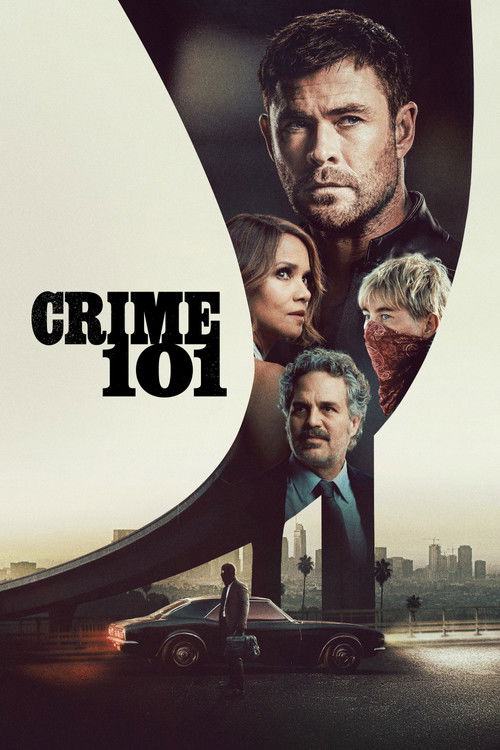
Crime 101
2026 · Bart Layton
When you're craving a proper adult crime saga — professionals, codes, freeway lights at night — and you want to settle in for something long, cool, and absorbing rather than loud. Comfort food for heist lovers, with more patience required than a popcorn actioner.
What it's about
A disciplined jewel thief has spent years pulling immaculate heists along the 101 freeway in Los Angeles, and now he wants one last score big enough to walk away on. His path crosses a disillusioned insurance executive at her own crossroads and a sheriff's detective who alone believes the string of robberies is the work of one man. A volatile young biker with an appetite for violence threatens to blow the whole careful system apart.
The experience
Patient, sleek, and coiled — a slow-burn cat-and-mouse that trusts you to enjoy procedure and character as much as action, then pays it off with real momentum. It feels like a grown-up night at the movies, unhurried and confident.
Performances
Chris Hemsworth strips away the movie-star charm to play the thief as a quiet, methodical professional, Mark Ruffalo brings rumpled obsession to the detective who sees the pattern nobody else will credit, and Barry Keoghan is live-wire danger as the biker who doesn't share anyone's code.
The craft
Bart Layton — known for blurring documentary and fiction — makes his first pure fiction feature and adapts Don Winslow's novella himself, bringing a true-crime eye for process to an invented story. It's a $90 million, 140-minute bet on the theatrical crime picture, and the LA freeway geography is practically a character; the nighttime driving and heist sequences reward a big screen.
Why it matters
A deliberate throwback in an era of franchises: a big-budget, star-driven, standalone crime film released to theaters, and a test case for whether that kind of movie still has a place there.
Snapshot
Crime 101 is Bart Layton's first work of pure fiction — his first film not built from a documented true event — and it arrives as a deliberately old-fashioned proposition: a $90 million, 140-minute adult crime picture with no franchise attachment, released theatrically in February 2026. Adapted by Layton from Don Winslow's 2020 novella (the opening piece in the collection Broken), it triangulates a disciplined jewel thief working the 101 corridor (Chris Hemsworth), the sheriff's detective who alone believes the thefts are one pattern rather than many (Mark Ruffalo), and an insurance executive (Halle Berry) whose professional position gives her both the information and the grievance to change the equation. Barry Keoghan enters as Ormon, a volatile young biker whose appetite for violence is precisely what the thief's code exists to exclude.
The film opened to strong reviews and weak business — an 88% Tomatometer across roughly 199 critics (7.1/10 average), a 68 Metacritic from 37 critics, a B CinemaScore, and about $72.9 million worldwide against that $90 million negative cost. That gap is the most legible thing about the film's place in the record: it is a well-received picture that did not return its budget, and its meaning for the industry is currently larger than its meaning for the genre.
Industry & production
The financing and corporate architecture are unusually revealing. Production was assembled by Working Title Films (Tim Bevan and Eric Fellner), Layton's own documentary house Raw TV (Dimitri Doganis), Chris Hemsworth's Wild State (with Ben Grayson), and The Story Factory — the company of Shane Salerno, Winslow's longtime producing partner and the vehicle through which Winslow's fiction has moved toward the screen. Layton produced as well as wrote and directed. This is a British studio-scale apparatus applied to American genre material, with the star's company inside the tent and the author's representation controlling the source.
Distribution split along a line that would have been strange a decade ago: Amazon MGM Studios handled the United States and Canada, with Sony Pictures Releasing International taking most foreign territories (France excepted). That arrangement belongs to Amazon MGM's post-2023 attempt to build a genuine theatrical slate rather than route originals straight to Prime Video, and Crime 101 was one of its wide, star-driven tests. Principal photography ran in Los Angeles from October 2024 — worth noting, because Los Angeles production volume had by then fallen sharply to runaway incentives, and a film organized around the specific geography of the 101 could not plausibly have been counterfeited elsewhere. The release date moved from 23 January to 13 February 2026; a London premiere preceded it on 28 January. Prime Video streaming followed on 1 April, physical media on 30 June — a ten-week theatrical window that is now near the long end of studio practice.
Layton has framed the theatrical gamble in explicitly moral terms, telling the BFI that "the big screen is a responsibility." The commercial result complicates that position without refuting it: the audience for an original adult crime film at this budget did not materialize at scale, which is a fact about the 2026 exhibition market at least as much as about the film.
Technology
The film's technical signature is a hybrid that has become one of the defining image strategies of the mid-2020s. Erik Wilson shot anamorphic on the Sony Venice, then the finished digital image was routed through a DFD — digital-film-digital — 35mm transfer at Cinelab in London: the picture is recorded out to 35mm negative and rescanned, so that grain structure, halation and highlight rolloff are photochemically produced rather than algorithmically applied. This is a different proposition from a film-emulation LUT, and a different proposition again from native 35mm origination; it buys the texture of the photochemical while retaining digital capture's low-light latitude, which matters enormously for a film that lives after dark.
The lens package was Panavision T Series anamorphics. Wilson has explained the choice as a practical constraint rather than a nostalgic one: because so much of the film is staged inside moving vehicles, the production needed close focus and speed that vintage anamorphics could not deliver, and Panavision supplied custom modifications to push minimum focus closer still for in-car work. The stated production philosophy — texture, perspective and physical production over digital artifice — implies practical vehicle work over LED-volume driving plates, though the precise balance of process trailer, poor-man's process and volume across the film's driving material is not something the published record settles.
Technique
Cinematography
Wilson is a returning Layton collaborator: he shot the dramatized reconstructions in The Imposter (2012), the film that established Layton's method. His work here is nocturnal, wide, and organized around the anamorphic frame's capacity to hold a face in close focus while the city runs unresolved behind it — the format's oldest trick, and the right one for a film about a man who must be simultaneously present and unplaceable.
The most specific and least expected reference the production has acknowledged is Gordon Parks's 1957 Life photo essay "The Atmosphere of Crime," used to set the palette and the raw nocturnal register. Parks's color work from that assignment — smeared sodium light, saturated reds bleeding into black, figures caught in motion at the edge of legibility — is not the sleek neon iconography that "L.A. noir" usually summons, and citing it signals an ambition toward documentary heat rather than designed cool. Whether the finished film sustains that distinction is precisely where critics divided.
Editing
The cutting was shared by Jacob Secher Schulsinger and Julian Hart — a pairing that reads as a thesis. Schulsinger comes from European art cinema's most rigorous school: Lars von Trier's Nymphomaniac and The House That Jack Built, Ruben Östlund's Force Majeure, The Square and Triangle of Sadness. Hart co-edited American Animals, which won the British Independent Film Award for editing and whose entire effect depended on cutting between dramatization and the real participants' contradictory testimony. Schulsinger brings patience and the willingness to let a scene run past comfort; Hart brings Layton's structural gamesmanship. At 140 minutes, the film is long for its genre, and several reviews located their reservations exactly there — The Hollywood Reporter judged it "well-made but overly familiar," straining toward a breadth of cinematic tapestry its material did not require.
Mise-en-scène / staging
The 101 is not merely a setting but the film's organizing spine. Winslow's conceit — thefts staged along a freeway corridor, exploiting the couriers' predictable routes — converts a piece of infrastructure into a dramatic map, and the film inherits from that a distinctly Angeleno logic in which class, opportunity and escape are all functions of which exit you take. Staging privileges procedure: the pleasure on offer is the pleasure of watching competence executed under time pressure, with the heists built from observable steps rather than montage abstraction. The interiors divide the same city by tier — the insurance world's glass and carpet against the fence's back rooms, with Nick Nolte's Money occupying the film's most physically weathered space.
Sound
Blanck Mass — Benjamin John Power, formerly half of Fuck Buttons, and composer for Calm with Horses, Ted K and The Rig — supplies a score of industrial synth mass alternating with restrained character writing. Power's own account of the assignment is the most useful critical gloss anyone attached to the film has offered: he described it as "not any heist movie, but more a Noir which happens to have a heist in it," and said that what drew him was character development — "I wanted to be with them sonically throughout." The score accordingly resists wall-to-wall propulsion; the thunderous passages are rationed against ambient textures built for the city at night. It was released by Lakeshore and Invada in February 2026.
Performance
The casting works by subtraction. Hemsworth, whose stardom was built on amplitude, plays a man whose entire professional identity is the refusal of excess — a role that requires the withholding of exactly the quality that made him famous; one review reached for Steve McQueen's Bullitt as the comparison. Ruffalo plays the detective in a rumpled, dogged register that critics repeatedly likened to Robert Duvall's line of working-class professionals. Berry, who has spoken of recognizing her character immediately — "I actually have been this character. I know what it's like to be in her shoes" — plays Sharon on a slow fuse. Keoghan, reunited with Layton six years after American Animals, functions as the film's entropy: the figure whose presence guarantees that a system built on discipline will fail. Jennifer Jason Leigh, as the detective's estranged wife, carries the domestic cost the procedural genre usually elides, and Corey Hawkins plays the partner. Layton has noted that Hemsworth and Ruffalo, Marvel colleagues for a decade, found the working environment sharply unlike what they expected.
Narrative & dramatic mode
Winslow's novella supplies a professional's code — "Crime 101" as a literal set of rules for staying uncaught — and the film's dramatic mode follows from it. This is procedural rather than psychological: character is revealed through method, and the moral argument is carried by whether a given figure keeps to their rules. The structure is the classic triangulation of the American crime film, in which thief and detective are constructed as mirrored professionals and the civilian third party destabilizes the symmetry. The "last job" frame supplies the pressure; the insurance-industry vector supplies the twist of perspective, relocating the largest theft in the film away from the man with the tools and toward the institutions that price risk. That relocation is what gives the film its populist charge — one critic read it as "a great middle finger to the one percent class and bosses."
Genre & cycle
The film sits knowingly inside the heist-procedural lineage that runs from The Asphalt Jungle and Rififi through Melville's Le Cercle rouge, Walter Hill's The Driver, Michael Mann's Thief and Heat, Friedkin's To Live and Die in L.A., and — in its freeway-and-sunlight register — Point Break and Drive. Layton has named the debts directly: Friedkin's The French Connection and To Live and Die in L.A. were "huge" for him, and of Mann he has said that "movies like Heat cast a long shadow. I love that movie. I certainly wasn't trying to replicate or emulate." The Rotten Tomatoes critics' consensus turns that inheritance into the review: the film "has studied the greats of L.A. noir closely and shows its homework." The compliment and the reservation are the same sentence.
Authorship & method
Layton's route to this film is the most interesting thing about it. He built his career in nonfiction television at Raw — the company behind Banged Up Abroad / Locked Up Abroad — before The Imposter (2012), an account of Frédéric Bourdin's impersonation of the missing Texas boy Nicholas Barclay, staged with noir lighting and unreliable first-person testimony, which won the BAFTA for outstanding debut. American Animals (2018) went further, cutting the dramatized 2004 Transylvania University rare-book heist against interviews with the real perpetrators, whose accounts contradict each other and the images on screen.
Crime 101 abandons that apparatus entirely. There is no membrane between fiction and document here to be played with — which makes it a genuine authorial pivot, and raises the fair question of what remains of Layton's signature when the trick is removed. What survives is the research discipline. He interviewed LAPD officers during development, and one detail he has cited migrated straight into the film's thematic core: an officer who left the department "because he felt there was more pressure upon him to hit the numbers, in a corporate way." That observation — policing as metrics management — is what allows the film to rhyme its cop, its thief and its insurance executive as three people managing quotas.
His key collaborators triangulate the same instinct. Wilson dates to The Imposter; Hart to American Animals; Schulsinger and Blanck Mass are new to Layton and both come from outside American commercial cinema. Layton also carries a direct line of transmission from the tradition he is working in: after American Animals, Friedkin "saw it and summoned me to lunch."
Movement / national cinema
Crime 101 is a British production of an American myth — formally a UK/US co-production, financed through Working Title, directed by an English documentarian, shot by a Norwegian, cut in part by a Dane. It belongs to the long tradition of European filmmakers reading Los Angeles as an outsider's text: Boorman's Point Blank, Schlesinger, Roeg, Ridley Scott, and more recently Nolan, McQueen, Mendes and Arnold. The transatlantic angle is not incidental to the film's sensibility; the freeway-as-social-map reading is an observation more easily made by someone who did not grow up assuming it.
Era / period
The film is contemporary in setting and consciously retrospective in aspiration. Layton has said he "wanted to create a movie for the cinema that felt like a throwback to those classic movies of the 70s, definitely Billy Friedkin" — an ambition that places Crime 101 inside the mid-2020s argument about whether the mid-budget, star-driven adult picture can still exist theatrically. Everything around it is period-specific: production in a depleted Los Angeles in late 2024, a streamer as domestic distributor, a conventional studio handling international, a ten-week window, and a February release slot that studios have increasingly used for adult counterprogramming. It is a film about professionals squeezed by institutional metrics, made inside an industry undergoing exactly that squeeze.
Reception, canon & influence
Critically, the film succeeded: 88% on Rotten Tomatoes from roughly 199 reviews with a 7.1 average, 68 on Metacritic from 37 critics, positive notices from Deadline (which called it a "stellar L.A. noir") and Variety, and a widely shared relief that a studio had made something for adults at all — Scott Tobias's "it's so rare to see studios bother with a well-plotted, crisply orchestrated crime picture" is representative of the tenor. The dissent was consistent rather than hostile: The Hollywood Reporter found it lavishly crafted but less than the sum of its polished parts, and the recurring word across reviews was "familiar." The B CinemaScore suggests audiences liked it without urgency.
Commercially it did not work. A $16 million four-day opening (third place), a 5.8 million second weekend, $37 million domestic and $36 million international for $72.9 million worldwide against a $90 million budget places it firmly in loss.
Backward, the influences are documented and admitted: Winslow's terse procedural prose, Friedkin's Los Angeles, Mann's professional ethics, Melville's code, and — visually, and more unusually — Gordon Parks's crime photography.
Forward, honesty requires a limit. The film is six months old at the time of writing; it has no measurable legacy, and any claim about what it shaped would be invention. The one consequence already legible is industrial rather than aesthetic: Crime 101 is now a data point in the argument over whether an original, star-led, $90 million adult crime film can be sustained in theatrical release by a streaming-native distributor. Critics said yes to the film and the market said no to the model, and it is the second answer that other studios will read.
Reception
How Crime 101 was received, from release to now →
How to watch Crime 101: what to notice on a first viewing
- Watch faces stay sharp while the city blurs behind them. Wilson shoots anamorphic with modified close focus so a face holds steady inside a moving car while Los Angeles runs unresolved in the background. The technique keeps someone both fully present and hard to pin down at the same time.
- Notice the smeared sodium light instead of sleek neon. The film's nighttime color leans raw and documentary, saturated reds bleeding into black, closer to a 1950s crime photo essay than glossy neon noir. The grittier palette is signaling a rawer version of L.A. crime imagery than the genre's usual cool designed look.
- Watch each heist unfold as a sequence of plain steps. The film builds its thefts from observable procedure rather than a flashy montage, letting you watch competence executed under time pressure instead of just its result. The pleasure here is following exactly how the work gets done, not being dazzled by a shortcut around it.
- Notice which freeway exit a character takes. The film keeps returning to the 101 corridor itself, using specific exits and routes to map who has access to what part of the city. Which exit someone takes is quietly telling you their place in the city's economy.
- Listen for the score staying quiet more than it swells. Blanck Mass rations his heavier industrial synth passages against long stretches of restrained, ambient writing built to sit with a character rather than drive a chase. The composer has said he wanted to be with these people sonically, which is why the score often holds back.
The whole guide to watching Crime 101, with the keys for a rewatch →
Influences: the films it descends from and the films it influenced
- The Imposter (2012) — Establishes the Layton–Erik Wilson method of lighting nonfiction like noir — hard key, deep shadow, faces half-buried — a grammar Wilson carries directly into Crime 101's fiction interiors, where testimony-style framing survives without any testimony.
- American Animals (2018) — The heist-as-rehearsal-and-failure structure, and the research discipline (primary-source interviews driving detail) that here yields the LAPD quota premise; Julian Hart's editing carries over even as the fiction/document membrane is discarded.
- To Live and Die in L.A. (1985) — The direct transmission line — Friedkin's use of the freeway itself as a shooting environment rather than a connective device, plus Robby Müller's sun-flattened industrial-flats palette and Wang Chung's synth pulse as procedural metronome, is Crime 101's structural template.
- The French Connection (1971) — Surveillance grammar built from long-lens handheld stakeout duration and location-sourced background performers — the documentary-trained camera watching professionals wait, which is the one technique Layton retains from nonfiction after abandoning the interview apparatus.
- Thief (1981) — Crime rendered as skilled labor: real practitioners hired as technical advisors, tools and torch-work shot in documentary close-up, and Tangerine Dream's sequencer score functioning as the machine rhythm of the work — the root of both the competence staging and the Blanck Mass industrial pulse.
- Heat (1995) — The mirrored thief/cop architecture in which the two men are rhymed by profession rather than morality, staged in wide anamorphic against LA's glass towers and vacant lots — the exact structural rhyme Crime 101 extends to a third figure, the insurance executive.
- Le Samouraï (1967) — Character disclosed only through ritual and procedure, with Henri Decaë's deliberately drained blue-gray palette produced as a lab process rather than a lighting one — the ancestor of Crime 101's digital-to-35mm filmout as a chosen chemical degradation.
- Le Cercle Rouge (1970) — The near-wordless extended heist played in something close to real time, where suspense is generated purely by the duration of correct actions — the model for Crime 101's dialogue-free central robbery.
- The Friends of Eddie Coyle (1973) — Criminals as wage laborers negotiating terms in parking lots and diners, shot by Victor Kemper in flat available light with no glamour grade — the seventies-throwback register and the 'everyone is managing a quota' economics Layton took from his LAPD interviews.
- Shaft (1971) — Parks translating his own Life photo-essay 'The Atmosphere of Crime' into narrative cinema — smeared practical neon, gelled squad-room greens, crime scenes lit by what is actually in the room — the explicit visual reference for Crime 101's night palette.
- Model Shop (1969) — The ur-text of the European outsider's LA: a film whose entire structure is a car moving through the city, with driving time as narrative time — the precedent for building a picture on the 101 as spine rather than as transition.
- Point Blank (1967) — Another outsider reading LA as graphic architecture — drainage channels, airport corridors, empty concrete planes used as compositional grids, with color-coded blocking — the abstracted-infrastructure eye Crime 101 applies to freeway interchanges and storage facilities.
- Drive (2011) — The other modern European-outsider LA crime film built on professional code and silence, using fixed in-car camera positions for long unbroken driving takes and a synth score carrying the emotional load the dialogue refuses.
- Nightcrawler (2014) — Robert Elswit shooting night LA on large-sensor digital at speeds film could not reach, so the freeway system and sodium-lit surface streets photograph as continuous illuminated terrain — the same technical premise behind Crime 101's Venice-plus-close-focus-anamorphic night work.
- Sicario (2015) — Competence-procedural staging in anamorphic — convoy geometry, breach choreography, tactical waiting — locked to Jóhann Jóhannsson's sub-bass industrial drone, the score-as-dread-engine model Blanck Mass works in here.
- Calm with Horses (2019) — Direct collaborator lineage: Blanck Mass's method of grinding distorted synth textures underneath naturalistic crime staging, treating score as physical pressure rather than melody, is the exact register imported into Crime 101.
- Force Majeure (2014) — Jacob Schulsinger's editing signature — holding a shot past the beat where coverage would normally cut, letting behavioral discomfort rather than plot resolve the scene — which is why Crime 101's negotiation and interrogation scenes run longer than genre convention allows.
Similar films
- Heat (1995) — influence & lineage
- Thief (1981) — influence & lineage
- Drive (2011) — influence & lineage
- Nightcrawler (2014) — influence & lineage
- Le Cercle Rouge (1970) — influence & lineage
- The Rip (2026) — shared sensibility
- The Asphalt Jungle (1950) — shared sensibility
- Ocean's Eleven (2001) — shared sensibility
All the films related to Crime 101 →
Watch it with: curated runs of related films
- The Walls Close In — A run of lean 2020s crime thrillers where an ordinary person gets pulled past the point of no return and the pressure keeps ratcheting.