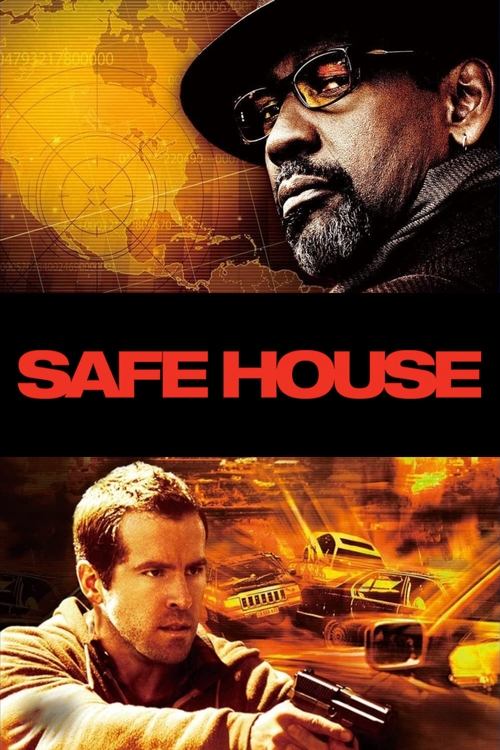
Safe House
2012 · Daniel Espinosa
For when you want a slick, adrenaline-forward spy thriller you don't have to take notes on — a Friday-night action fix with just enough betrayal and doubt to keep your brain in the game.
What it's about
A rookie CIA operative has spent a year babysitting an empty safe house in Cape Town, desperate for real action — until the Agency's most notorious traitor, a legendary rogue agent, is dragged in for interrogation. When mercenaries hit the house, the kid escapes with the prisoner in tow, and the two are forced into a wary alliance across the city while trying to figure out who inside the Agency wants them both dead.
The experience
Fast, loud, and relentlessly physical — car chases through township streets, bruising close-quarters fights, a stadium set piece — with a mind-game simmering underneath as the veteran needles the rookie's faith in the institution. Popcorn-paced with a cynical edge.
Performances
Denzel Washington is the reason to watch: as the renegade Tobin Frost he radiates calm, amused menace, turning every interrogation and back-seat conversation into a chess move. Ryan Reynolds holds his own as the in-over-his-head rookie, playing it straight and rattled.
The craft
Shot in a handheld, grainy, abrasive style that keeps the action scrappy and ground-level, with Cape Town — its highways, townships, and a packed soccer stadium — giving the chases a texture most studio spy films don't have. Rewards good speakers; the shootouts and vehicle work hit hard.
Why it matters
A solid hit that showed the gritty, morally cynical post-Bourne spy style could be built around star chemistry rather than a franchise, and it helped launch director Daniel Espinosa in Hollywood.
Snapshot
Safe House is a kinetic, two-hander CIA thriller that pairs an aging, disillusioned master spy with a green operative and runs them through a single propulsive night-and-day of betrayal in Cape Town. Built on a simple but durable engine — the safe-house "housekeeper" who has never seen action suddenly forced to keep alive the most dangerous man the Agency has ever produced — it is best understood as a high-gloss studio distillation of the post-Bourne espionage idiom: handheld, abrasive, morally cynical, propelled by close-quarters fights and vehicular chaos rather than gadgetry or geopolitics. Its distinguishing assets are two: Denzel Washington as the renegade Tobin Frost, lending genuine gravity and menace to a role that on the page is largely a cipher of cool; and the South African setting, which gives a familiar genre its one note of real texture. The film's true subject, beneath the chases, is institutional rot — the suspicion, by now a genre reflex, that the agency hunting the protagonists is the thing most worth fearing. It marked the English-language debut of Swedish-Chilean director Daniel Espinosa and was a substantial commercial success that nonetheless drew sharply divided reviews.
Industry & production
Safe House was a Universal Pictures release produced by Scott Stuber's Bluegrass Films, a project assembled around a spec screenplay by David Guggenheim that had circulated in Hollywood as an admired unproduced script before reaching production — Safe House is frequently cited among the era's well-regarded spec sales, the kind of clean, castable thriller premise that studios prize. The picture's signal industrial decision was its director: Universal hired Daniel Espinosa, then known internationally only for the Swedish crime film Snabba Cash (Easy Money, 2010), to make his Hollywood debut on a star-driven action vehicle — part of a broader 2010s pattern of studios importing genre directors from European and Scandinavian cinema (Niels Arden Oplev, Tomas Alfredson, the Norwegian and Danish action exports) on the strength of a single calling-card film.
The other defining production choice was location. Safe House shot principally in South Africa — Cape Town and its surrounds, with sequences staged in Langa and other townships, plus Johannesburg — making sustained use of a city that Hollywood had only intermittently exploited. The South African production base supplied a fresh backdrop, favorable costs, and a genuinely distinctive geography of harbor, highway, hillside, and informal settlement that the film exploits for its set pieces.
Casting put a bankable, awarded lead opposite a rising star: Denzel Washington as Tobin Frost and Ryan Reynolds as Matt Weston, supported by a deep bench of character actors as the Langley brass whose machinations frame the action — Vera Farmiga, Brendan Gleeson, and Sam Shepard as competing CIA superiors, with Rubén Blades, Robert Patrick, Liam Cunningham, and Nora Arnezeder in the field. Notably, Joel Kinnaman — the star of Espinosa's Easy Money — appears in a supporting role, a thread of continuity the director carried from his Swedish breakout into Hollywood. The film opened in February 2012 and proved a strong earner, comfortably outgrossing its mid-range budget on a worldwide basis and ranking among Washington's more successful star vehicles of the period; precise figures vary by source, but the commercial outcome is not in dispute.
Technology
Safe House is technologically conventional for a 2012 studio action picture, and deliberately so: its "technology" is an aesthetic of analog roughness rather than digital novelty. The capture and finishing favor a gritty, desaturated, high-contrast look, and the film leans on practical action — real vehicles, real Cape Town streets, stunt-driven crashes and brawls — supplemented by unobtrusive visual effects rather than foregrounded spectacle. In the world of the story, technology is similarly demystified: the MacGuffin is a data file smuggled on a microchip, and the espionage apparatus is rendered as surveillance feeds, phone traces, and biometric scans — the bureaucratic plumbing of modern intelligence — rather than as exotic hardware. This is consistent with the Bourne-derived school the film belongs to, which made a virtue of stripping the spy film of Bondian gadgetry in favor of bodies, cars, and improvised objects.
Technique
Cinematography
The film's most consequential craft credit is cinematographer Oliver Wood, who shot all three of the original Bourne films — The Bourne Identity, Supremacy, and Ultimatum — and whose hiring all but declares the movie's visual allegiance. Wood brings the same restless, handheld, available-light-inflected grammar: close, jostling framing in the fights; long-lens compression and whip-pans in the chases; a muted, sun-bleached and grime-toned palette suited to the South African light and the film's atmosphere of distrust. The camera is rarely still and rarely grants a clean, stabilizing overview; the viewer is kept inside the disorientation of the characters. It is a competent, sometimes vivid execution of a now-codified style — and, by 2012, a style so widely imitated that critics could no longer treat it as fresh, a tension that shadows the film's reception.
Editing
Cut by Richard Pearson (an editor with substantial studio action experience), Safe House moves at the relentless clip its premise demands, assembled around rapid, percussive cutting in the action beats and brisk cross-cutting between the fugitives in the field and the CIA command rooms tracking them. The editing is the chief instrument of the Bourne manner here: fast enough to generate kineticism and to paper over the geographic and logical seams of close-quarters combat, but, in the view of the film's detractors, fast enough to sacrifice spatial legibility — the recurrent complaint against the entire shaky-cam-plus-fast-cutting cycle. The parallel structure also performs the plot's machinery, intercutting the chase with the Langley scenes so that the institutional conspiracy and the physical pursuit tighten in tandem toward the reveal.
Mise-en-scène / staging
The staging exploits a strong set of contrasting environments: the clean, anonymous interiors of the titular safe house and its successors; the brutalist hush of CIA operations centers; and, against them, the crowded, sensorially dense exteriors of Cape Town — the harbor, the freeways, a soccer stadium, and the corrugated-iron density of a township, the film's standout location. The single most discussed staging set piece is an extended chase and shootout that spills through a packed stadium and into the surrounding informal settlement, using the geography of the place for genuine texture and scale. The production design keeps the espionage world deglamorized and procedural — server rooms, motel rooms, interrogation chambers — so that the eruptions of violence register against a backdrop of bureaucratic ordinariness.
Sound
Ramin Djawadi composed the score, working in a propulsive, percussion- and pulse-driven mode with electronic textures — functional tension music that drives the action and underscores the dread without much thematic identity, in keeping with the contemporary action-thriller template. The sound design is aggressive and immersive in the set pieces — the concussive report of gunfire in enclosed rooms, the metal-on-metal of the car chases, the ambient churn of the township and stadium crowds — and contributes substantially to the film's visceral, you-are-there intensity. As with the cinematography, the sonic approach prioritizes immediacy over distinctiveness.
Performance
The performances are where critical consensus most clearly favored the film, and the asymmetry is the point. Denzel Washington anchors the picture as Tobin Frost with a watchful, unhurried authority — a man who has decided everyone is corrupt and is rarely wrong — investing a fundamentally opaque role with menace, weariness, and the occasional flicker of perverse tutelage toward his captor-protector. It is a star performance in the truest sense: it supplies the gravity the screenplay withholds. Ryan Reynolds, as the idealistic, in-over-his-head Weston, plays the audience surrogate, his earnestness and mounting disillusionment set against Washington's cynicism; the film's spine is the friction and grudging exchange between them. The supporting ensemble — Vera Farmiga, Brendan Gleeson, and Sam Shepard as the maneuvering CIA principals — lends class and ambiguity to the conspiracy plot, their competence at suggesting hidden agendas doing much of the film's narrative work.
Narrative & dramatic mode
Safe House runs on one of the genre's most reliable structures: the forced-pairing chase, in which antagonists become reluctant allies under continuous external threat, and the younger man's education is the real arc. Its dramatic mode is propulsive and compressed — near-real-time urgency, a constantly moving target, a ticking sense that the next attack is imminent — overlaid on a conspiracy/whodunit framework: who ordered the hit on the safe house, and who inside the Agency is the traitor? The two registers reinforce each other, the physical pursuit serving as the surface while the institutional mystery supplies the turns. The film's emotional through-line is the mentor-protégé relationship between Frost and Weston, with Frost functioning as a corrupting/clarifying oracle who forces the rookie to confront the rot in the institution he serves. The mode is closer to relentless momentum than to suspense in the Hitchcockian sense; the pleasure is kinetic and the revelations, while present, are subordinate to the chase.
Genre & cycle
The film sits squarely in the post-Bourne CIA action-thriller cycle that dominated the espionage genre from the mid-2000s into the 2010s — a cycle defined by handheld realism, brutal hand-to-hand combat, vehicular set pieces, globe-trotting (or single-city) pursuit, and a default cynicism toward the intelligence apparatus, in which the deep-state conspiracy is the true antagonist. Its nearest genre kin include the Bourne films themselves (with which it shares a cinematographer), and the broader run of "rogue agent / corrupt agency" thrillers. The Frost–Weston pairing also locates it in the long lineage of the buddy/escort thriller — the seasoned cynic and the green idealist handcuffed together — that runs from older transport-the-prisoner pictures through countless action variants. Safe House is a polished, mainstream synthesis of these conventions rather than an innovator within them.
Authorship & method
Safe House is more a producer-and-star vehicle than an auteurist statement, but its authorship is legible in a few hands. Daniel Espinosa, directing his first English-language film, brought from Easy Money a taste for grimy realism, morally compromised characters, and propulsive momentum, and he carried over collaborator Joel Kinnaman; the film served as his Hollywood proof-of-concept, leading to Child 44 (2015), the sci-fi thriller Life (2017), and the comic-book film Morbius (2022). His method here is one of execution within a studio template rather than personal reinvention — capable, energetic, and faithful to the genre's codes. The screenplay is the work of David Guggenheim, an early produced credit that launched a career in thrillers and television. The decisive craft author is cinematographer Oliver Wood, whose Bourne pedigree shapes the entire visual and kinetic identity; editor Richard Pearson and composer Ramin Djawadi complete the technical authorship in the same idiom. Above all, Denzel Washington's star authorship — his control of tone, his ability to make Frost magnetic — is arguably the film's strongest organizing force, the element most responsible for its commercial appeal.
Movement / national cinema
Safe House is a Hollywood studio production and belongs to no national-cinema movement in the strict sense, but two transnational currents run through it. The first is the 2010s pipeline of Scandinavian and European genre directors into Hollywood action filmmaking, of which Espinosa's hiring on the strength of Easy Money is a textbook instance. The second is the use of South Africa — its locations, crews, and incentives — as a production base for international cinema; Safe House is among the more prominent studio films to foreground Cape Town not merely as a cost-saving stand-in but as an identifiable, atmospherically specific setting, with its township and harbor geographies woven into the action. If it belongs to a "movement," it is this globalized, location-mobile mode of contemporary studio production.
Era / period
The film is a product of the early-2010s intelligence thriller, made in the long shadow of the post-9/11 surveillance state and the disillusionment that followed the War on Terror's revelations about rendition, secret detention, and institutional bad faith. Its premise — that the gravest danger comes not from a foreign enemy but from within one's own agency, and that an exposed file of damning data is worth killing to bury — speaks directly to an era preoccupied with leaks, whistleblowers, and the unaccountability of the security apparatus (the cultural moment that, the following year, the Snowden disclosures would crystallize). The reflexive cynicism toward the CIA, the assumption that catastrophe flows from internal corruption rather than external villainy, is characteristic of its period's spy cinema.
Themes
The film's master theme is institutional corruption and the enemy within: the conviction that the agency sworn to protect is itself the source of the threat, and that loyalty to the institution is naïveté waiting to be cured. Around it cluster: the loss of innocence, traced through Weston's transformation from believing housekeeper to disillusioned operative; mentorship as corruption-and-clarification, with Frost as the cynic who teaches the younger man to see the rot; trust and betrayal, the currency in which every relationship in the film is transacted; and the moral cost of the secret world, the way the apparatus consumes the people who serve it. The data file that drives the plot — evidence of intelligence-agency wrongdoing — literalizes the theme: the truth about the institution is the thing everyone is willing to kill for. These are well-worn genre themes, executed with conviction rather than reinvented.
Reception, canon & influence
Critically, Safe House met a divided, broadly middling response. Reviewers consistently singled out Denzel Washington's performance — and the Washington–Reynolds dynamic — as the film's strongest asset, while faulting the picture for a derivative, over-familiar plot and, above all, for the by-then-exhausted Bourne-style shaky-cam-and-fast-cutting action that many found incoherent and wearying. The dominant critical verdict was of a competently made, well-acted, but conventional thriller that brought little new to a crowded genre. Commercially, by contrast, it was a clear success, comfortably exceeding its budget worldwide and standing as one of the more profitable entries in both Washington's and Espinosa's filmographies of the period — a gap between critical and popular reception typical of star-driven genre cinema.
Looking backward, its influences are unmistakable: the Bourne trilogy as the defining stylistic and tonal model (made literal through Oliver Wood's cinematography), the broader post-9/11 corrupt-agency thriller, and the venerable escort/buddy-thriller structure of cynic-paired-with-idealist. Looking forward, Safe House exerted little distinct influence on the genre — it is a consolidator and a beneficiary of trends rather than an originator — but its consequences are real in two register: it established Daniel Espinosa as a working Hollywood director, opening the path to his subsequent studio films, and it reinforced South Africa's, and Cape Town's, viability as a setting and production base for international action cinema. Within its cycle it remains a representative, professionally executed example — frequently cited as a showcase for Washington's late-career command of the genre, and as a case study in how thoroughly the Bourne aesthetic had become the default grammar of the studio spy film by the early 2010s.
A Deleuzian reading
The room is nowhere.
The full Deleuzian reading of Safe House →
Reception
A February 2012 hit that critics shrugged at (mixed reviews, endless Bourne comparisons) but audiences turned into one of Denzel's biggest openings — today it's less reappraised than fondly re-shelved as a prime example of the mid-budget star thriller Hollywood stopped making.
How Safe House was received, from release to now →
Influences: the films it descends from and the films it influenced
- The Bourne Supremacy (2004) — Established the handheld shaky-cam-plus-fragmentary-fast-cutting action grammar — shot by Oliver Wood — that Safe House adopts wholesale, down to the same DP rendering chases as disorienting bursts rather than legible geography.
- The Bourne Identity (2002) — Originated the post-Cold-War rogue-asset-on-the-run template and Oliver Wood's desaturated, vérité spy look that Safe House inherits as its default visual identity.
- The Bourne Ultimatum (2007) — Codified parallel cross-cutting between surveillance command-rooms and ground-level pursuit — the institutional-corruption-watching-its-own-agent structure Safe House restages in its CIA op-center scenes.
- Training Day (2001) — Built the deglamorized-procedural mentor-protégé friction with Denzel as the magnetic, morally compromised veteran corrupting an idealistic junior — the exact performance register and pairing Washington reprises as Tobin Frost.
- Three Days of the Condor (1975) — Defined the paranoid corrupt-agency conspiracy-whodunit in which the protagonist cannot trust his own institution — the plot architecture Safe House updates for the post-9/11 surveillance era.
- The French Connection (1971) — Pioneered the grain, handheld vérité immediacy and deglamorized urban-procedural realism that the Bourne school, and through it Safe House, treats as the signature of authenticity.
- Midnight Run (1988) — Set the forced-pairing escort-chase chassis — cynical professional cuffed to a reluctant charge, bickering across a cross-country flight from corrupt pursuers — that Safe House transposes into the spy genre.
- Snabba Cash (Easy Money) (2010) — Espinosa's own grimy, propulsive realism and morally compromised-protagonist sensibility — plus collaborator Joel Kinnaman — carried directly into Safe House as his Hollywood proof-of-concept.
- 2 Guns (2013) — Another Scandinavian-director-to-Hollywood Denzel vehicle in the deglamorized-procedural, institutional-corruption register, riding the same Washington late-career genre command Safe House showcased.
- Child 44 (2015) — Espinosa's immediate next film, carrying forward the desaturated palette, grimy-realist procedural texture and conspiracy-against-the-state structure his Safe House success enabled.
- The Equalizer (2014) — Extends Washington's deglamorized late-career action authorship — quiet menace plus brutal procedural set-pieces — that Safe House helped re-establish as a commercial Denzel brand.
- Sicario (2015) — Refines the same desaturated palette, immersive percussive sound design and deglamorized inter-agency conspiracy procedural into a more controlled, dread-driven form than Safe House's frenetic cutting.
- Quantum of Solace (2008) — Demonstrates the same Bourne-contagion — frenetic fast-cutting and handheld chaos imported into a previously classical franchise — that made the shaky-cam idiom the default studio-spy grammar Safe House works in.
- Body of Lies (2008) — Shares the post-9/11 corrupt-agency thriller's deglamorized field-procedural texture and conspiracy of institutional betrayal, staged in a non-Western production locale as Safe House does in Cape Town.
- Salt (2010) — A peer post-Bourne studio spy vehicle built on the same who-do-you-trust mole-whodunit and star-as-asset-on-the-run kineticism Safe House consolidates.
- Haywire (2011) — A contemporary rogue-operative-betrayed-by-handlers chase that pointedly rejects the shaky-cam idiom for legible long takes — the formal counter-argument to Safe House's fragmentary cutting.
- The Bourne Legacy (2012) — Released the same year and extending the identical franchise grammar — surveillance-state conspiracy plus Wood-school handheld pursuit — that Safe House borrows secondhand.
Similar films
- The Bourne Supremacy (2004) — influence & lineage
- The Bourne Legacy (2012) — influence & lineage
- The Equalizer (2014) — influence & lineage
- Training Day (2001) — influence & lineage
- Sicario (2015) — influence & lineage
- The Bourne Ultimatum (2007) — influence & lineage
- 13 Hours: The Secret Soldiers of Benghazi (2016) — shared sensibility
- Man on Fire (2004) — shared sensibility