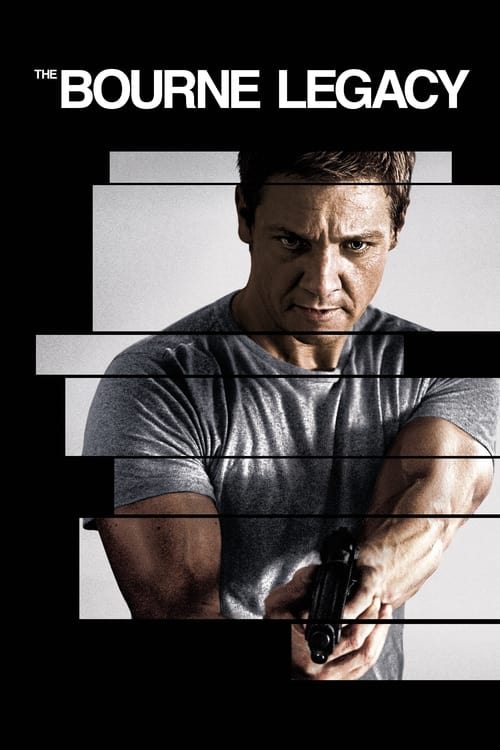
The Bourne Legacy
2012 · Tony Gilroy
For franchise completists and conspiracy-thriller fans in the mood for a competence story — a capable man versus an institution — without needing the emotional weight of the earlier films.
What it's about
When Jason Bourne's exposure of his old program reaches Washington, the intelligence apparatus decides to burn down every related black operation — including the one that produced Aaron Cross, an enhanced operative on a training rotation in the wilderness. Suddenly marked for erasure by his own government, Cross goes on the run and seeks out a pharmaceutical scientist who may be the only person able to keep him alive and functioning.
The experience
A slower, talkier burn than its siblings — more conspiracy procedural than chase film for long stretches, with bursts of sharp, brutal action when it moves. It's the entry for viewers who like watching a cover-up managed from conference rooms as much as escaped in alleys.
Performances
Jeremy Renner brings a wired, physical pragmatism that distinguishes Cross from his predecessor, and Rachel Weisz gives the scientist a convincing, escalating panic that keeps the stakes human.
The craft
Tony Gilroy, the franchise's longtime screenwriter, directs with an emphasis on institutional detail — how a purge is ordered, tracked, and executed — and stages a sustained final pursuit through Manila with real sweat and geography. The plotting interlocks cleverly with events from the earlier films.
Why it matters
It stands as a case study in how studios extend a marquee franchise past its star and director — a lateral expansion rather than a sequel, and a hinge point in the modern economics of series filmmaking.
Snapshot
The Bourne Legacy is the fourth installment in Universal's Bourne franchise and the first made without Matt Damon as Jason Bourne or Paul Greengrass in the director's chair. Conceived as a lateral expansion of the property rather than a direct sequel, it introduces Aaron Cross (Jeremy Renner), an operative in a black program adjacent to the Treadstone operation that produced Bourne. Its events run concurrently with those of The Bourne Ultimatum (2007): as Bourne's exposure of Treadstone reaches Washington, the intelligence apparatus moves to "burn down" its sister programs, and Cross becomes collateral the system tries to erase. The film is significant less for its own commercial standing than for what it represents institutionally — a studio's attempt to keep a marquee franchise alive by promoting its longtime screenwriter, Tony Gilroy, to director and shifting the saga from a single iconic body to the bureaucratic machine that manufactures such bodies. It is, accordingly, a more talk-driven, conspiratorial film than its predecessors, foregrounding the laboratories, oversight committees, and pharmacology behind the action.
Industry & production
The film exists because of a vacancy. After The Bourne Ultimatum, both Damon and Greengrass declined to return for a fourth picture without the other, leaving Universal with a valuable property and no protagonist. The studio's solution was to broaden the world rather than recast Bourne. Tony Gilroy — who had written or co-written all three prior films and had since established himself as a director with Michael Clayton (2007) and Duplicity (2009) — was engaged to write and direct a continuation built around a new agent. He developed the screenplay with his brother Dan Gilroy.
The title borrows from Eric Van Lustbader's continuation novels (Robert Ludlum, the original author, died in 2001, after which Lustbader extended the series), but the film adapts none of that material; it is an original screenplay using the franchise's branding and the established Treadstone mythology. The production assembled a notably prestigious craft team for an action tentpole — cinematographer Robert Elswit, an Academy Award winner, and composer James Newton Howard — signaling an intent to lend the spin-off the same sober credibility the series had cultivated. The film was released by Universal Pictures in August 2012. Reliable detail on its precise budget and worldwide gross varies across sources, so figures are best treated with caution here; the broad consensus is that it performed respectably but below the Damon-era peak, enough to leave a follow-up in question rather than guaranteed.
Technology
The Bourne Legacy sits at the tail end of the celluloid era for major studio action filmmaking. Robert Elswit, long associated with photochemical capture in his work with Paul Thomas Anderson, brought a film-based, naturalistic sensibility to the production rather than the era's emerging digital-capture workflow; the precise format details are not something to overstate, but the film's grain, latitude in low light, and handling of natural exteriors are consistent with a photochemically-minded approach. Within the story, technology is thematically central in an unusually literal way: the "Outcome" program depends on pharmaceutical "chems" — colored pills that elevate physical and cognitive performance — and the plot's engine is biotechnology, specifically a gene-therapy "viral" process meant to make Cross's enhancements permanent and free him from dependency on the pills. This pivot from the surveillance-and-pursuit technology of the earlier films (cell-phone triangulation, CCTV grids, satellite tracking) toward genetic and pharmacological engineering reflects a contemporary anxiety about the biological optimization of soldiers.
Technique
Cinematography
Elswit's photography is the film's most distinctive formal departure from the Greengrass entries. Where Greengrass and his cinematographer Oliver Wood built a jittery, handheld, immersive verité style, Elswit composes with more stability, depth, and legibility. The Alaska-set opening — Cross surviving a brutal wilderness training ordeal in snow and forest — is shot with a clarity and landscape grandeur foreign to the urban claustrophobia of the prior films. Interiors of the intelligence "situation rooms" are handled in cooler, controlled light. The result is a more classically readable action film: the audience can generally follow geography and bodies in space. This legibility was read by some viewers as a welcome corrective to franchise vertigo and by others as a loss of the kinetic urgency that defined the brand.
Editing
Editing duties fell to John Gilroy, another of the director's brothers, who had cut Michael Clayton. His work here is paced for a different rhythm than Greengrass's. The earlier Bourne films, edited by Christopher Rouse, were famous for a rapid, percussive cutting style that fragmented action into adrenalized shards. Legacy is more measured, allotting long stretches to exposition, procedure, and dialogue — the oversight committees deliberating, the laboratory back-story, Cross and Dr. Marta Shearing (Rachel Weisz) on the run and explaining the program to each other and to us. The film front-loads a great deal of setup, and the editing reflects that structural choice: the propulsion arrives late, concentrated in the Manila-set climax.
Mise-en-scène / staging
The film stages two contrasting worlds: the wild and the institutional. The wilderness sequences emphasize the lone, hyper-capable body against nature; the bureaucratic sequences emphasize sterile rooms, screens, and the faces of administrators managing a crisis. The action design culminates in an extended motorcycle and rooftop chase through Manila, exploiting dense urban texture — narrow streets, crowds, slum rooftops — for its set piece. Throughout, staging keeps the human cost of the program visible in clinical settings: medical examinations, a mass-shooting at a research facility, the apparatus of testing and disposal.
Sound
James Newton Howard composed the score, succeeding John Powell, whose driving, propulsive music had become part of the franchise's identity. Howard's contribution maintains tension and momentum while inflecting it with his own idiom. The series' signature sonic signature — Moby's "Extreme Ways," used over the end credits of each prior film — returns here as well, preserving continuity of brand even as the protagonist changes. Sound design in the action sequences favors a grounded, physical impact consistent with Elswit's more legible imagery.
Performance
Jeremy Renner, fresh from The Hurt Locker (2008) and his ascent through ensemble blockbusters, plays Cross with a wary intelligence and physical conviction, but the character is conceived differently from Bourne: less an amnesiac cipher than a man terrified of cognitive regression should he lose access to the chems, which gives Renner an anxious, motivated edge. Rachel Weisz, as the program scientist Marta Shearing, supplies the film's emotional and moral center, her terror and competence anchoring the long expository passages. Edward Norton plays Eric Byer, the retired officer brought in to manage the crisis — a cool, rationalizing bureaucrat rather than a physical antagonist, embodying the film's interest in the men who give the orders. The cast also folds in returning franchise figures and respected character actors (among them Stacy Keach, Donna Murphy, Scott Glenn, and a brief appearance by Oscar Isaac), and the film stitches itself to the earlier installments through cameo continuity with the prior films' intelligence officials.
Narrative & dramatic mode
Structurally, Legacy is a chase film wrapped around an exposé. Its dramatic mode is closer to the paranoid conspiracy thriller — Gilroy's home territory in Michael Clayton — than to pure action spectacle. The narrative is built on simultaneity: rather than continuing the timeline after Ultimatum, it threads through the same days, treating Bourne's actions as an off-screen cause whose blast radius destroys neighboring programs. This is an ambitious, intertextual conceit that rewards familiarity with the third film while risking opacity for newcomers. The script devotes much of its running time to establishing the rules of a new world — the chems, the genetic "viraling off," the chain of command — and defers conventional payoff. Its most-discussed structural weakness is the ending: the film resolves the immediate chase but stops rather than concludes, plainly engineered as the first chapter of an intended new series.
Genre & cycle
The film belongs to the post-9/11 cycle of intelligent, anti-triumphalist American spy thrillers that the Bourne series itself did much to define — pictures skeptical of state secrecy, torture, and the security apparatus, in pointed contrast to the gadget-driven fantasy of classic Bond. Within that cycle, Legacy extends the franchise's signature: the operative as victim of his own makers, the agency as the true antagonist. It also participates in the early-2010s vogue for franchise expansion through spin-off and "shared universe" thinking, attempting to convert a trilogy built on one character into an ongoing, multi-protagonist property.
Authorship & method
The dominant authorial signature is Tony Gilroy's. As the writer who shaped the previous three films and as a director drawn to institutional corruption and the moral compromises of professionals (Michael Clayton, Duplicity), Gilroy steers the franchise toward his abiding preoccupations: bureaucracy, deniability, and the people who do the system's dirty work. The screenplay's interest in oversight, liability, and the management of scandal is recognizably his. The production is notably a family enterprise on the creative side — Tony directing and co-writing, Dan Gilroy co-writing, John Gilroy editing — which lends the film an unusually unified authorial method for a studio tentpole. The key external collaborators reinforce a prestige sensibility: Robert Elswit's cinematography and James Newton Howard's score both pull the material toward gravity and craft rather than spectacle alone. The tension at the film's heart is between Gilroy's talky, procedural instincts and the franchise's demand for relentless motion — a tension the film never fully resolves.
Movement / national cinema
This is mainstream American studio filmmaking, a Hollywood franchise product. It carries no claim to a film movement, though it is shaped by the post-Bourne convention — now widely imitated — of grounded, documentary-inflected espionage action. Its globe-spanning production (sequences set in Alaskan wilderness, the corridors of American intelligence, and the streets of Manila) reflects the international logistics typical of contemporary blockbuster filmmaking rather than any national-cinema identity.
Era / period
The Bourne Legacy is very much a film of the early 2010s. It arrives at the close of the photochemical age in tentpole production and at the dawn of the "extended universe" strategy that would dominate the decade. Its thematic anxieties — the pharmacological and genetic enhancement of soldiers, the privatized and deniable corners of the security state, the disposability of human assets — belong to the post-9/11, post-financial-crisis American mood the broader franchise had been articulating since 2002. It also reflects a transitional moment for the action star: Renner was being positioned, here and across concurrent franchises, as a dependable lead, and Legacy was part of that elevation.
Themes
The film's central themes are dependency and disposability. Cross's reliance on the chems literalizes the franchise's recurring idea that the state manufactures its agents and can unmake them; his fear of cognitive decline reframes the super-soldier fantasy as a story of addiction and precarity. Surrounding this is the theme of bureaucratic erasure — the calm, administrative decision to liquidate a program and everyone in it, dramatized through Byer's rationalizations and the laboratory massacre. Knowledge and complicity run throughout: the scientists who built the program and the officials who run it are bound together by what they know, and survival depends on who can be persuaded that the truth has not escaped. Beneath all of it lies the series' enduring question of whether a person engineered to serve can reclaim ownership of his own body and mind.
Reception, canon & influence
Critical reception was mixed. Reviewers frequently praised the performances — Renner's intensity, Weisz's grounding presence, Norton's controlled menace — and Elswit's cinematography, while faulting the film for a slow, exposition-heavy first half and an ending that arrives abruptly without true resolution. A recurring critical observation was that Legacy substituted explanation for momentum, and that its concurrent-timeline conceit, while clever, made it feel ancillary to the Damon films rather than fully autonomous. Audience response was similarly divided between appreciation for its sober intelligence and frustration at its withheld payoff.
The influences on the film are clear and acknowledged: the three Greengrass/Liman Bourne pictures (and Gilroy's own scripts for them), Ludlum's franchise mythology as branding, and Gilroy's directorial template from Michael Clayton. Its forward legacy is more about a road not taken. A continuation centered on Aaron Cross was anticipated, but Universal ultimately chose instead to reunite Damon and Greengrass for Jason Bourne (2016), which returned the saga to its original protagonist and left the Cross storyline unresolved and effectively orphaned. As a result, The Bourne Legacy now occupies an unusual place in the canon: a competently made, ambitiously conceived spin-off that functions as a fascinating case study in the limits of franchise transplantation — what is lost when an iconic character is replaced by the world that produced him, and how difficult it is to migrate audience loyalty from a face to a system. Its most lasting interest may be precisely that institutional lesson, which the broader film industry would relearn repeatedly across the decade of "shared universe" experiments that followed.
A Deleuzian reading
There is a man alone in the Alaskan wilderness, hauling himself across ice and through freezing water, scaling rock with a competence that makes him look like one more feature of the landscape.
The full Deleuzian reading of The Bourne Legacy →
Reception
Landed in 2012 as the 'Bourne movie without Bourne' — a decent earner but a critical shrug, widely read as a placeholder until Matt Damon came back. It hasn't been reclaimed since; if anything, Jason Bourne (2016) underwhelming just made Legacy feel like the franchise's forgotten middle child rather than a hidden gem.
How The Bourne Legacy was received, from release to now →
Influences: the films it descends from and the films it influenced
- The Bourne Identity (2002) — Established the franchise's handheld, available-light realism and the trained-agent-improvising-with-found-objects fight grammar that Legacy inherits wholesale, down to Moby's 'Extreme Ways' as the recurring end-credit signature.
- The Bourne Supremacy (2004) — Greengrass's fragmented vérité editing and the agency-control-room intercut-with-field-operative structure are the template Gilroy must shoot around, since Legacy keeps the surveillance-bureaucracy apparatus even after swapping protagonists.
- The Bourne Ultimatum (2007) — Gilroy scripted its concurrent-timeline overlaps (events glimpsed in Ultimatum recur in Legacy from another angle), making Legacy a literal formal continuation of the chase-wrapped-around-an-expose architecture he helped build.
- Michael Clayton (2007) — Gilroy's directorial debut supplies Legacy's exact DNA: talky procedural pacing, the corporate/agency fixer managing liability and deniability, and the bureaucrat-antagonist (Norton echoing Tilda Swinton) rehearsing scandal-containment in clipped boardroom exposition.
- Duplicity (2009) — Gilroy's prior film with editor John Gilroy refines the measured, information-withholding cutting and corporate-espionage-as-procedure tone that Legacy applies to the intelligence world — the family-enterprise editing method made explicit.
- Three Days of the Condor (1975) — The foundational hunted-analyst-on-the-run template: an agency expendable discovers his own program wants him erased, the post-Watergate ancestor of Legacy's dependency-and-disposability and bureaucratic-erasure themes.
- The Parallax View (1974) — Pakula's paranoid framing of the individual dwarfed by an opaque institution — the conspiracy-thriller grammar of figures isolated within vast cold interiors that Gilroy and Elswit restage as agency war-rooms.
- The French Connection (1971) — The ur-text for documentary-style urban pursuit shot in real traffic and crowds, the genre innovation behind Legacy's Manila motorcycle-and-rooftop chase climax staged amid actual street density.
- Syriana (2005) — Robert Elswit's earlier geopolitical-thriller cinematography — desaturated, photochemical naturalism across multiple international threads — is the exact visual register he carries into Legacy's globe-hopping procedural.
- There Will Be Blood (2007) — Elswit's celebrated photochemical, naturalistic-light approach here is the craft credential Legacy imports to pull a tentpole toward gravity and texture rather than digital spectacle.
- The Fugitive (1993) — James Newton Howard's propulsive-yet-sober orchestral scoring for an innocent-man-pursued thriller prefigures his Legacy score, which leans on dread and momentum over bombast to dignify the chase.
- Jason Bourne (2016) — The direct descendant that reabsorbed the franchise's original face, retaining Legacy's agency-oversight-and-asset-disposal apparatus while reverting to Greengrass's kinetic cutting — the road taken instead of Cross.
Similar films
- The Bourne Supremacy (2004) — influence & lineage
- Jason Bourne (2016) — influence & lineage
- The Bourne Ultimatum (2007) — influence & lineage
- The Bourne Identity (2002) — influence & lineage
- Sicario (2015) — influence & lineage
- The Matrix Reloaded (2003) — shared sensibility
- Safe House (2012) — shared sensibility
- Jack Reacher (2012) — shared sensibility