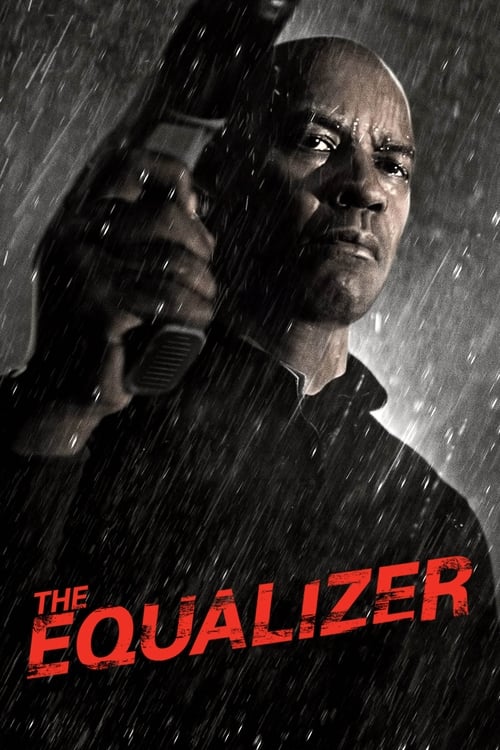
The Equalizer
2014 · Antoine Fuqua
For when you want the dark satisfaction of watching bad men get exactly what's coming to them — a violent comfort-food revenge picture for a late night when subtlety isn't the assignment.
What it's about
Robert McCall lives a monastic, meticulously ordered life as a clerk at a Boston home-improvement store, his violent past locked away where no one can see it. Then he befriends Teri, a teenage girl owned by Russian gangsters, and when they brutalize her, he decides the quiet life can wait. What follows pits one methodical man against an entire trafficking operation and the machinery behind it.
The experience
A slow burn that savors the stillness before each strike — long patient stretches of routine and menace, then sudden, surgical, wince-inducing violence. It's less a rollercoaster than a coiled spring, and the release is savage.
Performances
Denzel Washington carries the whole film on controlled stillness — the small rituals, the watchful eyes, the way calm becomes the scariest thing in the room. Few actors can make sitting quietly at a diner feel this loaded.
The craft
Fuqua stages the mayhem with deliberate build-ups and improvised-weapon ingenuity — the hardware store itself becomes an arsenal — and shoots nighttime Boston in slick, rain-glossed textures. The action is choreographed for clarity and impact rather than chaos, and it plays great loud.
Why it matters
It reinvented a 1980s TV premise as a star vehicle, launched a durable franchise, and cemented the Washington–Fuqua partnership as one of the reliable draws in modern studio action.
Snapshot
The Equalizer is a slow-burn vigilante thriller built around the controlled stillness of Denzel Washington, who plays Robert McCall, a former black-ops operative living an ascetic, deliberately small life as a clerk at a Boston home-improvement warehouse. When a teenage girl trapped in a Russian trafficking ring is brutalized, McCall reactivates a buried capacity for precise, methodical violence. Directed by Antoine Fuqua from a screenplay by Richard Wenk, the film adapts the 1985–1989 CBS television series of the same name — in which Edward Woodward played a courtly ex-intelligence officer who offered his services to the desperate via newspaper ad — but discards almost everything except the premise of a lethal protector answering the calls of the helpless. The picture is notable as the second collaboration between Washington and Fuqua after Training Day (2001), the film that won Washington his Best Actor Oscar, and it inverts that earlier dynamic: where Training Day made Washington a charismatic corruptor, The Equalizer makes him an avenging moral absolute. Commercially successful and tonally distinct from the era's frenetic action cinema, it launched a franchise — The Equalizer 2 (2018), the first sequel of Washington's career, and The Equalizer 3 (2023) — and stands as a defining entry in the 2010s cycle of "competent older man" action vehicles.
Industry & production
The film was produced and distributed by Columbia Pictures (Sony), with Escape Artists — the production company of Todd Black, Jason Blumenthal, and Steve Tisch, longtime Washington collaborators — among the principal producers. It belongs to a recognizable studio strategy of the early 2010s: reviving dormant intellectual property (here a nearly thirty-year-old network procedural) and reformatting it as a star-driven, hard-R action picture for an adult audience underserved by the franchise tentpoles dominating the calendar. The casting of Washington, a bankable star with credibility across prestige drama and commercial action, was the project's organizing principle; the property's recognition value was secondary to his presence. Richard Wenk, who had written The Mechanic (2011) remake, supplied a screenplay tuned to violent set-piece economy. The supporting cast paired Chloë Grace Moretz as the young woman, Teri/Alina, with Marton Csokas as Teddy, the tattooed enforcer-fixer dispatched by the Russian syndicate. The production filmed largely in and around Boston and Massachusetts, grounding an essentially mythic story of a lone protector in a specific, working-class American geography of late shifts, diners, and big-box retail. The commercial performance was strong enough to make a sequel a near-certainty, and the film's success helped cement Fuqua and Washington as one of the more reliable star-director partnerships in studio action filmmaking of the decade.
Technology
The Equalizer was shot digitally by cinematographer Mauro Fiore, working in the anamorphic-styled widescreen idiom that became standard for prestige action by the mid-2010s. The film's visual program leans on the strengths of modern digital capture in low light: much of the action unfolds at night, in rain-slick streets, in the sodium glow of the warehouse and the fluorescent flatness of its aisles, and in the deep shadow of the climactic confrontation. Digital sensors' tolerance for underexposure allowed Fiore to model McCall almost sculpturally out of darkness. The production used the controlled environment of the home-improvement store set as a stage for technologically inflected violence: McCall improvises weapons from the merchandise — nail guns, hand tools, hardware — which the film fetishizes with crisp focus and slow-motion punctuation, a technique that depends on high-frame-rate digital capture and precise post-production speed ramping. The picture's signature device, McCall's pre-action ritual of mentally clocking a room and timing his own efficiency by stopwatch, is rendered through a combination of subjective on-screen timing and quick analytical inserts — a stylization of "tactical perception" that owes something to the perception-as-montage conceit popularized by the Guy Ritchie Sherlock Holmes films, repurposed here for a colder, less playful effect.
Technique
Cinematography
Fiore — an Oscar winner for Avatar (2009) — gives the film a polished, high-contrast, desaturated palette of steel blues, blacks, and amber practicals. The camera is patient in the long first act, holding on Washington in static or slowly drifting compositions that let stillness carry meaning; it becomes more kinetic only when violence erupts. Reflective surfaces recur — windows, rain, the glass of the diner — isolating McCall within frames-within-frames, a visual correlative of a man watching the world from behind a pane. The climactic sequence in the darkened, sprinkler-flooded store is the film's bravura passage, lit in flickering fragments so that McCall moves through the space as a half-seen predator.
Editing
John Refoua, who cut Avatar and Olympus Has Fallen, edits for a deliberate rhythmic contrast: extended, unhurried scenes of routine and conversation set against compressed, brutal bursts of action. The film's most discussed stylistic gambit is its handling of McCall's combat as a near-instantaneous demonstration of overwhelming competence — fights resolved in seconds, the editing aligning the audience with his pre-visualized efficiency rather than with the chaos of the fight itself.
Mise-en-scène / staging
The production design organizes McCall's world around order and ritual: the obsessively neat apartment, the folded napkin, the book carried to the diner each night, the exact placement of a teacup. This controlled domesticity establishes the OCD-inflected discipline that the film later weaponizes. The big-box store is the central set-piece environment, its endless aisles converted from banal commerce into a lethal arena — a pointed staging of violence within the temple of American consumer normalcy.
Sound
The sound design foregrounds quiet: the tick of a watch, the turn of a page, the hum of fluorescent light. This near-silence makes the eruptions of violence and Harry Gregson-Williams's score land with greater force, and reinforces the characterization of McCall as a man of acute, controlled perception.
Performance
Washington's performance is the film's engine and its argument. He plays McCall with minimal external affect — economy of movement, watchful calm, a warmth reserved for the vulnerable and a flat blankness turned toward the guilty. The restraint is strategic: it makes the violence read as a moral verdict rather than a thrill. Csokas counters with a brittle, theatrical menace, and Moretz, in limited screen time, supplies the human stakes that justify McCall's return to violence.
Narrative & dramatic mode
The film operates in the mode of the redemptive vigilante parable, structured as a slow awakening. The long, almost novelistic first act establishes McCall's quiet life and his quasi-paternal bond with Alina before the plot's engine — her near-fatal beating — triggers his transformation. From there the narrative escalates through a series of confrontations from local pimps and corrupt police up the chain to a Russian crime syndicate and its enforcer Teddy. The dramatic structure is essentially that of the Western or the samurai tale: a retired master of violence, having renounced his skills, is morally compelled to take them up again, and the film treats this not as tragedy but as the restoration of a natural order. McCall's habit of reading "the hundred books one should read in a lifetime" — he is working through the list — frames his arc as a literary one, casting him as a figure consciously echoing Hemingway, Cervantes, and Ellison even as he dispenses justice.
Genre & cycle
The Equalizer belongs squarely to the 2010s cycle of the aging-protector action film, the lineage running through Taken (2008), the John Wick series (begun the same year, 2014), and a wave of pictures repositioning veteran male stars as quiet, lethal moral agents. Within that cycle it is distinguished by its slowness, its prestige-drama patience, and the moral seriousness Washington brings. It also participates in the IP-revival cycle, joining other film adaptations of old television properties. Its hard-R brutality aligns it with a counter-trend to PG-13 superhero spectacle: action for adults, with consequences rendered graphically.
Authorship & method
Antoine Fuqua's authorship runs through urban moral ambiguity, masculine codes under pressure, and a willingness to let violence carry ethical weight — concerns established in Training Day and continued across his filmography. Reuniting with Washington, Fuqua builds the entire picture around the actor's gravitas, trusting stillness and duration where other action directors would cut and accelerate. His key collaborators here are central to the result: cinematographer Mauro Fiore, whose darkness-modeled imagery defines the look; editor John Refoua, whose contrast of calm and rupture sets the rhythm; composer Harry Gregson-Williams, a frequent Fuqua partner, whose spare, electronic-orchestral score underscores the quiet; and screenwriter Richard Wenk, who supplied the violent set-piece architecture. The method is one of disciplined withholding — denying the audience the constant kinetic stimulation of contemporary action in order to make its eventual delivery feel earned and severe.
Movement / national cinema
The film is a product of mainstream American studio filmmaking and does not belong to any art-cinema movement, but it draws openly on transnational genre traditions: the American Western's lone gunman, the Japanese ronin film's masterless swordsman, and the European-inflected revenge thriller. Its Boston setting roots it in a specifically American working-class milieu, and its politics — a lone individual delivering justice where institutions (corrupt police, indifferent systems) fail — sit within a long American tradition of vigilante narrative.
Era / period
Released in 2014, the film is a clear artifact of mid-2010s Hollywood: the convergence of IP revival, the star vehicle's adaptation to a franchise economy, and the bifurcation of the market into PG-13 spectacle and adult-targeted hard-R genre fare. Its aesthetic of polished digital darkness, its perception-as-montage stylization, and its faith in the older male star as moral center all date it precisely to this moment. It arrived the same year as John Wick, and the two films together mark 2014 as a pivotal year for the reinvention of the action genre around disciplined, middle-aged competence.
Themes
The film's central theme is the impossibility of escaping one's nature: McCall's attempt at a quiet, anonymous life is undone by an inborn compulsion toward protection and justice. Surrounding this are themes of order versus chaos (literalized in McCall's rituals and his control of space), the corruption of institutions and the resulting necessity of private justice, and a quasi-religious notion of righteous violence as restoration rather than transgression. The film is also concerned with reading and self-improvement as moral discipline — McCall's literary project frames violence as continuous with the examined life — and with surrogate fatherhood, McCall's protection of Alina standing in for an absent family.
Reception, canon & influence
Critical reception was mixed-to-positive. Reviewers consistently praised Washington's controlled, commanding performance and Fuqua's confident craft while frequently noting the film's length, its tonal split between meditative drama and graphic violence, and the comic-book simplicity of its villains; the consensus held that Washington's gravitas elevated material that might otherwise have been routine. (Precise critical-aggregate scores and box-office figures are not cited here to avoid misstatement, but the film was a clear commercial success.)
The influences on the film (backward) are layered: most directly the 1985–1989 CBS series and Edward Woodward's gentlemanly avenger, though the adaptation retains little beyond the premise; beyond that, the Western's lone protector, the samurai/ronin tradition, and the immediate genre context of Taken and the older-hero revenge thriller. The perception-montage technique echoes the Sherlock Holmes films, and Fuqua's own Training Day informs the Washington persona being inverted here.
Its legacy forward is substantial within its genre lane. The film established a durable franchise — The Equalizer 2 (2018), notable as the first sequel Washington had ever made, and The Equalizer 3 (2023) — and contributed to a broader television reboot with Queen Latifah (CBS, 2021). More diffusely, alongside John Wick it helped consolidate the mid-2010s template of the quiet, hyper-competent older protector, demonstrating that an adult-skewing, slow-burn, hard-R action picture built on star presence rather than spectacle could anchor a franchise. It remains a benchmark for the Washington–Fuqua partnership and a representative case study in how 2010s Hollywood converted legacy television IP and veteran star power into sustainable commercial cinema.
A Deleuzian reading
Every night, the same diner, the same table, the same small liturgy.
The full Deleuzian reading of The Equalizer →
Reception
Critics shrugged in 2014 — too long, too generic, too violent — but audiences turned up hard, and a decade on it's settled comfortably into 'peak Denzel comfort-watch' status, the film that launched his first-ever franchise.
How The Equalizer was received, from release to now →
Influences: the films it descends from and the films it influenced
- Training Day (2001) — The original Fuqua–Washington collaboration that calibrated Washington's menace through a controlled, watchful gaze — the exact persona The Equalizer inverts from corrupt predator to righteous protector.
- Le Samouraï (1967) — Codified the solitary professional's ritual domesticity and precise pre-mission routine, the restrained-stillness performance grammar McCall's ascetic apartment life directly extends.
- Man on Fire (2004) — Prior Denzel vehicle fusing surrogate-fatherhood with escalating righteous violence on behalf of an endangered girl — the same redemptive-vigilante engine, minus Scott's frenetic cutting.
- Taken (2008) — Established the older-hero revenge-thriller template of a hyper-competent retired operative methodically dismantling a trafficking network with workmanlike brutality.
- Sherlock Holmes (2009) — Source of the perception-montage device — the protagonist pre-visualizes choreographed combat in slowed analytical beats before executing it in real time, McCall's signature 'clock' technique.
- Shane (1953) — The lone protector who tries to set down violence and is pulled back to defend the defenseless — the retired-master-returns Western archetype McCall reenacts in an urban register.
- Yojimbo (1961) — The wandering ronin who reads a corrupt power structure and surgically plays its factions against one another, the samurai-justice lineage behind McCall's tactical patience.
- Death Wish (1974) — Defined the urban-vigilante parable — an unassuming man delivering righteous street violence against predators the system won't touch.
- Unforgiven (1992) — The aging killer drawn back into violence, interrogating whether righteous violence restores or damns — the moral weight Fuqua grants each killing.
- A History of Violence (2005) — Built the calm-versus-rupture rhythm of a placid domestic surface shattered by sudden expert lethality — the mild man revealed as a master of violence.
- Léon: The Professional (1994) — The hard-R lone killer who becomes surrogate father to an imperiled youth, pairing tender mentorship with merciless competence.
- Shooter (2007) — Fuqua's direct continuation of the stoic-professional-craftsman formula: McCall is Swagger reconstituted as urban operative, with the same procedural-rhythm editing of methodical violence, the same character-actor menace ensemble, and the same institutional corruption as antagonist engine — now scaled into a franchise.
- The Equalizer 2 (2018) — Direct continuation that extends McCall's domestic-ritual vigilantism and the disciplined-withholding rhythm into Washington's first-ever sequel.
- Nobody (2021) — A suburban everyman's concealed lethal mastery erupting from domestic calm, inheriting the calm-versus-rupture structure and the hardware-store/improvised-arena set-piece logic.
- Logan (2017) — Elegiac hard-R action built on an aging, reluctant protector and surrogate-fatherhood toward an endangered child, trading kinetic spectacle for weary gravitas.
- The Foreigner (2017) — Extends the aging-protector lane with a grieving retired operative whose methodical, patient tradecraft drives a slow-burn vengeance.
- John Wick (2014) — Released the same year, it consolidated the quiet, ritualistic, hyper-competent older-protector template — a code-bound professional whose stillness makes the eventual violence read as severe rather than spectacular.
- Sicario (2015) — Shares the low-light digital, anamorphic widescreen aesthetic of darkness-modeled imagery and foregrounded quiet building dread before controlled bursts of violence.
- Eastern Promises (2007) — Descendant that inherits Eastern Promises' consolidation of vory tattoo iconography as shorthand for Russian organized crime, staging the villain's inked body as a legible criminal résumé the way the film taught mainstream cinema to read it.
Similar films
- John Wick (2014) — influence & lineage
- Man on Fire (2004) — influence & lineage
- Training Day (2001) — influence & lineage
- Nobody (2021) — influence & lineage
- Sicario (2015) — influence & lineage
- John Wick: Chapter 4 (2023) — shared sensibility
- Safe House (2012) — shared sensibility
- Shooter (2007) — shared sensibility