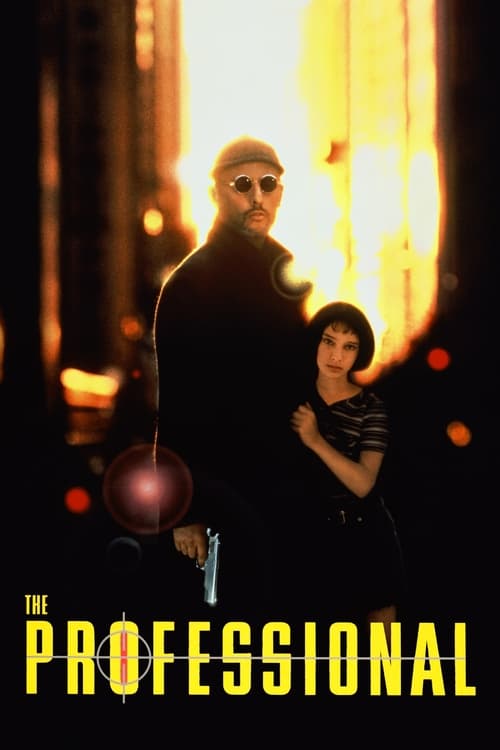
Léon: The Professional
1994 · Luc Besson
When you want a stylish 90s thriller with an actual beating heart — cathartic and cool rather than grim. Good for a night when you want to care about the people dodging the bullets.
What it's about
Léon is New York's best hit man — a near-silent, monkish 'cleaner' whose whole life is his routines, his milk, and his houseplant. When a corrupt DEA agent massacres the family next door, the sole survivor, twelve-year-old Mathilda, talks her way into his apartment and refuses to leave. She wants revenge, she wants him to teach her the trade, and his carefully sealed-off world starts cracking open.
The experience
Slick, violent, and unexpectedly tender — an action movie that keeps stopping to be a lonely-hearts story. It swings between operatic shootouts and odd, funny domestic scenes, with a live-wire villain who makes every one of his appearances feel dangerous. The bond at its center is genuinely moving and, by design or not, sits close enough to romance to leave some viewers uneasy.
Performances
Jean Reno makes a childlike innocent out of a professional killer; Natalie Portman, in her screen debut at thirteen, is startlingly assured as Mathilda; and Gary Oldman's pill-popping, Beethoven-quoting dirty cop is one of the great unhinged movie villains.
The craft
Luc Besson shoots New York with a European eye — long lenses, sudden bursts of balletic violence, action staged like opera rather than reportage. Éric Serra's moody score glues the cool and the melancholy together, and the apartment-corridor set-pieces are built with real precision. It's a film of texture and swagger that plays great loud.
Why it matters
It minted Natalie Portman as a star, crystallized the 90s archetype of the melancholy assassin with a soft center, and became Besson's defining English-language film — endlessly imitated by hitman movies since, and still argued over for the charge between its two leads.
Snapshot
Léon (released in France as Léon and in North America as The Professional) is Luc Besson's fifth feature, an English-language crime drama shot largely in New York City about a near-mute Italian hit man and the orphaned twelve-year-old girl who attaches herself to him after a corrupt DEA squad massacres her family. It crystallizes a particular 1990s sensibility: the action film as melancholic character study, the assassin as a figure of childlike innocence and arrested development, violence rendered with operatic stylization. The film is inseparable from three performances — Jean Reno's tender, monkish killer; Gary Oldman's flamboyantly unhinged dirty cop; and Natalie Portman's screen debut, which made her a star at thirteen — and from the persistent unease generated by the quasi-romantic charge between its adult and child leads, an unease Besson alternately courted and disavowed across the film's multiple cuts. It stands as the bridge between Besson's French stylist phase and his ascent to international, Hollywood-scaled spectacle.
Industry & production
Léon was produced through Besson's own company, Les Films du Dauphin, with backing from Gaumont, the French studio that had financed his earlier work and with which he was closely identified. It was a French production financed and steered from France but executed in English with an American setting and a substantially American-facing cast, a hybrid arrangement that reflected Besson's ambitions to operate at a larger commercial scale than the domestic French market allowed.
The project grew directly out of Besson's previous film. Nikita (La Femme Nikita, 1990) featured a supporting character — a coolly efficient "cleaner" named Victor, played by Jean Reno — who arrives to dispose of a botched job's aftermath. Besson has consistently described that figure as the seed of Léon; rather than developing a Nikita sequel, he expanded the cleaner archetype into a protagonist. By Besson's own account the screenplay was written quickly, and the film was produced in the interval between Nikita and his long-gestating science-fiction epic The Fifth Element (1997), partly because the larger project was not yet ready to mount.
Production used New York exteriors for authenticity of place while relying on studio facilities in France for interiors, a common practice that let Besson control the film's hermetic, designed look. The cast paired Besson's regular leading man Reno with established American and character actors: Danny Aiello as the restaurateur and mob fixer Tony who launders Léon's money, and Gary Oldman, then at a peak of his reputation for volatile screen villainy, as DEA agent Norman Stansfield. The decisive casting was Portman, selected after a search for the role of Mathilda; the part required a child performer able to carry adult dramatic weight and the film's discomfiting emotional register, and her selection is routinely cited as one of the more consequential debut castings of the decade.
The film exists in more than one version, a fact central to its production history and reception. The cut released theatrically in the United States was shorter; a longer cut — variously called the version intégrale, the International Version, or the "Director's Cut" — restored roughly twenty-odd minutes, principally scenes that deepen and complicate the Léon–Mathilda bond and show Mathilda accompanying Léon on jobs. Besson has indicated that some of this material was trimmed for American distribution out of concern over its reception, and the longer version's restoration of it is the source of much later critical debate.
Technology
Léon is a conventionally photographed mid-1990s 35mm feature, presented in a widescreen scope frame, and it does not depend on novel capture or post-production technology. Its visual distinction comes from craft and design rather than apparatus: lighting, lens choice, color, and physical effects for its gunplay and pyrotechnics. The climactic assault sequences rely on practical squibs, smoke, and staged destruction rather than digital augmentation, consistent with the period's action filmmaking before computer-generated imagery became routine for such work. Where the film feels technologically forward is less in tooling than in its glossy, advertising-influenced surface — a polish Besson and his cinematographer cultivated through controlled studio conditions.
Technique
Cinematography
The film was photographed by Thierry Arbogast, who became Besson's most important visual collaborator and would shoot The Fifth Element and other subsequent projects. Arbogast's work on Léon is defined by a warm, controlled palette — ambers and golds in the interior refuges, cooler register in the institutional and violent spaces — and by a willingness to let faces dominate the frame. The widescreen compositions isolate Léon within architecture, emphasizing his solitude, then close in tightly for the intimate two-handers between Reno and Portman. Camera movement is expressive rather than restless: gliding moves and dramatic angles punctuate the action setpieces, while the domestic scenes favor steadier framing that lets performance carry the meaning. The look is heightened and designed, closer to the saturated sheen of European commercial cinema and music video than to American naturalism.
Editing
The film was edited by Sylvie Landra, another recurring Besson collaborator. The cutting alternates between two rhythms: a propulsive, percussive assembly for the killings and the final siege, and a slower, observational patience for the apartment scenes where the central relationship develops. The contrast is structural — the film repeatedly withdraws from violence into stillness and back. The existence of the longer version intégrale makes editing a visible interpretive question here: the additional scenes do not merely lengthen the film but shift its emotional and moral balance, which is itself evidence of how much the work's meaning is constructed in the cut.
Mise-en-scène / staging
Besson stages Léon around a small set of charged spaces and objects. Léon's spartan apartment, his ritual of milk, his exercises, and above all his potted plant — which he tends, carries, and calls his only friend because it is "always happy" and has "no roots, like me" — externalize his arrested, rootless interiority. The plant functions as the film's governing symbol, and its planting in the earth at the close supplies the emotional resolution. The contrast between Léon's monastic order and Stansfield's chaotic, drug-fueled menace organizes the film's moral geography. Costuming reinforces character: Léon's round dark glasses and watch cap render him an anonymous, almost cartoon silhouette; Mathilda's choker and styling push her toward a precocious adulthood that the film both exploits and worries over.
Sound
The score is by Éric Serra, Besson's longtime composer, who scored nearly all of the director's films. Serra's music blends synthesized textures, bass-forward grooves, and lyrical passages, giving the film a contemporary, slightly melancholic electronic color rather than a traditional orchestral action sound. The film also makes pointed diegetic use of music as characterization, most famously through Stansfield, whose mania is tied to classical music — Beethoven especially — which he invokes while committing violence, fusing high-cultural reference to derangement. The closing use of Sting's "Shape of My Heart" over the finale has become one of the film's most recognized elements.
Performance
Performance is the film's center of gravity. Reno plays Léon with deliberate flatness and economy — limited speech, a hunched physical reticence, sudden lethal competence — so that the character reads as both dangerous and innocent, an overgrown child. Portman's debut is remarkable for its composure and emotional range under exposed conditions; she carries scenes of grief, bravado, and disconcerting forwardness with a control that belies her age. Oldman delivers a maximalist counterweight: twitchy, pill-swallowing, given to abrupt escalations from quiet to roaring, his Stansfield is one of the era's signature screen villains. Aiello supplies a grounded, transactional warmth as Tony. The friction between Reno's minimalism, Portman's poise, and Oldman's excess gives the film its distinctive tonal volatility.
Narrative & dramatic mode
The film operates as a melodrama housed inside an action-thriller. Its engine is an unlikely surrogate family formed by trauma: a man incapable of normal attachment and a child stripped of her own family find in each other something neither can name. The dramatic mode is intimate and two-handed for long stretches, punctuated by eruptions of stylized violence. Mathilda's arc is a revenge plot — she wants Léon to train her to kill the man who murdered her younger brother — but the film routes the revenge through the question of whether she will be allowed to become what Léon is, or be saved from it. The narrative is fairy-tale-like in shape (an orphan, a reluctant guardian, a monstrous ogre, a sacrificial rescue) while its content is adult and violent, and much of the discomfort it generates comes from the collision of those registers. The transgressive ambiguity of the central relationship — Mathilda's declared love, Léon's confused tenderness — is not incidental but the film's most discussed and most contested dramatic choice.
Genre & cycle
Léon belongs to the hit-man film, a genre with a long European lineage (Jean-Pierre Melville's Le Samouraï is the obvious antecedent for the disciplined, solitary, code-bound assassin) and a robust 1990s revival. It participates in the decade's fascination with the professional killer as existential figure and with stylized, choreographed gun violence. It also belongs to a smaller cycle pairing a lethal adult with a child or adolescent in a protective, transformative bond. Within Besson's own output it sits in a continuum of stylish action-melodramas with damaged protagonists — between Nikita, from which it directly descends, and the larger spectacle of The Fifth Element.
Authorship & method
Léon is a thoroughly auteurist work: Besson wrote and directed it, and it bears the consistent marks of his sensibility — the wounded loner, the surrogate-family bond, the fusion of slick action with sentiment, the child or youth thrust into a violent adult world. His method here, as elsewhere, is collaborative within a stable repertory company of craftspeople. The film is a node in a sustained working relationship: cinematographer Thierry Arbogast, composer Éric Serra, and editor Sylvie Landra were recurring members of Besson's creative team, and the continuity of their work across his films is part of what gives them a coherent visual and sonic signature. Reno, as Besson's frequent leading man, is similarly part of the authorial system. The screenplay's quick genesis and its derivation from a minor character in his prior film are characteristic of Besson's intuitive, momentum-driven approach to production.
Movement / national cinema
Besson is conventionally grouped with the cinéma du look, the 1980s French tendency — associated also with Jean-Jacques Beineix and Leos Carax — that prized glossy, advertising- and music-video-inflected visual style, youthful alienated protagonists, and surface spectacle, often at the expense of (or in deliberate provocation toward) the social-realist and intellectual traditions of French cinema. Léon postdates the movement's early-1980s heyday and represents its evolution into bigger-budget, internationally oriented filmmaking: a French-financed, French-authored film made in English and set in America. It is therefore best understood as French national cinema in an outward, globalizing phase — an instance of a European auteur deploying Hollywood genre and locations while retaining a distinctly non-American stylistic and emotional sensibility.
Era / period
The film is firmly of the mid-1990s, a moment when the stylized hit-man picture, glossy ultraviolence, and ironized genre filmmaking were ascendant in international cinema. Its electronic-inflected score, its fashion-conscious surfaces, and its New York grit-meets-glamour reflect the period. It also belongs to a pre-digital action era in which gun battles and destruction were realized practically. Viewed from later decades, the film is additionally a period document of shifting sensitivities: the very material that gave little pause in 1994 — the eroticized framing of a child character — has become the dominant lens through which contemporary criticism reassesses it.
Themes
The film's central themes are loneliness, surrogate family, and the transmission of violence across generations. Léon is a study in arrested development and rootlessness — the plant "with no roots" is his self-portrait — and the narrative asks whether human connection can take root in a life organized around killing. Innocence and corruption are juxtaposed throughout: Léon's childlike purity coexists with his lethality, while Stansfield's corruption wears the costume of law and culture. Revenge and its cost structure Mathilda's arc, posed as a choice between perpetuating violence and escaping it. Running beneath all of this is the film's most fraught theme — the unstable boundary between paternal protection and romantic desire — which the film stages without fully resolving, and which gives it both its emotional power and its enduring controversy.
Reception, canon & influence
On release the film drew a divided critical response and performed more strongly internationally than in the United States, where its initial reception was mixed and where the unsettling dimension of the central relationship was a recurring concern even in the shortened cut. Over time its standing rose substantially. It became a beloved cult and then near-canonical title, propelled especially by Portman's debut — now read as a landmark first performance — and by Oldman's villain, frequently cited among the great screen antagonists of the 1990s. The restored version intégrale sharpened later debate: as cultural standards shifted, the longer cut's franker treatment of Mathilda's feelings and her participation in violence drew renewed scrutiny, and the film is now routinely discussed as much for its ethical discomforts as for its craft.
Looking backward, the film's influences are legible: Melville's existential, code-bound assassins; Besson's own Nikita and its cleaner character; and the broader European tradition of the stylish, melancholic crime film. Looking forward, Léon proved widely influential on the action and crime cinema that followed. Its image of the disciplined, ascetic, almost saintly professional killer — solitary, ritualistic, bound by rules — fed a durable archetype that later films and franchises elaborated, and its pairing of a deadly protector with a vulnerable child became a recurring template in subsequent action storytelling. Besson himself continued the lineage in later productions he wrote and produced. The film's iconography — the round glasses, the milk, the potted plant, Stansfield's classical-music madness, the final whispered "everyone" and "no women, no kids" creed — entered the broader pop-cultural vocabulary, securing Léon's place as one of the defining stylized action dramas of its decade even as critical reassessment continues to wrestle with its central transgression.
A Deleuzian reading
A hit man drinks milk.
The full Deleuzian reading of Léon: The Professional →
Reception
In 1994 US critics were lukewarm and openly uneasy about the hitman-and-12-year-old premise, even as it hit big in Europe and Asia; it then spent two decades as a beloved gateway classic, and is now being re-examined all over again in light of the allegations against Besson.
How Léon: The Professional was received, from release to now →
Influences: the films it descends from and the films it influenced
- Le Samouraï (1967) — Jef Costello's monastic apartment ritual and economy of gesture are the template for Jean Reno's near-wordless minimalism — the lone professional defined by code and stillness rather than dialogue.
- Le Cercle Rouge (1970) — Establishes the existential, procedure-as-character grammar of the professional — long silent set-pieces built from method and discipline that Besson restages as Léon's tradecraft.
- La Femme Nikita (1990) — Léon is literally spun off from Victor 'the Cleaner', Reno's cameo here; it carries over the identical Arbogast/Serra/Landra repertory and the slick-action-plus-sentiment formula.
- Subway (1985) — Besson's underground cinema-du-look stylization — glossy surfaces, marginal loner inside a self-contained subculture — is the visual idiom Arbogast refines for Léon.
- Diva (1981) — Founding cinema-du-look text whose lacquered advertising-image surfaces and fetishized objects model Léon's high-gloss compositions and icon-making (glasses, plant, milk).
- Taxi Driver (1976) — The lonely violent man bent on rescuing a pre-teen girl (Iris) from a corrupt adult world supplies the protector/child charge — and the paternal-romantic discomfort — Besson pushes further with Mathilda.
- Gloria (1980) — A hardened killer reluctantly shields an orphaned child whose family was wiped out by mobsters — the direct structural template for Léon's deadly-guardian/vulnerable-kid pairing.
- The Killer (1989) — Codifies the honorable, sentimental hitman bound by a personal creed and rendered through balletic, operatic gun-staging — the romantic-assassin register Besson localizes.
- Nikita (1990) — Besson's literal self-citation: Reno's silent cleaner is expanded from cameo to full protagonist, recycling the same mentor/innocent dyad and confinement architecture.
- The Fifth Element (1997) — Immediate continuation of the same Arbogast widescreen palette, Serra scoring and Oldman-as-manic-villain mode that Léon prototyped (Zorg echoes Stansfield's twitchy theatricality).
- The Transporter (2002) — Besson-written; rebuilds Léon's ascetic professional defined by an explicit rule-set/creed and ritual discipline as the franchise's organizing principle.
- Man on Fire (2004) — Reanimates the deadly-protector/imperiled-girl bond (Creasy and Pita) with the lethal bodyguard's tenderness toward a child driving the revenge structure straight out of Léon.
- Colombiana (2011) — Besson-scripted; a child who witnesses her family's massacre is forged into a ritualistic professional assassin — the Mathilda premise grown to adulthood within his repertory.
- Kick-Ass (2010) — Hit-Girl is an explicit riff on Mathilda — the foul-mouthed, expertly lethal pre-teen trained by a paternal gunman — citing Léon's transgressive child-killer image directly.
- Hanna (2011) — Extends the trained-child-assassin figure raised by a surrogate parent into violence, scored to a pulsing electronic register descended from Serra's stylized soundworld.
- John Wick (2014) — Elaborates Léon's ascetic, rule-bound, almost saintly professional killer — solitary, ritualistic, embedded in a coded underworld — into a whole mythology of the disciplined hitman.
- Logan (2017) — A worn-down lethal man escorts a lethal child across a hostile landscape into an improvised surrogate family — Léon's protector/child structure and its theme of violence transmitted to the young.
- The Man from Nowhere (2010) — The child-in-jeopardy surrogate-parent dyad as structural engine — the specific device of a child's mortal jeopardy forcing a withdrawn professional killer back into violence, providing both the action motor and the protagonist's sole emotional aperture.
- The Equalizer (2014) — The hard-R lone killer who becomes surrogate father to an imperiled youth, pairing tender mentorship with merciless competence.
- Chainsaw Man - The Movie: Reze Arc (2025) — Supplies the template of tender, doomed romance between a lethal weapon-of-a-girl and a naive innocent, staged in quiet two-shots wedged between bursts of violence.
- Dracula (2025) — Besson's own template of the lonely, mythic outsider estranged from ordinary human life, transplanted here into period-horror clothing.
- The Big Blue (1988) — The film that consolidated Besson's repertory company — Arbogast's scope photography, Serra's synth-melancholy scoring, Reno as fixture — the craft 'signature' Léon inherits wholesale.
Similar films
- Le Samouraï (1967) — influence & lineage
- Gloria (1980) — influence & lineage
- Nikita (1990) — same viewing thread
- The Bourne Supremacy (2004) — same viewing thread
- The Bourne Identity (2002) — same viewing thread
- Ronin (1998) — same viewing thread
- Taxi Driver (1976) — influence & lineage · often watched together
- Interview with the Vampire (1994) — often watched together
All the films related to Léon: The Professional →
Watch it with: curated runs of related films
- The Silent Professional — A run of lethal loners who move through the world with monkish economy — watch them back to back for pure, terse competence under pressure and men who just want to disappear.