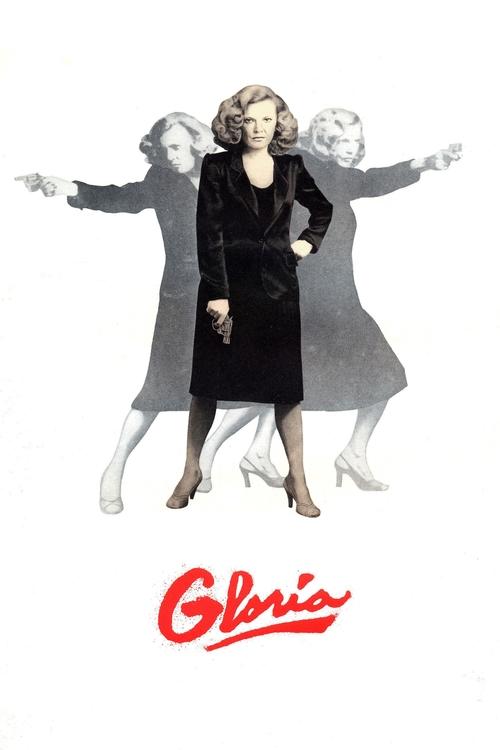
Gloria
1980 · John Cassavetes
For when you want a gritty New York thriller with soul — tense enough to grip you, human enough to move you, anchored by one magnificently tough woman. A great pick when slick modern action feels too weightless.
What it's about
A tough ex-showgirl in the Bronx — a woman with mob history and no interest in kids — gets stuck with the six-year-old son of her murdered neighbors, along with a ledger the gangsters will kill to recover. What follows is a flight across New York, through subways, cheap hotels, and old underworld haunts, with a pistol in her handbag and a child she keeps insisting she doesn't want.
The experience
Scrappy and alive — a chase thriller with the rough, unpredictable texture of real streets and real tempers, funny and abrasive one minute, genuinely dangerous the next. The prickly bond between the woman and the kid gives it a beating heart the plot alone wouldn't have.
Performances
Gena Rowlands is ferocious — striding through traffic, gun drawn, cigarette lit, daring the mob to try her. It's one of the great tough-woman performances in American movies, tender exactly where you don't expect it.
The craft
John Cassavetes, cinema's great chronicler of messy private lives, here bends his loose, actor-first style to a genre plot — so the shootouts and escapes carry an offhand realism most thrillers can't fake. Shot on location, it doubles as a time capsule of raw, unglamorous 1980 New York.
Why it matters
It became the template for a whole lineage of stories about a hardened loner reluctantly protecting a child, and it was remade outright — proof of how sturdy the premise is. It also showed a fiercely independent director could meet genre halfway without losing his voice.
Snapshot
Gloria is the anomaly in John Cassavetes's filmography: a genre picture — a gangster chase thriller — made by America's most uncompromising independent dramatist, and built around the single most ferocious performance of Gena Rowlands's career as anything other than a domestic woman in crisis. Rowlands plays Gloria Swenson, a hard-bitten ex-showgirl and former mob mistress in the Bronx who, almost against her will, takes custody of Phil (John Adames), the orphaned six-year-old son of a murdered neighbor. The boy carries a ledger the mob wants destroyed; Gloria carries a pistol and a Rolodex of old underworld acquaintances. What follows is a flight across New York — apartments, subways, taxis, cemeteries, cheap hotels — structured as pursuit but animated by the friction between a woman who insists she hates children and a child who needs her to be his mother. The film took the Golden Lion at the 1980 Venice Film Festival (shared with Louis Malle's Atlantic City) and earned Rowlands an Academy Award nomination for Best Actress. It is at once Cassavetes's most conventional commercial property and an unmistakable extension of his lifelong subject: the improvised, unsentimental, combustible bond.
Industry & production
Gloria was produced and released by Columbia Pictures, a studio context that sharply distinguishes it from the self-financed, self-distributed films (Faces, A Woman Under the Influence) on which Cassavetes built his reputation. The widely repeated account of the project's origin — recounted by Cassavetes in interviews and reproduced in Ray Carney's scholarship — is that Cassavetes wrote the screenplay as a property to sell rather than to direct, conceiving it as a commercial vehicle whose proceeds could underwrite more personal work. Columbia acquired the script but wanted Rowlands in the title role; with his wife attached, Cassavetes took the director's chair. The result is a studio-financed film that nonetheless retains the working methods, the New York milieu, and the performance-first priorities of his independent productions.
Because it operated inside a studio, Gloria afforded Cassavetes resources — a fuller crew, location permits across the five boroughs, a name composer — that his guerrilla productions lacked. The trade-off was a more disciplined, more legible narrative spine than the deliberately shapeless dramas he preferred. Precise budget and box-office figures are not something I can state reliably here; the film is generally characterized as a modest commercial performer rather than a hit, with its lasting value secured by the Venice prize and Rowlands's nomination rather than by returns. The casting of the boy is itself part of the production lore: John Adames, a non-professional child, delivers a stylized, almost operatic performance that has divided viewers for decades — some read it as a flaw, others as exactly the unmodulated, attention-demanding presence the film's emotional logic requires.
Technology
Gloria was shot on 35mm color film for standard theatrical exhibition, using the location-based, available-light-inflected approach that defined New York filmmaking of the period. There is no notable technological novelty here — Cassavetes was never a technical innovator in the apparatus sense, and the film uses no special process, optical, or sound technology that distinguishes it from its contemporaries. Its "technology," properly understood, is the lightweight, mobile, location-ready 35mm production package that allowed a crew to move quickly through real New York streets, subways, and apartments. The interest of the film lies entirely in human and dramatic technique rather than in any innovation of tools, and it would be inventing significance to claim otherwise.
Technique
Cinematography
The cinematography is credited to Fred Schuler, a German-born cameraman who had risen through the New York camera-operating ranks before stepping up to director of photography. Schuler's work on Gloria is grounded and reportorial: the film looks like the New York it was shot in, with the grain, the hard light, and the unglamorous interiors of a genuine location picture. Cassavetes's camera follows performance rather than dictating it — framings open up to accommodate the actors' movement, and the handheld restlessness familiar from his earlier films persists, though it is somewhat more composed here in service of the thriller's geography. The city is photographed without postcard romance: tenement hallways, taxi interiors, the flat daylight of cemetery grounds. What recurs is the visual motif of Gloria and the boy in transit — framed together in moving vehicles, on staircases, against the architecture of a city they are trying to disappear into. The camera's loyalty is to Rowlands's face, which it studies through the film's many reversals of feeling.
Editing
The editing is credited to George C. Villaseñor. Gloria is, by Cassavetes's standards, a relatively conventionally cut film — its chase structure imposes a forward momentum that his more discursive dramas resist. Yet the editing still bends toward performance: scenes are allowed to run on the actors' rhythms, and the cutting tolerates the awkward beats, overlaps, and abrupt tonal swings that are Cassavetes signatures. The tension in the cutting is between genre propulsion (the mob closes in; the pair must move) and the director's instinct to linger inside a confrontation until it has fully detonated. The film's pacing accordingly alternates between bursts of pursuit and long, charged standoffs — Gloria negotiating with gangsters in an apartment, Gloria and the boy quarreling in a hotel room — where the cut waits for emotion rather than plot.
Mise-en-scène / staging
Staging is where Cassavetes's authorship is most visible. The film is built around two-handers — Gloria and Phil — staged in confined, lived-in spaces: cars, apartments, hotel rooms. Cassavetes blocks his actors to collide physically, crowding them into frames and doorways so that the performances generate their own friction. The mob confrontations are staged with a theatrical bluntness; Gloria walking into a room full of men with a gun in her hand is presented less as choreographed action than as a dramatic dare. The boy is frequently staged as an obstacle and a burden within the frame — clutched, dragged, set down, picked up again — making the physical labor of guardianship literal. New York itself is the standing set, and Cassavetes uses its real textures (subway platforms, street corners, the anonymity of crowds) as the arena in which the relationship is forced to develop.
Sound
Sound is dominated by two elements: the overlapping, naturalistic dialogue Cassavetes prized, and Bill Conti's score. Conti — then at the height of his profile after Rocky — supplies a jazz-inflected, urban score that leans into the film's thriller identity, giving the chase a propulsive, brassy energy that is more "movie" than the rest of Cassavetes's output. The contrast is productive: the score promises a conventional crime picture while the performances deliver something rawer and stranger. Location sound carries the film's realism — traffic, crowds, the clatter of the city — and the dialogue retains the talked-over, half-caught quality of unforced speech.
Performance
Performance is the film's reason for being. Rowlands's Gloria is a tour de force of contradiction: brittle and maternal, terrified and fearless, profane and tender, a woman who keeps announcing that she dislikes children while risking her life for one. She carries the gun with a wholly convincing weariness, as someone who has been around violence long enough to be unimpressed by it. The performance earned her an Academy Award nomination and stands as one of the great hard-boiled female leads in American cinema. Opposite her, John Adames's Phil is deliberately unsmoothed — loud, defiant, sometimes grating — a non-professional child performance that refuses cuteness. Whether one reads Adames as miscast or as perfectly calibrated to deny the film easy sentiment, the abrasion between the two is precisely what the drama runs on.
Narrative & dramatic mode
Structurally, Gloria is a chase: an inciting massacre, a MacGuffin (the ledger), a pursuing force (the mob), and a flight that drives the plot. But its dramatic mode is the reluctant-guardian relationship melodrama, filtered through Cassavetes's anti-sentimental sensibility. The genre scaffolding exists to keep two mismatched people trapped together long enough for a bond to form against both their wills. The film withholds the easy emotional payoffs the premise invites; Gloria's tenderness is always shadowed by irritation, and the boy's need is always shadowed by rage. The arc is the slow, grudging conversion of an asserted non-relationship ("I don't like kids") into an enacted one. This is melodrama in the precise sense — a drama of feeling — but performed in a register that distrusts every cue toward easy tears.
Genre & cycle
Gloria sits at the intersection of the gangster film, the New York crime thriller, and the maternal melodrama. It belongs visibly to the gritty, location-shot New York cinema of the 1970s and early 1980s — the cycle that runs through films of urban crime and decay. But it inverts a durable genre convention by placing a middle-aged woman at the center of the gun-toting action, a role almost always reserved for men. In that sense it is also a pointed revision of the gangster's-moll archetype: Gloria is the moll who has outlived the gangster and now operates on her own terms. The mismatched-adult-and-child-on-the-run pairing connects it to a wider lineage of films built on that dynamic, and Gloria is frequently cited as a touchstone for later entries in that mode.
Authorship & method
Gloria is a John Cassavetes film in authorship even where it is a Columbia film in financing. Cassavetes wrote the screenplay and directed, and his method — performance-led, tolerant of mess, devoted to emotional truth over narrative tidiness — shapes every scene despite the genre packaging. The decisive collaborator is Gena Rowlands, his wife and lifelong creative partner, whose performance is the film's authorship as much as Cassavetes's direction; their decades-long collaboration (across A Woman Under the Influence, Opening Night, and others) reaches one of its peaks here. Cinematographer Fred Schuler grounds the picture in real New York light. Composer Bill Conti supplies the commercial genre energy that pulls the film toward its thriller identity. Editor George C. Villaseñor manages the tension between chase momentum and Cassavetes's preference for unhurried confrontation. The film is thus a negotiation between two authorial pressures — the studio's genre expectations and Cassavetes's performance-first independence — held in productive tension throughout.
Movement / national cinema
The film is a landmark of American independent cinema's relationship to Hollywood, made by the figure most often named as the father of the modern American independent movement. Yet Gloria is the case where that independent sensibility operates inside the studio system rather than against it. It belongs to the broader New York school of location filmmaking and to the post-1970s American auteur cinema in which directors of strong personal vision worked within commercial genres. Cassavetes's lineage runs back to the actor-centered, improvisation-friendly ethos he pioneered with Shadows in the late 1950s; Gloria shows that ethos surviving translation into a mainstream genre property.
Era / period
Gloria is firmly of its moment: 1980, a New York of economic strain, visible urban hardship, and the crime-cinema iconography that the city's condition made available. The film captures a pre-gentrification New York of tenements, subways, and unglamorous neighborhoods, and it arrives at the hinge between the auteur-driven American cinema of the 1970s and the franchise-oriented Hollywood that would dominate the decade to come. Within Cassavetes's own career it is a late-period work, made in the years before his health declined, and one of the last in which Rowlands carried a film for him at full power.
Themes
The film's central theme is reluctant, unsentimental love — care given by someone who insists she is incapable of it, to someone who makes it as difficult as possible. Around that core cluster several others: maternity recast outside biology and outside softness; the survival of women in a world built and run by violent men; the persistence of loyalty and code among people the law has discarded; and the city as both threat and hiding place. Childhood here is not innocence but need and noise, an unromanticized demand. Gloria's transformation dramatizes the idea that identity is revealed under pressure — that who a person is emerges not from what they claim but from what they do when a child's life is in their hands. The film also quietly interrogates the gangster mythology by showing its leftover human cost: the ex-moll who knows all the men and all the rules and has nothing to show for it but the competence to survive.
Reception, canon & influence
Critically, Gloria has occupied a contested but durable place. Its most decisive endorsement came at Venice, where it shared the 1980 Golden Lion with Atlantic City, and at the Academy Awards, where Rowlands's Best Actress nomination confirmed the performance as the film's enduring achievement. Contemporary and later criticism has tended to split: some regard it as a lesser, compromised Cassavetes precisely because of its genre conventionality and the divisive child performance; others prize it as one of his most accessible and emotionally direct works, and as a singular showcase for Rowlands. Over time, the Rowlands performance has only grown in stature, frequently cited among the great female leads in American crime cinema.
Looking backward, the film draws on the gangster and crime-thriller traditions and on the gritty New York location cinema of the 1970s, while inverting the gangster's-moll archetype it inherits. It also draws, most importantly, on Cassavetes's own prior collaborations with Rowlands, transposing their study of women under pressure into a new genre frame. Looking forward, Gloria has cast a long shadow over the mismatched-tough-adult-and-endangered-child subgenre; it is routinely named as a forerunner and reference point for later action-melodramas built on that pairing, and its DNA is visible wherever a hardened protector is forced into reluctant guardianship of a child marked for death. The film was directly remade by Sidney Lumet in 1999 with Sharon Stone in the title role — a version generally judged inferior, but whose existence testifies to the durability of the original premise. The truest measure of its influence, though, remains Rowlands's Gloria herself: a template for the armed, weary, fiercely competent woman at the center of a crime film, a figure American genre cinema had rarely allowed before and has returned to many times since.
A Deleuzian reading
Start with the image everyone keeps: Gena Rowlands in heels and a rumpled cream suit, sunglasses pushed up, walking into a room full of mob men with a pistol already in her hand.
The full Deleuzian reading of Gloria →
Reception
Cassavetes wrote it as a for-hire script he never meant to direct, and treated it as his 'commercial' outlier — yet it won the Golden Lion at Venice, and decades later cinephiles have reclaimed it as far more Cassavetes than its genre wrapper suggested.
How Gloria was received, from release to now →
Influences: the films it descends from and the films it influenced
- Léon: The Professional (1994) — The clearest descendant of the hardened-killer-and-endangered-orphan pairing: a competent armed loner reluctantly guarding a child the mob wants dead, lifting Gloria's premise wholesale.
- Shadows (1959) — Originates the handheld, location-shot New York improvisation and performance-led method Gloria carries into genre — actors discovering scenes in real streets rather than hitting marks.
- Faces (1968) — Establishes Cassavetes's overlapping dialogue and his preference for holding on faces through unhurried emotional confrontation, the rhythm that fights the thriller's chase momentum in Gloria.
- A Woman Under the Influence (1974) — The defining Cassavetes–Rowlands study of a woman cracking under pressure that Gloria directly transposes into a crime frame — same authorship-by-performance, new genre packaging.
- Opening Night (1977) — Models the idea of Rowlands's performance AS the film's authorship — a woman improvising survival in real time — which Gloria inherits as its structuring principle.
- The Killing of a Chinese Bookie (1976) — Cassavetes's prior experiment in running gangster-genre machinery through his loose, character-first method — the rehearsal for Gloria's tension between studio thriller and independent texture.
- Little Miss Marker (1934) — Sets the Runyonesque template of hardened underworld figures saddled with an orphaned child they did not want — the reluctant-guardian-meets-mob premise Gloria inverts through gender.
- The French Connection (1971) — Defines the documentary-style handheld New York crime cinema — grabbed location light, real streets, kinetic pursuit — that Fred Schuler's photography grounds Gloria in.
- Mean Streets (1973) — The gritty New York location-realist crime film built on behavioral performance over plot mechanics, the immediate environment Gloria's gangster world emerges from.
- Paper Moon (1973) — Pairs a hard-bitten adult with a precocious child on the run, the mismatched-protector-and-kid two-hander dynamic Gloria reworks under threat of death.
- The Panic in Needle Park (1971) — Pioneers the scoreless, raw New York street realism and on-location verité grit that situates Gloria's chase in an authentically dangerous city.
- Gloria (1999) — A direct remake that copies the armed-woman-protecting-a-marked-child premise beat for beat, testifying to the durability of Cassavetes's structure even as it loses the Rowlands performance.
- Aliens (1986) — Recasts the Rowlands template as Ripley — an armed, weary, fiercely competent woman whose maternity-outside-biology toward Newt drives a survival-chase, the same protector-of-a-marked-child engine.
Similar films
- The Killing of a Chinese Bookie (1976) — influence & lineage · same viewing thread
- Opening Night (1977) — influence & lineage
- A Woman Under the Influence (1974) — influence & lineage
- Faces (1968) — influence & lineage
- Mean Streets (1973) — influence & lineage · same viewing thread
- Raging Bull (1980) — same viewing thread
- A Bronx Tale (1993) — same viewing thread
- Once Upon a Time in America (1984) — same viewing thread
All the films related to Gloria →
Watch it with: curated runs of related films
- American Crime, Long Memory — A run of mob epics, noir, and neighborhood tragedies that all circle the same wound — loyalty, masculine violence, and the past that never lets go — so watch them close together and let the decades and cities blur into one long American story.