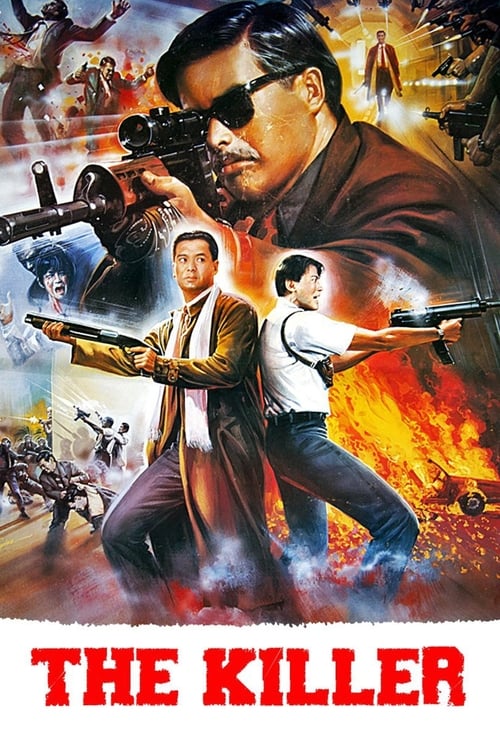
The Killer
1989 · John Woo
For when you want action that feels grand rather than gritty — a crowd-pleaser to put on loud, ideally with friends, when you're in the mood to be swept up and maybe a little misty-eyed between shootouts.
What it's about
Ah Jong is Hong Kong's finest contract killer, a man who treats his lethal work as a calling with rules. When a hit goes wrong and a nightclub singer is blinded in the crossfire, he takes one last job to pay for the operation that could restore her sight — and gets double-crossed by his employers. Meanwhile a stubborn police inspector hunting him begins to realize the assassin he's chasing may be the most honorable man in the case.
The experience
Full-throttle and full-hearted — operatic gunfights staged like dance numbers, wrapped around a melodrama played completely straight. It's thrilling and unexpectedly moving; you come for the action and stay because it means every ounce of its emotion.
Performances
Chow Yun-fat is effortless movie-star charisma — lethal, tender, and impossibly cool, often in the same shot — and his push-pull chemistry with Danny Lee's inspector gives the film its beating heart.
The craft
John Woo turns gunfire into choreography: slow motion, doves, candlelit churches, two-pistol standoffs — images so striking they became a visual language of their own. The set pieces are edited with an emotional logic, escalating like arias, and the whole thing is built to be seen big and heard loud.
Why it matters
This is the film that carried Hong Kong 'heroic bloodshed' cinema to the world and made Woo an international director; its fingerprints are all over decades of Hollywood action, from balletic gunplay to the cop-and-killer mirror story.
Snapshot
The Killer (喋血雙雄, literally "two blood-soaked heroes") is the film that turned John Woo from a successful Hong Kong genre director into an international auteur and made "heroic bloodshed" a recognizable global idiom. A baroque melodrama disguised as a crime thriller, it follows Ah Jong (Chow Yun-fat), a contract assassin who accidentally blinds the nightclub singer Jennie (Sally Yeh) during a hit and takes one last job to pay for the operation that might restore her sight. Pursued by the dogged Inspector Li Ying (Danny Lee), Ah Jong finds in his hunter a mirror image — a man bound by the same code of honor — and the two converge on a betrayal that ends in a church awash in candlelight, gunfire, and doves. Made within Tsui Hark's Film Workshop on the momentum of Woo's A Better Tomorrow (1986), it fuses Hollywood action spectacle, Cantonese melodrama, French policier cool, and Chinese chivalric tradition into something simultaneously operatic and absurd. Its reputation abroad — built through festival screenings and the early-1990s arthouse-video circuit — eventually exceeded its standing at home, and its visual grammar of slow-motion gunplay and tragic male partnership reshaped action cinema worldwide.
Industry & production
The Killer was produced under Film Workshop, the production house Tsui Hark founded in 1984, and released through the Golden Princess circuit, the distribution-exhibition combine that financed much of Hong Kong's late-1980s commercial output. The film arrived inside the boom that followed A Better Tomorrow, the 1986 Woo–Tsui collaboration that resurrected both Woo's flagging career and Chow Yun-fat's, and that established the heroic-bloodshed cycle as a commercial juggernaut. By 1989 Woo had the latitude — and the star, in Chow — to push the formula toward pure tragic abstraction.
The Woo–Tsui partnership is central to the film's history and to its tensions. The two men, close collaborators on A Better Tomorrow and A Better Tomorrow II, were creatively and temperamentally divergent, and accounts of the period describe a relationship strained by competing visions and producer-director friction; The Killer is frequently cited as a flashpoint in a collaboration that did not long survive it. The precise allocation of credit and conflict is a matter on which sources differ, and the inside story is told largely through later interviews rather than contemporaneous documentation, so it should be treated with appropriate caution. What is clear is that the film bears Woo's authorial stamp unmistakably.
The shoot, by the standards of Hong Kong's fast, improvisatory production culture, was demanding: elaborate squib work, large quantities of blank ammunition, and the practical staging of the climactic church sequence with live doves. Hong Kong filmmaking of the era worked at speed and on comparatively modest budgets relative to Hollywood, and The Killer's polish is partly a triumph of craft over resources. Domestically the film performed respectably without being a runaway blockbuster on the scale of the A Better Tomorrow phenomenon; I would avoid citing specific gross figures, as the reliable record on Hong Kong box office of this period is inconsistent. Its larger commercial and cultural afterlife came through overseas distribution.
Technology
The film is a showcase of conventional late-1980s 35mm filmmaking pushed to expressive extremes rather than a technological innovator in the equipment sense. Its "technology" is squib choreography, blank-firing weaponry, and the optical and in-camera tools of slow motion. Woo's signature ramping — overcranking the camera to stretch moments of violence and grief into elongated arias — depends on careful frame-rate control and on editing that interleaves slowed and full-speed footage. Practical pyrotechnics and blood squibs carry the gore; the carnage is physical and on-set, not optical trickery. The church finale's doves are likewise a practical, in-camera element, deployed for their associative charge (peace, the soul, sanctuary defiled) rather than as effect for its own sake. The film predates the digital-effects era entirely, and its enduring physicality — the weight and recoil of bodies and weapons — is inseparable from that analog basis.
Technique
Cinematography
The photography (credited to Wong Wing-Hang, with Peter Pau also associated with the film's camerawork) is glossy, saturated, and emphatically expressive. Woo and his cinematographers favor warm amber and candlelit interiors, hard backlight that haloes the actors, and a willingness to bathe scenes in unmotivated color for emotional effect. The camera is mobile and dramatic — tracking, craning, and circling the actors — but the most celebrated images are compositional set-pieces: Ah Jong and Li seated together with guns drawn, framed in mirror symmetry; the recurring iconography of the Catholic church, its statuary and stained glass turned into a theater of sacrifice. The visual register is closer to melodrama and to the religious sublime than to the gritty naturalism that "crime thriller" might imply.
Editing
Editing (credited to Fan Kung-Ming, working closely to Woo's design) is where the film's rhythmic identity lives. Woo constructs action as music — building and releasing tension through accelerating cuts punctuated by sudden slow-motion suspensions. The technique of intercutting different speeds within a single exchange of fire, and of crosscutting between the killer and the cop to insist on their equivalence, gives the violence its lyrical, almost balletic phrasing. The much-imitated result is "bullet ballet": gunplay edited for grace and pathos rather than for spatial clarity alone.
Mise-en-scène / staging
Woo's staging is theatrical and iconographic. Spaces are dressed for symbolic resonance — the church above all, but also the nightclub, the beach, the safe houses — and bodies are arranged in poses of confrontation and communion. The Mexican standoff, guns leveled at point-blank range, is a Woo signature elevated here into a recurring emotional motif: the standoff is less about who shoots than about what two men recognize in each other. Doves, candles, religious statuary, and the doubling of hero and antihero are deployed as a coherent visual symbolism rather than as decoration.
Sound
The score by Lowell Lo and the diegetic songs performed by Sally Yeh are load-bearing. Jennie's singing is woven into the plot — it is in her nightclub that the inciting accident occurs — and music functions as both narrative device and emotional commentary. Gunfire is mixed for impact and rhythm, and silence and song are used to frame the violence. The film's English-dubbed versions, long the form in which many Western viewers first encountered it, alter names and tone considerably; the Cantonese-language original is the authoritative text.
Performance
Chow Yun-fat's Ah Jong is the definitive heroic-bloodshed performance: melancholy, courtly, almost saintly in his self-sacrifice, with Chow's particular gift for combining movie-star glamour with wounded interiority. Danny Lee, long associated with cop roles in Hong Kong cinema, plays Inspector Li as Ah Jong's righteous double, and the chemistry between hunter and hunted — culminating in the running gag of the nicknames they assign one another — is the film's emotional engine. Sally Yeh gives Jennie a fragile sincerity, and Chu Kong, as Ah Jong's conflicted handler Sidney (Fung Sei), supplies the film's other great current of loyalty and betrayal. Shing Fui-On's triad boss provides a coldly venal antagonist against whom the heroes' code shines.
Narrative & dramatic mode
The dramatic mode is melodrama in the fullest sense — heightened emotion, moral absolutes, coincidence, and sacrifice — grafted onto the crime-thriller skeleton. The plot turns on guilt and redemption: an accidental wounding obligates the assassin to a final job; a double-cross strands him; an unlikely alliance with his pursuer offers the only path to honor. Woo is unembarrassed by sentiment, and the film moves in large, legible emotional gestures rather than psychological nuance. Structurally it alternates intimate dialogue scenes — built around codes of honor, debts, and brotherhood — with escalating action arias, a rhythm that pulls the audience between tenderness and spectacle. The mistaken-and-then-mutual recognition between killer and cop drives a buddy dynamic that the finale converts into shared martyrdom.
Genre & cycle
The Killer is a defining text of "heroic bloodshed," the term (popularized in English-language fan and critical writing of the period, associated with the critic Rick Baker) for the cycle of Hong Kong gangster films — centered on Woo, Chow Yun-fat, and Tsui Hark's Film Workshop — that foregrounded loyalty, honor, slow-motion gunplay, and tragic male bonds. The cycle's foundational hit was A Better Tomorrow (1986); The Killer is its most refined and internationally resonant entry. The genre fuses the Hong Kong gangster (triad) film with the chivalric ethos of the wuxia and the kung-fu film, transposing the swordsman's code into the modern criminal underworld and replacing the blade with the handgun.
Authorship & method
John Woo's method here is the culmination of a lineage. Trained at Shaw Brothers in the early 1970s as an assistant to the great martial-arts director Chang Cheh, Woo absorbed Chang's yanggang ("staunch masculinity") ethos — male blood-brotherhood, heroic suffering, the beautiful death — and translated it into the gun film. Onto that he grafted the cool fatalism of Jean-Pierre Melville's crime cinema, the slow-motion violence of Sam Peckinpah, the operatic widescreen of Sergio Leone, and a deep affection for the Hollywood musical, whose sense of movement and emotion shapes his action staging. Woo has spoken often of these debts in interviews, and they are legible in the film itself. His Catholicism — Woo grew up in a devout Christian household — informs the church iconography and the redemptive, sacrificial structure.
His key collaborators are essential to the result: producer Tsui Hark, whose Film Workshop provided the platform and whose creative pressure shaped (and, by many accounts, complicated) the production; star Chow Yun-fat, Woo's onscreen surrogate and the cycle's defining face; composer Lowell Lo and singer Sally Yeh, who give the film its musical spine; cinematographer Wong Wing-Hang (with Peter Pau) for the saturated, candlelit look; and editor Fan Kung-Ming, who realized the film's distinctive cutting rhythms. The screenplay is Woo's own.
Movement / national cinema
The film belongs to the golden age of Hong Kong commercial cinema in the 1980s, a period of extraordinary output, technical bravado, and genre invention that made the territory one of the world's most prolific and influential film industries. It is a product of the Cantonese-language popular cinema's confidence at its peak, distinct from the art cinema of the Hong Kong New Wave even as it shares the era's energy. Made eight years before the 1997 handover, it carries — like much Hong Kong genre film of the period — an undertow of anxiety about loyalty, betrayal, and dissolving order that critics have often read allegorically, though Woo's own statements frame the film primarily in terms of personal and moral, rather than political, concerns.
Era / period
The Killer is emphatically of the late 1980s: in its synth-and-strings scoring, its nightclub milieu, its fashion and weaponry, and its analog, practical-effects physicality. It sits at the high-water mark of the heroic-bloodshed cycle, after A Better Tomorrow established the template and before Woo's move toward the harder, more militarized action of Bullet in the Head (1990) and Hard Boiled (1992), and then to Hollywood (Hard Target, Broken Arrow, Face/Off) from 1993 onward. It is a snapshot of a national cinema at the peak of its commercial powers and creative nerve.
Themes
The governing themes are honor, loyalty, and redemption through sacrifice. Ah Jong is a killer whose moral seriousness — his sense of his work as a vocation, his refusal to harm innocents, his debt to the woman he blinded — marks him as more righteous than the institutions arrayed against him. The doubling of killer and cop dramatizes Woo's recurring conviction that integrity, not the law, defines the hero, and that true kinship is found between men bound by a shared code. Betrayal — by handlers, bosses, and a corrupt order — is the engine of tragedy. Catholic imagery saturates the film's moral universe: guilt, atonement, martyrdom, and the church as a contested sanctuary. Blindness operates as a controlling metaphor — for innocence damaged, for the inability to see who one's true allies are, and for a love that must be felt rather than seen.
Reception, canon & influence
At home, The Killer was a solid commercial success without eclipsing A Better Tomorrow's phenomenon, and contemporary Hong Kong critical opinion was mixed about its unabashed sentiment and stylization. Its canonization came substantially from abroad. Through festival screenings and the burgeoning arthouse and home-video market of the early 1990s, the film found passionate Western audiences and critics, who embraced it as a revelation of what action cinema could be; its U.S. theatrical and video release made it a cult touchstone. It has since been widely canonized — included in serious critical surveys of action and world cinema and given a prestige home-video life (including a Criterion Collection edition) — as one of the defining genre films of its decade.
The influences on the film are well documented and largely acknowledged by Woo: Melville's Le Samouraï (the lone, fatalistic professional killer) above all, alongside Chang Cheh's blood-brotherhood swordplay, Peckinpah's slow-motion violence, Leone's operatic staging, and the Hollywood musical's choreographic sense. The influence of the film, forward, is enormous. Woo's bullet-ballet aesthetic — dual-wielded pistols, slow-motion dives, the Mexican standoff, the tragic-romantic bond between adversaries — became common currency in 1990s and 2000s action cinema. Filmmakers including Quentin Tarantino and Robert Rodriguez championed Woo and absorbed his style; the "gun fu" of The Matrix and the choreographed gunplay of the John Wick films descend directly from his innovations. The killer-and-cop-as-mirror structure and the moral seriousness Woo lent to the hitman archetype echo through decades of subsequent crime cinema. The film's standing was confirmed in 2024 when Woo himself directed an English-language remake — a rare instance of a director returning to reinterpret his own landmark — testifying to the original's durable place at the center of the action canon.
A Deleuzian reading
Start with the image everyone keeps: two men in a candlelit church, arms locked straight out, each man's pistol an inch from the other's face — and neither one fires.
The full Deleuzian reading of The Killer →
Reception
Only a modest hit in Hong Kong on release, it exploded on the international festival and video circuit and became the gateway drug that introduced Western audiences to 'heroic bloodshed' — now it's fixed in the action canon and Woo's most celebrated film.
How The Killer was received, from release to now →
Influences: the films it descends from and the films it influenced
- Le Samouraï (1967) — Woo lifts the ritualized solitude of the contract killer — the professional's fixed code, the fatalism, the cool minimalist staging of preparation — directly from Jef Costello, and his hitman's death-by-honor reframes Melville's blank existential ending as Catholic martyrdom.
- Le Cercle Rouge (1970) — The structural parity between hunter and hunted — cop and criminal drawn as mirrored professionals bound by the same fatalistic code — is the policier architecture Woo grafts onto the killer-and-Inspector-Li doubling.
- The Wild Bunch (1969) — Peckinpah's multi-camera, intercut slow-motion squib carnage — bodies arcing in undercranked balletic death — is the literal technical grammar of Woo's bullet-ballet shootouts.
- Once Upon a Time in the West (1968) — The operatic widescreen standoff — held closeups, ritual delay, music swelling before the draw — gives Woo his Mexican-standoff staging and the willingness to stretch a confrontation into aria-length set piece.
- The Golden Swallow (1968) — Woo's mentor codified the yanggang 'staunch masculinity' ethos — heroic suffering and the beautiful, blood-soaked death — that Woo translates wholesale from the sword into the pistol.
- Vengeance! (1970) — Chang's blood-brotherhood revenge structure — sworn male loyalty redeemed through self-sacrificial slaughter — is the emotional skeleton beneath the killer–cop bond and the melodramatic honor code.
- A Better Tomorrow (1986) — Woo's own immediately prior film established the heroic-bloodshed template — Chow Yun-fat's iconographic gunman, dual-wielded pistols, brotherhood-and-betrayal melodrama — that The Killer refines into its purest form.
- Army of Shadows (1969) — Woo transposes Melville's code-of-honor structure into Hong Kong action cinema: Chow Yun-fat's physical stillness and contained grief echo Ventura's blankness directly, and Woo employs Melville's silence-then-sudden-violence contrast rhythm — prolonged stillness as formal weight, eruption as release — as the film's structural heartbeat.
- Bob le Flambeur (1956) — Hong Kong inheritor of the Melville idiom — the honor-bound assassin, ritualized friendship between cop and criminal, and melancholy fatalism transplanted from Bob's code into balletic crime cinema.
- Le Doulos (1962) — Directly descends from Melville's stylized male code — the honorable hitman, the cop who mirrors him, loyalty and betrayal staged as ritual — Woo's acknowledged debt to the Melvillian gangster.
- Le Deuxième Souffle (1966) — Transplants Melville's code of honor between assassin and pursuing cop and the ritualized male loyalty into Hong Kong action, explicitly citing the Le Samouraï/Deuxième Souffle ethic of the doomed professional.
- Hard Boiled (1992) — Woo escalates the same techniques — sustained slow-motion ramping, dual-gun ballet, church-and-hospital iconography, the cop-and-killer alliance — into a feature-length crescendo of choreographed gunplay.
- Reservoir Dogs (1992) — Tarantino, an avowed Woo champion, imports the three-way Mexican standoff and the doomed-loyalty-among-criminals melodrama as the film's structural climax.
- Desperado (1995) — Rodriguez transplants Woo's dual-wielded-pistol ballet, slow-motion dives through gunfire, and operatic body count directly into a Mexican setting, openly acknowledging the debt.
- Face/Off (1997) — Woo pushes his cop-and-killer-as-mirror conceit to its literal extreme — the two men swap faces — while exporting the candle-lit church standoff and dove-flutter iconography into Hollywood.
- The Matrix (1999) — The 'gun fu' lobby shootout — slow-motion, two-handed pistol choreography treated as dance — descends directly from Woo's bullet-ballet, now fused with wire-fu and bullet-time.
- Léon: The Professional (1994) — Besson extends the Melville-via-Woo lyrical-hitman lineage: a ritualistic lone killer with a rigid code whose professionalism dissolves into self-sacrificial tenderness and a redemptive death.
- John Wick (2014) — Its legible, full-body 'gun fu' choreography — reload-as-rhythm, continuous wide takes of pistol combat as martial-arts dance — is the contemporary culmination of Woo's bullet-ballet aesthetic.
- Drive (2011) — Refn revives the Melville-Woo melancholic lone professional — a near-silent killer governed by code, scored by a diegetic pop ballad that supplies the film's emotional spine, exactly as Sally Yeh's song does in The Killer.
- Mission: Impossible II (2000) — Established the mirrored protagonist-antagonist face-off as the climactic convention, the heightened Foley design that makes slow-motion gunfire tactile and musical simultaneously, and the gun-fu choreography of bodies as weaponized instruments — all directly extended in MI:II's beach finale.
- Infernal Affairs (2002) — The elegiac underscore convention — melancholic orchestral scoring applied to doomed male partnerships under institutional pressure — that Infernal Affairs inherits as its primary emotional register, then structurally subverts by deploying the same musical grammar for men who are adversaries rather than comrades, making the score's lament ironic rather than sincere.
- Infernal Affairs II (2003) — Woo's scoring practice of layering swelling, grief-saturated orchestral music over moments of criminal male sacrifice — converting melodrama into tragic dignity — is the direct sound template IA2 applies to Ngai Wing-Hau's decline and its elegiac closing sequences.
- The Yellow Sea (2010) — Woo's hitman mythology — ballistic grace, operatic slow-motion, redeemable morality — is the genre template The Yellow Sea systematically inverts; Na replaces elegance with physical degradation to argue against the hitman film's ethical and aesthetic conventions.
- City on Fire (1987) — A contemporaneous Hong Kong golden-age crime film built on the same undercover-cop/criminal emotional mirroring and gritty male loyalty, sharing Chow Yun-fat as the cycle's defining face.
Similar films
- Hard Boiled (1992) — influence & lineage · same viewing thread
- A Better Tomorrow (1986) — influence & lineage · same viewing thread
- Face/Off (1997) — influence & lineage
- John Wick (2014) — influence & lineage
- City on Fire (1987) — influence & lineage
- The Mission (1999) — same viewing thread
- I Saw the Devil (2010) — same viewing thread
- A Bittersweet Life (2005) — same viewing thread
All the films related to The Killer →
Watch it with: curated runs of related films
- Elegant Savagery — A run of sleek, merciless thrillers where vengeance arrives in tailored suits and is paid in broken bone — watch these when you want beauty and brutality in the same frame.