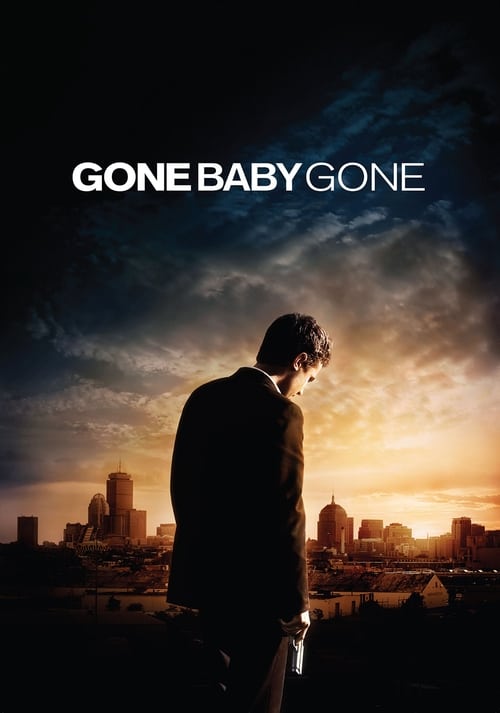
Gone Baby Gone
2007 · Ben Affleck
When you want a mystery with real stakes and a genuine ethical dilemma to chew on for days — the kind of film that ends and then keeps going in your head. Challenging rather than comforting, and worth it.
What it's about
A four-year-old girl vanishes from a working-class Boston neighborhood, and when the police stall, her family hires two young private investigators who grew up on those same streets. What starts as a missing-child case pulls them into a maze of addicts, cops, and old grudges — and toward questions with no clean answers about what's actually best for a child. It's a detective story that turns into a moral gut-check.
The experience
Tense and grim in the way of the best crime novels, but what really grips you is the moral weight — the film keeps tightening the screws until you're arguing with yourself. Expect to finish it unsettled and to want someone to talk it over with immediately.
Performances
Casey Affleck is quietly remarkable as the baby-faced investigator whose softness keeps getting mistaken for weakness, and Amy Ryan earned an Oscar nomination for a fearless, unvarnished turn as the missing girl's mother. Ed Harris brings flinty, unpredictable force as a veteran detective.
The craft
Ben Affleck's directorial debut is striking for its restraint and its deep feel for place — Dorchester's bars, porches, and faces are photographed with a local's eye, using real neighborhood locations and extras. Adapted from Dennis Lehane's novel, the film trusts its story and refuses easy resolutions.
Why it matters
It announced Ben Affleck's second act as a serious filmmaker and stands with the strongest of the Boston crime dramas — a case study in how genre can carry real ethical weight.
Snapshot
Gone Baby Gone is Ben Affleck's directorial debut, adapted from Dennis Lehane's 1998 novel of the same name—the fourth installment in Lehane's Kenzie-Gennaro series. Set in the working-class neighborhoods of Dorchester, Boston, the film follows private investigators Patrick Kenzie (Casey Affleck) and Angie Gennaro (Michelle Monaghan) as they search for four-year-old Amanda McCready, a case that spirals from procedural mystery into an agonizing moral reckoning about who has the right to determine a child's welfare. The film marked Affleck's emergence as a filmmaker of serious purpose, bringing to his hometown the kind of sociologically grounded crime drama that had made Lehane's Boston fiction a fixture of American literary noir, and it established a directorial voice—restrained, location-specific, ethically serious—that he would develop across the subsequent decade.
Industry & production
Gone Baby Gone was distributed by Miramax, then in a post-Disney transitional phase under new management, which positioned the film as a prestige awards release. The production was modest in budget relative to the recognition of its talent, operating without the resources of a major studio while securing actors of considerable institutional standing. Affleck opened the film in limited release in October 2007 before a national expansion—a rollout strategy consistent with Miramax's historical approach to awards-oriented titles.
Casting decisions attracted public attention before the film released. Affleck was candid about his choice to cast Casey in the lead rather than a more commercially bankable star, emphasizing his brother's embodiment of a specific Boston type—understated, neighborhood-rooted, intelligent without ostentation—over the conventional leading-man profile. For the role of Helene McCready, Amanda's negligent mother, Affleck cast Amy Ryan, then known primarily for her stage work and her recurring role on The Wire. Ryan's performance required visible physical and behavioral transformation; the result was the film's most discussed acting contribution and earned her an Academy Award nomination for Best Supporting Actress—an unusual distinction for a role so aggressively unsympathetic.
Morgan Freeman as Captain Jack Doyle and Ed Harris as Detective Remy Bressant were cast with awareness of the reputational weight both actors bring to figures of institutional authority, an authority the film then systematically complicates. Affleck also cast non-professional actors and actual Dorchester residents in supporting and background roles—a documentary-inflected practice that extends from Italian neorealism through the American social-realist tradition and that had been visible recently in the location-grounded work of John Sayles and early David Gordon Green.
Technology
The film was shot almost entirely on location in Dorchester and surrounding Boston neighborhoods, with minimal studio construction. Affleck pursued practical locations—actual bars, housing projects, rooftops, parks—over built sets, producing a documentary texture seldom achieved in mainstream American crime cinema. The production format was primarily photochemical, with Affleck seeking a grain structure that would anchor the image in the neighborhood's material reality rather than the digital cleanliness that was increasingly available. The post-production pipeline followed standard American independent practice of the period.
Affleck's pre-production included extended engagement with Dorchester communities—establishing relationships with residents and local institutions that provided location access and cast members not available through standard channels. This approach, closer to ethnographic fieldwork than to conventional studio pre-production, was a deliberate counter to what Affleck identified as the inauthenticity of Boston crime films shot primarily elsewhere or on studio lots.
Technique
Cinematography
The film's visual grammar is defined by restraint and spatial honesty. Wide-angle lenses at close range place characters within their environments rather than separating them through telephoto compression; the poverty of Dorchester is never viewed from a comfortable optical distance that would permit aestheticization. Handheld work is used selectively rather than as a documentary default—its appearance in moments of pursuit or confrontation marks a departure from the film's observational baseline, lending those sequences a specific urgency. Interior scenes are lit to suggest available or near-available sources, with practical lamps and motivated illumination rather than the even fill common to studio crime production.
The visual treatment consistently refuses two temptations that afflict location crime filmmaking: romantic atmosphere (the soft-focus Boston of tourist imagery) and condescending grimness (the poverty-porn aesthetic of sensationalized documentary). The camera treats Dorchester with the matter-of-fact attention a resident might—neither impressed nor appalled, simply precise.
Editing
The editorial rhythm serves the film's procedural architecture while resisting the rapid fragmentation that had become standard in American genre cinema of the period. Scenes of interrogation, informant meetings, and neighborhood confrontations are allowed relatively long durations; conversations develop their own internal pressure before the film cuts away. This patience is rooted in a directorial trust in location and performance that many genre films do not extend to their material.
The structural pivot arriving in the final third—the revelation that transforms the moral calculus established in the first hour—is prepared by an editorial approach that has conditioned viewers to read scenes as complete dramatic units. When the film's ethical architecture shifts, viewers have been given enough uninterrupted time with each character to feel the weight of that shift rather than processing it as information alone.
Mise-en-scène / staging
Affleck's staging follows a logic of spatial accountability. Conversations happen on stoops, in bars, in cars—in actual relation to the world the film has constructed—rather than in the abstracted dialogue spaces of matched close-ups and over-the-shoulder two-shots that American genre cinema typically defaults to. This staging choice keeps the social world visible even in scenes that are purely character-driven.
The climactic moral confrontation—Patrick's decision to return Amanda to Helene despite the alternative that has been arranged—is staged with notable economy. Affleck does not editorialize through cutting or musical cue; the camera holds on Casey Affleck's face as the decision forms, making the viewer complicit in the reasoning rather than guided toward a verdict from outside the character's position.
Sound
The sound design draws on ambient Dorchester—traffic, music from apartment windows, the particular sonic texture of working-class Boston English—as a continuous environmental layer beneath the score and dialogue. This grounding performs a function parallel to the location photography: it makes the neighborhood an active presence rather than an interchangeable backdrop.
The score functions in a supporting rather than expressive role for much of the runtime, entering to register emotional weight at key transitions but largely absent during procedural sequences. This restraint prevents the music from becoming a pre-interpretive editorial voice at moments the film wants viewers to assess independently—a choice of genuine restraint in a commercial context where score is often used to reduce audience uncertainty.
Performance
Amy Ryan's Helene McCready is the film's most formally audacious performance. Ryan plays a woman whose inadequacy as a mother is not softened into pathos; Helene is selfish, loud, occasionally cruel, and credible as a product of the specific social world Affleck has constructed. Ryan declines the redemptive arc that Hollywood convention would typically require, and the film does not ask for sympathy on Helene's behalf. The Academy Award nomination Ryan received—alongside wins from critics' organizations—was notable precisely because the role offered none of the conventional markers of awards-worthy suffering.
Casey Affleck's Patrick Kenzie is a counter-performance: inward, watchful, calibrated. Patrick's intelligence is not made charismatic; his knowledge does not protect him from the moral trap that closes around him at the film's end. Ed Harris surfaces an unease beneath Bressant's professional authority that makes the character's eventual revelation feel prepared rather than arbitrary. Morgan Freeman's Doyle is a more restrained exercise in institutional gravitas that the film subjects to devastating revision in the final act—the gap between what Doyle represents and what he has done serving as the film's most concentrated image of how institutions fail the people they claim to protect.
Narrative & dramatic mode
Gone Baby Gone operates within the investigative procedural tradition but uses that framework as a container for a philosophical inquiry into moral agency under conditions of social deprivation. The investigation resolves in a conventional sense—Amanda is found—but the resolution generates a second, harder problem: what constitutes the child's genuine welfare, and who possesses the moral authority to decide?
Lehane's novel posed this question explicitly, and Affleck's adaptation preserves and sharpens it by compressing the procedural machinery and keeping the ethical inquiry visible throughout. The film's final act is a formal departure from genre satisfaction: it denies the closure that procedural narrative typically delivers and instead produces a state of deliberate moral discomfort. Patrick returns Amanda to Helene—a decision in favor of procedural ethics over consequentialist ethics, in favor of what the law requires over what outcomes suggest. The film presents this as a defensible position and then, in its closing sequence, systematically subjects it to doubt without resolving the question.
This narrative mode—using genre structure to produce an ethical rather than an epistemological climax—connects the film to a strain of American crime fiction that includes Lehane, James Ellroy, and James Lee Burke, and cinematically to films like Michael Mann's The Insider (1999) and Sidney Lumet's Prince of the City (1981), where institutional procedure generates moral crisis rather than resolving it.
Genre & cycle
Gone Baby Gone belongs to the Boston crime film cycle that consolidated during the late 1990s and 2000s, drawing on a geography with a well-documented literary tradition—Robert B. Parker's Spenser novels, Lehane's Kenzie-Gennaro series—and on the social specificity of a city whose white working-class neighborhoods had been sites of significant civic conflict over desegregation busing in the 1970s, providing crime drama with an unusually charged social substrate.
The cycle's primary works include Ted Demme's Blow (2001), Martin Scorsese's The Departed (2006), and Affleck's subsequent The Town (2010). The Departed and Gone Baby Gone form a productive diptych: one a large-scale studio film deploying the city as theater for operatic institutional corruption, the other a smaller, ethnographically grounded investigation of the same social world's human costs at the individual level. Both arrived in a period when the Boston crime cycle's conventions were sufficiently established to be extended critically rather than simply reproduced.
The film also participates in the broader American neo-noir cycle of the 2000s, which revisited genre conventions established in the 1940s through a social-realist lens. Within this cycle, its closest adjacent work is Mystic River (Clint Eastwood, 2003), also adapted from a Lehane novel, which uses crime against a child to excavate a Boston neighborhood's psychological history—though Eastwood's film is considerably more operatic in its emotional register.
Authorship & method
Ben Affleck co-wrote the screenplay with Aaron Stockard, compressing Lehane's novel and trimming secondary plot lines while preserving the ethical architecture that distinguishes the novel from conventional crime fiction. The adaptation consistently prioritizes felt experience over argued position: the moral question must arise from dramatic situation, not from dialogue that explicates it.
Affleck's account of his directorial method emphasizes preparation, location fidelity, and a willingness to subordinate conventional genre satisfactions to ethical complexity. His relationship with his lead actor—his brother—introduced a production dynamic unusual in American commercial filmmaking; Affleck has discussed the advantages of that familiarity in terms of communicative shorthand and mutual trust, while acknowledging the professional complications of directing a family member through demanding material.
Dennis Lehane's source novel is the fourth in a five-book Kenzie-Gennaro series (1994–1999) that Lehane produced before pivoting to the stand-alone novels—Mystic River (2001), Shutter Island (2003)—that would make him one of the most cinematic crime writers of his generation. Lehane was not involved in the screenplay adaptation but has spoken positively about Affleck's version. The Kenzie-Gennaro series as a whole has not been further adapted for film, though its moral concerns—the cost of living by principle in environments where principle is a luxury—recur throughout Lehane's subsequent work.
Movement / national cinema
Gone Baby Gone occupies the boundary between American independent production and studio genre filmmaking—using independent aesthetic credentials and modest budgetary scale while accessing studio distribution and recognizable talent. Its immediate context is the post-Miramax prestige independent cycle of the 2000s, in which films sought awards traction through a combination of literary adaptation, social seriousness, and recognized cast, distributed through machinery that Miramax had built in the 1990s and that survived its corporate turbulence.
The film's sociological orientation—its insistence on neighborhood as a determining force rather than a picturesque backdrop—aligns it with an American social-realist tradition extending from John Cassavetes through Sidney Lumet and the New Hollywood directors of the 1970s. William Friedkin's The French Connection (1971) is a visible precursor in its use of actual neighborhood space as a character-level pressure; Lumet's Q&A (1990) and Prince of the City (1981) establish the template for institutional crime drama in which following the rules produces moral catastrophe. The contemporaneous influence of The Wire—David Simon's HBO series (2002–2008), then in full run—is plausible at the level of visual grammar and sociological seriousness, though direct influence is difficult to document.
Era / period
2007 was a remarkable year for American crime cinema. No Country for Old Men (Joel and Ethan Coen), Michael Clayton (Tony Gilroy), and There Will Be Blood (Paul Thomas Anderson) all appeared in the same release window, producing an unusual concentration of formally ambitious, morally serious genre-adjacent American films. Gone Baby Gone received less critical and commercial attention than those titles but belongs to the same late-aughts moment: a seriousness of purpose in American filmmaking that had not been comparably concentrated since the mid-1970s.
The film appeared at the height of the Boston crime cycle's visibility—The Departed had won the Academy Award for Best Picture the previous year—and when that cycle's conventions were sufficiently established to permit either reproduction or critical extension. Affleck chose extension, deploying the genre's procedural machinery not to produce satisfaction but to generate an ethical impasse that the machinery alone cannot resolve.
Themes
The film's central preoccupation is the relationship between legal obligation and moral judgment—whether following a rule produces justice, and what one owes to the vulnerable when institutional process fails them. Patrick's decision to return Amanda to Helene is a choice in favor of procedural ethics: he cannot know that Amanda would have been better off with Doyle, but he knows that the arrangement was wrong regardless of its outcome. The film presents this position as coherent, then closes on an image—Patrick sitting with Helene and Amanda, watching a reality television program, the child staring at him—that refuses to confirm the decision as right.
Class is the film's social substrate and the condition that makes its ethical questions intractable. The Dorchester it depicts is a community defined by limited mobility, by networks of obligation and betrayal that substitute for the institutional protections available to wealthier communities, and by a moral code—concerning loyalty, neighborhood solidarity, care for children—that the film takes seriously without romanticizing. Helene's inadequacy as a mother is not pathologized but socialized: she is the product of a world that did not equip her, and the film understands this without excusing her.
Parenthood and the fitness to parent structure the film's character system. Against Helene's spectacular inadequacy, Doyle's grief-driven paternalism (he has lost his own daughter), Bressant's protective violence, and Patrick and Angie's unresolved relationship to the idea of family are all positioned—and all found wanting. The film refuses the comfort of an adequate alternative. Every adult who might have cared for Amanda better is compromised in some respect, and the question of who has the right to decide her fate is ultimately unanswerable within the film's terms.
Reception, canon & influence
Critical reception on release was strongly positive. Roger Ebert awarded four stars and named the film among the year's best; many critics who had approached Affleck's directorial debut with skepticism about the actor-turned-director transition were surprised by the film's assurance and moral seriousness. Amy Ryan's performance generated the most sustained discussion and became the film's primary entry point in the awards conversation.
The film performed modestly at the box office but achieved critical standing that would prove durable. It appears regularly in assessments of the best American crime films of the 2000s and in discussions of the decade's most serious engagements with ethical complexity in genre form.
The backward influences are legible. Mystic River is the most proximate, sharing not only its source author but its use of a crime against a child to map a community's psychological geography—though Eastwood's film operates at a higher emotional pitch and reaches toward Greek tragedy rather than moral philosophy. Sidney Lumet's Prince of the City (1981) and Q&A (1990) establish the tradition of American institutional crime drama in which procedural compliance produces moral catastrophe. William Friedkin's The French Connection (1971) provides the template for location-grounded American crime cinema that uses the city's actual texture as a dramatic force. More distantly, the film participates in a lineage of procedurals that use genre satisfaction as a trap—setting up conventional expectations and then using the resolution to generate a problem that the genre cannot resolve.
The film's forward influence is most legible in Affleck's own subsequent career. The Town (2010) demonstrates craft refinements—tighter action construction, more confident tonal control—that are plausibly traceable to the formal discipline Affleck developed on Gone Baby Gone. Argo's Best Picture win at the 2013 Academy Awards retroactively reframed Gone Baby Gone as the inaugural installment of an accomplished directorial career rather than an anomalous achievement. In the broader field of American crime cinema, the film's insistence that procedural genre can bear genuine ethical weight—that the investigation can arrive somewhere the detective cannot accept and survive—remains an influence on a generation of filmmakers for whom the genre's conventional satisfactions have become insufficient.
A Deleuzian reading
The last shot is two people on a couch watching television.
The full Deleuzian reading of Gone Baby Gone →
Reception
Landed in 2007 as the shock that rebuilt Ben Affleck's reputation — the Gigli-era punchline suddenly a serious director — and it's since climbed from 'surprisingly good debut' to being routinely called his best film, even over the Oscar-winning Argo.
How Gone Baby Gone was received, from release to now →
Influences: the films it descends from and the films it influenced
- The Friends of Eddie Coyle (1973) — Yates and cinematographer Victor Kemper established the foundational visual grammar of Boston working-class crime cinema through actual-location shooting with photochemical grain that refuses atmospheric enhancement, giving Affleck the direct precedent for Dorchester as unembellished documentary space.
- Mean Streets (1973) — Scorsese developed the method of available-light interior shooting within actual neighborhood locations, using practical illumination from bars, street signs, and domestic sources to embed characters in their economic environment rather than separating them through studio lighting that would aestheticize poverty.
- Serpico (1973) — Lumet constructed procedural investigation as prolonged institutional resistance rather than dramatic escalation, using extended scenes of bureaucratic process and dialogue-heavy confrontations that prioritize systemic complexity over narrative momentum—the template for Affleck's editorial patience in interview and confrontation sequences.
- Bicycle Thieves (1948) — De Sica's integration of a non-professional lead (Lamberto Maggiorani) with actual Roman working-class locations established the neorealist casting method—credibility through lived specificity rather than trained transformation—that Affleck applied to his Dorchester ensemble of neighborhood residents alongside professional actors.
- The Battle of Algiers (1966) — Pontecorvo established a disciplined grammar of selective handheld: static observational setups as the baseline, with handheld reserved for pursuit and confrontation—exactly the selective-rather-than-default approach Affleck uses to mark dramatic escalation without reducing the whole film to agitated urgency.
- Chinatown (1974) — Polanski structured the investigation so that the detective's procedural success produces moral catastrophe rather than restoration of order, establishing the narrative model where the ethical climax arrives through, not despite, the investigator's competence—the formal architecture Affleck's ending directly inherits.
- City of Hope (1991) — Sayles used wide-angle compositions to embed characters physically within institutional environments—police stations, construction sites, municipal offices—denying the telephoto isolation that would have permitted sympathy without accountability to the system's spatial and social pressures.
- George Washington (2000) — Green's debut established photochemical 16mm grain as a principled aesthetic commitment in American social-realist filmmaking rather than a budget concession, mixing non-professional community casting with dramatic narrative structure in a grammar Affleck translated directly to his Boston context.
- Mystic River (2003) — Eastwood demonstrated that Lehane's structural device of a long-deferred ethical revelation—one that reframes the moral value of every prior scene—could be sustained through patient, non-psychological performance direction, providing Affleck with a proof of concept for the same source author's storytelling architecture.
- Good Will Hunting (1997) — Extends the Boston-neighborhood class-and-loyalty drama in authentic local cadences, the strand the screenwriters consolidated.
- The Town (2010) — Affleck retained the wide-angle location grammar and selective handheld approach from his debut while scaling to higher production values and genre action sequences, demonstrating that spatial accountability to Boston's actual geography could survive the budget expansion without migrating to studio aesthetics.
- Prisoners (2013) — Villeneuve structured his investigation around the identical ethical question—who has moral authority to determine a child's welfare through extralegal means—using the same pattern of patient interrogation scenes that defer the ethical revelation to the final movement, extending Gone Baby Gone's procedural-moral architecture into a studio register.
- Manchester by the Sea (2016) — Lonergan applied the anti-redemptive character arc and wide-angle location grammar within actual Massachusetts working-class environments, refusing dramatic resolution through a performance direction—Casey Affleck again as the lead—that inhibits emotional catharsis without inhibiting emotional specificity.
- Wind River (2017) — Sheridan structured a procedural investigation culminating in an ethical revelation about institutional failure toward a marginalized community, using ambient location sound and on-location photography in actual reservation terrain to anchor moral weight in specific geography rather than genre convention.
- Zodiac (2007) — Released the same year, Fincher demonstrated that procedural patience—scenes extended to investigative duration rather than dramatic economy—could sustain a studio crime film without conventional resolution, validating alongside Gone Baby Gone an editorial mode that trusts accumulated procedural detail over kinetic plot machinery.
- No Country for Old Men (2007) — The Coens used near-ambient sound design—minimal score, location audio as the dominant register—and a principled withholding of cathartic resolution to deny the audience genre satisfactions that would aestheticize moral failure, working in the same formal register as Affleck's restrained score and anti-redemptive ethical openness.
- 4 Months, 3 Weeks and 2 Days (2007) — Mungiu's static wide-angle long takes—holding scenes to their uncomfortable duration without coverage cutaways—generate ethical weight through spatial accountability and real time, the same principle underlying Affleck's refusal to cut away from morally difficult conversations before they reach their full pressure.
Similar films
- The Town (2010) — influence & lineage · same viewing thread
- Manchester by the Sea (2016) — influence & lineage
- Mystic River (2003) — influence & lineage
- Chinatown (1974) — influence & lineage
- Mean Streets (1973) — influence & lineage
- Prisoners (2013) — influence & lineage
- Serpico (1973) — influence & lineage · same viewing thread
- The Departed (2006) — same viewing thread
All the films related to Gone Baby Gone →
Watch it with: curated runs of related films
- Undercover and Underworld — A run of cops, criminals, and the moles planted between them — watch these back-to-back for how loyalty curdles into betrayal across one corrupt city after another, from the Boston docks to Hong Kong to Marseille-by-way-of-New-York.