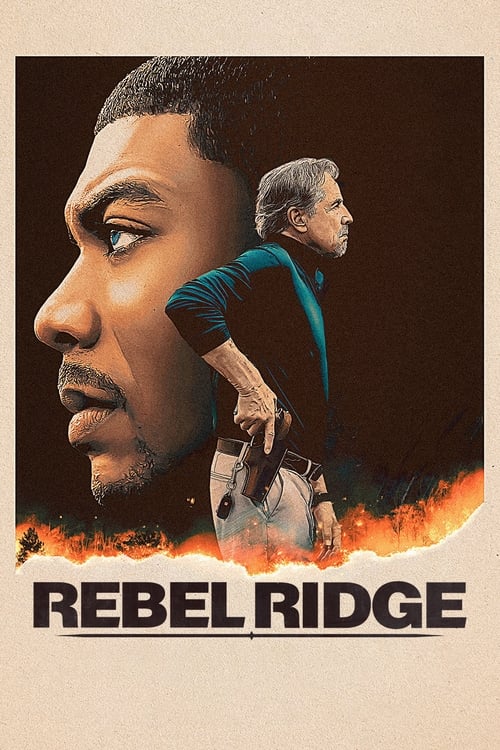
Rebel Ridge
2024 · Jeremy Saulnier
When you want a smart, satisfying thriller with something on its mind — righteous-anger viewing that still delivers genre pleasure. Great for a night when a dumb action movie won't cut it but you still want your pulse raised.
What it's about
A former Marine bikes into a small Louisiana town carrying the cash to bail out his cousin — and the local police seize it before he ever reaches the courthouse, entirely by the book. What follows is a standoff between one supremely disciplined man and a police department that has turned legal fine print into a weapon, with the whole town's rot slowly coming into view.
The experience
Tense in an unusual, simmering way: the suspense comes from paperwork, procedure, and the constant threat of violence rather than the violence itself. You spend the movie leaning forward, willing the hero to keep his cool — and marveling that he does.
Performances
Aaron Pierre is a revelation — coiled, watchful, and quietly commanding, he makes restraint itself feel like an action sequence. Don Johnson brings silky menace to the police chief across the table from him.
The craft
Jeremy Saulnier directs with surgical control, building set-pieces out of traffic stops, bail hearings, and evidence rooms, and grounding it all in how civil asset forfeiture actually works. When physical action does come, it's fast, precise, and deliberately unglamorous.
Why it matters
It landed as one of the most acclaimed thrillers of its year and sharpened the conversation about policing and civil forfeiture, while confirming Saulnier as the current master of grounded, methodical genre filmmaking.
Snapshot
Rebel Ridge is Jeremy Saulnier's fourth feature and his most controlled, procedurally minded film — a small-town corruption thriller that takes the familiar premise of the wronged outsider versus a crooked local police force and reroutes it through an unusually exact understanding of how American municipal policing actually exerts power. The wronged man is Terry Richmond (Aaron Pierre), a former Marine biking into a Louisiana town to post bail for his cousin, whose cash is seized by officers under civil asset forfeiture before he can reach the courthouse. What follows is less a rampage than a siege of paperwork, leverage, and escalating threat, in which Terry's training makes him formidable but his restraint — his pointed refusal to become the violent Black man the system expects and is primed to destroy — becomes the film's true subject. Against him stands Police Chief Sandy Burnne (Don Johnson), an avuncular, self-justifying authority who embodies a whole apparatus of legalized extraction. Released by Netflix in September 2024 after a troubled production history, the film was widely received as a return to form for Saulnier and a breakout for Pierre, and it stands as a rare action thriller that derives its tension from procedure, de-escalation, and institutional knowledge rather than from bloodshed.
Industry & production
Rebel Ridge was developed and produced for Netflix, part of the streamer's continuing investment in mid-budget genre features by directors with festival pedigrees. Saulnier wrote the screenplay as well as directing, consolidating the writer-director model he had followed since his debut. The production is most notable in industry terms for its protracted and disrupted path to completion. Principal photography began in 2021 with John Boyega cast in the lead role of Terry Richmond, but Boyega departed the production shortly after filming started, citing family reasons; the production shut down and was substantially restarted. Aaron Pierre, a British actor then best known for supporting roles, was cast in the part, and the film was eventually shot to completion and released in 2024. This kind of mid-shoot recasting and shutdown is unusual and costly, and the film's arrival three years after its first cameras rolled reflects that interruption.
The picture was shot largely on location in Louisiana, whose tax incentives and Southern textures suit the film's setting of a fictional small town governed by an entrenched, self-dealing police department. Don Johnson, a veteran whose career stretches from Miami Vice through a late run of character work, was cast as the chief; AnnaSophia Robb plays Summer McBride, a court clerk with her own grievance against the department who becomes Terry's ally and conduit to the system's inner workings. The supporting cast fills out the ranks of the department and the town's machinery. Beyond the recasting, the public production record is comparatively thin on granular detail, and it would be invention to assign specific budget figures or scheduling particulars that are not securely documented.
Technology
Rebel Ridge is, in technical terms, a contemporary digitally photographed thriller that makes no display of technological novelty; its sophistication is in craft rather than apparatus. The film's distinguishing technical commitment is to clarity and legibility — both visual and procedural. Where many modern action films lean on rapid cutting and shaky handheld coverage to manufacture chaos, Rebel Ridge favors stable, comprehensible spatial geography so that the audience always understands who is where, what each party knows, and what legal or physical leverage is in play. This is a film whose tension depends on the viewer tracking information, and its technical means are organized to keep that information clear. The specific camera systems and post-production pipeline are not matters of public emphasis, and the film does not foreground any technical innovation; to claim otherwise would be to overstate the record. What is worth noting is the deliberate restraint of the technology's deployment — the refusal of stylistic excess in favor of a clean, observational image.
Technique
Cinematography
The cinematography is by David Gallego, the Colombian cinematographer known for his work on Ciro Guerra's Embrace of the Serpent and Rungano Nyoni's I Am Not a Witch — a background in art cinema that brings an unexpected compositional discipline to a genre thriller. Gallego's work on Rebel Ridge favors a sober, daylight-heavy palette and a measured, watchful camera that holds on faces and spaces rather than fragmenting the action. The framing tends to keep Terry centered and contained, emphasizing his stillness and self-possession; the film's most charged moments are often the quietest, with the camera observing a stand-off rather than goosing it. Sightlines — appropriate to this atlas's name — are a real concern of the staging: who can see whom, the geography of a parking lot or a station house, the distances a body must close. The lighting is naturalistic and unglamorous, rooting the story in the ordinary surfaces of a Southern town — municipal interiors, asphalt, fluorescent offices — and refusing the heightened expressionism that Saulnier's earlier films sometimes embraced.
Editing
The editing organizes the film as a steadily tightening procedural, building tension through the controlled release of information rather than through montage acceleration. The cutting is patient in conversation scenes, allowing negotiations and interrogations to play at length so that the audience can register every shift in leverage; it tightens precisely when physical confrontation becomes unavoidable. Crucially, the film's few outbreaks of violence are cut for legibility and impact rather than for a blur of carnage — each move readable, each consequence clear. This restraint is a deliberate structural choice: by withholding the cathartic action-movie payoff for so long, the editing keeps the audience in the same state of constrained, calculating patience as Terry himself. The rhythm mirrors the protagonist's discipline.
Mise-en-scène / staging
Saulnier's staging is built around procedure and space. The film maps the physical and bureaucratic geography of a corrupt municipality with care — the police station, the courthouse, the records office, the roads in and out — and stages its drama as a series of confrontations in these institutional spaces. The most distinctive element of the staging is its treatment of violence and its threat. Terry, established as a Marine with martial-arts training, is choreographed to neutralize rather than destroy: disarming, restraining, and controlling opponents with conspicuous discipline. The action design dramatizes self-control as much as capability, repeatedly showing Terry choosing the non-lethal option, and the staging makes that choice legible as a strategy of survival within a system poised to read any Black man's force as justification for lethal retaliation. The costuming and production design keep Terry plain and unthreatening in presentation, sharpening the gap between how the town perceives him and what he is actually capable of.
Sound
The sound design favors a grounded, naturalistic register — the ambience of small-town exteriors, the hum of municipal interiors, the specific sounds of restraint and struggle in the close-quarters confrontations. The original score is credited to Brooke and Will Blair, the Blair brothers, Saulnier's longtime musical collaborators who scored Blue Ruin, Green Room, and Hold the Dark; their work here tends toward tense, restrained underscoring that supports the film's procedural suspense rather than inflating it. (Readers should treat fine details of the music's construction as beyond the firmly documented record.) Consistent with the film's overall discipline, the sound refuses bombast, keeping the audience inside the tense, information-rich quiet that defines the picture's mode.
Performance
Performance is central to the film's effect, and Aaron Pierre's turn as Terry Richmond is its anchor. Pierre plays Terry as a study in banked intensity — soft-spoken, courteous, almost preternaturally calm, with physical capability held in reserve and revealed sparingly. The performance's achievement is to make stillness compelling: Terry's power registers in what he does not do, in the visible cost of his restraint, and the role established Pierre as a major emerging lead. Don Johnson's Chief Burnne is the necessary counterweight, a portrait of folksy, rationalized authority whose geniality masks a comfortable ruthlessness; Johnson uses his easy charm to make institutional corruption feel ordinary and self-satisfied rather than cartoonish. AnnaSophia Robb gives Summer McBride a nervy, principled energy as the insider who supplies Terry — and the audience — with the bureaucratic knowledge the plot turns on. The supporting ensemble of officers fills out a department portrayed as a self-protecting organism.
Narrative & dramatic mode
Rebel Ridge's dramatic mode is the procedural thriller crossed with the tradition of the wronged-loner revenge film, but it deliberately frustrates the revenge form's usual catharsis. The inciting injustice is mundane and bureaucratic — a cash seizure under civil asset forfeiture, a legal mechanism that allows police to confiscate money and property on suspicion alone — and the narrative engine is Terry's attempt to recover what was taken through escalating but largely lawful pressure. The film withholds the expected explosion of violence, structuring itself instead around negotiation, leverage, and the gathering of information, with Terry and Summer probing the department's records for the corruption that will give them a hold over the chief. This makes the film a drama of restraint: the suspense comes from the audience's anticipation of a violence that the protagonist keeps refusing to unleash, and from the knowledge that the system is engineered to punish that violence the instant it appears. When physical force finally comes, it is contained and tactical rather than apocalyptic. The narrative is, at bottom, about whether a man can defeat an unjust system without becoming the thing the system needs him to be in order to destroy him.
Genre & cycle
The film belongs to the durable American cycle of the lone competent man against a corrupt small town — a lineage that runs through Walking Tall (1973), First Blood (1982), and the Jack Reacher novels and their adaptations. Its closest structural ancestor is First Blood: a trained, traumatized military veteran is harassed by small-town law enforcement and pushed toward a confrontation he did not seek, his combat expertise turning the town's aggression back on itself. But Rebel Ridge pointedly revises the template. Where First Blood builds to wholesale destruction, Saulnier's film insists on restraint and legal stratagem, and it foregrounds race and the specific machinery of contemporary American policing — civil asset forfeiture, qualified immunity, the everyday extraction by which departments fund themselves — in a way the earlier films did not. It thus participates simultaneously in the action-thriller cycle and in a more recent strain of socially conscious genre filmmaking that uses the thriller chassis to examine systemic injustice. Within Saulnier's own work it marks an evolution: the revenge premise of Blue Ruin and the siege structure of Green Room are recognizable, but the graphic, ironic brutality of those films is here replaced by discipline and procedure.
Authorship & method
Rebel Ridge is unmistakably a Jeremy Saulnier film, even as it represents a deliberate departure. Saulnier's authorship has been defined by stories of ordinary, ill-equipped people drawn into violence — the hapless avenger of Blue Ruin, the trapped punk band of Green Room — rendered with a hard, unromantic view of bloodshed's consequences and a craftsman's attention to suspense. His method has consistently paired competent-incompetence and moral exhaustion with meticulously staged tension. Rebel Ridge retains his interest in violence and its costs but inverts his usual protagonist: Terry is supremely competent and self-controlled, and the film's drama lies in his withholding of the very force Saulnier's earlier characters stumbled into. The persistent Saulnier theme — that violence is a trap, costly and rarely redemptive — is here made explicit as strategy rather than tragedy.
Among the key collaborators, cinematographer David Gallego supplies the film's sober, art-cinema-inflected clarity; the score by the Blair brothers, Brooke and Will Blair, continues a musical partnership that spans Saulnier's career and lends the film its restrained tension. Saulnier's long creative association with the actor and filmmaker Macon Blair, his collaborator since their earliest work, is part of the broader authorial context, though the firm public record on division of labor within Rebel Ridge itself is limited, and specific claims beyond the documented credits should be treated cautiously.
Movement / national cinema
Rebel Ridge is a product of the contemporary American independent-to-streaming pipeline, in which directors who emerged through the festival circuit — Saulnier broke through with Blue Ruin at Cannes' Directors' Fortnight in 2013 — are financed by streaming platforms to make mid-budget genre work that would once have occupied the theatrical middle. As national cinema it is emphatically American and regional, rooted in the textures of the rural and small-town South and in a specifically American institutional landscape of municipal policing and its legal apparatus. It belongs to no organized movement, but it sits within a recognizable current of post-2010s American genre cinema that fuses thriller mechanics with social critique, and within the broader phenomenon of auteur-driven films made directly for streaming distribution rather than theaters.
Era / period
The film is a precise artifact of its moment, the United States of the early-to-mid 2020s, and its concerns are inseparable from the period's intensified national debate over policing, race, and institutional accountability that followed the protests of the late 2010s and 2020. Its choice of civil asset forfeiture as the inciting injustice is pointed and contemporary: the practice, which permits law enforcement to seize cash and property without a criminal conviction and which has become a documented revenue stream for many departments, crystallizes the film's argument about policing as a system of legalized extraction. The film's attention to qualified immunity and to the structural difficulty of holding officers accountable likewise reflects period preoccupations. Terry's identity as a Black man navigating a white-controlled Southern town, and his strategic refusal of violence as a survival calculus, situate the film squarely within the era's reckonings. The interruption of its own production by the disruptions of the early 2020s further marks it as a film of its time.
Themes
The governing theme of Rebel Ridge is restraint as resistance — the proposition that, for a Black man confronting a system designed to criminalize his force, self-control is both a moral stance and a tactical necessity. Around this orbit several linked concerns. There is the theme of institutional corruption as ordinary procedure: the film locates evil not in a single villain but in routine mechanisms — forfeiture, immunity, the self-funding department — that operate within the law. There is the theme of legal versus physical power, the film repeatedly testing whether knowledge of the system can beat a system that holds a monopoly on legitimate violence. There is the persistent Saulnier theme of violence as a trap rather than a solution, here reframed as something the protagonist must consciously decline. And there is the question of perception and race: the gap between how the town reads Terry — as a threat to be neutralized — and who he actually is, a gap the film makes the engine of both its suspense and its critique. Beneath these runs a concern with dignity under pressure, the cost of remaining principled inside an apparatus engineered to provoke the response that would destroy you.
Reception, canon & influence
Rebel Ridge was met with strong critical reception on its September 2024 Netflix release, with reviewers widely praising it as a confident return to form for Saulnier after the more divisive Hold the Dark, and singling out Aaron Pierre's lead performance as a breakout. Critics responded particularly to the film's discipline — its willingness to wring tension from procedure, negotiation, and restraint rather than from spectacle — and to its sharp engagement with civil asset forfeiture and contemporary policing. As a streaming release the film has no theatrical box-office record, and precise viewership figures should be treated as outside the firmly verifiable account; what is documented is the consensus of critical approval and the elevation of Pierre's profile. Formal awards recognition for a fall streaming genre release was modest, in keeping with the category's typical reception.
Influences on the film run backward most clearly to First Blood and the lineage of the wronged-veteran and corrupt-small-town thrillers (Walking Tall, the Reacher tradition), and to the procedural suspense of the broader American crime film; within Saulnier's own filmography it extends the revenge logic of Blue Ruin and the siege construction of Green Room while consciously inverting their relationship to violence. Its engagement with civil forfeiture and qualified immunity draws on a body of contemporary journalism and public debate about American policing. Its influence forward is, given its recency, still emerging: its most concrete legacy to date is the establishment of Aaron Pierre as a leading man, and it stands as a prominent example — within the streaming era — of how the action thriller can be reorganized around restraint and institutional critique rather than escalation, a model later genre filmmakers working in the socially engaged thriller may well inherit. As a recent release its ultimate place in the canon remains to be settled, but it has already secured a reputation as one of the more intelligent American genre films of its year.
A Deleuzian reading
A man pedals into a Louisiana town on a back road.
The full Deleuzian reading of Rebel Ridge →
Reception
No reappraisal needed — it dropped quietly on Netflix in September 2024, shot to #1, and critics and audiences agreed almost instantly; the only arc is the lingering grumble that a theatrical release and awards attention never came.
How Rebel Ridge was received, from release to now →
Influences: the films it descends from and the films it influenced
- First Blood (1982) — The explicit template Saulnier names: a supremely competent ex-soldier deploying guerrilla tradecraft and deliberately non-lethal tactics against a corrupt rural police force, withholding the lethal force he plainly possesses until the institution forces his hand.
- Walking Tall (1973) — Originates the lone-man-vs-corrupt-Southern-town structure and the choice of a signature blunt instrument over gunplay, encoding the moral-tactical preference for incapacitation rather than killing that Rebel Ridge formalizes.
- Southern Comfort (1981) — Hill's hostile-Louisiana-territory siege staging — outsiders read against locals through precise tactical geography and sightlines — is the regional-thriller spatial grammar Saulnier inherits.
- Deliverance (1972) — Establishes the procedural dread of ordinary competent men and the unromantic, irreversible weight of each violent act — the 'violence is a costly trap' ethic underpinning Saulnier's whole method.
- No Country for Old Men (2007) — Source of the controlled-release suspense built from procedure and silence, and of the folksy aging-lawman moral counterweight (Tommy Lee Jones → Don Johnson's banked authority).
- Blue Ruin (2013) — Saulnier's own grammar of amateurish, physically costly violence in which every wound is legibly staged and consequential — Rebel Ridge inverts the incompetent avenger into a competent one but keeps the legible-violence accounting.
- Green Room (2015) — The siege architecture of a known floor plan, with weapons, bodies, and sightlines tracked through fixed spatial geography — the staging engine Rebel Ridge reuses for its station-house and bayou standoffs.
- Embrace of the Serpent (2015) — Establishes DP David Gallego's observational, naturalistically-lit camera — the sober art-cinema clarity that gives Rebel Ridge its un-stylized, documentary-adjacent surface.
- Wind River (2017) — Organizes a procedural genre thriller around systemic injustice toward a marginalized population, with violence kept sudden, legible, and morally costly rather than escalatory.
- I Don't Feel at Home in This World Anymore (2017) — The Saulnier-circle film by his oldest collaborator, extending the same consequential, un-glamorous-violence grammar in which an ordinary person's escalation carries real bodily cost.
- Haywire (2011) — Casts physical credibility over star gloss and shoots hand-to-hand combat in clean, near-unscored, legible wide takes — the same commitment to readable, grounded fight choreography Saulnier gives Aaron Pierre.
- The Raid (2011) — Choreographs confined-building combat for total spatial legibility, the audience always oriented in the floor plan — the sightlines-and-geography action craft Rebel Ridge applies at lower intensity.
- Jack Reacher (2012) — The methodical near-invulnerable loner who dismantles local corruption through procedure, investigation, and economical hand-to-hand rather than firepower escalation.
- Sicario (2015) — Builds tension from controlled information-release and institutional rot, staging restrained violence through legible tactical geography (convoys, border crossings) rather than spectacle.
- Hell or High Water (2016) — A socially-engaged crime procedural that critiques an extractive institutional system, privileging restraint, negotiation, and a folksy lawman over action — the institutional-critique-as-thriller model Rebel Ridge shares.
- Michael Clayton (2007) — Wrings sustained suspense from procedure, negotiation, and the controlled withholding of information against a corrupt institution — the restraint-over-spectacle thriller architecture Rebel Ridge adopts for policing and forfeiture.
Similar films
- Hell or High Water (2016) — influence & lineage
- The Order (2024) — same viewing thread
- Number 24 (2024) — same viewing thread
- The Rip (2026) — shared sensibility
- Citizen Vigilante (2026) — shared sensibility
- Leviathan (2014) — shared sensibility
- Relay (2025) — shared sensibility
- Shooter (2007) — shared sensibility
All the films related to Rebel Ridge →
Watch it with: curated runs of related films
- One Man Against the Machine — A run of thrillers about a single conscience squaring off against entrenched, corrupt or outright murderous power — watch these when you want the slow-burn tension of someone who won't back down.