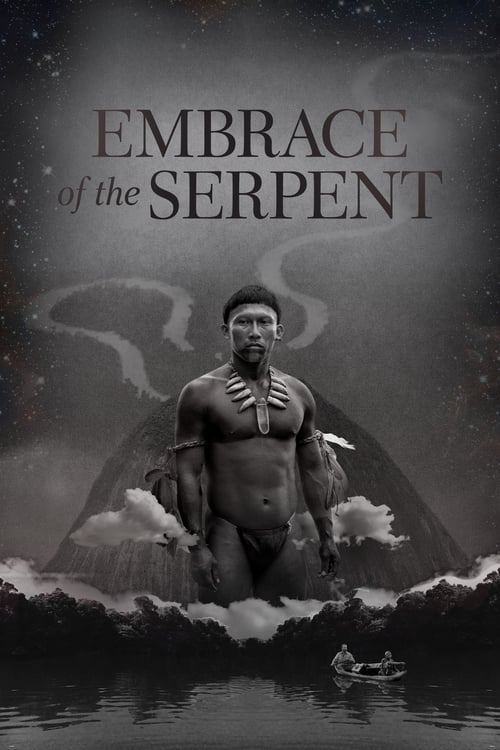
Embrace of the Serpent
2015 · Ciro Guerra
When you want to be transported somewhere genuinely other and are willing to surrender to a slower rhythm — a film to chew on for days, not background viewing. Firmly on the challenge end, and worth it.
What it's about
An Amazonian shaman named Karamakate, the last survivor of his people, twice guides a white scientist upriver in search of a rare sacred plant — a German ethnographer in 1909, an American botanist in 1940. Drawn from the real explorers' journals, the film braids the two journeys into one long reckoning between the forest's knowledge and the world that came to take it.
The experience
Hypnotic and slow-burning, like drifting downriver into a dream — long silences, sudden eruptions of strangeness and violence, and a mounting sense of grief for everything being erased. It's the kind of film you surface from rather than finish.
Performances
Antonio Bolívar, one of the few remaining speakers of the Ocaina language, gives the older Karamakate a wry, wounded authority that no trained actor could fake; the Indigenous non-professional cast is the film's soul.
The craft
David Gallego shot the jungle on 35mm in luminous black and white — silvered and dreamlike instead of postcard green, echoing the expedition photographs the story is built on. The dual-timeline structure lets the same river carry two eras at once. It rewards the biggest, darkest screen you can find.
Why it matters
It became Colombia's first film nominated for the Best Foreign Language Film Oscar and reframed how cinema tells colonial encounter stories — with the visitors as the enigmas and Indigenous knowledge at the center.
Ciro Guerra's Amazonian odyssey braids two journeys, four decades apart: a German ethnographer in 1909 and an American botanist in 1940, each guided upriver by Karamakate, a shaman who is the last of his people and who regards both visitors with justified suspicion. Drawn from the journals of the real explorers Theodor Koch-Grünberg and Richard Evans Schultes, the film inverts the colonial adventure story — here the white travelers are the enigmas, and the forest's knowledge is what's at stake. David Gallego shot it on 35mm in luminous black and white, turning the jungle into something silvered and dreamlike rather than picture-postcard green; the choice recalls the expedition photographs the film is built on. Guerra cast Indigenous non-professionals in the central roles, and Antonio Bolívar, one of the few remaining speakers of Ocaina, gives the older Karamakate a wounded, sardonic authority. It became the first Colombian film nominated for the foreign-language Oscar, and announced a national cinema ready to reckon with the rubber-boom atrocities its own history books had softened.
A Deleuzian reading
The water is silver.
The full Deleuzian reading of Embrace of the Serpent →
Reception
It arrived already garlanded — the Art Cinema Award at Cannes' Directors' Fortnight, then Colombia's first-ever Oscar nomination — and a decade on it's only climbed, settling in as one of the defining art films of the 2010s and the standard-bearer of the new Colombian cinema.
How Embrace of the Serpent was received, from release to now →
Influences: the films it descends from and the films it influenced
- Aguirre, the Wrath of God (1972) — Establishes the Amazon-river expedition as a descent into colonial delirium, shot in punishing real locations with indigenous non-professionals — the template Guerra inverts by handing narration to the native side.
- Fitzcarraldo (1982) — Dramatizes the rubber-boom Amazon and casts real riverine communities on location, supplying the exact historical-economic backdrop (rubber barons, missions, extraction) that Embrace stages from the victims' vantage.
- Apocalypse Now (1979) — Codifies the upriver voyage as a hallucinatory moral spine where each bend deepens the derangement — the river-as-narrative-structure device Guerra doubles across two timelines.
- Dead Man (1995) — Black-and-white spiritual death-journey in which an indigenous companion (Nobody) reorients the whole cosmology, decentering the white protagonist — the colonial-inversion and indigenous-guide framework Embrace inherits.
- Nanook of the North (1922) — Founds the ethnographic drama built from indigenous non-professionals re-enacting their own lifeways on location, the documentary-fiction hybrid mode Embrace's Antonio Bolívar casting descends from.
- Black Robe (1991) — Subtitled indigenous-language canoe expedition pairing a missionary with native guides, using immersive location shooting to stage a first-contact clash of belief systems rather than an adventure.
- The New World (2005) — Tells colonial first contact through natural-light, near-documentary indigenous performance and competing interior voiceovers, privileging the native sensorium over the colonizer's narration.
- Atanarjuat: The Fast Runner (2001) — Entirely indigenous-language production cast from the community, dramatizing oral tradition from inside the culture — the from-within ethnographic method Embrace pursues.
- The Mission (1986) — A Amazonian colonial-encounter film that deliberately inverts The Mission's European-centered viewpoint, answering its 'white savior' framing by narrating the river journey from the indigenous protagonist's perspective.
- Apocalypto (2006) — Takes the indigenous-language authenticity strategy seriously as ethics rather than spectacle, casting Amazonian native speakers and reconstructed tongues — a corrective answer to the colonial-narrative critique Apocalypto drew.
- Magellan (2025) — Inherits the Aguirre-via-Diaz line into postcolonial cinema: black-and-white encounter between European travelers and indigenous worlds, reframed from the colonized vantage rather than the explorer's, as Magellan does with Lapulapu and Mactan.
- Birds of Passage (2018) — Guerra's own follow-up extends the indigenous-language ethnographic drama into Wayuu culture, driving narrative through ritual, dreams and cosmology rather than Western plotting.
- Monos (2019) — Colombian-national-cinema successor deploying expedition-grade landscape photography and immersive non-professional performance in remote terrain, extending Embrace's craft of shooting hostile wilderness as character.
- Rebel Ridge (2024) — Establishes DP David Gallego's observational, naturalistically-lit camera — the sober art-cinema clarity that gives Rebel Ridge its un-stylized, documentary-adjacent surface.
- The Blue Trail (2025) — Builds its narrative as an Amazon river-journey of waystation encounters with a hallucinatory, indigenous-sourced soundscape carrying the drift.
- I Am Not a Witch (2017) — Cinematographer David Gallego, whom Nyoni carried over, developed here the same austere anamorphic-widescreen compositions and precise horizon-line framing of figures dwarfed by landscape that structure the witch-camp vistas.
- On Becoming a Guinea Fowl (2024) — Cinematographer David Gallego's method — held, deep-frame compositions with a steady anthropological gaze — is the collaborator craft carried directly into Guinea Fowl's imagery.
- Los Muertos (2004) — Contemplative Latin-American river journey carried by a non-professional lead and long takes that let the jungle's sensory weight, not plot, generate meaning.
- Jauja (2014) — A colonial officer lost in indigenous terrain undergoes formal disorientation that dismantles the outsider's rationality — the same collapse of the European vantage Guerra dramatizes.
- Zama (2017) — A colonial functionary dissolves into the South-American environment via dense, disorienting sound design that steadily undermines the European point of view.
- Ixcanul (2015) — Contemporaneous Latin-American ethnographic drama built on Kaqchikel-speaking non-professionals and indigenous cosmology, sharing Embrace's language-preservation impulse.
- Ten Canoes (2006) — Indigenous-language, community-cast film that alternates black-and-white and color to separate two nested time layers of story and myth, a dual-register structure akin to Embrace's dual timeline.
- Even the Rain (2010) — Reflexive critique of colonial extraction in Latin America that foregrounds the exploitation of indigenous labor, sharing Embrace's colonialism-and-resource-boom indictment.
- The Mysterious Gaze of the Flamingo (2025) — Represents the contemporary Colombian/Latin American art-cinema lineage of Céspedes's cinematographer Angello Faccini, foregrounding landscape-as-character imagery in a pan-Latin-American co-production frame.
- Antonio das Mortes (1969) — Carries forward the syncretic-cosmology impulse, staging Amazonian ritual and Catholic-messianic collision as a formal allegory of colonial violence.
- I Dream in Another Language (2017) — Follows the extractive ethnographer who arrives to record a vanishing indigenous knowledge, structured across two braided time layers around a salvaged object — the collector-ethics plus recognition/withheld-revelation architecture.
- Identifying Features (2020) — Latin American precedent for routing a journey narrative into mythic register, using non-professional casting and folkloric cosmology to confront colonial and extractive violence.
Similar films
- Birds of Passage (2018) — influence & lineage
- Zama (2017) — influence & lineage
- Aguirre, the Wrath of God (1972) — influence & lineage
- Fitzcarraldo (1982) — influence & lineage
- The New World (2005) — influence & lineage
- I Dream in Another Language (2017) — shared sensibility
- Magellan (2025) — shared sensibility
- Beasts of No Nation (2015) — shared sensibility