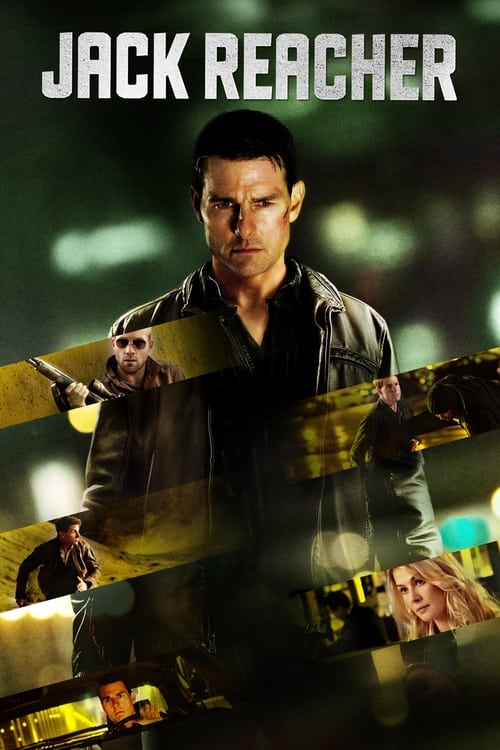
Jack Reacher
2012 · Christopher McQuarrie
For a Friday night when you want a smart, meat-and-potatoes thriller — the kind where a capable loner takes a case apart piece by piece. Pure comfort viewing for mystery and action fans, no homework required.
What it's about
Five strangers are shot dead one morning by a sniper firing from a parking garage, and the evidence against the ex-military shooter in custody looks airtight. His only statement is a scrawled note: 'Get Jack Reacher.' Reacher — a drifting ex-Army investigator with no address, no phone and no patience — turns up on his own and, though he suspects the police have the right man, starts pulling at the case alongside the suspect's defense attorney. The threads don't hold.
The experience
Lean, cool and satisfying — an unhurried procedural that trusts you to follow the clues, punctuated by hard, clean bursts of action and a dry streak of humor. It has the confident, no-nonsense feel of a 70s crime picture.
Performances
Tom Cruise plays Reacher with stillness instead of his usual charm — watchful, blunt, faintly menacing — and Werner Herzog turns a few scenes as the villain into something genuinely chilling; Robert Duvall shows up late and steals every moment he's in.
The craft
McQuarrie directs with old-school discipline: a nearly wordless opening sniper sequence that sets the whole film's nerve, fights staged wide and readable, and a practical, engine-roaring muscle-car chase with no digital gloss. The sound of that chase alone is worth good speakers.
Why it matters
It revived the grounded, analog action thriller in a CGI era and launched a franchise, while cementing the Cruise–McQuarrie partnership that would go on to reshape big-screen action.
Snapshot
Jack Reacher is a deliberately old-fashioned procedural thriller dressed in the clothes of a contemporary star vehicle: a throwback to the lean, ground-level American crime cinema of the 1970s, built around a wandering investigator who answers to no institution and carries nothing but a folding toothbrush. Adapted by writer-director Christopher McQuarrie from Lee Child's 2005 novel One Shot — the ninth book in Child's long-running series — it opens with a near-wordless set piece in which a sniper kills five apparent strangers from a parking garage above a Pittsburgh riverfront plaza. The evidence is overwhelming, the suspect is in custody, and the case appears closed; but the accused man's only statement is a scrawled demand, "Get Jack Reacher." Reacher (Tom Cruise) arrives unbidden, intending to confirm the man's guilt, and instead pulls a thread that unravels a frame-up orchestrated by a shadowy criminal architect. The film's wager is one of register and pace: it forgoes the maximalist spectacle of the modern blockbuster for a slower, talkier, more analytic mode — interrogation, ballistics, footwork — punctuated by bursts of blunt, practical violence. It is also, in retrospect, a pivot point in Cruise's career and in McQuarrie's, the beginning of a partnership that would reshape the Mission: Impossible franchise.
Industry & production
The film was produced under the Skydance–Paramount arrangement that defined Cruise's output in the early 2010s, with David Ellison's Skydance Media co-financing alongside Paramount Pictures, which distributed. Cruise produced through his own banner with longtime associates including Don Granger and Paula Wagner, and the project was developed as a potential franchise launch — the obvious appeal being Child's deep catalog of Reacher novels, a ready-made library of self-contained mysteries built around a single durable protagonist.
The defining industry story of Jack Reacher is its casting controversy. Child's literary Reacher is a giant — described across the novels as roughly six foot five and around two hundred and fifty pounds, fair-haired, physically overwhelming — and the casting of the much shorter, dark-haired Cruise provoked sustained objection from the books' large fan base. Child himself publicly defended the choice, arguing that Reacher's essence was an attitude of unstoppable self-possession rather than literal stature, and that Cruise could deliver that presence; the debate nonetheless followed the film throughout its release and remains the single most-cited fact about it. The disjunction is real and worth naming plainly: the film effectively reconceives Reacher around Cruise's particular kind of coiled, precise intensity rather than the books' brute physicality.
The other widely reported production fact concerns the film's release. Jack Reacher opens on a mass public shooting, and its scheduled Pittsburgh premiere fell within days of the Sandy Hook Elementary School shooting in December 2012. The premiere was canceled out of respect for the victims, and the film's violent opening became, by grim coincidence, a point of public discomfort at the moment of its debut. The picture opened in North American theaters later that December.
Commercially, the film performed solidly rather than spectacularly — a modestly budgeted star vehicle that earned a comfortable multiple of its production cost worldwide, enough to justify a sequel but short of the breakout that would have established a robust franchise. I'll avoid citing exact grosses, which vary by source; the salient point is that it landed as a moderate success, strong enough abroad to keep the property alive.
Technology
Technologically, Jack Reacher is unremarkable by design, and that restraint is the point. It was shot on 35mm film by cinematographer Caleb Deschanel during a period when digital capture was rapidly becoming the studio norm, and the choice of celluloid is consonant with the film's broader 1970s-throwback sensibility. Visual effects are sparse and largely invisible, confined to the sort of clean-up and augmentation expected of a contemporary studio release rather than to spectacle. The production's signature "technology" is mechanical and physical: the centerpiece car chase through Pittsburgh was staged practically, with real vehicles on real streets and Cruise performing much of his own driving in a muscle car, in keeping with the actor's well-documented insistence on practical stunt work. The film belongs, in other words, to a tradition that treats analog craft — real cars, real locations, real ballistics logic — as a form of authenticity, and it pointedly declines the digital maximalism of its blockbuster peers.
Technique
Cinematography
Caleb Deschanel — a veteran whose credits include The Black Stallion, The Right Stuff, and The Patriot — shoots Pittsburgh as a cold, hard, grayed-out American city, all riverfront concrete, parking structures, and overcast light. The opening massacre is the film's bravura passage: a near-silent sequence built largely from the sniper's point of view through the scope, the crosshairs drifting across an ordinary lunchtime crowd with appalling patience, the geometry of sightlines and victims laid out with procedural clarity before a shot is fired. Deschanel's camera elsewhere favors classical stability and legibility over the handheld agitation fashionable in action cinema of the period; the framing is composed, the action readable, the violence staged so the viewer always knows who is where. This compositional discipline is itself a stylistic argument — a deliberate rejection of chaos-cinema in favor of an older, cleaner action grammar.
Editing
Kevin Stitt's cutting reinforces the film's unusual rhythm: it is, for a star action vehicle, a notably patient film, willing to dwell on interrogation scenes, ballistics reconstruction, and dialogue, and to let the plot advance through deduction rather than incident. The action set pieces, when they arrive, are cut for spatial clarity rather than disorientation — the car chase in particular is assembled so that the geography of the pursuit remains coherent, an old-fashioned virtue. The editing's task is to sustain a procedural through-line: the audience is meant to follow Reacher's reasoning, to watch a false solution be dismantled piece by piece, and the cut serves that legibility.
Mise-en-scène / staging
The film's staging is grounded and unglamorous: police bullpens, a defense attorney's office, a gun range, parking garages, anonymous motels and bars, the disused quarry where the climax unfolds. Reacher himself is a study in minimalist staging — a man with no luggage, no phone, no fixed address, who buys cheap clothes and discards them, and McQuarrie frames him repeatedly as a figure passing through spaces he has no stake in. The action choreography favors economy and impact over balletic excess: Reacher fights with a blunt, efficient brutality, and one recurring comic-tense motif stages him dispatching multiple attackers with almost contemptuous ease. The overall production design insists on a plausible, lived-in American urban texture rather than stylized spectacle.
Sound
Joe Kraemer's score is one of the film's quiet distinctions — a muscular, brass-and-percussion-forward orchestral score consciously evoking the hard-edged crime scoring of the 1960s and 1970s, with a driving propulsion in the action cues that recalls the era of Bullitt and Dirty Harry. Kraemer was a relatively low-profile composer at the time, and his work here led directly to his scoring McQuarrie's subsequent Mission: Impossible — Rogue Nation. The sound design is similarly disciplined: the opening massacre derives much of its horror from sonic restraint and the flat report of rifle fire, and the practical car chase foregrounds the mechanical roar of real engines over musical underscoring.
Performance
Cruise's Reacher is built on stillness and certainty rather than bulk — a performance of total, unflappable competence, the character always several deductive steps ahead, dispensing dry, deadpan lines with a faint menace. Whether this satisfies as Reacher depends on one's investment in the novels, but as a piece of Cruise star-acting it is precise and controlled. The supporting cast is unusually strong for the genre: Rosamund Pike as Helen Rodin, the defense attorney who recruits and then doubts him; Richard Jenkins as her father, the district attorney; David Oyelowo as a detective; Robert Duvall as a laconic gun-range owner who becomes Reacher's ally; and Jai Courtney as the henchman-sniper Charlie. The most discussed performance is Werner Herzog's — the great German director cast, in a piece of inspired stunt casting, as the villain known only as "The Zec," a gulag survivor of almost geological coldness who recounts having chewed off his own frostbitten fingers to survive. Herzog's natural gravity and unplaceable accent make the character genuinely unsettling, and his presence is the film's most memorable grace note.
Narrative & dramatic mode
Jack Reacher operates in the mode of the investigative thriller rather than the action spectacle: its engine is mystery and deduction, and its pleasures are those of watching a closed case reopened and a hidden design exposed. The structure is essentially that of a detective story — an apparently airtight solution, a lone investigator who distrusts it, a methodical dismantling of the official narrative, and a reveal of the true architect behind the crime. Reacher functions as an almost mythic figure of incorruptible competence: he has no institutional ties, no personal stakes beyond a code, and no vulnerabilities the plot can easily exploit, which shifts the dramatic tension away from his survival and toward the unraveling of the puzzle and the protection of those around him. The dramatic mode is cool and procedural, leavened with dry humor, and it withholds conventional action gratification for long stretches in favor of conversation and reasoning — a structural choice that distinguishes it sharply from the franchise filmmaking around it.
Genre & cycle
The film sits squarely in the lineage of the American hard-boiled crime thriller and the lone-investigator subgenre, with a pronounced 1970s inflection. Its most direct genre ancestors are the tough-guy urban thrillers of that decade — the Dirty Harry cycle, the Steve McQueen mode of Bullitt, and the broader tradition of the laconic drifter-avenger that runs back through the Western to figures like the Man with No Name. Within its own moment it belongs to a small cycle of attempts to build durable, mid-budget action franchises around a single recurring literary or pulp hero — adjacent to the Bourne films, the Liam Neeson Taken cycle, and the Jack Ryan relaunches — at a time when studios were searching for non-superhero franchise material. It is also a Tom Cruise vehicle in the specific early-2010s sense, the period in which Cruise consolidated his late-career identity as an action star defined by practical stunt work.
Authorship & method
Jack Reacher is most legible as the work of Christopher McQuarrie, and as the consolidation of his creative partnership with Cruise. McQuarrie had won the Academy Award for the The Usual Suspects screenplay in 1995, made his directorial debut with the cult crime film The Way of the Gun (2000), and had recently written Valkyrie (2008), Cruise's wartime thriller. Jack Reacher was only his second feature as director, and it bears his screenwriter's sensibility: a tightly plotted mystery, sharp and quotable dialogue, and a structural elegance in how information is revealed and withheld. The film proved a hinge in both men's careers — it cemented a working relationship that would make McQuarrie the principal architect of the modern Mission: Impossible films (Rogue Nation, Fallout, and the Dead Reckoning films), the most sustained director-star collaboration in contemporary blockbuster cinema.
His key collaborators contribute meaningfully to the film's distinct texture: cinematographer Caleb Deschanel, whose classical, legible image-making grounds the picture in a grayed urban realism; composer Joe Kraemer, whose retro orchestral score supplies its 1970s-crime-film spine and who would follow McQuarrie to Rogue Nation; and editor Kevin Stitt. The source author, Lee Child, is part of the authorial picture too: the film adapts his One Shot faithfully in plot mechanics while reconceiving the protagonist around Cruise, and Child's public endorsement of that reconception was itself a notable authorial intervention.
Movement / national cinema
Jack Reacher is a mainstream Hollywood studio production and does not belong to any art-cinema movement; its affiliations are generic and industrial rather than national-school. If it is "of" anything, it is of the practical-stunt, mid-budget action tradition that Cruise personally championed in the 2010s — a reaction, in spirit, against the digital-spectacle dominance of the superhero era — and of the older American genre filmmaking it consciously revives. Its production base in Pittsburgh ties it to that city's emergence in the period as a favored, tax-incentivized stand-in for the generic American metropolis.
Era / period
The film is a product of the early-2010s studio search for franchise properties beyond the superhero and young-adult cycles, and of a particular moment in Tom Cruise's career — the rebuilding of his star brand around death-defying practical action following a period of public turbulence in the late 2000s. Its sensibility, however, is deliberately anachronistic: it reaches back past its own moment to the textures of 1970s crime cinema, positioning itself against the prevailing maximalism. Its release is also marked, unavoidably, by the cultural climate of late 2012 — the proximity of its opening to the Sandy Hook shooting lent its premise an unintended and uncomfortable topicality that briefly shadowed its debut.
Themes
The film's thematic core is incorruptible competence in a compromised system: Reacher is a figure of pure capability operating outside and against institutions — the police, the courts, organized crime — all of which are shown to be corruptible, fallible, or actively malign. Around this cluster several related concerns: justice versus the law, dramatized in the gap between the legal machinery that has produced a tidy false verdict and the rougher justice Reacher pursues; the lone man without ties, the romantic American myth of the unencumbered drifter who can act precisely because he wants and owns nothing; violence as professional craft, both in the sniper's cold geometry and in Reacher's own efficient brutality; and the manufactured truth, the thriller's animating idea that an apparently complete narrative of evidence can be an elaborate fabrication. The Herzog villain embodies a counter-theme of survival stripped of all morality — competence and will divorced from any human limit — making him a dark mirror of Reacher himself.
Reception, canon & influence
Critically, Jack Reacher was received as a solid, intelligent, better-than-expected genre entry — praised for McQuarrie's tight script and direction, for the practical car chase, for the supporting cast, and especially for Herzog's villain, while the casting of Cruise remained the persistent reservation among reviewers and the novels' readership. It was not a major awards contender and did not enter the critical canon, but it earned a reputation as a well-made, unpretentious thriller, and its standing has if anything improved in hindsight as the McQuarrie–Cruise partnership it launched bore extraordinary fruit.
Looking backward, its influences are clear: Lee Child's One Shot as direct source; the 1970s American crime thriller and the lone-avenger tradition as genre lineage; and the broader template of the literary-hero franchise. Looking forward, the film's most consequential legacy is industrial and personal rather than aesthetic — it inaugurated the McQuarrie–Cruise collaboration that would redefine Mission: Impossible and, with it, a whole strain of practical-stunt blockbuster filmmaking. As a franchise in its own right it faltered: a single sequel, Jack Reacher: Never Go Back (2016), was directed not by McQuarrie but by Edward Zwick, was more coolly received, and effectively ended the film series. The property's afterlife instead moved to television, where Amazon's Reacher (from 2022, with the physically imposing Alan Ritchson) restored the character's literary stature and proved a substantial success — an implicit commentary on the original casting debate and the clearest evidence of what these films, and this property, ultimately shaped.
A Deleuzian reading
Start with the crosshairs.
The full Deleuzian reading of Jack Reacher →
Reception
Dismissed in 2012 as a mid-tier Cruise vehicle with a casting problem, it's since been warmly reappraised as one of the leanest, most confident star thrillers of the decade — the film that convinced Cruise to hand McQuarrie the Mission: Impossible keys.
How Jack Reacher was received, from release to now →
Influences: the films it descends from and the films it influenced
- Point Blank (1967) — Lee Marvin's near-wordless revenant avenger is the template for Reacher's coiled stillness — menace conveyed through economy of motion and flat affect rather than dialogue, advancing through an elliptical revenge procedural.
- Bullitt (1968) — Established the in-camera, real-streets car chase scored by engine noise alone — the exact sound/sonic-restraint and practical-staging grammar McQuarrie revives for Reacher's nocturnal pursuit.
- Dirty Harry (1971) — The lone-avenger detective who works outside procedure, framed in scope against an indifferent gray city — the hard-boiled visual and moral posture Reacher inherits wholesale.
- The French Connection (1971) — Grimy documentary-realist procedural where deduction is shoe-leather legwork and the chase is shot at street level without glamour — the 1970s crime texture Reacher deliberately emulates.
- Charley Varrick (1973) — Lean, unadorned professional-criminal mechanics and a drifter protagonist outsmarting institutional muscle — the plot-clockwork-over-spectacle ethos behind McQuarrie's construction.
- Death Wish (1974) — Codified the vigilante lone-avenger delivering extrajudicial justice as audience catharsis, the genre engine Reacher updates with a detective's deductive frame.
- The Driver (1978) — A nameless, minimalist drifter defined by craft competence and sonic restraint, with practical driving sequences — Hill's stripped existential professionalism prefigures Reacher's blank-slate hero.
- The Usual Suspects (1995) — McQuarrie's own Oscar-winning screenplay; its architecture of strategically withheld and re-sequenced information is the narrative-engineering signature he brings to Reacher's deduction reveals.
- The Way of the Gun (2000) — McQuarrie's directorial debut establishes his deliberate, weighty gunplay realism and quotable hard-boiled antiheroes — the authorial method Reacher consolidates.
- Mission: Impossible – Rogue Nation (2015) — The direct fruit of the partnership Reacher launched — McQuarrie's tight withheld-information plotting and Joe Kraemer's retro-orchestral score carried over intact into the franchise.
- Mission: Impossible – Fallout (2018) — Extends Reacher's practical-stunt, real-vehicle chase craft to blockbuster scale — the in-camera car and motorcycle pursuits are the same staging philosophy amplified.
- Jack Reacher: Never Go Back (2016) — The direct sequel that abandons McQuarrie's procedural tightness and practical-chase discipline, demonstrating by absence exactly what the original's craft contributed.
- Reacher (2022) — The Amazon series restores the character's literary physicality through casting Alan Ritchson, an implicit corrective to the original's stillness-over-stature performance choice.
- The Right Stuff (1983) — Caleb Deschanel's classical, legible, stable image-making — the same cinematographer's grayed realism and unshowy compositional grounding he supplies to Reacher.
- Drive (2011) — A contemporary neo-1970s exercise in the minimalist near-silent drifter and coiled stillness, leaning on practical driving — the same lone-avenger archetype rendered with parallel formal restraint.
- Valkyrie (2008) — The immediately prior Cruise vehicle written by McQuarrie; the procedural-thriller scripting and star-management method that the Reacher collaboration directly extends.
- Rebel Ridge (2024) — The methodical near-invulnerable loner who dismantles local corruption through procedure, investigation, and economical hand-to-hand rather than firepower escalation.
Similar films
- Mission: Impossible - Fallout (2018) — influence & lineage · same viewing thread · often watched together
- The Usual Suspects (1995) — influence & lineage
- Shooter (2007) — same viewing thread
- 13 Hours: The Secret Soldiers of Benghazi (2016) — same viewing thread
- Mission: Impossible - The Final Reckoning (2025) — often watched together
- Top Gun: Maverick (2022) — often watched together
- Mission: Impossible (1996) — often watched together
- Oblivion (2013) — often watched together
All the films related to Jack Reacher →
Watch it with: curated runs of related films
- The Set-Piece Machine — A run of hard-charging, forward-driving action cinema — watch these back-to-back when you want mission-structured, physical-stakes spectacle built by people who know exactly how to escalate.