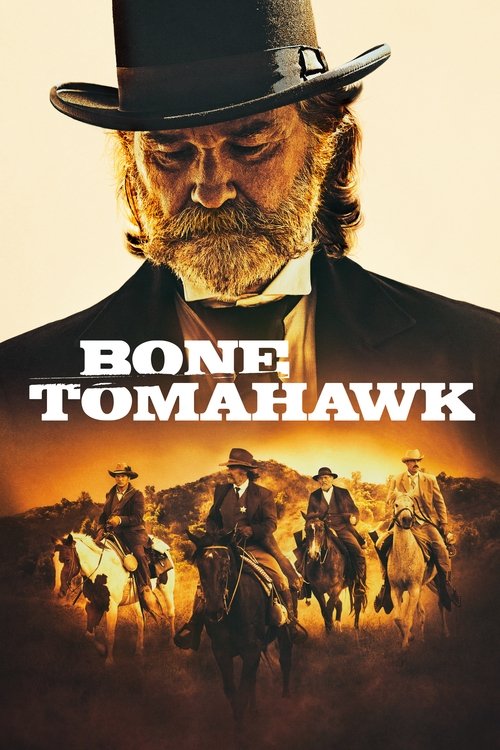
Bone Tomahawk
2015 · S. Craig Zahler
For when you want a long, immersive sit that earns its shocks — and only if you have a strong stomach, because the last act is genuinely extreme. A challenge pick for genre fans, not a casual Western night.
What it's about
In the frontier town of Bright Hope, a sheriff wounds a suspicious drifter — and that night the drifter, a deputy, and the woman nursing him are carried off by a band of cave-dwelling cannibals. Four men ride out to get them back: the stoic sheriff, his chatty elderly back-up deputy, the kidnapped woman's husband hobbling on a broken leg, and a vain, Indian-hating gunfighter. Most of the film is the long ride itself, and the rescue they're riding toward is worse than anything they imagine.
The experience
A strange, patient hybrid — for two hours it's a talky, dryly funny Western of campfire digressions and growing unease, and then it becomes one of the most brutal horror finales in modern genre film. The slowness is the point: you come to love these men before the film tests them.
Performances
Kurt Russell anchors it with weathered, iconic authority, but Richard Jenkins steals the film as Chicory, turning a rambling old deputy into its warm, aching heart. Matthew Fox and Patrick Wilson round out one of the decade's best genre ensembles.
The craft
S. Craig Zahler's dialogue is the secret weapon — ornate, funny frontier talk that makes the long ride a pleasure rather than a wait. The violence is staged practically and unflinchingly, and the film's vast quiet landscapes and spare sound design reward a big screen and a dark room.
Why it matters
It made Zahler's name overnight as a distinctive voice in slow-burn genre cinema and became a key film in the 2010s revival of the Western crossed with horror.
Snapshot
Bone Tomahawk is S. Craig Zahler's first feature as a director. It is a slow, talky captivity Western that turns in its final act into some of the most graphic violence in American genre cinema of the 2010s. The story starts in the frontier town of Bright Hope. Sheriff Franklin Hunt (Kurt Russell) shoots and wounds a drifter, and that night the drifter, a deputy, and Samantha O'Dwyer (Lili Simmons), who was nursing him, are taken by a band of cave-dwelling cannibals. Four men ride out to bring them back. Hunt goes with his elderly "back-up deputy" Chicory (Richard Jenkins). Samantha's husband Arthur (Patrick Wilson) comes too, though his leg is broken. The fourth is John Brooder (Matthew Fox), a dandyish gunman who hates Indians. Most of the film is the ride, told in long, digressive conversations and set-backs on the trail. The last section shows the captors' world bluntly and without stylisation.
The film was made cheaply and fast. It premiered at Fantastic Fest in 2015, got a small theatrical release alongside video-on-demand, and found most of its audience at home. It is now treated as a key title in the 2010s revival of the "horror Western" and as the founding work of Zahler's style: deliberate pacing, ornate dialogue, and violence that is rare but extreme.
Industry & production
Zahler was known before this film as a novelist, a musician, and a screenwriter whose scripts circulated widely but were rarely produced. His Western script The Brigands of Rattleborge had a strong reputation in the industry. Bone Tomahawk was his own original screenplay. He got to direct it largely because the cast agreed to work for limited money on the strength of the script.
The producers were Jack Heller and Dallas Sonnier, who was also Zahler's manager, through their production entities, chiefly Caliber Media. The budget is widely reported in trade coverage and interviews as under $2 million, and the shoot is commonly given as about three weeks, around 21 days, in southern California. Those figures come from the filmmakers' own accounts, not audited sources. Zahler and the cast have described the schedule as punishing, with little time for coverage or retakes, and that pressure shaped the film's spare style.
RLJ Entertainment released it in North America in October 2015, in a limited number of theatres and on VOD at the same time. Its theatrical gross was small, and it built its reputation on streaming, home video, and word of mouth. Russell's casting gave it commercial visibility. The same year he also appeared in Quentin Tarantino's The Hateful Eight, and the two snowbound and trail-bound Westerns were often discussed together that winter.
Technology
The film was shot digitally. Its look is plain rather than showy: natural light where possible, desaturated earth tones, and few visible effects. The violence relies mostly on practical make-up and prosthetics, and the cave interiors were built and lit on a modest scale. The technical approach is best read as the result of the budget, since there was no money for large-scale digital spectacle. The finished film turns that limit into restraint. Detailed specifications of the camera and lens package are not well documented in readily available sources, so this account does not try to give them.
Technique
Cinematography
Benji Bakshi was the cinematographer. He favours steady, mostly static compositions and wide frames that place the small posse in open scrubland and rocky terrain. The camera rarely moves for its own sake. Conversations are often held in medium two-shots and long takes, which suits the script's long exchanges. Night scenes around campfires are lit low, with faces partly lost in darkness.
The cave interiors at the end are dim and cramped, filmed in a harsher, more claustrophobic style. When the violence comes, the camera does not cut away and does not dramatise it with fast handheld work. It simply keeps watching. Much of the film's reputation for brutality comes from that steady, unflinching camera.
Editing
The film was edited by Fred Raskin and Greg D'Auria. It runs a little over two hours and is cut at a deliberately unhurried pace. Scenes play out at full length, digressions are kept in, and the journey's tedium, pain, and growing danger are allowed to build. The editing avoids the rapid montage of modern horror. Shocks come from sudden, short bursts of violence set against long quiet stretches, so the pacing itself is the main tool for suspense. Some reviewers called the middle section slow. Others argued that the slowness is what makes the climax hit so hard.
Mise-en-scène / staging
The production design is spare and functional: a small, plain frontier town, a saloon, a jail, and dusty trails. The costumes mark the characters clearly. Brooder dresses in fine, almost foppish clothes, Chicory wears homely layers, and Hunt has the worn practicality of a lawman.
The cannibal "troglodytes" are the film's most distinctive design. They are pale, painted, near-wordless figures, and some have bone instruments implanted in their throats that make an eerie howling whistle. They are staged as a closed, alien society rather than ordinary villains. Zahler is careful, at least by intention, to separate them from the Native American characters. Early on, a Native character referred to as "the Professor" (Zahn McClarnon) explains that his own people regard the troglodytes as a degenerate, inbred, separate group. Critics debated whether that framing works (see Themes).
Sound
The score, credited to Jeff Herriott and Zahler, is sparse. Long passages have no music, leaving wind, hooves, footsteps, and conversation. That near-silence makes the troglodytes' unearthly howling much more striking: it works as both a sound motif and a warning. The sound design of the violence is blunt and physical, with no heightening. Zahler is a working musician, and the restrained use of music became a mark of his later films too.
Performance
The film is carried by its ensemble and by Zahler's highly stylised dialogue: formal, wry, and full of odd vocabulary and long, winding anecdotes.
- Kurt Russell plays Hunt with calm, dry authority. The performance draws on his earlier Western work, most famously as Wyatt Earp in Tombstone (1993), and on his John Carpenter roles.
- Richard Jenkins as Chicory was the most widely praised performance. He is garrulous, gentle, and slightly addled, and he is the film's comic and moral warmth. His meandering monologues, such as one about reading in a bathtub, became much-quoted.
- Patrick Wilson plays Arthur as a man in increasing physical agony, dragging a badly broken leg. His suffering is the journey's running test of endurance.
- Matthew Fox plays Brooder as a vain, coldly capable killer whose open bigotry and self-regard sit alongside real competence and, in the end, a kind of courage.
- Lili Simmons plays Samantha as resourceful, not a passive victim.
- The supporting cast includes David Arquette and Sid Haig in the prologue, Kathryn Morris, Sean Young, Fred Melamed, and Michael Paré. Haig's presence is itself a nod to horror history.
Narrative & dramatic mode
The film has a three-part structure. A prologue shows two drifters, Purvis (Arquette) and Buddy (Haig), murdering travellers and then blundering into a sacred burial ground. The first act is set in Bright Hope: the wounded stranger, the abduction, and the forming of the posse. The long middle section is the journey, with horse theft, injury, and arguments that test the men. The final act is the capture and the escape.
The tone shifts between dry, almost comic character drama and sudden horror. Much of the film plays like a talky character Western, close to the classical "quest" form of John Ford's The Searchers (1956). The ending turns into survival horror. The climax includes one notorious killing, shown in full, which became the film's defining and most-discussed image. The structure deliberately postpones the genre the audience may have expected. The dramatic weight rests on endurance, loyalty, and sacrifice, ending in an act of self-sacrifice that is understated rather than heroic.
Genre & cycle
Bone Tomahawk is a deliberate hybrid. It is a classical captivity or rescue Western joined to a cannibal or "backwoods savage" horror film. It belongs to a small tradition of horror Westerns. Its closest precursor is Antonia Bird's Ravenous (1999), and it also draws on the "hostile isolated community" horror of The Hills Have Eyes (1977) and The Descent (2005). In its graphic content it recalls Italian cannibal films such as Cannibal Holocaust (1980), though it rejects their exploitation style.
The film came during a modest revival of low-budget, revisionist, and genre-mixing Westerns in the 2010s. It is often discussed alongside The Hateful Eight (2015), Slow West (2015), and The Salvation (2014). It is better understood, though, as a seed of the "genre-literate horror Western" that grew afterwards than as part of a single cycle.
Authorship & method
S. Craig Zahler wrote and directed the film. As a novelist, his books include A Congregation of Jackals and Wraiths of the Broken Land, the latter a violent Western, and his prose style shows clearly in the film's formal dialogue. He has also played drums in heavy metal bands. Bone Tomahawk set out the method of his next two features, Brawl in Cell Block 99 (2017) and Dragged Across Concrete (2018):
- deliberate, unhurried pacing and long dialogue scenes;
- genre premises taken seriously and without irony;
- violence that is rare but, when it comes, extreme and shown in full;
- a stoic, competent male hero tested to his limit.
Key collaborators:
- Benji Bakshi (cinematography): plain, steady frames and natural light; he shot Zahler's later features too.
- Fred Raskin and Greg D'Auria (editing): the patient pace.
- Jeff Herriott and S. Craig Zahler (music): a sparse, mostly absent score.
- Jack Heller and Dallas Sonnier (producers): put together the financing and the cast for an independent production.
Movement / national cinema
This is an American independent production made outside the studio system with genre-market financing. It reflects a 2010s model of independent film that relied on festival premieres (Fantastic Fest), simultaneous VOD release, and casting recognisable actors willing to work for low fees to get a director's vision made. It is not part of a defined artistic movement. It sits on the border between genre cinema and auteur cinema, the kind of "elevated" genre work that critics and festivals were championing in that period.
Era / period
The film was made in the mid-2010s, when the American Western survived mostly in revisionist, independent, or genre-mixed forms rather than as a mainstream studio genre. It also appeared during a strong period for horror, as independent horror was earning more critical respect. Its release model, a small theatrical run plus VOD, is typical of how mid-budget and low-budget genre films were distributed in that era. Its reputation was built after release rather than at the box office.
Themes
- Civilisation and its other. The film sets the fragile order of a frontier town against an unknowable "savage" world. That opposition sits at the heart of the classical Western, and the film shows it in its most extreme form.
- Race and representation. This is the most contested theme. Zahler explicitly has the troglodytes disowned by a Native American character. Brooder's racism is shown as a flaw, though he is also a capable fighter. Some critics argued that this framing does not escape the genre's long tradition of the "savage Indian" stereotype, since the premise itself still links cannibalism to the frontier's indigenous landscape. Others read it as a sincere attempt to separate the villains from real peoples. The disagreement is a real one and remains unresolved in the critical literature.
- Endurance and the body. Arthur's broken leg and the general physical suffering turn the trip into an ordeal of pain, perseverance, and stubbornness.
- Loyalty, duty, and sacrifice. Hunt's sense of duty and Chicory's devotion carry the moral weight. The ending turns on an act of self-sacrifice.
- Masculinity and its codes. Taciturn competence, chivalry, vanity, and pride are each examined through the four riders.
Reception, canon & influence
Critical reception. The film was well received on release. Critics singled out the dialogue, the ensemble (especially Jenkins and Russell), and the confidence of a first-time director. Many said they were shocked by the violence. Some found the middle section too slow, and others, as noted above, questioned how it handles race. Specific review-aggregator figures and awards are not given here to avoid stating numbers that cannot be checked. It is fair to say the film was generally praised and later became a cult favourite.
Influences on the film (backward).
- John Ford's The Searchers (1956) and the captivity-narrative Western.
- Ravenous (1999) and the horror-Western tradition.
- Backwoods horror such as The Hills Have Eyes (1977) and The Descent (2005).
- The graphic Italian cannibal cycle, which it echoes in content but not in style.
- Kurt Russell's Western and John Carpenter persona, especially Tombstone (1993).
- Zahler's own pulp and literary background, including his violent Western fiction.
Legacy (forward).
- It launched Zahler's directing career and set out his method for Brawl in Cell Block 99 and Dragged Across Concrete.
- It became a reference point in the later revival of horror Westerns and genre-mixing Westerns.
- Its slow-build-then-sudden-violence structure became a model often cited in discussion of "elevated" or "slow-burn" independent horror.
- Its long afterlife on streaming and home video made it a standard example of a film whose reputation was built after release.
The record on the film's specific influence on particular later films is thin and mostly anecdotal, so this account does not claim direct lines of influence beyond the general shaping noted above.
Influences: the films it descends from and the films it influenced
- The Searchers (1956) — Zahler borrows Ford's captivity-rescue structure: a small posse rides a long way into hostile country to recover an abducted woman, and the long trek takes up most of the running time.
- Rio Bravo (1959) — Richard Jenkins's rambling, loyal old deputy Chicory is a version of Walter Brennan's Stumpy, the talkative older sidekick whose chatter is a counterweight to the stoic sheriff's competence.
- Ulzana's Raid (1972) — Aldrich's cavalry-pursuit Western gives the template for a methodical frontier manhunt in which off-screen atrocity builds dread before graphic bodily violence is finally shown, with the settler-versus-'savage' framing openly in view.
- The Texas Chain Saw Massacre (1974) — Hooper's closed, inbred backwoods clan with its own rituals and lair anticipates the Troglodytes as a self-contained hostile society that the outsiders blunder into.
- The Hills Have Eyes (1977) — Craven's feral cannibal family in the desert, who ambush and carry off travellers, is the direct model for the Troglodytes as a cave-dwelling predator clan in arid wilderness.
- Cannibal Holocaust (1980) — The Italian cannibal cycle's signature set-piece, a public ritual dismemberment of a living captive, is restaged in the cave-execution scene, though Zahler drops the found-footage sleaze for steady, composed framing.
- The Thing (1982) — It sets up Kurt Russell as the laconic, competent leader of a doomed group, and it is a benchmark for showing fully realised practical gore in long, unbroken shots instead of hiding it in the cut.
- Tombstone (1993) — Russell's mustachioed, quietly authoritative frontier lawman, and the film's taste for formal, ornate period dialogue, carry over almost directly into Sheriff Franklin Hunt.
- Ravenous (1999) — Bird's frontier-cannibal film shows how to fuse the Western and horror: it plays a period setting straight with dry, mordant humour, then turns to graphic anthropophagic violence.
- The Descent (2005) — Marshall's blind, cave-dwelling crawlers, and his structure of a long character-driven descent before the monsters show up, give Zahler the subterranean humanoid predators and the delayed turn into horror.
- The Burrowers (2008) — This low-budget direct-to-video horror Western comes closest to Bone Tomahawk's premise: a posse rides out after abducted settlers, assumes Native raiders are responsible, and finds a nonhuman underground predator, with the frontier's racial assumptions built into the plot.
- Apocalypto (2006) — Replays the rescue-party-into-hostile-wilderness captivity chase, building to deliberate, anatomically graphic brutality presented as ordeal in the same unflinching register.
- Brawl in Cell Block 99 (2017) — Zahler and cinematographer Benji Bakshi carry over the static wide frames, the unhurried first act and the late plunge into bone-breaking practical effects, now moved to a prison film.
- Dragged Across Concrete (2018) — It stretches the Bone Tomahawk method to the limit, with very long real-time dialogue stake-outs in plain, steady compositions that end in sudden, abrupt violence shown in full.
- Hostiles (2017) — It takes up the same slow-burn revisionist escort-journey form, with long stretches of quiet travel broken by sudden, graphic frontier violence, and puts the question of 'savagery' and racial hatred at the centre.
- The Wind (2018) — This indie horror Western continues the genre revival with a spare, low-music sound design and a patient, isolated frontier setting that keeps its supernatural horror at a deliberate distance.
- The Hateful Eight (2015) — Released the same year, it shares Kurt Russell and the method of long, mannered dialogue scenes that hold off sudden, extreme practical gore, which is the talk-then-carnage rhythm of the 2010s revisionist Western.
- The Revenant (2015) — Like Bone Tomahawk's long walk with Wilson's shattered leg, it makes frontier survival about bodily endurance, filming wounds, crawling and slow recovery as the main drama.
- Green Room (2015) — Saulnier's thriller from the same moment of the VOD-era indie scene uses the same slow-build tension and blunt, matter-of-fact practical violence that comes without warning and is shown without cutaways.
- True Grit (2010) — Zahler employs an archaizing dialogue register—formal, grammatically elaborate, period-accurate diction delivered without ironic distancing—that parallels the Coens' direct transcription of Portis's speech rhythms; both films also use unhurried editing that allows character exchange to breathe at length before abrupt, devastating violence.
- Straw Dogs (1971) — Descendant fusing the Western homestead-rescue siege with unflinching, deliberately paced eruptions of bodily violence, carrying Peckinpah's refusal to let violence be clean into modern genre cinema.
Similar films
- Ravenous (1999) — influence & lineage · same viewing thread
- Hostiles (2017) — influence & lineage
- The Texas Chain Saw Massacre (1974) — influence & lineage
- The Hateful Eight (2015) — influence & lineage
- The Thing (1982) — influence & lineage · same viewing thread
- Wake in Fright (1971) — same viewing thread
- Bones and All (2022) — shared sensibility
- Bacurau (2019) — shared sensibility
All the films related to Bone Tomahawk →
Watch it with: curated runs of related films
- Into the Heart of Darkness — A run of grueling journeys into hostile country — jungle, ice, desert, occupied forest — where the ordeal strips men down to something primal, hallucinatory, and often unrecoverable.