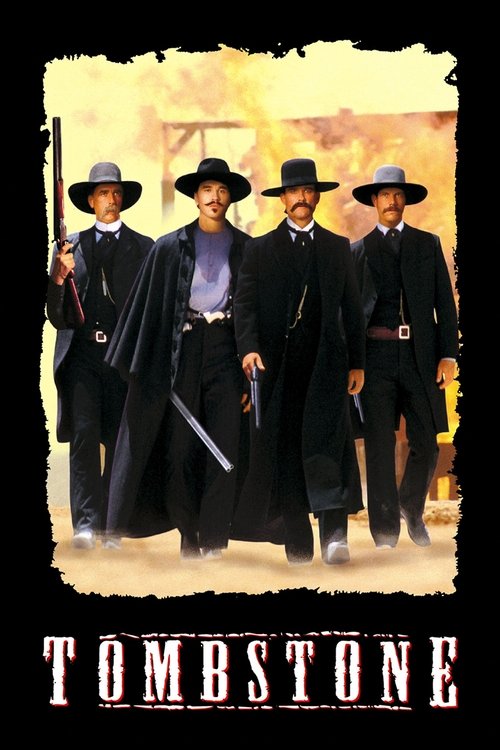
Tombstone
1993 · George P. Cosmatos
For when you want a crowd-pleaser with teeth — a Friday-night western to watch with friends who'll be trading lines from it for weeks. Comfort viewing of the highest caliber.
What it's about
Wyatt Earp arrives in the silver-boom town of Tombstone, Arizona, in 1881, done with lawing and hoping to get rich alongside his brothers. But the Cowboys — a red-sashed gang of rustlers and killers — own the territory, and as their violence closes in, Earp is pulled back toward the badge, with his lethal, tubercular friend Doc Holliday at his side. It all funnels toward the most famous gunfight in the history of the West, and what came after.
The experience
Big, swaggering, and endlessly quotable — a western that embraces the legend instead of tearing it down, with real menace under the mustaches and velvet vests. It moves like an action picture but lingers on friendship, loyalty, and a dying man's wit.
Performances
Val Kilmer's Doc Holliday is one of the great supporting turns of the 1990s — pale, sweating, silk-tongued, and funnier at death's door than everyone else at full health — and Kurt Russell anchors it with a granite, slow-burning Wyatt Earp.
The craft
The script gives nearly every character a line worth stealing, and the film dresses its violence in genuine period splendor — the costuming, saloons, and firearms are lavishly detailed. It's operatic rather than gritty: gunfights staged like arias, villains you love to hate, a look built for a big screen.
Why it matters
Landing in the early-90s western revival, it chose myth over deconstruction and won the long game — initially received as mere entertainment, it's become one of the most beloved and quoted westerns ever made.
Snapshot
Tombstone is a lavish, operatic retelling of the events surrounding the 1881 Gunfight at the O.K. Corral and its bloody aftermath, built around Kurt Russell's granite Wyatt Earp and Val Kilmer's consumptive, silk-tongued Doc Holliday. Arriving in the first wave of the early-1990s Western revival — after Dances with Wolves (1990) and Unforgiven (1992) had made the genre commercially and critically viable again — it chose a different register from those films: where Eastwood deconstructed the gunfighter myth, Tombstone embraced it, delivering a romantic, star-driven, quotably theatrical entertainment. Its production was famously turbulent, its authorship genuinely contested, and its critical reception at release merely respectable; yet it has since hardened into one of the most beloved and endlessly quoted Westerns of the modern era, largely on the strength of Kilmer's performance. It stands as a case study in how a compromised, troubled shoot can nonetheless yield a durable popular classic.
Industry & production
The film was produced by Cinergi Pictures — the company of Hungarian-born producer Andrew Vajna — and released through Hollywood Pictures, a Disney label, with Buena Vista distributing. It emerged from a period when two competing Wyatt Earp projects were racing to screens: Tombstone and Lawrence Kasdan's more somber, Kevin Costner–led Wyatt Earp (1994). Tombstone reached theaters first, at Christmas 1993, and is widely credited with having taken the wind out of its rival, which underperformed the following summer.
The production's defining crisis was its change of director. Screenwriter Kevin Jarre — who had written Glory (1989) — authored the screenplay and was originally hired to direct. According to numerous accounts from cast and crew, Jarre, a first-time director, fell behind schedule and struggled with the logistics of a large ensemble Western, and was dismissed a few weeks into filming. George P. Cosmatos, a journeyman action director (Rambo: First Blood Part II, Cobra), was brought in to salvage the shoot. Jarre's departure also meant his lengthy, historically dense script was heavily cut, streamlining a sprawling chronicle into a more conventional dramatic arc.
Complicating the record further, Kurt Russell has stated in interviews (notably a widely cited 2006 account) that he effectively directed much of the film himself, using Cosmatos as a "ghost" front and handing him shot lists each night. Cosmatos, who died in 2005, did not publicly corroborate this before his death, so the precise division of directorial labor remains genuinely unsettled — a point any honest account must flag rather than resolve. What is undisputed is that the credited direction is Cosmatos's and that the film's on-set authority was unusually diffuse.
Casting drew on a deep bench: Sam Elliott and Bill Paxton as Virgil and Morgan Earp, Powers Boothe as Curly Bill Brocius, Michael Biehn as Johnny Ringo, Stephen Lang as Ike Clanton, Dana Delany as Josephine Marcus, plus Jason Priestley, Thomas Haden Church, Michael Rooker, and a young Billy Bob Thornton in a small role. Charlton Heston appears in a cameo. Robert Mitchum was reportedly cast as the elder Clanton but, sidelined by an injury, instead supplied the film's grave voice-over narration. Filming took place at familiar Arizona Western locations, including Old Tucson and Mescal.
Financially, the film is generally reported as a solid commercial success — commonly cited at roughly $56 million domestically against a budget usually placed in the mid-twenty-million range — comfortably outpacing its troubled origins and its later competitor. Exact figures vary by source and should be treated as approximate.
Technology
Tombstone is a conventional early-1990s 35mm studio production, photographed on film in widescreen and finished for standard theatrical release; it predates the digital-intermediate era, so its look was achieved photochemically and in-camera. There is no significant special-effects innovation to note — the film's spectacle is practical, built from horses, squibs, black-powder smoke, costumes, and constructed and standing Western sets rather than optical or digital trickery. Its technological interest lies less in novelty than in the disciplined deployment of mature, classical Hollywood craft: anamorphic-style widescreen composition, orchestral scoring recorded traditionally, and location shooting in the Arizona desert. In that sense it is a deliberately old-fashioned object, using the tools of the studio Western as they had existed for decades.
Technique
Cinematography
Director of photography William A. Fraker — a five-time Oscar nominee whose credits include Rosemary's Baby, Bullitt, and the Western Monte Walsh — gives the film a burnished, golden-hued classicism. His widescreen frames favor strong horizontal compositions of the desert and the town's dusty main street, warm interior firelight, and the iconography of silhouetted riders. The photography leans toward beauty and mythic grandeur rather than the grit or irony of the era's revisionist Westerns; Fraker's veteran eye lends visual coherence and prestige to a shoot that was, behind the scenes, chaotic.
Editing
The film is credited to multiple editors — among them Frank J. Urioste (an Oscar nominee for Die Hard and Basic Instinct), Roberto Silvi, and Harvey Rosenstock — a division of labor consistent with a production reworked heavily in post. The editing is brisk and propulsive in its action, particularly the O.K. Corral gunfight and the later vendetta sequences, and it papers over the narrative compression forced by Jarre's dismissal, using Mitchum's narration to bridge historical gaps. The seams of a much longer intended film are occasionally visible in abrupt transitions, but the finished cut moves with confident momentum.
Mise-en-scène / staging
Production design by Catherine Hardwicke — later a director in her own right (Thirteen, Twilight) — and costume design by Joseph Porro give the film a rich, tactile period surface: waistcoats, dusters, ornate saloon interiors, and the memorable red sashes that mark the outlaw Cowboys as a quasi-uniformed gang. That red-sash motif is one of the film's shrewdest staging ideas, turning a loose confederation of rustlers into a visually legible standing threat. The town of Tombstone is rendered as a bustling, prosperous boomtown, its theatricality underscored by set-pieces staged in and around a saloon and a stage theater.
Sound
Bruce Broughton's orchestral score supplies sweeping, traditional Western melody — Broughton had earlier scored Kasdan's Silverado (1985) — reinforcing the film's romantic, mythic mode rather than undercutting it. Gunfire, spurs, and the crack of black powder are rendered with muscular clarity, and Mitchum's gravelled narration frames the drama as recovered history. The soundscape, like the imagery, is polished and classical.
Performance
Performance is the film's true engine, and it is dominated by Val Kilmer's Doc Holliday — a mannered, wit-drunk, physically deteriorating creation, pale and sweating with tuberculosis, who steals nearly every scene. Kilmer reportedly committed intensely to the role's physical decline; several of the specific anecdotes about his preparation circulate as lore and should be treated as such. His delivery of lines such as "I'm your huckleberry" and "You're a daisy if you do" became instantly iconic. Russell anchors the film with a weary, controlled gravitas, Sam Elliott and Bill Paxton lend fraternal warmth, and Powers Boothe and Michael Biehn make vivid, charismatic villains. The ensemble's collective conviction is a large part of why the film endures.
Narrative & dramatic mode
The narrative follows a clear tragic-heroic arc: Wyatt Earp, seeking a peaceful, prosperous retirement in Tombstone with his brothers, is drawn reluctantly back into violence by the predations of the Cowboys, culminating in the O.K. Corral gunfight and — after his brothers are ambushed — a righteous vendetta ride. The dramatic mode is romantic and mythologizing rather than skeptical: it frames Earp as a man pulled by duty and loyalty toward a violence he would rather avoid, and Holliday as the doomed friend who follows him out of love. Mitchum's bracketing narration lends the whole a legendary, storybook quality, opening on the historical situation of the Cowboys and closing with the eventual fates of the survivors. The emotional core is the Earp–Holliday friendship, which gives the bloodshed its pathos.
Genre & cycle
Tombstone belongs squarely to the early-1990s Western revival, but it defines itself against that cycle's dominant deconstructive tendency. Where Unforgiven interrogated the moral cost of killing and the falsity of frontier legend, Tombstone restores the pleasures of the classical Western: clear heroes and villains, code-bound masculinity, and cathartic gunplay. It is a myth-affirming rather than myth-puncturing film. Within the narrower sub-tradition of O.K. Corral pictures — a lineage running from John Ford's My Darling Clementine (1946) through John Sturges's Gunfight at the O.K. Corral (1957) and Hour of the Gun (1967) — it is among the most detailed and character-rich, foregrounding the Cowboys as an organized faction and giving Holliday unusual prominence.
Authorship & method
Authorship is the film's most vexed question. The credited director is George P. Cosmatos, but the creative fingerprints are shared among Kevin Jarre, whose original screenplay supplied the film's structure, historical texture, and much of its celebrated dialogue; Cosmatos, who executed the reconstituted shoot; and Kurt Russell, who by his own later account exercised substantial uncredited directorial control. This makes Tombstone a genuine authorship puzzle — a film with no single, uncontested guiding hand.
The key collaborators, however, are firmly established. Fraker's cinematography supplies the classical visual grammar; Broughton's score supplies the romantic sweep; the multiple editors reshaped a compromised production into a coherent whole; and Jarre's script — even trimmed — furnished the lines and characterizations that fans quote to this day. The film is best understood not as a director's vision but as a producer-and-star-driven salvage operation whose success owed much to strong department heads and a superb cast.
Movement / national cinema
Tombstone is a mainstream American studio production with no allegiance to any art-cinema movement; its "movement," insofar as it has one, is commercial Hollywood genre revivalism. It is worth noting the film's international production dimension — a Hungarian-born producer in Vajna and a Greek-Italian director in Cosmatos, both journeymen of transnational commercial cinema — which situates it within the globalized, financier-driven Hollywood of the late 20th century rather than any nationally inflected school of filmmaking. Its idiom, though, is thoroughly, self-consciously American: the Western remains the United States' foundational national myth-genre, and Tombstone engages that mythology directly.
Era / period
The film is a product of the early-1990s Hollywood moment when the Western, long presumed commercially dead, briefly returned to prestige and profit. It reflects that era's appetite for star vehicles, its comfort with large ensembles, and its transitional craft — mature analog filmmaking on the cusp of the digital age. Its depicted period, 1880s Arizona Territory, is rendered with evident affection for the boomtown West at the very moment of the frontier's closing, a historical threshold the film treats with elegiac undertones even as it delivers rousing action.
Themes
The film's central theme is loyalty — fraternal, between the Earp brothers, and elective, in the extraordinary bond between Wyatt and Doc, a friendship that repeatedly overrides self-interest and survival. Around it cluster the recurring Western concerns of law versus vengeance (Earp's arc moves from lawful restraint to personal reprisal after his brothers are attacked), the reluctant hero drawn back to violence, and codes of masculine honor. There is a persistent elegiac awareness of the frontier's passing and of mortality, embodied above all in Holliday, who lives and kills under a death sentence of tuberculosis and pursues a kind of grace through friendship. The Cowboys, marked by their red sashes, function as an image of organized lawlessness against which communal order must be violently defended — a theme with a long pedigree in the genre.
Reception, canon & influence
Critical reception at release was mixed-to-favorable rather than rapturous; reviewers frequently singled out Kilmer's Doc Holliday for high praise while regarding the film overall as a handsome, entertaining, somewhat conventional Western. Kilmer's performance, though widely admired, received no major awards recognition, an omission fans have relitigated ever since. The influences on the film run backward through the Western canon: the O.K. Corral lineage of Ford, Sturges, and their successors; the broader classical Hollywood Western tradition of Ford and Hawks; and, contextually, the contemporaneous revival sparked by Dances with Wolves and Unforgiven, which created the commercial space for it to exist.
Its legacy has proved far larger than its opening reviews implied. Through home video and endless cable rotation, Tombstone became a genuine cult and popular classic, routinely ranked among the best modern Westerns and cemented in pop culture by its immense quotability — "I'm your huckleberry" being perhaps the single most recycled line of any 1990s Western. Kilmer's Doc Holliday is now widely regarded as the definitive screen version of the character and a career-defining performance. The film's forward influence is more cultural than formal: it renewed popular affection for the traditional, myth-embracing Western at a time when the genre was tilting toward revisionism, demonstrated the commercial appetite for star-driven period action, and supplied a template of quotable, character-forward genre entertainment. Its enduring status is, in the end, a striking rebuke to its own chaotic making — proof that a film of contested authorship and troubled production can nonetheless earn a lasting place in the popular canon.
Reception
In 1993 it was the scrappy underdog Western that critics shrugged at but audiences loved — and it flat-out beat Kevin Costner's bigger, more prestigious Wyatt Earp (1994) to theaters and in the culture. Thirty years on, it's the one everybody remembers, a certified cable-and-rewatch classic while its rival is a footnote.
How Tombstone was received, from release to now →
How to watch Tombstone: what to notice on a first viewing
- Notice the red sashes worn by one group of outlaws. The Cowboys are marked with matching red sashes, turning a loose confederation of rustlers into a gang you can spot across a crowded street instantly. One piece of costume design turns a vague threat into something your eye can track the moment it appears on screen.
- Watch how pale and sweat drenched Kilmer plays Doc Holliday. Kilmer commits to Holliday's tuberculosis physically, playing him pale, sweating, and visibly deteriorating while never letting the wit or the menace drop for a scene. You can see the sickness working on him in nearly every scene, which is why the wit lands harder instead of softer.
- Notice the warm golden light on the desert and streets. Fraker shoots the town and desert in burnished golden tones, favoring wide horizontal compositions and warm firelight over grit, aiming for mythic beauty rather than realism. The film is choosing to look like a legend rather than a document, and the light tells you that from the first frame.
- Listen for Robert Mitchum's narration bracketing the story. A gravelled voiceover opens and closes the film, framing the events as recovered, legendary history rather than a story unfolding in the present. You are told upfront this is already history, which changes how you hold the danger while you watch it happen.
- Watch how the Earp brothers stand close together in a room. Wyatt, Morgan, and Virgil are repeatedly staged as a tight unit, shoulder to shoulder, so their bond reads visually before the film ever states it in dialogue. The closeness between the brothers is built into how they are blocked in a scene, not just into what they say to each other.
The whole guide to watching Tombstone, with the keys for a rewatch →
Influences: the films it descends from and the films it influenced
- My Darling Clementine (1946) — Establishes the Earp–Holliday partnership and the tubercular-gentleman-gunfighter archetype, plus the O.K. Corral rendered as an elegiac set piece of civic order, the staging template Tombstone reprises.
- Gunfight at the O.K. Corral (1957) — Codifies the star-driven, widescreen, romanticized Earp–Holliday two-hander as commercial spectacle, the box-office model Tombstone updates for the 1990s.
- Hour of the Gun (1967) — Begins with the gunfight and dramatizes the vindictive post-Corral vendetta, supplying the 'law versus vengeance' tragic-aftermath arc that Tombstone's back half adopts.
- The Man Who Shot Liberty Valance (1962) — Its 'print the legend' myth-affirming ethos and framing-narration device prefigure Mitchum's voiceover and Tombstone's deliberate embrace of legend over revisionism.
- She Wore a Yellow Ribbon (1949) — Winton Hoch's warm golden-hour Technicolor classicism is the burnished, honeyed palette Fraker's anamorphic photography consciously echoes.
- Red River (1948) — Its Hawksian code of male professionalism and tested loyalty between men under pressure underwrites the Earp–Holliday bond at the film's emotional core.
- Monte Walsh (1970) — Fraker's own elegiac, painterly end-of-the-frontier western establishes the mortality-tinged compositional eye he later brings as Tombstone's cinematographer.
- Silverado (1985) — Bruce Broughton's sweeping, unapologetically romantic orchestral western score here is the direct stylistic precursor to his Tombstone score.
- Dances with Wolves (1990) — Its blockbuster success and lush prestige widescreen photography reopened commercial space for the traditional western and set the burnished visual expectation Tombstone met.
- Unforgiven (1992) — The immediately preceding revival hit that revived the market; Tombstone defines itself by positioning its myth-embracing classicism against Unforgiven's revisionism.
- Rio Bravo (1959) — Structured on Rio Bravo's specialist-team logic: the Earps and Doc Holliday operate as a type-differentiated professional ensemble, and Val Kilmer's Holliday — tuberculosis and whiskey as his version of the rehabilitation arc — directly reprises the Dude template of a talented professional destroyed by vice who must recover professional function before the climactic showdown.
- Open Range (2003) — Extends the myth-affirming, non-revisionist register and burnished classical staging, building toward a deliberate main-street shootout in Tombstone's tradition.
- 3:10 to Yuma (2007) — A star-driven, quotable, character-forward genre revival that similarly builds its appeal around a charismatic gunfighter's verbal wit.
- Appaloosa (2008) — Centers a laconic two-man partnership of lawmen-for-hire, extending Tombstone's loyalty-and-banter dynamic between paired gunmen.
- Bone Tomahawk (2015) — Russell's mustachioed, quietly authoritative frontier lawman, and the film's taste for formal, ornate period dialogue, carry over almost directly into Sheriff Franklin Hunt.
- Wyatt Earp (1994) — The rival three-hour biographical treatment of identical Earp material released months later, the sprawling elegiac counterweight to Tombstone's lean star vehicle.
- Deadwood (2004) — Builds a densely textured Tombstone-era mining-camp world driven by heightened, quotable period dialogue that foregrounds character voice as the primary pleasure.
Similar films
- My Darling Clementine (1946) — influence & lineage · same viewing thread
- The Man Who Shot Liberty Valance (1962) — influence & lineage · same viewing thread
- Unforgiven (1992) — influence & lineage
- 3:10 to Yuma (2007) — influence & lineage
- Dances with Wolves (1990) — influence & lineage
- Silverado (1985) — influence & lineage
- Red River (1948) — influence & lineage
- Pat Garrett & Billy the Kid (1973) — same viewing thread · often watched together
All the films related to Tombstone →
Watch it with: curated runs of related films
- Print the Legend — A run of frontier myths and their unmaking — town-taming marshals, aging gunfighters, and the stories the newspapers chose to print instead of the truth.