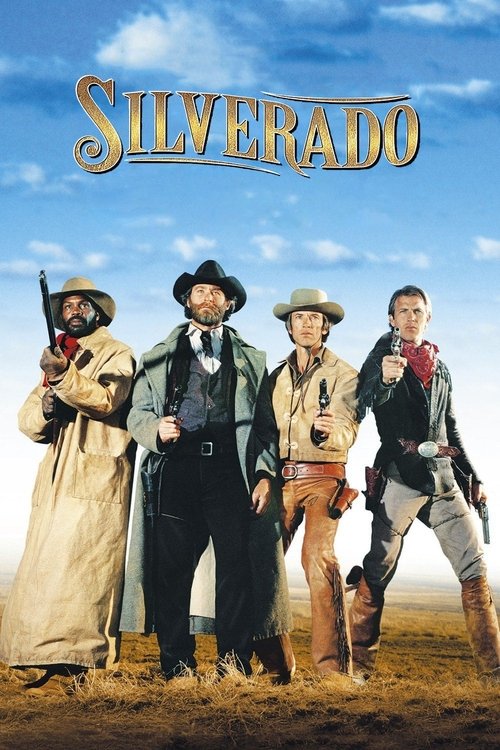
Silverado
1985 · Lawrence Kasdan
For when you want an old-fashioned good time at the movies — heroes to root for, villains to hiss, wide-open country, and nothing to brood over afterward. Comfort viewing with real craft behind it.
What it's about
Four drifters — a quiet ex-con, his reckless quick-draw younger brother, an easygoing gambler with a compromised past, and a Black cowboy coming home to a homestead under siege — cross paths on the trail and ride into Silverado, a town squeezed by a corrupt sheriff, a land-grabbing rancher, and a murderous posse. Before they can save anyone, they have to break each other out of jail and figure out which side each of them is really on.
The experience
Pure pleasure — a big, generous, fast-moving Western that stacks up jailbreaks, chases, saloon brawls, and gunfights with an almost giddy affection for the form. It's warm and funny between the shootouts, and the whole thing moves like it can't wait to get to the next set piece.
Performances
A ridiculous bench: Kevin Kline's amiable, morally slippery Paden, Scott Glenn's flinty calm, Danny Glover's quiet steel, and a young Kevin Costner practically vibrating with joy as the trigger-happy kid brother — a star-making turn of pure physical exuberance.
The craft
Lawrence Kasdan, fresh off writing some of the era's biggest adventures, rebuilds the Western from its classic parts — the drifter, the cattle country, the street duel — and shoots it in sweeping widescreen with a rousing orchestral score. The action is staged with clean, legible showmanship, and the New Mexico landscapes beg for a big screen.
Why it matters
Made when the Western was considered box-office poison after a run of studio disasters, it was a deliberate act of genre resuscitation — proof the form could still deliver joy — and it launched Kevin Costner toward stardom.
Snapshot
Silverado is the sound of a genre being restarted by hand. Made at the low ebb of the American Western — five years after Heaven's Gate had turned the form into a byword for studio catastrophe and taken United Artists' independence with it — Lawrence Kasdan's third feature is an unembarrassed, full-orchestra assembly of everything the Western had been: the drifter alone in a line shack, the jailbreak, the cattle drive, the corrupt sheriff, the land-grabbing rancher, the saloon, the homesteaders' burned wagons, the street duel at the end. Four men — Emmett (Scott Glenn), his hair-trigger younger brother Jake (Kevin Costner), the amiable, compromised Paden (Kevin Kline), and Mal Johnson (Danny Glover), a Black cowboy returning to a family homestead he will find under siege — converge on a town run by Sheriff Cobb (Brian Dennehy) on behalf of the cattleman McKendrick.
Two things distinguish it from pastiche. First, it is a restoration, not a deconstruction: after two decades in which the serious Western meant Peckinpah's slaughterhouse elegies and Altman's mud, Kasdan proposed that the classical form still worked and did not need to apologize. Second, the restoration is not a wholesale one — the ensemble has been quietly rebuilt for 1985, with a Black protagonist whose arc concerns dispossession and a set of women (Rosanna Arquette's settler Hannah, Linda Hunt's Stella, Lynn Whitfield's Rae) who want things and pursue them. The film was a moderate commercial performer rather than the revival Columbia hoped for. Its real consequence arrived later, through the career it launched and the appetite it proved still existed.
Industry & production
Kasdan came to Silverado with unusual leverage and an unfashionable idea. He had written The Empire Strikes Back, Raiders of the Lost Ark, and Return of the Jedi for Lucas and Spielberg, and had directed Body Heat (1981) and The Big Chill (1983) — the latter a genuine cultural event. That capital bought him the one genre studio executives had learned to treat as radioactive. The Western in 1985 was not merely out of fashion; its production base had atrophied. Standing town sets, wrangler crews, stunt riders, and horse-trained second units were no longer the routine infrastructure they had been in the 1950s, and the picture had to reassemble much of that base from scratch.
It was shot on location in northern New Mexico, in the high desert and mesa country around Santa Fe and the Galisteo Basin, with a full-scale town built for the production — an investment that outlived the film, as the site continued to serve later productions. Kasdan produced as well as directed, and wrote the screenplay with his brother Mark Kasdan, which gives the film its slightly anthological structure: it reads like two enthusiasts cataloging the set pieces they most wanted to stage.
Casting followed the Big Chill method — an ensemble of strong character actors rather than a single above-the-title star, with room for oddities at the edges (John Cleese as an English sheriff in a neighboring town; Jeff Goldblum as a gambler; Linda Hunt, fresh from her Academy Award for The Year of Living Dangerously, running the saloon in a room built to her scale). Costner's presence carries a well-documented backstory: he had been cast in The Big Chill as the dead friend seen in flashback, and those scenes were cut from the finished film; Silverado was Kasdan's restitution. Reports of a substantially longer first assembly, with subplots trimmed for the 133-minute release version, have long circulated, though the details of what was lost are not well documented in the public record.
It opened in the summer of 1985 into a crowded field, weeks apart from Clint Eastwood's Pale Rider — the two films together constituting the year's attempted resuscitation of the genre. It earned two Academy Award nominations, for Bruce Broughton's original score and for sound.
Technology
Silverado is a fully photochemical, pre-digital production, and its pleasures are inseparable from that fact. Every stampede, wagon burn, horse fall, window smash, and squib is a physical event staged in front of the camera, in a landscape that had to be reached, lit by the sun, and shot at the hour it looked best. There is no digital crowd extension and no matte-painted horizon; the scale in the frame is the scale that existed.
The film is composed for a 2.35:1 widescreen frame and was mixed for Dolby Stereo, with 70mm blow-up prints in premium engagements — the standard prestige presentation of the mid-1980s, and a meaningful choice for a genre whose entire visual argument is about width. Silverado is frequently listed among the earlier features to use the Super 35 process — exposing the full spherical negative and extracting the scope frame in post rather than shooting anamorphic — but the technical documentation on this point is inconsistent across sources, and it should be treated as probable rather than established.
The relevant technological story is really an industrial one: by 1985 the craft technologies of the Western — falling horses trained to specification, mounted stunt teams, period wagon and harness work — survived as a specialty rather than a standing capacity. Assembling them was a substantial part of what the production was buying.
Technique
Cinematography
John Bailey, Kasdan's cinematographer on Body Heat and The Big Chill, shoots Silverado in a register of clean, high-key classicism that is almost polemical after the smoky revisionism of the preceding decade. The film's opening is its thesis statement: Emmett wakes in a dark line shack, is fired on through the walls, and the room fills with hard needles of daylight through bullet holes; when the door finally swings open, the screen detonates into an enormous sunlit desert. It is a lesson in what the widescreen frame is for, delivered in the first ninety seconds.
Thereafter Bailey alternates two scales. Exteriors are staged for depth and breadth — riders reduced to marks against mesa and sky, the horizon held high or low to give the land its weight — in the tradition that runs from Ford's Monument Valley through the Technicolor landscape Westerns of the 1950s. Interiors are warmer, lamp-motivated, and shallower, with the saloon in particular treated as a stage of pooled light. Crucially, the exteriors are bright: dust and sun rather than dusk and rain. The refusal of gloom is a genre argument.
Editing
Carol Littleton, Kasdan's regular editor (and Spielberg's on E.T.), cuts for legibility above all. In an era when action was beginning to drift toward fragmentation, Silverado's set pieces are built on the classical principle that the audience should always know where everyone is: master, clean geography, then cut in. The jailbreak, the stampede through town, and the climactic street confrontations are constructed as spatial problems with spatial solutions. The looser aspect of the film — its episodic first hour, in which four separate men are picked up and braided together — is a screenplay structure the cutting honors rather than disguises, moving in discrete panels rather than smoothing them into continuous flow.
Mise-en-scène / staging
Production design (Ida Random) and costume (Kristi Zea) aim at a lived-in but uncrusted West — a deliberate mid-point between the pristine backlot town and the mud-and-lice naturalism that had become the marker of seriousness. The town of Silverado is legible as a place, with a main street whose ends and middle matter dramatically. Kasdan stages for the frame's width, frequently arranging his four principals in a lateral line — the visual signature of the professional group Western, from Rio Bravo to The Wild Bunch — and letting the composition do the work of asserting that these men now constitute a unit.
Sound
The Oscar-nominated sound work builds the film's world by distance: gunshots that report and then return off canyon walls, hoofbeats approaching across open ground, the difference between a shot fired in a room and one fired in the desert. In the mid-80s Dolby environment, the stereo field is used for orientation — an off-screen threat placed before it is seen — which reinforces the editing's commitment to legible space.
Performance
The acting is pitched to types without collapsing into them. Kline's Paden is the film's most interesting invention: a charming man with a code he can't fully explain and a past he shares with the villain, played with a lightness that keeps curdling into something rueful. Glenn's Emmett is granite, deliberately unshowy. Costner's Jake is the anomaly — a grinning, twirling, adolescent gunfighter whose energy is almost cartoon, and whose sheer physical enthusiasm reads now as a star being discovered in real time. Glover's Mal carries the film's moral weight quietly, and does the most difficult work: playing exclusion (a drink refused, a family's land taken) without letting the film's buoyancy trivialize it. Dennehy's Cobb is the picture's best villain precisely because he is genial; he is what Paden could have become, and he knows it.
Narrative & dramatic mode
The structure is convergence-then-siege. Four strangers-and-brothers are introduced separately, accumulate obligations to each other on the trail, and arrive in a town where each has a private stake: Emmett and Jake a family vendetta, Mal a father and sister, Paden an old partnership he'd rather not resume. The second half resolves these in parallel, culminating in a set of individually motivated confrontations rather than a single mass shootout.
The mode is romance in the Frye sense — an affirmative adventure in which competence, loyalty, and the willingness to act are efficacious, and in which violence, though real and mortal, is finally restorative rather than corrosive. Kasdan is explicit about the fun: the tone runs to comedy at the edges (Cleese's fastidious lawman) without becoming parody. The film knows it is a compendium of conventions; it declines to be ironic about them. That earnestness is the whole gamble.
Genre & cycle
Silverado belongs to what is best called the neoclassical Western: a post-revisionist return to affirmative form, undertaken with full knowledge of the revisionist critique. Its raw materials are traceable to specific ancestors — the homesteader-versus-cattle-baron spine of Shane, the professional-group dynamic of Rio Bravo and The Magnificent Seven, the town-taming and family-vengeance architecture of My Darling Clementine and the 1950s Ford and Hawks cycle. What it does not import is the revisionist assumption that the form's optimism was a lie.
Placed beside Pale Rider, released the same summer, the contrast is instructive: Eastwood re-reads Shane through an almost supernatural, elegiac lens; Kasdan re-reads the whole genre as a functioning machine. Neither ignited the revival. The genre's actual return would come from the historical-epic direction — Dances with Wolves (1990) — and its critical apotheosis from the revisionist one, in Unforgiven (1992). Silverado sits between the deconstructive 1970s and the 1990s revival as the moment when someone demonstrated the parts still fit together.
Authorship & method
Kasdan's authorship is best understood through the company he kept. He was the New Hollywood generation's most fluent genre archivist, the writer who helped Lucas and Spielberg turn the Republic serial into Raiders of the Lost Ark and the space opera into Star Wars. Silverado applies the same operation to the Western: identify the pleasures, remove the accumulated condescension, stage them at full scale with modern resources. His method is collaborative and consistent — Bailey on camera, Littleton in the cutting room, and the Kasdan brothers' shared script.
Bruce Broughton's score is the film's other authorial signature. A composer who had come up through television, Broughton wrote for Silverado a broad, brass-forward Americana in direct descent from Jerome Moross's The Big Country and Elmer Bernstein's The Magnificent Seven — a main theme so effectively archetypal that it has led a long second life outside the film. It was nominated for the Academy Award and effectively established Broughton as a feature composer; he would return to the genre with Tombstone (1993), one of the key titles of the 1990s revival the earlier film had helped make thinkable.
Movement / national cinema
This is Hollywood cinema at the height of the Reagan-era blockbuster consolidation, made by a member of the film-school generation who had shifted from the counterculture's suspicion of American myth to a curatorial affection for it. That shift is the movement Silverado belongs to: the mid-1980s classicist turn among the movie brats, in which genres coded as naïve — the serial, the space opera, the Western, the screwball comedy — were revived at prestige budgets and with sincere intent. The film's Americana is not nationalist in an aggressive sense, but it is unmistakably a reclamation project, and it arrives at a moment when reclamation of American self-image was the surrounding political weather.
Era / period
The film is set in a generalized post-Civil War frontier West, deliberately unpinned to a specific year — the mythic present tense of the classical Western rather than the dated historical West of The Long Riders or, later, Wyatt Earp. Its period concerns are the genre's canonical ones: the closing of open land, the conversion of the frontier into property, the arrival of a law that can be bought.
Read as a document of 1985, it is more interesting still. Its four-man ensemble, its comic timing, its bright photography and wall-to-wall score belong to the summer-picture grammar of its own decade as much as to the 1950s. It is a Western built to the specifications of the blockbuster era, and part of its historical value is showing exactly what that translation cost and what it preserved.
Themes
Chosen family. The film's organizing sentiment — that people who owe each other nothing may end up owing each other everything — is Kasdan's abiding subject, carried directly over from The Big Chill into a genre where it can be expressed in action rather than conversation.
Dispossession and property. Nearly every antagonism turns on land: who may hold it, who may be burned off it, who is permitted to file. Mal's family's homestead and the settlers' wagons make the same argument from two directions — that the frontier's promise of a second chance is administered by whoever controls the sheriff.
Race, stated plainly. Mal is refused service; his family's land is taken; a Black settlement exists at the story's margins. The film does not build an essay around this, and some critics have found its treatment too easily assimilated into the adventure. But by placing a Black cowboy among its four leads and giving him the most direct grievance, Silverado corrects an erasure the classical Western had maintained almost without exception.
The double. Paden and Cobb are the film's moral engine: two men from the same past, one of whom took the job. The Western's recurring question of whether the gunfighter can be domesticated is answered here not by death but by employment — Paden ends the film inside the institution he fought.
Violence as restoration. Unlike the revisionist cycle, Silverado holds that the right person shooting the right person can fix a town. It stages this without gore and without triumphalism, and the sincerity of that position is the thing most likely to divide viewers.
Reception, canon & influence
Contemporary notices split along a predictable line. Admirers — Roger Ebert prominent among them — welcomed a large, confidently made, unironic Western after a decade of exhaustion, and praised the craft, the ensemble, and Broughton's score. Skeptics found it an anthology of borrowed parts, expertly assembled but lacking a governing vision of its own: everything the Western had done, done again, competently, with nothing new said. Both readings are defensible and the film has never fully escaped the second. Commercially it performed respectably without breaking out; the genre revival it was meant to trigger did not follow, and the specific grosses reported for it vary enough across sources that they are best left uncited.
Backward. Its debts are open and numerous: Shane for the homesteaders and the boy's hero-worship; Rio Bravo and The Magnificent Seven for the professional group and the jail; Ford's Clementine and Liberty Valance for the town and the ambivalent law; the Moross–Bernstein symphonic Americana for its sound; and, structurally, the Kasdan-Lucas-Spielberg Raiders model of curated genre pleasure.
Forward. Its clearest legacy is Kevin Costner. Jake made him a star and set the terms of a screen persona that would define the Western's next three decades — Dances with Wolves (1990), Kasdan's own somber corrective Wyatt Earp (1994), Open Range (2003), Hatfields & McCoys, Yellowstone, and the Horizon films. Broughton's Silverado score carried its idiom into Tombstone and, through relentless secondary use, into the general soundtrack of American mythmaking. The film's tonal template — ensemble, humor, big score, classical staging, gunplay without despair — is visible in Young Guns (1988), Tombstone (1993), and the run of studio Westerns that followed the genre's early-90s return, and it remains the reference point whenever a producer proposes that the Western can be made enjoyable again rather than only elegiac. Its town set outlived the production as working New Mexico infrastructure, part of that state's emergence as a location center.
Its canonical position is secure but middling: not a masterpiece, rarely taught, but permanently cited — the film that proved, at the genre's lowest point, that the machine still ran.
A Deleuzian reading
A man wakes in the dark.
The full Deleuzian reading of Silverado →
Reception
In 1985 it was the noble attempt to resurrect the then-dead Western that got respectful reviews and two Oscar nods but only modest box office; now it's cherished as pure comfort-food cinema and credited as the bridge to the genre's Dances with Wolves/Unforgiven revival.
How Silverado was received, from release to now →
How to watch Silverado: what to notice on a first viewing
- Watch the light change when the door swings open. The film opens in a dark line shack lit only by bullet holes, then cuts to a sunlit desert filling the whole frame the instant the door opens. In ninety seconds the film shows you exactly what its widescreen frame is for.
- Notice how often the four men stand in a line. Kasdan repeatedly arranges Emmett, Jake, Paden, and Mal laterally across the widescreen frame, a composition borrowed from the classic professional-group Western. The lineup tells you these four now function as one unit before a line of dialogue does.
- Listen for gunshots that echo off canyon walls. The sound design places threats in the stereo field before you see them and lets shots report and return off the landscape, unlike a flatter studio sound. You are oriented in space by ear before your eyes catch up.
- Notice how bright and sunlit the exteriors stay. John Bailey shoots dust and sun rather than dusk and rain, keeping the outdoor scenes high-key and clear instead of smoky or gray. The brightness itself is a stance, refusing the gloom that had defined the genre for years.
- Watch how the bartender treats Mal differently from the others. Danny Glover's Mal is refused a drink at a bar that has served every other cowboy without comment, a small break in an unspoken rule of the town. The refusal makes visible a rule the film had let you take for granted until then.
The whole guide to watching Silverado, with the keys for a rewatch →
Influences: the films it descends from and the films it influenced
- Shane (1953) — Kasdan restages Stevens' homesteader-versus-cattle-baron land war almost beat for beat — the boy's worship of the drifter, the muddy-lot fistfight, the flat cracking rifle report — and inherits Stevens' habit of planting small figures against deep-space landscape so the contested acreage stays visible in frame.
- My Darling Clementine (1946) — The purpose-built town as moral architecture — boardwalk, porch and one street shot laterally so the whole community reads in a single composition — is Ford's, as is the marshal who cleans the street out of temperament rather than office.
- The Big Country (1958) — Jerome Moross's open-interval, wide-stride Americana is the avowed model for Broughton's main title, and Wyler's holding of riders as specks in extreme long shot to make land itself the antagonist is Bailey's deep-space strategy.
- Rio Bravo (1959) — Hawks' small professional group defined entirely by competence and joshing, holding a jail as fortress and moral center, supplies both the four-man unit and the breakout/countersiege staged in continuous legible interior space.
- The Magnificent Seven (1960) — The recruit-the-specialists-then-defend-the-town architecture is Silverado's structural blueprint, and Elmer Bernstein's galloping brass main title is the direct compositional ancestor of Broughton's.
- The Man Who Shot Liberty Valance (1962) — The legend-versus-civic-law split and the villain whose menace arrives as amused charm descend from Ford and Marvin; Dennehy's Cobb is Valance rewritten as the town's own sheriff, genial right up to the draw.
- The Professionals (1966) — Brooks' assembled team, each man introduced by a demonstration of his one particular skill and kept talking straight through the action, is the recruitment grammar Silverado applies to its four leads.
- Body Heat (1981) — Kasdan's debut assembled the unit that makes Silverado — Bailey on camera, Littleton in the cutting room — and proved his method of reviving a dead form by playing its conventions absolutely straight rather than in quotation marks.
- Raiders of the Lost Ark (1981) — Kasdan's own script established the operation Silverado performs on the Western: strip an exhausted pulp form of its accumulated irony and stage its pleasures at full studio scale, with high-key photography and continuity cutting that keep every set piece geographically legible.
- Greystoke: The Legend of Tarzan (1984) — Pioneered the Super 35 process Bailey adopts here — a 2.35 frame extracted from the full negative using fast spherical lenses, which is what makes Silverado's handheld-capable daylight exteriors practical at scope width.
- Heaven's Gate (1980) — Anamorphic widescreen Western consciously restoring grand frontier vistas and large practical staging after the genre's post-Heaven's-Gate collapse, an attempt to rebuild the epic Western Cimino's failure had foreclosed.
- Young Guns (1988) — The first film to run Silverado's tonal template as its entire design: youthful gunfighter ensemble, banter between shootouts, a big brass score, and violence staged as spectacle rather than elegy.
- Dances with Wolves (1990) — Costner converts the persona Jake minted into a directing career, extending Silverado's conviction that the Western can be played at full symphonic scale without irony into Dean Semler's long-held anamorphic landscape wides.
- Tombstone (1993) — Broughton returns to the genre with the same brass-forward Americana idiom he wrote for Silverado, scoring an ensemble of named gunmen staged laterally along one main street.
- Wyatt Earp (1994) — Kasdan's own corrective: same star, same editor in Carol Littleton, same purpose-built-town staging and convergence-then-showdown structure, stretched long and somber to answer the charge that the earlier film was craft without weight.
- Open Range (2003) — Directs the Silverado street gunfight in its mature form — classical spatial continuity through a town whose geography the audience has been taught in advance, with the Dolby mix placing off-screen gunfire so unseen shooters stay located.
- Horizon: An American Saga — Chapter 1 (2024) — The late, sprawling extension of the line Silverado started Costner on: dispossession-and-land as narrative engine, strangers converging on a settlement, purpose-built Western town sets, and a broad Americana score written in the Broughton register.
- Pale Rider (1985) — The other 1985 studio bid to reanimate the Western, built on the same Shane dispossession plot of smallholders against a mining/cattle interest — but Bruce Surtees' smoke-and-shadow exteriors are the precise photographic inverse of Bailey's noon-light clarity.
- Unforgiven (1992) — Uses the same purpose-built one-street town as a readable moral map and converges its scattered principals on a single saloon for the finish, with Jack Green's rain-dark lamplight answering Silverado's sunlit staging of that identical geometry.
Similar films
- Rio Bravo (1959) — influence & lineage
- Dances with Wolves (1990) — influence & lineage
- Shane (1953) — influence & lineage
- The Man Who Shot Liberty Valance (1962) — influence & lineage
- Unforgiven (1992) — influence & lineage
- The Magnificent Seven (1960) — influence & lineage
- Tombstone (1993) — influence & lineage
- El Dorado (1966) — shared sensibility