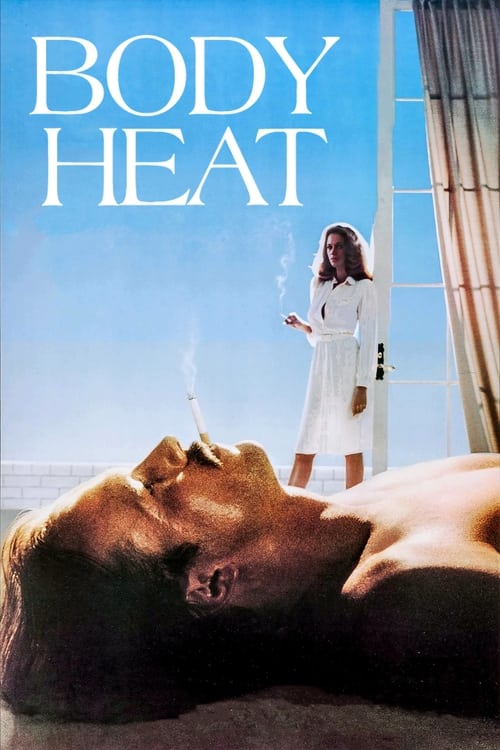
Body Heat
1981 · Lawrence Kasdan
For a hot, late night when you want something adult, dangerous, and slow-burn sexy — a thriller to sink into rather than jump at. Pure pleasure viewing with a wicked edge.
What it's about
In a Florida town wilting under a brutal heatwave, a small-time lawyer with more appetite than talent falls into an affair with a beautiful married woman. Her husband is rich, absent, and in the way, and as the nights get hotter the affair curdles into a plan to kill him. It follows the lawyer as desire pulls him somewhere his judgment can't follow.
The experience
Slow, sticky, and openly carnal — the movie moves like the weather, all sweat and murmured propositions, then tightens into genuine dread as the scheme takes hold. It keeps you leaning forward, half-seduced and half-suspicious.
Performances
Kathleen Turner's screen debut is legitimately startling — a smoky, self-possessed woman whose every line seems to have a double bottom — and William Hurt plays the lawyer's cocky hunger and slow-dawning fear with perfect looseness.
The craft
Lawrence Kasdan's debut as director turns weather into storytelling: the heat is in every frame — fogged windows, damp shirts, ceiling fans — until the atmosphere itself feels like a moral condition. John Barry's sultry saxophone-drenched score does half the seducing. Best watched in the dark with the sound up.
Why it matters
It single-handedly revived film noir for the modern era, proving the 1940s crime-of-passion story could work with contemporary frankness, and it launched Kathleen Turner and Kasdan's directing career in one stroke.
Snapshot
Body Heat is Lawrence Kasdan's directorial debut: a self-conscious resurrection of 1940s film noir transplanted to a sweltering Florida summer and saturated with an explicitness the studio-era model could only imply. A small-town lawyer of limited talent and large appetite is drawn into an affair with a married woman; together they murder her wealthy husband, and the lawyer discovers too late that he has been the instrument rather than the author of the scheme. The film is at once a connoisseur's pastiche — its debts to James M. Cain and to Billy Wilder's Double Indemnity are worn openly — and a fully achieved work in its own right, distinguished by John Barry's sultry score, Kathleen Turner's startling screen debut, and a command of atmosphere that converts heat into a moral climate. It stands as a foundational text of 1980s neo-noir and a direct ancestor of the erotic thriller cycle that followed.
Industry & production
Body Heat was produced through The Ladd Company, the venture Alan Ladd Jr. founded after leaving 20th Century-Fox, with distribution by Warner Bros. The production placed an unusual bet: handing a first-time director a sexually frank, morally bleak genre piece. Kasdan's leverage came from screenwriting. Having written The Empire Strikes Back (1980) and Raiders of the Lost Ark (1981) for George Lucas and Steven Spielberg, he had accumulated enough industry capital to insist on directing his own original screenplay rather than selling it outright. Accounts of the period credit Lucas's support — and the goodwill attached to Kasdan's writing — with helping the project find backing; the precise contractual mechanics are not something I can state with confidence beyond that general context.
The casting strategy was built around relative unknowns and rising names rather than stars, which suited both the budget and the noir conceit of ordinary people undone by appetite. William Hurt, then early in a film career launched by Altered States (1980), took the lead. Kathleen Turner, a stage actress, made her film debut as the femme fatale — a piece of casting that proved decisive to the film's reception. The supporting bench is notably deep with talent on the verge of fame: Ted Danson (shortly before Cheers) as a prosecutor, Mickey Rourke in an early role as a soft-spoken arsonist, plus the seasoned Richard Crenna as the doomed husband and J. A. Preston as a detective. Filming took place in Florida; the action is set in a fictional town in the state's south, and the production leaned on real heat-belt locations to ground its atmosphere.
Technology
Body Heat was shot photochemically on 35mm color stock with anamorphic-era studio tools — the conventional apparatus of an early-1980s Hollywood production rather than any technical innovation. Its interest lies not in new equipment but in the disciplined use of established craft toward a single sensory end: making the audience feel temperature. The relevant "technology" is therefore the lighting and exposure craft of the period — gels, diffusion, practical sources, and careful color control — marshaled to render perspiration, glare, and humidity legible on screen. I would not claim any first-of-its-kind technical process for the film; its achievement is one of orchestration, not invention.
Technique
Cinematography
Richard H. Kline photographed the film, and his work is central to its identity. The visual scheme renders the heatwave as a near-physical presence: hazy light, sweat-sheened skin, the constant suggestion of glare and torpor. Interiors are frequently warm and underlit, pooling shadow in the noir manner while keeping the palette keyed to amber and ember tones rather than the silver of black-and-white. Kline and Kasdan exploit screens, blinds, ceiling fans, and windows both as compositional framing devices and as motivated light sources, so that bodies are repeatedly striped, fragmented, or veiled — a direct inheritance from classical noir's vocabulary of venetian-blind shadow, redeployed in color. The eroticism is built as much through this lighting as through staging: the camera treats skin as a surface that holds light and moisture.
Editing
Carol Littleton edited the film; she was among Kasdan's most important early collaborators and was working in the same period on Spielberg's E.T. The cutting favors patience over propulsion, letting scenes breathe so that languor itself becomes expressive — the slowed metabolism of people too hot to move quickly. The structure withholds: the film's late revelations depend on an editorial discipline that has allowed the audience to share the protagonist's partial knowledge, so that the retrospective reassembly of the plot lands as a genuine reversal. Littleton's pacing is one reason the film reads as a tragedy of dawning comprehension rather than a mechanical thriller.
Mise-en-scène / staging
The production design organizes the world around heat and class. The husband's wealth is signified by cool, ordered spaces; the lawyer's milieu is shabbier and more porous. Recurring objects — ice, drinks, wind chimes, fans, screened porches, a bandstand — accumulate into a motif system in which every prop registers temperature or threshold. Staging repeatedly places characters at openings (doorways, windows, gates), dramatizing transgression and the crossing of boundaries. The famous early image of a distant fire seen from a balcony establishes the film's emblematic logic: combustion as both literal plot mechanism (arson, evidence) and figurative state.
Sound
Beyond the score (treated below), the film's sound design foregrounds the ambient signature of a Southern summer night — insects, wind chimes, the hum of fans, distant music — to sustain the sense of an enervating climate. These textures do quiet narrative work, marking the porousness of the characters' world and the constant intrusion of the outside (and of witnesses) into supposedly private acts.
Performance
The performances are calibrated to noir archetype without collapsing into parody. William Hurt plays Ned Racine as complacent, vain, and not as clever as he believes — a crucial choice, since the plot requires a protagonist whose self-regard blinds him. Kathleen Turner's debut as Matty Walker is the film's revelation: a husky-voiced, composed presence that holds ambiguity in reserve, allowing the late revelation of her design to feel both shocking and, in hindsight, fully seeded. Richard Crenna lends the husband a wary intelligence; Ted Danson and J. A. Preston supply the decent, watchful counterweights of the law; Mickey Rourke's brief turn as the arsonist is memorably underplayed.
Narrative & dramatic mode
The film operates in the tragic-ironic mode characteristic of Cain-derived noir: a fundamentally weak man is led by desire into a crime that destroys him, and the dramatic engine is dramatic irony — the audience's gradual sense that the protagonist understands less than he thinks. Structurally, the screenplay is a slow seduction followed by a conspiracy followed by an unraveling, with the final movement reframing everything that preceded it. The decisive device is the femme fatale's concealed agency: what the protagonist experiences as a mutual passion is revealed to have been an engineered scenario, complete with manipulated documents and a substituted identity. This twist is not a gimmick appended to the plot but its thesis — the noir conviction that knowledge always arrives too late.
Genre & cycle
Body Heat belongs to the neo-noir revival and effectively helped inaugurate its 1980s phase. Where the 1970s had produced revisionist noirs that interrogated the form (e.g., Chinatown, The Long Goodbye), Kasdan's film is closer to ardent reconstruction: it reanimates the classical template — femme fatale, patsy, murder-for-inheritance, fatal investigation — and updates only its sexual candor and its color palette. It also stands at the head of the erotic-thriller lineage, the strain of neo-noir in which explicit sexuality is the central narrative currency. In that sense the film is doubly generic: a backward-looking homage and a forward-looking template.
Authorship & method
The dossier's center of gravity is Kasdan as writer-director, but the film is unusually legible as a collaboration. As writer, Kasdan composed an original screenplay steeped in Cain and Wilder, foregrounding crackling, innuendo-laden dialogue and a tightly sprung reversal. As director, making his debut, he showed a confident command of tone and a willingness to let the film luxuriate. His cinematographer, Richard H. Kline, supplied the heat-soaked visual scheme; his editor, Carol Littleton, supplied the patient, withholding rhythm; and his composer, John Barry, supplied the film's emotional through-line. Barry — by then long associated with the James Bond scores and a master of romantic-melancholic orchestration — provided a smoky, saxophone-inflected theme that is inseparable from the film's identity, lending the sordid plot an undertow of genuine longing. The collaboration is exemplary of early-1980s American filmmaking at a high craft level, and several of these figures (Littleton especially) recur across Kasdan's subsequent work.
Movement / national cinema
The film is a product of American studio cinema in the transitional moment between the director-driven 1970s and the high-concept 1980s. It is not affiliated with a formal movement, but it can be read as part of the broader "movie-literate" sensibility of the so-called New Hollywood's second generation — filmmakers who came up admiring the classical studio canon and who made films in dialogue with that history. Body Heat is, in this sense, a deeply cinephilic American picture, its national-cinema identity bound up with Hollywood's own self-reflection on its noir past.
Era / period
Released in 1981, the film sits at the leading edge of the decade's appetite for glossy, adult-oriented genre entertainment, and it anticipates the erotic thriller's commercial ascendance later in the decade and into the 1990s. Its loosened sexual frankness reflects the post-1968 ratings environment; its nostalgic formal program reflects an early-1980s turn toward classical pastiche. The film thus reads simultaneously as a period artifact of 1981 and as a deliberate evocation of the 1940s — a doubled temporality that is part of its meaning.
Themes
Heat is the organizing metaphor: physical temperature stands in for desire, moral enervation, and the breakdown of judgment, with the recurring imagery of fire literalizing combustion and consumption. Around it cluster the film's persistent concerns — sexual obsession as a solvent of reason; greed and the lure of inherited wealth; the gap between self-image and capacity (the protagonist's fatal vanity about his own cleverness); and the noir conviction that the femme fatale's autonomy is precisely what the male protagonist cannot perceive. The film also meditates on knowledge and belatedness: its tragic force comes from comprehension arriving only after it can do any good.
Reception, canon & influence
Body Heat was received as a striking debut and is widely credited with launching Kathleen Turner as a major screen presence and with establishing Kasdan as a director, not merely a sought-after screenwriter. It has since settled into the canon as a touchstone of neo-noir, routinely cited in discussions of the form's 1980s revival. (I'm avoiding specific box-office or awards claims here, as I can't verify exact figures from memory.)
Influences on the film (backward): The most overt debt is to James M. Cain's fiction and to Billy Wilder's Double Indemnity (1944), whose insurance-and-inheritance murder plot, fatalistic structure, and predatory femme fatale supply Kasdan's template; The Postman Always Rings Twice (and its 1981 remake, contemporaneous with Kasdan's film) belongs to the same Cain lineage. Beyond specific titles, the film draws on the general grammar of classical Hollywood noir — its lighting, its archetypes, its tone of doomed romance.
Legacy (forward): Body Heat is a principal ancestor of the erotic thriller, the cycle that would crest with films built on the same fusion of explicit sexuality and noir plotting; Basic Instinct (1992) is the most frequently invoked descendant, but the broader 1980s–90s run of glossy, sexually charged thrillers carries its imprint. It also helped certify a model of cinephilic neo-noir pastiche that later filmmakers would extend. For Kasdan himself it inaugurated a directing career that would soon range widely (The Big Chill, Silverado), while the careers it helped launch — Turner above all, with Danson and Rourke close behind — extended its influence through the decade. The film endures less as a plot than as an atmosphere: the standard against which subsequent attempts to film desire as weather are measured.
A Deleuzian reading
A man stands on a balcony at night and watches a building burn somewhere across town.
The full Deleuzian reading of Body Heat →
Reception
A sleeper hit in the summer of 1981 that some critics (Pauline Kael among them) dismissed as slick noir pastiche — but it's since been canonized as THE founding text of the neo-noir/erotic-thriller wave, the sweaty template every 80s and 90s imitator chased.
How Body Heat was received, from release to now →
Influences: the films it descends from and the films it influenced
- Double Indemnity (1944) — Supplies the literal template — insurance-murder plot, retrospective fatalism, and Venetian-blind slatted shadow falling across the lovers — that Kasdan rebuilds beat-for-beat, down to the predatory wife luring a weak professional into a killing.
- The Postman Always Rings Twice (1946) — Adapts the same James M. Cain blueprint of drifter-and-wife conspiring to kill the husband, modeling the sweat-and-lust register of two ordinary people undone by appetite that Kasdan makes literal as heat.
- Out of the Past (1947) — Codifies the doomed-narrator structure and the femme fatale whose concealed agency is revealed only belatedly — the knowledge-too-late device Kasdan organizes his dramatic irony around.
- The Big Sleep (1946) — Source of the innuendo-laden, double-entendre verbal sparring between man and woman that Kasdan foregrounds in Ned and Matty's crackling, sexually charged dialogue exchanges.
- Chinatown (1974) — Establishes the New Hollywood neo-noir mode of sun-drenched, heat-soaked period pastiche replacing rainy expressionism with bright amber light — the cinephilic noir-revival grammar Kasdan inherits.
- Klute (1971) — Gordon Willis's underexposed, amber-and-shadow palette and patient, withholding rhythm modernize noir lighting into the muted, lamp-pooled darkness that Richard Kline's heat-scheme extends.
- Goldfinger (1964) — John Barry's Bond-era idiom of smoky, saxophone-and-strings romantic-melancholic orchestration — the very style he brings to Body Heat, lending the sordid plot its undertow of longing.
- Niagara (1953) — Early Technicolor noir that, like Body Heat, films the femme fatale in heat and bright color rather than monochrome shadow, pioneering desire-as-lurid-saturation against a sweltering setting.
- To Have and Have Not (1945) — Kasdan stages Kathleen Turner's Matty Walker as a conscious descendant of Bacall's Slim — the woman who initiates the erotic contract through voice texture and physical self-possession rather than receiving desire — in a film whose period-inflected cinematography deliberately evokes the studio-glamour key-light portraiture of classical Hollywood noir as both homage and trap.
- American Gigolo (1980) — Revives the noir frame-up as a sweat-and-skin erotic thriller, taking up the exact genre lineage Gigolo is credited with reopening for the 1980s.
- Basic Instinct (1992) — The most-cited heir, extending the femme-fatale-with-concealed-agency and explicit-sex-as-murder-plot fusion into the glossy 1990s, with a blonde fatale whose desire is itself the lethal mystery.
- Jagged Edge (1985) — Carries the Body Heat template into the courtroom-thriller register, building suspense on a sexually entangled protagonist who cannot read the lover's true agency until too late.
- Fatal Attraction (1987) — Extends the glossy erotic-thriller cycle Body Heat seeded — desire filmed as overheated atmosphere tipping into deadly consequence — into the marquee studio version of the form.
- The Last Seduction (1994) — Perfects Body Heat's femme-fatale-conceals-her-plan reversal, with a woman manipulating a dim male accomplice into crime and walking free — the concealed-agency twist taken to its cold extreme.
- Against All Odds (1984) — A direct Out of the Past remake recast in the Body Heat mold — sweaty erotic obsession, amber tropical light, and a fatale whose loyalties stay concealed — fusing classic noir source with the new erotic-thriller heat.
- Mulholland Falls (1996) — Late-cycle cinephilic neo-noir pastiche of exactly the kind Body Heat certified, recreating classical noir archetypes and lighting as deliberate retro homage.
- Devil in a Blue Dress (1995) — The 1980s revival that proved classic femme-fatale-and-fall-guy machinery could be rebuilt at feature scale for a modern audience — the neo-noir precedent that made a straight-faced Mosley adaptation commercially legible.
- Babygirl (2024) — Re-templated the erotic thriller for a new decade through neo-noir revivalism — the same act of period-updating a dormant genre that Babygirl performs for the 2020s.
- Silverado (1985) — Kasdan's debut assembled the unit that makes Silverado — Bailey on camera, Littleton in the cutting room — and proved his method of reviving a dead form by playing its conventions absolutely straight rather than in quotation marks.
- The Big Chill (1983) — Assembles the crew and the look — Bailey shooting from practical sources (lamps, ceiling fans, slatted light) and Carol Littleton cutting to breath rather than beat — a house style Kasdan then transplants from noir to the ensemble comedy of manners.
- The Postman Always Rings Twice (1981) — Contemporaneous Cain adaptation released the same season, pushing classical noir into explicit New Hollywood sexuality — the exact fusion of frank eroticism and fatal noir plotting Kasdan was pursuing in parallel.
- Blood Simple (1984) — Parallel New Hollywood revival of Cain-style adultery-and-murder noir, sharing the sweaty Texas heat-as-moral-climate setting and the dramatic-irony architecture of characters acting on partial knowledge.
- To Live and Die in L.A. (1985) — Companion 1980s neo-noir built on a saturated, sun-baked color palette and synth-and-sax atmosphere, treating heat and light as the genre's new expressive medium rather than shadow.
- The Empire Strikes Back (1980) — Kasdan's directorial debut channels the same Brackett hard-boiled tradition he brought to Empire's screenplay — the terse, sexually charged banter between Hurt and Turner is the neo-noir expression of the Han/Leia dialogue mode, both rooted in Brackett's Hawks-era screenplay grammar of desire communicated through deflection.
- Bound (1996) — Reintroduces the explicit neo-noir femme fatale who seduces an accomplice into a lethal scheme, the erotic-thriller register Bound inherits and subverts.
Similar films
- The Postman Always Rings Twice (1946) — influence & lineage
- Fatal Attraction (1987) — influence & lineage
- Basic Instinct (1992) — influence & lineage
- The Postman Always Rings Twice (1981) — influence & lineage
- The Big Sleep (1946) — influence & lineage
- Out of the Past (1947) — influence & lineage
- Double Indemnity (1944) — influence & lineage
- Klute (1971) — influence & lineage
All the films related to Body Heat →
Watch it with: curated runs of related films
- The Long Shadow of M — A run from Lang's Weimar crime films through their noir and neo-noir children — killers, con men, masterminds, and manhunts — where you can watch expressionist menace mutate step by step into the modern thriller.