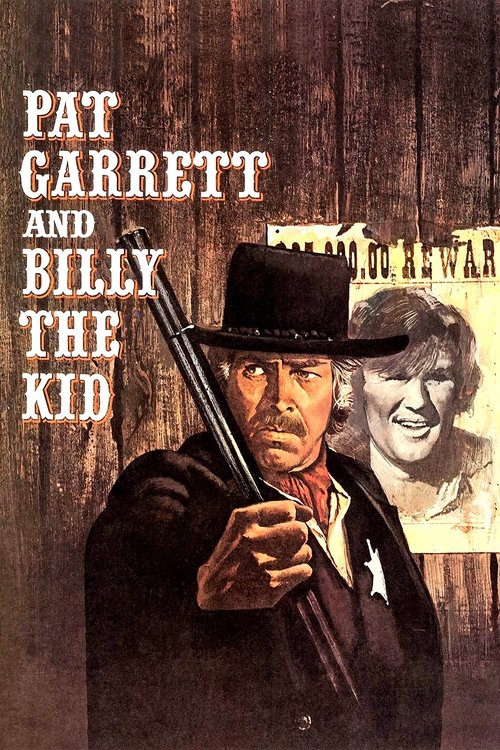
Pat Garrett & Billy the Kid
1973 · Sam Peckinpah
For a whiskey-and-dusk kind of evening when you want melancholy, not heroics — a Western for mourning the myth instead of cheering it. Best watched unhurried, in its rhythm rather than yours.
What it's about
New Mexico, 1881: cattle money is buying up the territory, and the barons hire Pat Garrett — newly pinned with a sheriff's star — to hunt down his old friend and riding partner, Billy the Kid. Both men know the score: the open frontier is closing, and one of them has been paid to bury it. What follows is less a chase than a long, mournful reckoning between two men who used to be the same man.
The experience
Slow, sad, and violent in bursts — a funeral march of a Western where every gunfight feels like a loss even when the 'right' man wins. It leaves you with a lingering ache rather than a thrill.
Performances
James Coburn is remarkable as Garrett — weathered, compromised, visibly sickened by the job he's chosen — while Kris Kristofferson plays Billy as easy, magnetic refusal. And Bob Dylan drifts through the whole thing as the enigmatic 'Alias,' an unrepeatable piece of casting.
The craft
Peckinpah shoots the dying frontier in long, dust-golden takes punctuated by his signature slow-motion violence, and Dylan's score — including 'Knockin' on Heaven's Door,' written for the film — gives the killing an elegiac pull no conventional soundtrack could. The film was infamously recut against the director's wishes, and later restorations have been part of its legend.
Why it matters
A cornerstone of the revisionist Western and a defining chapter in the story of directors versus studios — its mutilated release and rediscovered cuts made it a cause as much as a film, and it gave the world one of Dylan's most famous songs.
Snapshot
Pat Garrett & Billy the Kid is Sam Peckinpah's elegiac, much-mutilated Western about the closing of the American frontier, dramatizing the historical 1881 pursuit of the outlaw William Bonney by his former associate, the newly deputized sheriff Pat Garrett. Working from a screenplay by novelist Rudolph Wurlitzer, Peckinpah recast a well-worn legend as a slow funeral march in which both men understand that the territory has been bought up by cattle and commercial interests, and that to survive is to be paid to kill the past. James Coburn plays Garrett as a weathered, compromised pragmatist; Kris Kristofferson plays Billy as an almost passive embodiment of refusal; and Bob Dylan, in his first significant screen role, drifts through as the enigmatic "Alias" while supplying the score. The film is inseparable from its production history: MGM, under James Aubrey, took the picture from Peckinpah and released a truncated version in 1973 to hostile reviews, and the work's reputation was substantially rebuilt by a 1988 "preview" reconstruction and a 2005 special edition. It is now widely regarded as one of the great American Westerns and one of the most poignant statements of Peckinpah's recurring theme — men outliving their own era.
Industry & production
The film was produced by Gordon Carroll for Metro-Goldwyn-Mayer, a studio then in steep decline and run by James T. Aubrey, an executive nicknamed "the Smiling Cobra," whose mandate was austerity and tight control. The production shot in Durango, Mexico, in late 1972 — the same region where Peckinpah had filmed Major Dundee years earlier — and the shoot became one of the more storied troubled productions of the era. Accounts from cast and crew, repeated across Peckinpah biographies (notably David Weddle's "If They Move… Kill 'Em!" and Paul Seydor's work on the film), describe a malfunctioning camera that ruined footage, an outbreak of influenza on location, and a director drinking heavily and falling badly behind schedule and over budget.
The decisive conflict was between Peckinpah and Aubrey over length and final cut. Peckinpah delivered a long, deliberately paced film; MGM, wanting a leaner commercial product, recut it without his consent and released a version running roughly 106 minutes in 1973. Peckinpah reportedly disowned the studio cut, and the episode hardened his already adversarial reputation in Hollywood. The disastrous critical reception of the theatrical release, combined with the budget overruns, materially damaged the film's commercial standing and contributed to the narrative of Peckinpah as a self-destructive talent at war with the industry. Precise box-office figures for the release are not something I can state reliably, and I won't invent them; what is securely documented is that the film was treated at the time as both a critical and commercial disappointment.
The film's afterlife is itself an industry story. In 1988 a "preview" version — closer to Peckinpah's intentions and drawing on a workprint screened before the studio recut — was assembled and circulated, dramatically improving the film's reputation. In 2005, a special-edition reconstruction overseen by editor Paul Seydor offered another configuration of the material. The existence of multiple substantially different cuts makes Pat Garrett & Billy the Kid a textbook case in debates about authorship, final cut, and the ethics of posthumous restoration.
Technology
The film was shot on 35mm color stock in a flat (non-anamorphic) format, with cinematography by John Coquillon. Technologically it belongs to early-1970s American filmmaking practice: zoom lenses, naturalistic available-light-influenced exposures, and the by-then-established Peckinpah toolkit of multiple cameras running at varied frame rates to enable his signature slow-motion violence. The reported camera malfunction during the Durango shoot — which is said to have spoiled a quantity of footage — is a reminder of how dependent the period's location productions were on fragile, hard-to-monitor equipment far from a lab. The score's distribution of Dylan's songs and the prominence of the recorded ballad "Knockin' on Heaven's Door" also reflect the era's tightening relationship between film soundtracks and the popular-music industry, where a marketable song could function as both score and commercial asset.
Technique
Cinematography
John Coquillon's photography is one of the film's glories and a key reason the slower cuts feel meditative rather than inert. The palette favors dusty earth tones, golds, and the deep blue of dusk; many of the film's most celebrated images are crepuscular, set at "magic hour," when figures become silhouettes against a fading sky. The famous death of Sheriff Baker (played by Slim Pickens), who walks to a riverbank to die as Dylan's "Knockin' on Heaven's Door" plays, is staged and lit as a kind of secular pietà, the water and low sun doing as much dramatic work as the actors. Coquillon, who also shot Peckinpah's Cross of Iron, balances long lenses and zooms with carefully composed wide shots that locate small human figures within an indifferent landscape — a visual argument about the smallness of these legendary men against the closing frontier.
Editing
Editing is the film's most contested and most discussed technical dimension, precisely because there is no single authoritative cut. Peckinpah was famous for elaborately constructed montage and for cross-cutting that fractures violent action into multiple temporal registers, and the longer reconstructions restore a more ruminative rhythm, including the framing device of Garrett's own death in 1909, which brackets the main narrative as a flashback and lends the whole film a fatalistic, predestined cast. The 1973 studio cut excised material, compressed Peckinpah's deliberate pacing, and (by most critical accounts) removed the framing structure and other connective tissue, yielding a choppier, less coherent experience. Comparing the cuts has become a standard exercise in film studies for understanding how editing alone can reconstitute a film's meaning, mode, and reputation.
Mise-en-scène / staging
Peckinpah stages the film as a series of encounters and farewells rather than a tightly causal chase. Interiors are crowded with worn, specific period detail; exteriors emphasize fences, ferries, ranch buildings, and dusty streets — the infrastructure of an economy enclosing the open range. A recurring staging idea is the gathering of old gunfighters and friends who keep turning up to be killed or to say goodbye, populating the frame with weathered character faces (a Peckinpah trademark) so that the West feels like a community of the already-doomed. Violence is staged abruptly within these tableaux, so that death intrudes on conversation and ritual.
Sound
The soundscape mixes naturalistic location ambience — wind, water, gunfire, the creak of leather and wood — with Bob Dylan's score, which is unusual in a Western for leaning on contemporary singer-songwriter idiom rather than orchestral or traditional Western scoring. The integration of "Knockin' on Heaven's Door" into the Baker death scene is the most celebrated marriage of song and image in the film and arguably one of the most effective in the genre. Elsewhere Dylan's instrumental cues and recurring motifs lend a plaintive, modern melancholy that historicizes the action emotionally, framing 1881 from the vantage of a later, mournful sensibility.
Performance
James Coburn gives one of his finest performances as Garrett: contained, tired, and morally hollowed out, a man who has chosen the side of money and survival and knows exactly what it costs him. Kris Kristofferson's Billy is deliberately less psychologically articulated — charismatic, unhurried, almost serene in his refusal to leave — which some contemporary critics read as flat but which the film's admirers see as the point: Billy is less a character than a principle the new order must extinguish. Bob Dylan's "Alias" is a minor, watchful presence whose enigmatic quality suits the role. The supporting bench is exceptionally deep, including Slim Pickens and Katy Jurado in the wordless, devastating riverbank sequence, Jason Robards, Richard Jaeckel, Chill Wills, Barry Sullivan, Jack Elam, and others — many of them faces from earlier Westerns, so that the casting itself eulogizes the genre.
Narrative & dramatic mode
The dramatic mode is elegy, not suspense. Although the plot is a manhunt, Peckinpah drains it of conventional thriller mechanics; we know from the start — especially in the framed versions, which open with Garrett's own murder — how it must end. The structure is episodic and valedictory, a string of encounters in which Garrett closes in while both men, and the audience, register the inevitability of the outcome. The central relationship is less rivalry than mutual recognition: two versions of the same frontier manhood, one of whom has agreed to be domesticated by capital and one of whom refuses. The film's emotional engine is regret and complicity rather than excitement, and its tragedy is historical as much as personal — the sense that the frontier's freedom is being bought out from under everyone, and that to be hired is to be implicated.
Genre & cycle
The film belongs to the late, revisionist Western of the late 1960s and early 1970s — the cycle that includes Peckinpah's own The Wild Bunch (1969) and Ride the High Country (1962), Arthur Penn's Little Big Man (1970), Robert Altman's McCabe & Mrs. Miller (1971), and the work of younger directors deconstructing frontier myth. Within that cycle it is among the purest distillations of the genre's autumnal strain: the Western not as adventure but as obituary for itself. It also engages directly with the much-filmed Billy the Kid legend — a story told many times before, from King Vidor's Billy the Kid to Arthur Penn's The Left Handed Gun (1958) — and reframes it from the conventional outlaw-romance toward an account of institutional power and economic enclosure.
Authorship & method
This is a quintessential Peckinpah film in theme and texture, even as the studio's intervention makes "authorship" the film's central scholarly question. Peckinpah's obsessions are all present: aging men outliving their era; loyalty and betrayal among friends; the corruption of the frontier by money and law; violence rendered both balletic and abrupt; and a deep ambivalence about the very codes his films mourn. His method on this picture — long, intuitive, improvisatory, conducted under the influence and in open warfare with his producers — is well documented in the biographical record and is inseparable from both the film's richness and its incoherence in the released cut.
The key collaborators are essential to its identity. Screenwriter Rudolph Wurlitzer, a novelist associated with countercultural and existential American fiction, supplied a script whose laconic, fatalistic sensibility meshes with and sometimes pulls against Peckinpah's; the relationship between writer and director on the film was reportedly fraught. Cinematographer John Coquillon provided the dusk-soaked imagery that defines the film's mood. Bob Dylan contributed both a performance and the score, an authorial intervention unusual for a major studio Western. The reconstruction work of editor and scholar Paul Seydor on the later cuts has materially shaped which "Peckinpah film" audiences now see, making him an unusual kind of posthumous collaborator in the film's authorship.
Movement / national cinema
The film is a product of "New Hollywood" — the period when a generation of directors gained unusual creative latitude within a faltering studio system before the blockbuster era reconsolidated corporate control. Its very conflict (an auteur's vision versus an executive's commercial recut) is emblematic of that moment's central tension. As an American national text it is also a self-conscious meditation on national myth, using the most American of genres to interrogate the founding stories of the frontier, individual freedom, and the rule of law, at a time when American institutions and self-image were under broad cultural strain.
Era / period
Made in 1972–73 and set in 1881 New Mexico Territory (with a framing set in 1909), the film is doubly historical. Its 1881 is rendered with attention to the economic forces — the cattle barons, the Santa Fe Ring of business and political interests — that historically transformed the territory, foregrounding the enclosure of the open range over gunfighter heroics. Its production era, the Vietnam and Watergate years, plainly informs its disenchantment: the suspicion of institutions, the sense that violence is sanctioned and purchased by the powerful, and the mourning of lost freedoms all read as much about 1973 as about 1881. I'd note that the film does not press explicit contemporary allegory; the resonance is atmospheric and thematic rather than coded.
Themes
The governing theme is the death of the frontier and, with it, a way of being a man. Closely bound to it are: complicity and the price of survival (Garrett sells his past to keep his future); friendship and betrayal as inseparable; the conversion of law into an instrument of capital; and time itself as antagonist — the past cannot be outrun, only joined. The framing of Garrett's own death makes the manhunt a suicide in slow motion, the hunter's fate sealed by the same forces that doomed his quarry. Underlying all of it is Peckinpah's characteristic elegiac ambivalence: a mourning for codes of honor he simultaneously knows to be myths.
Reception, canon & influence
On release in 1973 the studio cut was received poorly; contemporary American reviews were largely unenthusiastic and often dismissive, faulting it as slack, incoherent, or self-indulgent — a judgment now widely understood as a response to MGM's mutilation rather than to Peckinpah's film. The critical reversal is one of the more dramatic in American cinema: as the 1988 preview version and later the 2005 reconstruction circulated, critics and scholars increasingly ranked the film among Peckinpah's finest and among the great elegiac Westerns, and the Baker death scene and Dylan's "Knockin' on Heaven's Door" became canonical.
The influences on the film run backward through Peckinpah's own Ride the High Country and The Wild Bunch, through the long screen tradition of the Billy the Kid legend, and through the broader revisionist impulse of contemporaries like Altman and Penn. Its legacy forward is twofold. Aesthetically, it deepened the template of the mournful, anti-heroic Western and the integration of contemporary popular music into film scoring; "Knockin' on Heaven's Door" became a standard far beyond the movie. Institutionally, the film became a permanent reference point in arguments about directors' final cut, studio interference, and film restoration — a case study taught precisely because its multiple versions let viewers see authorship being made and unmade in the editing room. Its standing today rests less on the version audiences saw in 1973 than on the reconstructions that recovered, as nearly as possible, the film Peckinpah seems to have intended.
A Deleuzian reading
A wounded sheriff named Baker walks down to the water to die.
The full Deleuzian reading of Pat Garrett & Billy the Kid →
Reception
Butchered by MGM and dumped into theaters in 1973 to mixed reviews, it was reborn when a longer preview cut surfaced in 1988 — now widely regarded as Peckinpah's last great western and one of the era's supreme elegies.
How Pat Garrett & Billy the Kid was received, from release to now →
Influences: the films it descends from and the films it influenced
- Ride the High Country (1962) — Establishes Peckinpah's elegiac aging-partners structure and farewell-tableau staging, plus the casting of worn veteran actors (McCrea/Scott) as the moral center — the template Pat Garrett reprises with its procession of weathered faces.
- The Wild Bunch (1969) — Invents the multi-camera, multiple-cut slow-motion death montage that Pat Garrett reprises in attenuated, mournful form — the same cutting grammar of violence assembled from intercut frame rates.
- The Gunfighter (1950) — The elegy-not-suspense template: a famous gunman passively awaiting a foreordained death rather than driving a suspense plot, structuring Garrett's pursuit as fatalistic procession.
- The Left Handed Gun (1958) — The direct predecessor in the screen-Billy tradition — a psychologized, revisionist Kid that breaks from heroic legend, the deglamorizing impulse Wurlitzer and Peckinpah inherit.
- Shane (1953) — Codifies the death-of-the-frontier elegy and the gunfighter as a vanishing figure incompatible with the settling, money-and-law West that closes in on Billy.
- One-Eyed Jacks (1961) — A former-partners betrayal between lawman and outlaw shot in dusk lyricism — and a project Peckinpah scripted early, feeding directly into the Garrett/Billy intimacy-turned-hunt.
- McCabe & Mrs. Miller (1971) — The immediate model for non-diegetic singer-songwriter scoring of a revisionist Western — Leonard Cohen's songs over the frontier prefiguring Dylan's integration into Pat Garrett.
- Bring Me the Head of Alfredo Garcia (1974) — The immediate self-descendant, extending the doomed-protagonist sun-blasted fatalism and Coquillon-school dusk imagery into an even more dissolute, personal key.
- Heaven's Gate (1980) — Extends the dust-and-haze magic-hour elegiac tableau — and becomes the next great case study in the directors'-final-cut and studio-mutilation argument Pat Garrett opened.
- Unforgiven (1992) — The aging-gunfighter elegy with weathered character faces and a death-of-the-frontier reckoning over the cost of killing, deepening Peckinpah's anti-heroic Western template.
- Dead Man (1995) — A doomed journey toward death scored by a solo singer-songwriter (Neil Young), carrying forward elegy-not-suspense and the integration of contemporary musicianship into Western scoring.
- The Assassination of Jesse James by the Coward Robert Ford (2007) — Deakins' magic-hour silhouette photography and an elegy-not-suspense structure around a foreordained killing between intimates — the direct heir to Garrett's mournful pursuit of Billy.
- The Proposition (2005) — Nick Cave's singer-songwriter score laid over a sun-scorched frontier-death elegy, extending the Dylan model of authorial musician-as-scorer in a revisionist Western.
- Bonnie and Clyde (1967) — The slow-motion, multi-angle balletic rendering of death that New Hollywood developed in parallel with Peckinpah into a shared editing grammar of violence.
- The Hired Hand (1971) — Contemporaneous elegiac revisionist Western built on magic-hour lyricism, dissolve-heavy montage, and a folk/singer score (Bruce Langhorne) — the same mood-over-plot construction.
- Dirty Little Billy (1972) — A same-era deglamorized Billy the Kid rendered in mud, squalor, and anti-myth — the revisionist debunking of the legend running alongside Peckinpah's.
- Little Big Man (1970) — Vietnam-era demythologizing of the West and its institutional violence, the New Hollywood revisionist impulse Peckinpah names as a shared current.
- Bad Company (1972) — Young-outlaw drift and anti-heroic frontier survival staged in the laconic, fatalistic New Hollywood register that meshes with Wurlitzer's screenplay sensibility.
Similar films
- Ride the High Country (1962) — influence & lineage · same viewing thread · often watched together
- Shane (1953) — influence & lineage · same viewing thread · often watched together
- The Wild Bunch (1969) — influence & lineage · same viewing thread
- McCabe & Mrs. Miller (1971) — influence & lineage · same viewing thread
- The Gunfighter (1950) — influence & lineage · same viewing thread
- Unforgiven (1992) — influence & lineage
- Bring Me the Head of Alfredo Garcia (1974) — influence & lineage
- Heaven's Gate (1980) — influence & lineage
All the films related to Pat Garrett & Billy the Kid →
Watch it with: curated runs of related films
- Print the Legend — A run of frontier myths and their unmaking — town-taming marshals, aging gunfighters, and the stories the newspapers chose to print instead of the truth.