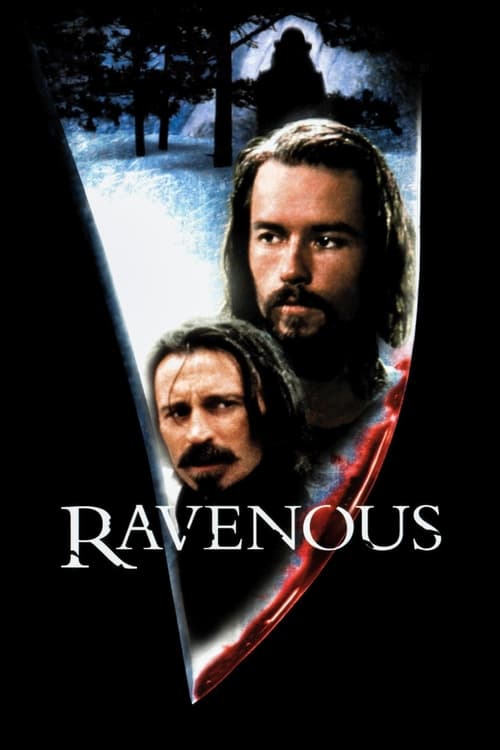
Ravenous
1999 · Antonia Bird
When you want a cult midnight movie with teeth — something violent and witty you can't quite believe got made by a studio. Great with friends who like their horror served with a smirk.
What it's about
In 1847, a soldier whose battlefield 'heroics' were really an act of cowardice is exiled to a crumbling Army outpost in the snowbound Sierra Nevada. One night the garrison takes in a half-frozen stranger with a terrible story: a stranded wagon party, a guide who turned on them, and meals no one wants to describe. The rescue mission they mount is a trap, and the frontier legend behind it — eat human flesh and you gain strength, along with a hunger that never stops — starts coming true.
The experience
A genuinely strange brew: gory horror, deadpan black comedy and western adventure in one pot, with a tone that lurches from grisly to giddy on purpose. It's tense, funny, nasty, and faster on its feet than you expect.
Performances
Robert Carlyle is the reason to come: charming, pathetic and terrifying by turns, often in the same scene. Guy Pearce plays his haunted opposite number with clenched, wordless guilt.
The craft
Antonia Bird shoots the mountains as both gorgeous and hostile, and the celebrated score by Michael Nyman and Damon Albarn — jaunty banjo over carnage — gives the film its off-kilter heartbeat. The violence is practical, wet and startling.
Why it matters
A flop on release that became a beloved cult object, it's now regularly cited among the great horror-westerns and as a sly satire of American appetite and expansion.
Snapshot
Ravenous is a cannibal western set in 1847, during the Mexican–American War. It is also a horror film, a pitch-black comedy and a satire of American expansion. Captain John Boyd (Guy Pearce) survives a battle by playing dead under a pile of corpses, then stumbles into a heroic capture of an enemy command post. He is quietly exiled to Fort Spencer, a decrepit way-station in the Sierra Nevada, as a reward that is also a punishment. There the garrison takes in a half-frozen Scottish stranger, Colqhoun (Robert Carlyle). He tells them that a snowbound wagon party resorted to eating its dead, and that their guide, an army colonel, turned predator. The rescue party walks into a trap. The story is a version of the Algonquian wendigo legend: eating human flesh gives strength, healing and a hunger that never stops.
The film was a troubled studio production and failed commercially on release. It has since become one of the more durable cult films of the late 1990s. It is admired for its mix of tones, for Carlyle's performance, and above all for its strange score by Michael Nyman and Damon Albarn.
Industry & production
Ravenous was produced for Fox 2000 Pictures, the 20th Century Fox division for mid-budget, adult-oriented films, with Adam Fields and David Heyman among the producers. Heyman made this film shortly before he became the producer of the Harry Potter series. The original screenplay was by Ted Griffin, then an early-career writer who later wrote Ocean's Eleven (2001) and Matchstick Men (2003).
The production is remembered for its change of director. Milcho Manchevski, whose Before the Rain (1994) had won the Golden Lion at Venice, was the original director. He left within the first weeks of shooting after disputes with the producers and studio. Accounts agree that the conflict was serious, though the details vary by source. Robert Carlyle, already cast, is widely credited with suggesting Antonia Bird as the replacement. He had worked with her on Priest (1994) and Face (1997). Bird came on at short notice, inherited a production already underway, and later spoke publicly about the pressures of the shoot and about friction with the studio over cutting and marketing.
The film was shot mostly in Slovakia, whose Tatra mountain landscapes stood in for the Sierra Nevada, with further work in Durango, Mexico, a long-standing western location. Fox released it in the United States in March 1999. It is generally reported to have earned only a small fraction of its budget at the domestic box office. The marketing, which struggled to sell a film that was a period western, a gore film and a comedy at once, is often blamed in retrospective accounts.
Technology
Ravenous is a conventional 35mm production of its time and makes no technological innovations. What matters technically is its use of practical effects for the violence: prosthetic wounds, butchery and body make-up. The gore is tactile and physical, not digitally enhanced, and it is often filmed with a matter-of-factness that makes it funnier and more repellent at once. Shooting on location in real snow, mud and forest gives the film a physical texture that the cold and the frontier depend on.
Technique
Cinematography
Anthony B. Richmond, the cinematographer of Nicolas Roeg's Don't Look Now (1973), shot the film. He takes a mostly classical approach: wide, deep-focus views of mountains and forest that place the small fort and its men inside a landscape far bigger than they are. The palette is cold and muted, with grey-blue snow, brown timber and dirty uniforms. Blood appears against it with shocking brightness, especially on snow. Interiors in the fort and the cave are lit in a low, firelit register that hints at the gothic. The camera usually stays steady and observational, with few expressionist flourishes. That restraint lets the absurd and the horrific play straight.
Editing
Neil Farrell's editing works with a deliberately uneven rhythm. Long, slow stretches of fort life and trekking are interrupted by sudden violence. The opening battle cuts between Boyd's dinner-table nausea at his promotion and his memory of the battlefield, so that eating and slaughter are linked from the first scenes. Because Bird took over mid-production, and because the film's release history includes reports of studio input, the final cut should be read with some caution as an expression of a single intention. The surviving record does not let us say exactly which cuts were Bird's alone.
Mise-en-scène / staging
Fort Spencer is a run-down outpost staffed by misfits: a drunk, a pious soldier, a stoner, a would-be warrior, and a commander, Colonel Hart (Jeffrey Jones), who is bookish and resigned. The fort is a parody of the frontier garrison of the classic cavalry western. The staging makes the cave, the place of the massacre, the film's dark centre. It is a gullet-like space of bones and remains. The film keeps returning to tables, cooking pots and meat, turning ordinary food into a running visual joke and a source of disgust. Costumes and props stay broadly within the period, but the performances and blocking often push toward comedy and farce.
Sound
The score by Michael Nyman and Damon Albarn is the film's most famous element. It deliberately avoids conventional western and horror scoring. It uses period and folk-sounding instrumentation, with banjo, fiddle and other acoustic textures, together with mechanical, repetitive figures in Nyman's minimalist manner, jaunty marching tunes and passages that sound deliberately off-key or lurching. The music often works against the image. Bright, almost cheerful cues play under scenes of horror or desperate pursuit, and that clash produces much of the film's black comedy. The score has had a strong afterlife of its own and is regularly singled out as one of the most distinctive film scores of the decade. Accounts of how the work was split between the two composers vary, and the record of who wrote which cue is not fully settled.
Performance
Guy Pearce plays Boyd as almost wordless. He is a man defined by shame, fear and bodily revulsion, and his role is largely reactive and physical. Robert Carlyle plays a double role, first as the trembling, pitiable Colqhoun and then as the confident, mocking Colonel Ives. He moves from vulnerability to predatory charm in a performance critics singled out even when they disliked the film. Jeffrey Jones gives Hart a weary, ironic intelligence. David Arquette, Jeremy Davies, Neal McDonough, Stephen Spinella and John Spencer fill out the cast with sharply sketched, sometimes broadly comic turns. Joseph Runningfox and Sheila Tousey play George and Martha, the Native characters who provide the wendigo framework. The film gives them dignity, though it also keeps them at the edges of the drama.
Narrative & dramatic mode
The film opens with two epigraphs. The first is Nietzsche's warning that whoever fights monsters should take care not to become one. The second is the attributed joke "Eat me." These signal the film's mixed mode: serious moral allegory alongside grotesque humour. The story falls into three movements. First comes the frontier-outpost set-up with the stranger's tale. Then comes the expedition to the cave, which turns into a massacre. Finally, back at the fort, Boyd finds himself the sole witness, disbelieved, as Ives returns in a new role and starts to recruit rather than simply to kill.
The central device is the wendigo myth: eating human flesh gives the eater strength and healing, at the price of insatiable hunger. Boyd himself has eaten flesh to survive. That makes the film's question one of complicity, not plain villainy. The climax, in which Boyd and Ives are caught together in a bear trap, makes literal the bond between the two men, who are moral twins. Throughout, the film offers comedy and horror at the same time and does not tell the viewer which reaction is correct.
Genre & cycle
Ravenous belongs to the loose tradition of the "weird western", in which the western's iconography meets the supernatural or horrific. Its predecessors include Kathryn Bigelow's Near Dark (1987), a vampire film set in western landscapes. It also relates to the revisionist and "acid" western of the 1970s and 1990s, including Jim Jarmusch's Dead Man (1995), which likewise treats the frontier as a place of absurdity and death. Within horror it belongs to the cannibal film, though it is much closer to the vampire allegory than to the Italian cannibal cycle of the 1970s and 1980s. Ives works like a vampire figure who recruits, seduces and offers vitality. The film was not part of any commercial cycle in 1999. Its mix of genres was one reason it was hard to market and one reason it later found a devoted audience.
Authorship & method
Antonia Bird (1951–2013) came from British theatre and television, including work on the BBC's EastEnders and on social-realist drama. She was best known for Priest (1994), a combative drama about a gay Catholic priest, and Face (1997), a London heist film. Both starred Carlyle. She came to Ravenous as a replacement and had to work within a script, cast and schedule already in place. Even so, the finished film shows traits found elsewhere in her work: a taste for moral provocation, an interest in institutions such as church, police and army, and close attention to performers. She is usually credited with leaning into the film's black comedy and its allegorical reading of American expansion.
Ted Griffin's screenplay provided the core idea: the wendigo legend mapped onto Manifest Destiny, with echoes of the Donner Party (1846–47) and of the Colorado cannibal Alferd Packer.
Anthony B. Richmond (cinematography) brought long experience in British and American features. Neil Farrell edited. Michael Nyman, best known for his scores for Peter Greenaway and for Jane Campion's The Piano (1993), and Damon Albarn, then frontman of Blur, wrote the music. It was an unlikely pairing whose result became the film's signature. Robert Carlyle's role in bringing Bird to the project makes him an important contributor beyond his performance.
Movement / national cinema
Ravenous is an American studio film about American history, set in the United States and made with Hollywood money. Its key creative team, however, was largely British: Bird, Carlyle, Nyman, Albarn and Richmond, together with the Australian Guy Pearce. It was shot in Central Europe. That outsider perspective is often linked to its satire of Manifest Destiny and its refusal of the western's heroic myths, in the tradition of European and émigré revisions of the genre. It does not belong to any national movement. It is better understood as a transatlantic product of 1990s studio-financed independent-style filmmaking.
Era / period
The film was made at the end of the 1990s, a period when Hollywood studios ran "specialty" divisions such as Fox 2000, Fox Searchlight and Miramax and were funding unusual, director-driven projects in the wake of the independent boom. It also came out in a decade of revisionist westerns, including Unforgiven (1992), Dead Man and Lone Star (1996), and of horror that was self-aware and ironic, such as Scream (1996). Ravenous draws on both strands while fitting neither. Its commercial failure is typical of how such hybrids often fared when released through mainstream channels at the end of the decade.
Its historical setting, 1847, places it in the Mexican–American War and the westward migration of the 1840s. The Donner Party disaster happened in the Sierra Nevada the winter before. That context is the core of its allegory.
Themes
- Consumption as national expansion. The film's central argument is that Manifest Destiny is a form of cannibalism. Ives sees America as a nation stretching westward to devour, and the film links his appetite to the conquest of territory, to the war with Mexico and to the displacement of Native peoples.
- Complicity and survival. Boyd's cowardice, his survival under corpses and his own consumption of flesh make him not the opposite of Ives but his mirror. The film refuses to let its hero be morally clean.
- The body and appetite. Healing, vitality and addiction are central. The cannibal's strength works like a drug that heals and enslaves at once, and critics have often read the film as an allegory of addiction.
- Religion and communion. Images of eating flesh and drinking blood draw on Christian sacrament, a recurring concern in Bird's work.
- Military institutions and masculinity. The fort is a parody of the cavalry outpost. Rank, courage and heroism are shown as hollow or arbitrary.
- Indigenous knowledge. The wendigo legend comes from Algonquian peoples. The film's Native characters understand what is happening before the white soldiers do, though their role in the story stays secondary.
Reception, canon & influence
Critical reception. On release Ravenous drew mixed reviews. Some critics praised its daring, its humour, Carlyle's performance and especially the score. Others found its shifts of tone jarring or its gore off-putting. It did poorly at the box office, and the studio's marketing is widely seen to have misjudged it. Bird's later comments about the production and its handling have shaped how the film is discussed. In the years since, its reputation has risen steadily. Home video, repertory screenings and online critical writing have established it as a cult classic, often cited as one of the most underrated films of the 1990s and as one of the best of the horror western's few major entries.
Influences on the film (backward). The most direct sources are historical and folkloric: the Donner Party, the Alferd Packer case and the Algonquian wendigo legend. Cinematically it draws on the revisionist western, from Robert Altman's McCabe & Mrs. Miller (1971) and Sydney Pollack's Jeremiah Johnson (1972), with its snowbound mountain-man survival and violence, to Dead Man. From horror it draws on the vampire film and on the horror-western hybrid of Near Dark. Its black comedy belongs to a British sensibility shared by its makers. Nietzsche's epigraph signals the moral frame.
Legacy (forward). Ravenous is regularly invoked as a reference point for later horror westerns and frontier horror films. These include S. Craig Zahler's Bone Tomahawk (2015), with its cannibal troglodytes and frontier rescue mission; Scott Cooper's wendigo film Antlers (2021); and the AMC series The Terror (2018), whose doomed expedition, cannibalism and supernatural monster cover similar ground. Writing on these works often mentions Ravenous as an ancestor, though direct acknowledged influence is not always documented and should not be overstated. The Nyman–Albarn score has also had a life of its own, cited in discussions of unconventional film music and of how much a score can drive a film's tone. The film's cult standing is a lasting example of a commercial failure being rediscovered, and it stands as the most widely remembered work of Antonia Bird's career.
Influences: the films it descends from and the films it influenced
- McCabe & Mrs. Miller (1971) — Vilmos Zsigmond's flashed, desaturated winter photography of a raw frontier settlement set the cold, muddy palette that Ravenous uses for Fort Spencer's dying outpost.
- Jeremiah Johnson (1972) — Its on-location Sierra snowscapes and mountain-man survival story, where violence comes in sudden bursts and the wilderness slowly wears the man down, are the model for Ravenous's snowbound landscapes and its pursuit through the mountains.
- The Good, the Bad and the Ugly (1966) — Morricone's strange instrumentation (whistles, yodels, twangs) that comments ironically on violence instead of underscoring it is the western precedent for the Nyman–Albarn score of banjo, fiddle and ragged folk.
- The Cook, the Thief, His Wife & Her Lover (1989) — Michael Nyman's insistent repeating minimalism set against scenes of gluttony and a final act of cannibalism, the template for his cheerfully mechanical counterpoint to the eating in Ravenous.
- The Thing (1982) — Its isolated snowbound garrison, paranoia about which comrade has already been 'consumed' and changed, and graphic practical gore effects are the model for Fort Spencer's siege and Ravenous's prosthetic carnage.
- Near Dark (1987) — It moved vampire hunger into western iconography, with nomadic outlaws, spurs and open country, and treated bloodlust as both addiction and kinship; Ravenous takes over that hybrid when it rewrites the wendigo as a vampire-like frontier appetite.
- Dead Man (1995) — A deadpan revisionist western that reads westward expansion as a slow death and lets an anachronistic rock musician's score (Neil Young's improvised guitar) set the tone, much like Albarn's pop sensibility in Ravenous.
- Alive (1993) — Its survivors explicitly justify eating their dead by comparing it to Holy Communion; Ravenous turns that rationalisation into black comedy through its Eucharist imagery and its 'eat the body' theology.
- The Burrowers (2008) — It inherits Ravenous's frontier-horror structure: a cavalry search party in the 1870s West is picked off by flesh-eating creatures, which the film ties directly to the U.S. Army's destruction of the Native food supply.
- Bone Tomahawk (2015) — It follows Ravenous's pattern of a slow western rescue mission that breaks into extreme practical-effects cannibal gore, with laconic, darkly funny dialogue between the doomed men.
- The Hateful Eight (2015) — A snowbound western in which a group trapped in one waystation turns on itself, with gory blood-on-snow imagery, grotesque black comedy and a deliberately odd horror-inflected score (Morricone reusing his music for The Thing).
- Raw (2016) — It extends Ravenous's addiction allegory: one taste of flesh starts a craving the heroine can't control and a moral double (her sister) acts out, shot with the same mix of body horror and deadpan comedy.
- The Wind (2018) — Frontier isolation becomes a supernatural possession story drawn from settler folklore, using the Ravenous method of setting an Indigenous-adjacent demon myth against the psychic cost of homesteading.
- Antlers (2021) — It takes up Ravenous's wendigo-as-allegory idea directly, linking the creature's hunger to addiction (an opioid-addicted father) and to extraction from colonised land, and shows the transformation through practical creature work.
- Bones and All (2022) — It recasts cannibalism as an inherited compulsion played out across a mythic American landscape, and puts an elder 'eater' who tempts the young heroine at its centre, a mentor-seducer much like Colqhoun.
- Fresh (2022) — It uses Ravenous's jaunty, contrapuntal music against cannibal butchery, cutting cheerful pop and dancing against meat preparation to make consumption-as-capitalism both funny and nauseating.
- Trouble Every Day (2001) — Like Ravenous, it shows cannibal hunger as a chronic, shameful addiction its sufferers try and fail to manage, and its moody Tindersticks score carries the film's tone in the same way.
- 101 Reykjavik (2000) — Damon Albarn's idiosyncratic, non-orchestral film scoring as a craft signature — the same art-rock composer's-ear that makes the Albarn–Einar Örn score inseparable from 101's identity.
Similar films
- Bone Tomahawk (2015) — influence & lineage · same viewing thread
- The Thing (1982) — influence & lineage · same viewing thread
- Bones and All (2022) — influence & lineage
- Near Dark (1987) — influence & lineage
- The Hateful Eight (2015) — influence & lineage
- Dead Man (1995) — influence & lineage
- Jeremiah Johnson (1972) — influence & lineage · same viewing thread
- Mandy (2018) — same viewing thread
All the films related to Ravenous →
Watch it with: curated runs of related films
- Into the Heart of Darkness — A run of grueling journeys into hostile country — jungle, ice, desert, occupied forest — where the ordeal strips men down to something primal, hallucinatory, and often unrecoverable.