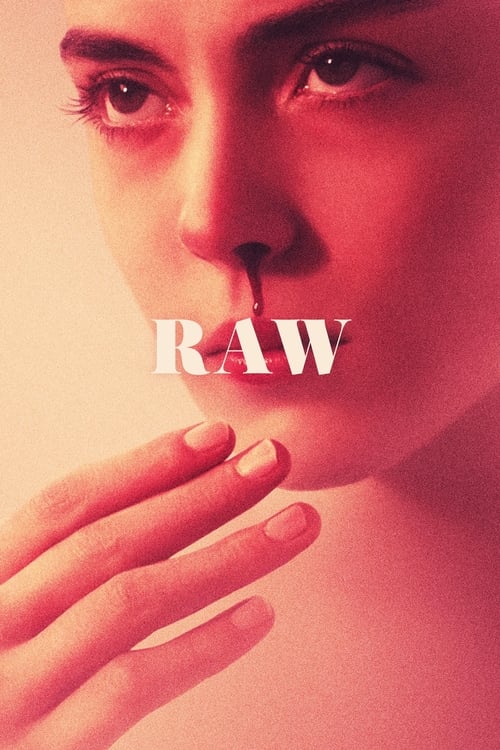
Raw
2017 · Julia Ducournau
Titane's Palme d'Or made her the face of the "new extremity goes mainstream" conversation; her follow-up Alpha divided Cannes and fed the "was Titane a fluke" discourse. Invoked whenever body horror and prestige collide.
When you want a film to chew on for days and you've got the stomach for it — this is challenge viewing, not comfort, best for a night when you want horror that's actually about something.
What it's about
Justine, a lifelong vegetarian from a family of veterinarians, arrives for her first week at veterinary school and is plunged into a brutal hazing ritual — presided over in part by her own older sister, already a student there. Pressured into eating raw meat for the first time, she develops a craving that starts to escalate, and her discovery of appetite becomes inseparable from her discovery of everything else: desire, rivalry, and who she actually is.
The experience
Unflinching and physical — it earns its reputation for making audiences squirm — but the shock lives inside a sharp, darkly funny coming-of-age story about sisters. You come out shaken and weirdly moved, thinking less about the gore than about what it stood for.
Performances
Garance Marillier is ferocious as Justine, charting the slide from timid freshman to something wilder with total physical commitment; her scenes with Ella Rumpf as her sister give the film its volatile heart.
The craft
Julia Ducournau directs her first feature with startling control — clinical, beautiful compositions that make the visceral moments hit harder, and a sound design that makes every bite audible. The neon-lit hazing sequences have a woozy, ritualistic pull that rewards a proper screen and sound.
Why it matters
A festival sensation that announced Ducournau as one of the most fearless new directors in Europe and became a cornerstone of the modern French genre renaissance — the film that put her on the path to the Palme d'Or.
Snapshot
Raw (French title Grave) is Julia Ducournau's first feature: a coming-of-age film that uses cannibalism as its central conceit and treats it less as a horror premise than as a physiological fact of growing up. Justine, a sixteen-year-old vegetarian from a family of veterinarians, arrives at veterinary school and is subjected to a week of hazing by upperclassmen — including her older sister Alexia, already enrolled. Forced to swallow a raw rabbit kidney, she develops first a rash, then a craving, and the craving escalates from raw chicken breast pulled from the fridge to human flesh. The film ends by reframing everything that preceded it as inheritance rather than accident.
What distinguishes Raw from the body-horror lineage it obviously belongs to is its refusal of the genre's usual moral architecture. Justine is not punished, cured, or destroyed; she is initiated. The film's structure is a school year, not a monster's arc, and its emotional center is the sibling relationship — a rivalry that turns collaborative, then predatory, then something like solidarity. Ducournau shoots the transformation with clinical calm and a great deal of skin, and she is unusually interested in ordinary embarrassments: bad haircuts, dorm-room politics, a roommate who wants to sleep, the specific humiliation of being the youngest person in a room.
The film premiered in the Semaine de la Critique sidebar at Cannes in 2016 and arrived internationally in 2017. It made Ducournau's name almost immediately, and four years later she became the second woman to win the Palme d'Or, for Titane (2021) — a trajectory that has caused Raw to be read retroactively as the opening statement of a coherent authorship concerned with flesh, family, and transformation.
Industry & production
Raw is a French–Belgian co-production, made within the funding architecture that supports most European auteur debuts: national and regional film funds, a co-production partner across the border, television pre-sales, and a festival launch to secure international distribution. Belgium's involvement — the film shot substantially in Belgium, using a real veterinary campus environment — reflects the tax-shelter and co-production incentives that have made Belgian participation routine in French art-cinema financing since the 2000s. The Semaine de la Critique, Cannes's parallel section dedicated to first and second features, is precisely the venue this kind of film is built to reach.
Ducournau came to the feature through the standard French pathway: she trained in screenwriting at La Fémis, the state film school, then made the short Junior (2011), which played at Cannes in the Critics' Week short film competition and won a prize there, followed by the television feature Mange (2012), co-directed with Virgile Bramly. Junior is a direct antecedent — a teenage girl whose stomach flu becomes a molting, her skin peeling off to reveal something new underneath, with Garance Marillier in the lead. Raw effectively expands that short's premise to feature length and keeps its actress, an unusually direct line from apprenticeship to debut.
The most persistent piece of Raw's industrial history is its reception as an endurance object. Reports of walkouts and viewers requiring medical attention at a festival screening — most widely circulated after its Midnight Madness screening at the Toronto International Film Festival in 2016 — became the film's dominant marketing story in the English-language press. Ducournau publicly resisted the framing, and the film's actual content is far less extreme than the reputation suggested; the gore is concentrated in a handful of scenes. The episode is a useful case study in how festival anecdote functions as distribution capital for genre-adjacent art cinema, and it shaped how many viewers arrived at the film. The precise details of what occurred are the sort of thing that hardened into legend faster than into record, and I would not want to state more about it than that it was widely reported and widely amplified.
The film received an adults-only certification in several territories and was handled by specialty distributors positioned at the art-house/genre boundary — the commercial niche that had already absorbed a decade of festival horror. Its budget was modest by any standard, and its production values reflect resourceful concentration rather than scale: a limited number of locations, a small principal cast, and effects work deployed sparingly and precisely.
Technology
Raw was shot digitally, in widescreen, in the mid-2010s window when high-end digital capture had become the default for European features of this budget and when low-light sensitivity had improved enough to make available-light party scenes and corridor sequences practical. This matters more than usual here, because a substantial portion of the film takes place in near-darkness lit by strobes, glowsticks, and fluorescent tubes. The rave and hazing sequences depend on a camera that can hold color and detail in conditions that would have required either much heavier lighting or much coarser grain on film stock.
The effects work is predominantly practical: prosthetics, appliances, and physical makeup for the rash, the peeling, the bite wounds, and the finger. The film's most-discussed images — a torn body, a chewed-off digit, a rash blooming across a torso — are things placed in front of the camera rather than added afterward, which is why they hold up under Ducournau's preference for holding a shot rather than cutting around it. Digital work is used where it should be: cleanup, wire and rig removal, extensions to practical effects. The commitment to practical makeup is a lineage marker as much as a budgetary one, aligning the film with the analog body-horror tradition of the late 1970s and 1980s rather than with the digital splatter of the 2000s.
The film's soundtrack mixes composed score with source music, and its club and dorm sequences are built around loud, contemporary tracks — a technological and cultural fact of the setting as much as an aesthetic choice, since the world of the film is one where phones record everything and music is always playing through someone's speakers. The horizontal-video hazing footage and the pervasiveness of documentation are part of the film's period texture.
Technique
Cinematography
Ruben Impens shot the film. Impens is a Belgian cinematographer best known before this for his work with Felix van Groeningen, including The Broken Circle Breakdown (2012) — a background in intimate, emotionally volatile drama rather than in genre. That is legible throughout. Raw is photographed like a naturalistic school film that occasionally admits something monstrous, not like a horror film that occasionally admits realism.
The dominant register is a mobile, handheld-adjacent camera that stays close to Justine, often at her shoulder, often slightly behind. Impens and Ducournau favor a shallow field that keeps the veterinary campus a smeared institutional blur behind her. The palette runs cold — concrete gray, corridor green, the clinical blue-white of fluorescents — punctuated by the film's few strong colors: blood, the paint poured over the freshmen during hazing, the sodium and neon of night sequences. The hazing sequences are the visual set pieces, staged in saturated, disorienting light with bodies packed into the frame; they are shot for immersion rather than legibility, and the film deliberately withholds a clear overview of the ritual so the viewer shares Justine's disorientation.
Against this, the horror is shot with conspicuous stillness. Ducournau and Impens repeatedly hold the frame on an act the viewer wants the camera to leave — the eating, the wound, the aftermath. The formal argument is that these acts are continuous with the ordinary body rather than a rupture from it, and the camera's refusal to flinch is the argument's grammar.
Editing
Jean-Christophe Bouzy cut the film. The editing serves a structure of escalating episodes across a school term, and its most characteristic move is patience within scenes and abruptness between them. Scenes are allowed to run past the point of comfort; transitions are frequently hard, dropping the viewer into a new situation without establishing material. The effect is a first-year student's experience of time — sequences of institutional pressure with no clear boundaries between them.
The film also uses ellipsis to protect its central reveal. Certain aftermaths are shown before their causes, most importantly in the sequence involving Alexia and the road, which the film stages so the viewer reconstructs it a beat late. This is the editing's most explicitly generic gesture, and it is used sparingly.
Mise-en-scène / staging
The veterinary school is the film's second protagonist. Ducournau stages the campus as a total institution — dormitories, lecture halls, dissection rooms, a morgue-like refrigerated space, a pool, a corridor system that seems to have no exterior. Animals are everywhere: as bodies to be worked on, as anesthetized patients, as carcasses. The film's key thematic staging device is the constant proximity of the animal body to the human one, so that the moment Justine crosses the line has been visually prepared for an hour.
Costume and body staging are precise. Justine begins in shapeless, sexless clothing and moves toward exposure; the film's famous scenes of her alone in a room in front of a mirror, or dancing to a song in lipstick, are staged as the ordinary business of a teenager assembling a self, with the horror content sitting inside that rather than beside it. Nudity in the film is persistent and matter-of-fact — bodies in showers, bodies in beds, bodies in dissection — which is part of the point: this is a place where flesh is the subject of study.
Sound
Jim Williams composed the score. Williams, a British composer, had previously worked with Ben Wheatley on Kill List (2011), Sightseers (2012), and A Field in England (2013), and he brings from those films a facility for score that is atmospheric and dissonant without announcing itself as horror music. His work here alternates between low, textural unease and passages of something closer to lament — the score treats Justine's condition as a sorrow rather than a threat. Williams would go on to score Titane, continuing the collaboration.
The sound design is the film's most aggressive department. Eating is recorded and mixed with a foregrounded wetness — chewing, tearing, swallowing — that does more to unsettle than any image does. The same is true of the body sounds around the transformation: skin, breath, the small noises of a person in a bed. Against this, the film's use of loud diegetic music in party scenes creates a pressure differential; quiet scenes feel exposed because the loud ones were so enveloping.
Performance
Garance Marillier's Justine is the film's spine, and the performance is built on a specific physical intelligence: she plays the character's hunger as an involuntary condition, something happening to a body rather than a decision made by a person. Marillier had worked with Ducournau since Junior, and the shorthand shows — the performance is unguarded in a way that suggests trust rather than exposure. Ella Rumpf's Alexia is the film's more volatile pole, a performance of aggressive competence with something reckless underneath; the sisters' scenes together carry the film's real emotional argument. Rabah Naït Oufella plays Adrien, Justine's roommate, with a lightness that makes him legible as a friend rather than a romantic device, which sharpens the film's final act. Laurent Lucas, a familiar face from French genre cinema including In My Skin (2002) and Calvaire (2004), plays the father, and his casting is itself a lineage signal.
Narrative & dramatic mode
The film's dramatic mode is coming-of-age realism with a horror premise metabolized into it. It observes the conventions of the campus film almost pedantically: arrival, hazing, roommate, first party, first exam, first sexual experience, sibling rivalry, a break. Nothing in the plot's architecture is supernatural; the film never explains cannibalism as curse, infection, or possession. It is presented as a family trait, revealed in the final scene as something the parents have lived with and managed.
That final revelation restructures the film. What has played as a story of corruption — a vegetarian degraded by a cruel institution — becomes a story of recognition. The hazing did not create Justine's hunger; it triggered a disclosure that was going to happen. This is the film's central formal decision, and it is what separates it from the moralized body-horror tradition where transgression produces transformation and transformation produces punishment. Raw is closer in shape to a puberty narrative or a queer coming-out narrative, in which the protagonist's ordeal is the discovery of what she already is and the question is whether she can live with it and with the people who share it.
The sister plot carries the film's ethics. Alexia is by turns Justine's tormentor, teacher, and accomplice, and the film's most disturbing sequences are those in which the sisters' bond and their appetite become indistinguishable. The last act's escalation belongs to Alexia rather than Justine, which allows the film to end without condemning its protagonist.
Genre & cycle
Raw sits at the intersection of three cycles. The first is body horror in the Cronenbergian sense — horror located in the transformation of flesh, treated with clinical rather than moralistic attention, and concerned with what a body's changes mean for identity. The second is the French genre resurgence of the 2000s, sometimes called the New French Extremity, which produced In My Skin (2002), High Tension (2003), Calvaire (2004), Inside (2007), Frontier(s) (2007), and Martyrs (2008), and which established a French mode of extreme, formally serious horror. The third is the mid-2010s international wave of festival horror — The Babadook (2014), It Follows (2014), The Witch (2015), Under the Shadow (2016) — in which horror premises were used to carry psychological and social material and were received as art cinema.
Raw's relation to the second cycle is the most argued-over. It shares the New French Extremity's willingness to show bodily damage without irony and its refusal of horror's usual release valves, and it casts Laurent Lucas, an actor associated with that movement. But it lacks that cycle's nihilism and its punitive relation to the body. Ducournau has been consistent in describing her interest as transformation rather than degradation, and the film's ending — an inheritance, a family, a continuation — is temperamentally opposite to Martyrs or Inside. It is more accurate to say Raw arrives after the New French Extremity and metabolizes its techniques for different ends.
Its cannibalism also belongs to a specific lineage in which eating people is a metaphor for appetite, class, or desire rather than a monster's behavior: Trouble Every Day (2001) is the closest French antecedent, and Raw shares its treatment of consumption as inseparable from sex.
Authorship & method
Ducournau wrote and directed Raw, and her authorship is unusually stable across the small body of work that follows: Junior (2011), Raw (2016/17), Titane (2021), Alpha (2025). The consistent preoccupations are metamorphosis, the family as the site where bodies are inherited and transmitted, and a refusal to treat the transformed body as an object of disgust. Her stated method involves writing with the body's specificity in mind — what a change feels like from inside rather than how it looks from outside — and directing toward physical rather than psychological performance.
Her key collaborators form a durable unit. Ruben Impens photographed both Raw and Titane, carrying over the combination of naturalistic proximity and controlled color that defines her look. Jim Williams scored both. Garance Marillier appears in Junior, Raw, and Titane, making her something like Ducournau's recurring body — a continuity of performer across films that treat the body as their subject. Jean-Christophe Bouzy edited Raw.
Ducournau's training as a screenwriter at La Fémis is legible in the film's discipline. Raw is tightly constructed: every element introduced in the first act is used, the hazing rituals establish the rules the film later breaks, and the final scene's revelation is prepared by the family's behavior in the opening sequence. The film is not improvisational or associative; it is a well-made screenplay with a monstrous center.
Movement / national cinema
The film is French cinema in the institutional sense — La Fémis, CNC-supported financing, Cannes — and in the intellectual sense, drawing on a French critical tradition that takes the body and its transgressions seriously as philosophical material. Its co-production with Belgium places it within a Franco-Belgian production culture that has become one of European art cinema's most productive arrangements, and its cinematographer's background in Belgian social realism is part of what gives the film its unglamorous surface.
More broadly, Raw belongs to a generational shift in French cinema in which women directors moved into positions of visibility across genres previously coded male. Ducournau's emergence is contemporaneous with a wider reassessment of authorship in French film, and her Palme d'Or for Titane — following Jane Campion's shared award for The Piano (1993) as only the second to a woman director — was treated as a landmark for that reason.
Era / period
Raw is a mid-2010s film in ways that go beyond its production date. The hazing sequences depict institutional cruelty as a documented, circulated, phone-recorded phenomenon, which places the film in a period when bullying and initiation rituals were being publicly reckoned with. Its treatment of sexuality — frank, unromantic, centered on a young woman's own confusion rather than on how she is perceived — belongs to a moment just before and during the broader cultural reassessment of consent and power that intensified in 2017. And its reception, dominated by an endurance narrative, is characteristic of a period when festival horror was marketed on physiological effect.
The film's release also sits at the peak of what was widely called "elevated horror" — a term Ducournau and many of her contemporaries rejected, on the grounds that it implies the genre needed elevating. The critical argument around that term is part of Raw's period context, and the film is frequently used as evidence on both sides of it.
Themes
The film's governing theme is appetite as identity. Justine's hunger is simultaneously for meat, for sex, for status, and for her sister's approval, and the film refuses to separate these. The vegetarianism she begins with is presented as inherited principle rather than conviction — her mother's rule — so that abandoning it is the first act of self-authorship rather than a fall.
Family and inheritance run beneath everything. The film's final scene makes explicit what the structure has been arguing: this is a condition passed down, managed by one generation and discovered by the next, and the parents' marriage is a portrait of what living with it costs. The sisters are the theme's working-out — two people with the same condition who develop opposite strategies for it.
The institution is the third theme. The veterinary school teaches its students to handle bodies as material, and its hazing rituals teach them to handle each other the same way. The film draws a line between the professional dehumanization of the animal body and the social dehumanization of the freshman body, and Justine's cannibalism is the point where the line closes into a circle.
Finally, the film is about embodiment as a female experience specifically: the rash and its treatment, the waxing scene, the mirror, the way a young woman's body is public property in a dormitory. Ducournau's insistence on ordinary bodily humiliation as the same substance as horror is the film's most durable formal idea.
Reception, canon & influence
Critically, Raw was received strongly and quickly. It won the FIPRESCI prize at Cannes in 2016 in the parallel sections, and reviews consistently identified it as a debut of unusual formal control, praising Marillier's performance and Ducournau's refusal of easy shock. Dissent focused on whether the metaphor was too neatly legible — coming-of-age as cannibalism read by some as a thesis executed rather than discovered — and on whether the film's final revelation deflated the ambiguity it had built. The endurance narrative around the TIFF screening dominated general-press coverage and produced a gap between the film's reputation and its actual texture that several critics noted at the time.
Its backward influences are traceable and were widely discussed. Cronenberg is the structural antecedent — The Fly (1986) and Rabid (1977) for transformation as biology, Shivers (1975) for appetite as infection — though Ducournau's tone is warmer than his. Claire Denis's Trouble Every Day (2001) is the nearest French precursor for cannibalism as erotic condition. Marina de Van's In My Skin (2002) is the precursor for a woman's self-consumption filmed with clinical calm, and the shared casting of Laurent Lucas makes the connection explicit. Carrie (1976), in its treatment of a girl's emerging power as bodily and humiliating, is a standing reference point for the subgenre, and Ginger Snaps (2000) is the most direct model for the sister-pair puberty-horror structure. The hazing material connects to a European tradition of institutional cruelty films running back through Zéro de conduite (1933) and if.... (1968).
Forward, Raw's influence has been considerable and is still resolving. Most immediately it established Ducournau, and Titane's Palme d'Or in 2021 retroactively canonized Raw as the first statement of a major authorship — the two films are now routinely programd and taught together, with Alpha (2025) extending the sequence. Within the genre, Raw is a central reference in the cannibal-romance and body-horror revival that followed: Bones and All (2022) is the most-cited descendant, and the wave of women-directed body horror around Titane, Fresh (2022), and Saint Maud (2019) is regularly discussed with Raw as an anchor point, though influence in a cycle this dense is diffuse and simultaneous rather than linear. Its most specific legacy may be tonal: it demonstrated that a horror premise could be carried inside a naturalistic coming-of-age film without either register apologizing for the other, and that the resulting film could travel from Critics' Week to international distribution on its own terms.
In the longer canon, Raw now functions as a teaching text — for body horror, for French genre cinema after the 2000s extremity, for feminist readings of appetite and embodiment, and as a case study in how festival anecdote shapes a film's public life. Its position is secure enough that the interesting critical work has moved past whether it is good to what its metaphor actually claims.
A Deleuzian reading
A girl stands at an open refrigerator at night and eats a raw chicken breast.
The full Deleuzian reading of Raw →
Reception
In 2016–17 the headlines were all about paramedics and fainting audience members at its TIFF Midnight Madness screening; once the smelling salts wore off, it settled in as a tender coming-of-age film in horror clothing — and after Ducournau won the Palme d'Or for Titane, Raw got retroactively canonized as the debut that announced her.
How Raw was received, from release to now →
How to watch Raw: what to notice on a first viewing
- Notice how often the camera stays behind Justine's shoulder. Impens keeps a shallow, handheld-adjacent frame close to Justine, blurring the campus behind her into an institutional smear. This proximity puts you inside her body's experience instead of watching it from outside.
- Count the animal bodies visible in the background of scenes. Carcasses, anesthetized patients, and dissection tables recur throughout the veterinary school, always near Justine before her hunger appears. The film prepares the line she crosses for an hour before she crosses it.
- Listen for the wet, foregrounded sound of chewing and swallowing. Jim Williams's score goes quiet during eating scenes, letting the sound design carry the unease alone. The sound, not the image, does most of the unsettling work.
- Notice the cold gray-green light turn to hot color at parties. The palette runs clinical and cold through corridors and dorms, then breaks into saturated paint and neon during hazing and rave scenes. The color shift marks the difference between institutional control and the loss of it.
- Watch Justine's posture change from stiff to loose across scenes. Marillier plays hunger as something happening to her body, not a choice, visible in small physical shifts. Her performance treats the transformation as involuntary, closer to puberty than to corruption.
The whole guide to watching Raw, with the keys for a rewatch →
Influences: the films it descends from and the films it influenced
- Junior (2011) — Ducournau's own short establishes the exact device Raw scales up — adolescence filmed as a literal full-body molt, with Garance Marillier again the shedding body and the camera again refusing to cut away from the peeling.
- Shivers (1975) — Appetite as contagion spreading through a sealed modernist building gives Raw its total-institution architecture: a fixed population inside one campus where the change reads as an outbreak rather than an isolated affliction.
- The Fly (1986) — Transformation kept as documented biological bookkeeping in discrete stages (the finger, the ear, the tooth) — Raw follows the same incremental prosthetic ledger of rash, peel, pulled hair, bitten finger instead of one reveal.
- Trouble Every Day (2001) — Establishes cannibalism as an erotic condition rather than a monster's habit, and Agnès Godard's skin-proximate handheld gives Raw its grammar for framing mouths on bodies without editorializing.
- In My Skin (2002) — A woman's self-consumption shot with a clinically calm, non-reactive static camera — Raw inherits the held-shot autophagy method outright, and the casting of Laurent Lucas as the father declares the debt.
- Carrie (1976) — The template for staging communal humiliation around a girl's body and its fluids — Raw's paint-drenched hazing rituals rebuild the shower/blood-drop structure of a body publicly marked by a group.
- Ginger Snaps (2000) — Supplies the sister-pair puberty-horror architecture: one sibling transforms while the other is simultaneously witness, caretaker and rival, which is Raw's entire Justine/Alexia load-bearing structure.
- if.... (1968) — Hazing filmed as institutional procedure at student eye-level — Raw's rookie-versus-elder grammar (the crawl through the corridor, forced ingestion, the dorm raid) descends from this treatment of cruelty as timetable.
- Zéro de conduite (1933) — The founding boarding-school film: a closed world with its own physics and its own dormitory uprising, the staging model underneath Raw's vet school as a sealed society with rules the outside never sees.
- Beau travail (1999) — Institutional ritual choreographed as bodies drilled into formation and displayed — Raw's hazing set-pieces stage the collective body the same way, treating movement as institutional grammar rather than plot delivery.
- Martyrs (2008) — New French Extremity's held shot on transgression, where duration rather than gore generates dread; Raw adopts the refusal to cut away while stripping the escalation down to a bitten finger.
- Kill List (2011) — Jim Williams' scoring method — dissonant orchestral dread laid under flatly naturalistic domestic scenes so the music, not the image, announces the genre — is transposed intact onto Raw's dorm-room banality.
- Titane (2021) — Ruben Impens and Jim Williams both return; the metal-in-flesh pregnancy extends Raw's operating rule that the changed body follows its own biology and is never framed by the camera as an object of disgust.
- Bones and All (2022) — The most direct descendant: carries a cannibal premise inside a fully naturalistic coming-of-age register, with eating foley pushed forward in the mix so the sound design, not the image, does the horror work.
- Fresh (2022) — Builds a film around one hard transition — the title card dropping half an hour in — extending Raw's use of abrupt cuts and elliptical withholding to flip register on an audience already settled into another genre.
- Alpha (2025) — Third film in the same authorship, again treating the family as the transmission site where a bodily condition is inherited rather than caught — the mechanism Raw introduces with the mother's revelation.
- The Ugly Stepsister (2025) — Establishes the young-woman coming-of-age corporeal horror where appetite and bodily self-alteration are dramatized through unflinching practical-effects viscera rather than metaphor.
- Saint Maud (2019) — Cold controlled interiors and a static camera on a woman's body remaking itself, closing on a final image that retroactively reframes everything prior — the same withhold-then-restructure ending logic as Raw.
- Possessor (2020) — Shares Jim Williams as composer and the same clinical-procedure treatment of body horror, scoring bodily violation with sustained orchestral tone rather than stingers.
- The Substance (2024) — New French Extremity feminist body horror in which the female body's transformation under institutional pressure and appetite-as-identity converge; clinical patience with visceral imagery that refuses to pathologise the protagonist's monstrousness.
- Love Letters (2025) — Established Ella Rumpf's guarded, watchful physicality — the withheld-reaction acting register Douard builds her lead performance around here.
- Leviticus (2026) — Appetite-as-body-horror during a coming-of-age, doubling protagonist against a sister/mirror-self to dramatize the frightening person one is becoming.
- Climax (2018) — A New French Extremity initiation film that stages communal degeneration through a hazing rave, letting a party's intoxicated collective body tip into appetite and violation.
- Stoker (2013) — Same central figure treated as a body problem: coming-of-age filmed as the surfacing of a hereditary appetite, with the older blood-relative functioning as tutor rather than antagonist and consummation staged as a first kill that the film frames as an arrival, not a fall.
Similar films
- Titane (2021) — influence & lineage
- Bones and All (2022) — influence & lineage
- Fresh (2022) — influence & lineage
- Martyrs (2008) — influence & lineage
- Ginger Snaps (2000) — influence & lineage
- The Ugly Stepsister (2025) — shared sensibility
- Thirst (2009) — shared sensibility
- Fat Girl (2001) — shared sensibility