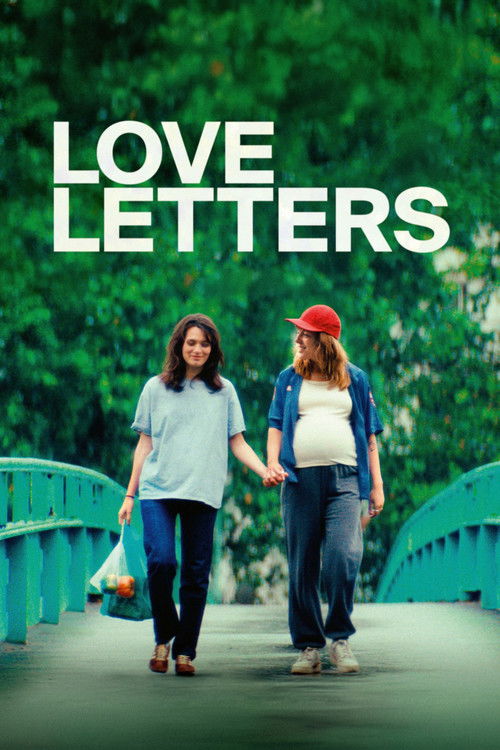
Love Letters
2025 · Alice Douard
For a thoughtful night when you want warmth with substance — a film about family that earns its feelings without wringing them out of you. Gentle enough to be comfort viewing, honest enough to stay with you.
What it's about
Céline is three months from becoming a mother, but she's not the one who's pregnant — her wife Nadia is. Because French law requires Céline to adopt her own daughter, she must gather written testimonials of love from friends and family, proving on paper what she already knows in her body. Around that absurd errand, the film watches a woman search for her place — with her wife, her skeptical mother, and the state.
The experience
Lighter than its subject suggests — closer to a comedy of nerves than a message drama — which is exactly why its emotional moments land so hard. Tender, wry, and quietly devastating in short bursts.
Performances
Ella Rumpf plays Céline with a guarded watchfulness that makes every small crack in her composure count — you can see her rehearsing legitimacy in real time.
The craft
Douard works in the intimate register of contemporary French realism, refusing both militancy and melodrama; the bureaucratic indignity at the story's center becomes a quietly ingenious dramatic engine. Scenes stay loose and lived-in, so the film's arguments arrive as feelings rather than speeches.
Why it matters
A debut that took on a subject French cinema had barely touched — the mother who is not pregnant — and registered what the marriage-equality battle did and didn't settle a decade on.
Alice Douard's debut feature approaches a subject French cinema had barely touched: the mother who is not pregnant. Céline's wife will give birth in three months, and Céline — legally required to prove her fitness to adopt her own daughter — must assemble testimonials of love from friends and family, an administrative indignity the film turns into a quietly devastating dramatic engine. Set a decade after France's bruising battle over marriage equality, it registers how the law can grant recognition and withhold legitimacy in the same gesture. Douard, working in the intimate register of contemporary French realism, refuses both militancy and melodrama; the tone stays light on its feet, closer to a comedy of nerves, which makes its emotional payloads land harder. Ella Rumpf, the Swiss actress who broke through in Raw, plays Céline with a guardedness that thaws in increments — a performance built from listening. The letters of the title accumulate into something like a portrait of a person assembled by the people who love her, a form as moving as it is bureaucratically absurd.
Reception
It opened Cannes Critics' Week in May 2025 to warm reviews (a rare 100% on Rotten Tomatoes) and has spent the year since as a festival-circuit favorite, picking up NewFest's Grand Jury Prize on its way to word-of-mouth queer-canon status.
How Love Letters was received, from release to now →
Influences: the films it descends from and the films it influenced
- Raw (2016) — Established Ella Rumpf's guarded, watchful physicality — the withheld-reaction acting register Douard builds her lead performance around here.
- Two Days, One Night (2014) — Supplies the ticking-procedural engine — a protagonist working through a finite sequence of documentary/administrative steps — and the handheld, present-tense realism that turns paperwork into suspense.
- A Separation (2011) — Model for using a legal/bureaucratic apparatus as the dramatic motor, letting institutional process (not confession) expose the fault lines inside a family.
- Saint Omer (2022) — French antecedent for the listening-based, courtroom-of-recognition mode — long-held reaction shots and the law adjudicating what counts as motherhood.
- Happening (2021) — Contemporary French realism that dramatizes a woman navigating a legal/administrative gauntlet with clinical restraint rather than melodramatic swelling.
- The Kids Are All Right (2010) — Foundational template for the naturalistic queer-family comedy-of-nerves, mining domestic tension for wince-humor instead of issue-drama.
- Tomboy (2011) — French queer domestic realism built on observation and children's/adults' unspoken negotiation, where meaning lands in glances and silences.
- Portrait of a Lady on Fire (2019) — Epistolary-portrait construction and emotional restraint — intimacy rendered through looking, waiting, and withheld gesture rather than declaration.
- Petite Maman (2021) — Sibling in treating non-biological/chosen maternal bonds with hushed tenderness and a formally spare, anti-melodramatic register.
- BPM (120 Beats Per Minute) (2017) — French queer cinema that fuses the intimate and the institutional — bodies and love stories inseparable from law, rights, and collective recognition.
- A Fantastic Woman (2017) — Sibling in following a queer protagonist through bureaucratic and legal dis/recognition, holding on a guarded face that refuses to perform grief for the audience.
- 35 Shots of Rum (2008) — Master-class in the listening-based, near-wordless family portrait where love is conveyed through routine and restraint, the camera patient with quiet.
Similar films
- Petite Maman (2021) — influence & lineage
- Portrait of a Lady on Fire (2019) — influence & lineage
- Tomboy (2011) — influence & lineage
- Young Mothers (2025) — same viewing thread
- The Little Sister (2025) — shared sensibility
- Little Amélie or the Character of Rain (2025) — shared sensibility
- Romería (2025) — shared sensibility
- The Mysterious Gaze of the Flamingo (2025) — shared sensibility
All the films related to Love Letters →
Watch it with: curated runs of related films
- Families Made and Unmade — A run of intimate domestic portraits — watch these together and feel marriages dissolve, mothers improvise, and love keep redrawing the shape of a family across sixty years.