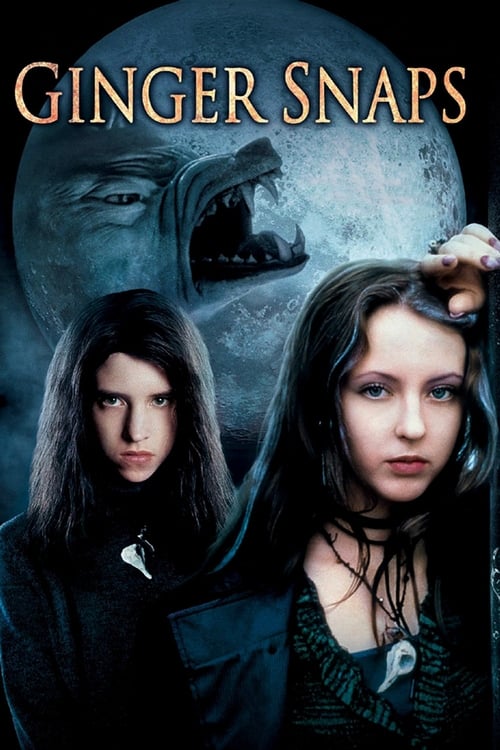
Ginger Snaps
2000 · John Fawcett
For when you're craving a horror movie with an actual brain and bite — dark, funny, and unsettling, best on a night when you want your scares to mean something.
What it's about
Two death-obsessed teenage sisters, inseparable outcasts in a numbingly bland suburb, have a pact against ever becoming normal. Then the elder, Ginger, is savagely attacked by something wild on the night of her first period — and though her wounds heal fast, she begins changing in ways that look a lot like growing up, only with teeth. Her younger sister Brigitte is the only one who sees what's happening, and the only one who might stop it.
The experience
Acerbic, deadpan, and genuinely gnarly — it plays like a razor-tongued teen comedy that keeps tipping into real body horror. The scares are physical and slow-building, but what lingers is the ache of watching two sisters get pulled apart.
Performances
Emily Perkins and Katharine Isabelle are the whole engine as Brigitte and Ginger — a lived-in sisterly bond that makes the deadpan funny and the transformation genuinely tragic.
The craft
Karen Walton's screenplay welds a wickedly quotable teen voice to the werewolf myth, and the film favors gradual, practical-effects transformation over quick spectacle, letting the change register on a body scene by scene. The dead-eyed suburban Ontario setting is shot with just enough gothic chill to make the lawns feel sinister.
Why it matters
A modest Canadian release that grew into a genuine cult classic, it became a foundational text for feminist horror and proof that the werewolf film still had something new to say.
Horror · Werewolf & transformation · Body horror · Teen horror. Deadpan suburban teen comedy that keeps tipping into gnarly practical-effects body horror, with real grief between two sisters underneath.
Snapshot
Ginger Snaps is a Canadian werewolf film that reroutes one of horror's oldest myths through the body of an adolescent girl, making lycanthropy a literal figure for menarche, sexual awakening, and the violence of growing up female in a sedated suburb. Directed by John Fawcett from a screenplay by Karen Walton, it follows the Fitzgerald sisters — death-obsessed, mutually devoted outcasts in the fictional Ontario subdivision of Bailey Downs — after the elder, Ginger, is mauled by a creature on the night of her first period and begins a slow, unmistakably pubertal transformation. What distinguishes the film is not spectacle but tone: a deadpan, acerbic teen sensibility welded to genuine body horror, anchored by two remarkable lead performances. Modest in budget and initially modest in release, it has since become one of the most influential horror films of its era and a foundational text for the feminist-horror conversation of the following two decades.
Industry & production
Ginger Snaps is a product of the Canadian genre-financing ecosystem of the late 1990s, produced by Steven Hoban's Copperheart Entertainment with the involvement of Canadian public funding bodies and tax-credit structures that made English-language genre production viable outside Hollywood. It was a low-budget feature — I do not have a reliably documented exact budget figure and will not invent one — and its economy is legible in its concentrated locations (school, suburban home, streets) and its reliance on practical rather than digital effects.
The most frequently cited fact about the production is its collision with the Columbine High School massacre of April 1999, which occurred while the project was in development or pre-production. A film built around two teenage girls preoccupied with death — who stage elaborate faked-suicide and death tableaux for a school assignment in the opening sequence — became suddenly fraught for financiers and institutions anxious about youth, violence, and schools. This context has been recounted by the filmmakers in later interviews as a real obstacle to getting the film made and is part of the film's origin lore; the picture's unflinching commitment to its morbid teenage worldview reads, in hindsight, as a refusal to sand down that material under pressure.
The film was released in 2000 to a limited theatrical footprint and found its durable audience through festivals, home video, and word of mouth rather than a wide commercial rollout. Its commercial afterlife proved more significant than its initial run, and it generated a small franchise: two follow-ups shot largely back-to-back and released in 2004, Ginger Snaps 2: Unleashed and the period prequel Ginger Snaps Back: The Beginning.
Technology
Shot on 35mm film in the standard practice of its moment, Ginger Snaps is notable less for any novel imaging technology than for its deliberate commitment to practical, prosthetic-driven effects at a time when digital transformation work was increasingly available. The werewolf and the stages of Ginger's mutation — the healing bite, the growth of coarse hair, the emergence of a tail, the graduated deformation toward a full creature in the finale — are realized primarily through makeup, prosthetics, and a physical creature rather than CGI morphing. This choice aligns the film with the tactile lineage of werewolf cinema (the tradition of physical transformation effects that peaked in the early 1980s) and suits both its budget and its thesis: the horror is embodied, glandular, and material, not weightless spectacle. Where the record on the precise effects credits is thin or I am not certain of exact attributions, I flag that rather than guess.
Technique
Cinematography
The photography, by Thom Best, builds a suburban palette that is deliberately drab and autumnal — overcast skies, muted greens and browns, the flat institutional light of high-school corridors — against which blood and transformation register with heightened shock. The visual world of Bailey Downs is one of conformity and beige uniformity, and the camera treats it with a slightly clinical detachment that mirrors the sisters' contempt for it. As Ginger's condition advances, the imagery grows more visceral and bodily in emphasis without abandoning that grounded, unglamorous base register.
Editing
Brett Sullivan's editing balances two modes that the film keeps in tension: a dry, rhythmically comic cutting for the sisters' dialogue and their scornful navigation of school and family, and a more ruptured, escalating construction for the horror beats and the transformation. Sullivan's intimacy with the material is underscored by his later stepping up to direct the first sequel, Ginger Snaps 2: Unleashed.
Mise-en-scène / staging
The film's design leans on the ironic horror of the ordinary. The opening credits sequence — a montage of the Fitzgerald sisters' staged death photographs, elaborate mock suicides and mutilations composed with morbid craft — functions as a mission statement, framing death as the sisters' shared aesthetic project and inoculating the audience against the coming gore with black comedy. Domestic spaces (the cluttered bedroom, the suburban kitchen presided over by an oblivious mother) are staged to emphasize the gulf between the girls' inner world and the manicured normalcy around them. The recurring motif of the sisters' pact — "out by sixteen or dead in this scene, together forever, united against life as we know it" — organizes the staging of their relationship as a closed dyad that the transformation forces apart.
Sound
The score, credited to Michael Shields, supports the film's tonal doubleness rather than announcing itself, moving between wry restraint and dread. As with several technical credits on a film of this scale, the sound design serves the transformation viscerally — the bodily register of the horror — without drawing attention away from performance and dialogue, which remain the film's primary instruments.
Performance
The film lives on its two leads. Katharine Isabelle plays Ginger's arc from sardonic older sister to predatory, sexualized, increasingly monstrous force with a controlled escalation that keeps the character legibly human even as she becomes dangerous; the performance treats lycanthropy as a cruel, intoxicating puberty rather than as simple villainy. Emily Perkins, as the younger and more withdrawn Brigitte, gives the film its aching center — a study in loyalty, dread, and the terror of being left behind by the person you have organized your whole self around. Mimi Rogers, as the relentlessly cheerful, willfully uncomprehending mother, and Kris Lemche, as the local drug dealer Sam who becomes Brigitte's uneasy ally in seeking a cure, provide crucial supporting texture. The sisters' chemistry — the sense of a private language and a shared war against the world — is the load-bearing element the entire premise depends on, and it holds.
Narrative & dramatic mode
Structurally the film is a horror-inflected coming-of-age tragedy built on the mechanics of infection and the ticking clock. The dramatic engine is not "will the monster be defeated" but "can the bond survive the change" — Brigitte's quest for a cure (drawing on the folkloric properties of monkshood/wolfsbane and on Sam's help) races against Ginger's accelerating transformation and her seduction by her own new power. This gives the film a melodramatic core beneath the genre surface: it is about a sister watching another sister become someone she can neither reach nor save, and about the impossibility of the pact they swore as children. The mode is tonally hybrid — caustic teen comedy, body horror, and domestic drama braided together — and its refusal to resolve into pure genre is central to its lasting reputation.
Genre & cycle
Ginger Snaps belongs to the werewolf subgenre but is best understood within two larger cycles: the lineage of puberty-as-horror films descending from Carrie (1976), in which menstruation and emergent female sexuality are figured as monstrous and uncontrollable; and the turn-of-the-millennium revival of self-aware, character-driven teen horror. It arrives after the Scream-era wave of ironic, genre-literate teen horror but pushes past reflexivity into something more sincere and more transgressive. Within werewolf cinema specifically, it stands with the small tradition that reads lycanthropy as female rather than male — an approach whose most important precursor is Neil Jordan and Angela Carter's The Company of Wolves (1984).
Authorship & method
The film is a genuinely dual authorship. John Fawcett (director; co-author of the story) supplies the tonal control and the grounded suburban texture, and would go on to a substantial television career. Karen Walton (screenwriter) is arguably the decisive creative voice: her screenplay is widely credited with the film's sharp, unsentimental dialogue and, crucially, its feminist reframing of the werewolf myth — the insistence that the horror be routed through a specifically female bodily experience and that the sisters be written as complex, funny, and cruel rather than as victims. The collaboration of a male director and a female screenwriter is frequently noted as integral to why the film's gender politics land as lived rather than gawked at. Key collaborators include cinematographer Thom Best, editor Brett Sullivan (later director of the second film), and composer Michael Shields, with producer Steven Hoban shepherding the project and its sequels through Copperheart. The leads Isabelle and Perkins should be counted among the film's authors in practice, given how much its meaning is carried in their performances.
Movement / national cinema
Ginger Snaps is a landmark of English-Canadian genre cinema and is often placed in conversation with the country's distinguished horror tradition — most obviously the "body horror" lineage associated with David Cronenberg, whose preoccupation with the transforming, betraying, biologically unstable body the film clearly inherits and re-genders. It is a product of the Canadian public-financing and tax-credit environment that sustained ambitious low-budget genre work outside Hollywood, and it is regularly cited as one of the best Canadian horror films ever made. Its suburban Ontario setting is not incidental: the film's critique of anesthetized, conformist suburbia is part of its national-cinema texture.
Era / period
The film is very much of the turn of the millennium. It follows the late-1990s reinvigoration of teen horror and its self-conscious, media-literate sensibility, but it channels that energy toward earnestness and transgression rather than pastiche. Its production was shadowed by the specific cultural moment of post-Columbine anxiety about teenagers, death imagery, and schools, which sharpened both the difficulty of making it and the transgressive charge of its content. In retrospect it sits at the threshold of the 2000s, anticipating the decade's appetite for body horror and for horror that takes adolescent female experience seriously.
Themes
The film's central and most-discussed theme is the equation of the werewolf transformation with female puberty: the bite arrives with Ginger's first period, the "curse" is both literal (lycanthropy) and slang (menstruation), and the changes — hair, blood, appetite, aggression, sexual magnetism — map onto adolescence with pointed wit. From this spine radiate several linked concerns: the horror and exhilaration of sexual awakening and the double standard that greets female desire; the terror of bodily change and loss of control over one's own flesh; and, most movingly, the fragility of the sisterly bond under the pressure of one sister "developing" and pulling away. The film also mounts a sardonic critique of suburban conformity and of adults — the mother especially — who cannot or will not see what is happening to their children. Contagion, addiction, and the impossibility of a clean "cure" give the final act its tragic weight.
Reception, canon & influence
Critical reception grew rather than arrived: the film's limited initial release meant its reputation was built through festivals, home video, and cumulative critical reassessment, after which it came to be widely regarded as a modern horror classic and a touchstone of feminist genre filmmaking. Karen Walton's screenplay and the Isabelle–Perkins performances are the elements most consistently singled out.
Influences on the film (backward): the puberty-horror template of Carrie (1976); the female-centered werewolf imagination of The Company of Wolves (1984) and, behind it, Angela Carter's revisionist fairy-tale sensibility; the physical-transformation tradition of earlier werewolf cinema; the Canadian body-horror lineage associated with Cronenberg; and the acidic, death-fixated teen-outsider tone that recalls films like Heathers (1988).
Legacy (forward): Ginger Snaps is now routinely cited as a crucial precursor to the wave of feminist and female-bodied horror that followed — invoked in discussions of Jennifer's Body (2009) and, more broadly, of coming-of-age body horror such as Raw (2016) — and it is a fixture of scholarship and criticism on gender in horror. It spawned two 2004 sequels (Ginger Snaps 2: Unleashed and the prequel Ginger Snaps Back: The Beginning), helped establish the careers of its leads within genre cinema, and remains a reference point whenever critics discuss horror that treats adolescent girlhood as monstrous, powerful, and worthy of serious dramatic attention. Its standing as both a canonical Canadian horror film and an early anchor of the feminist-horror canon is, by now, secure.
Reception
Barely released theatrically and dogged by post-Columbine hand-wringing over its teen-horror premise, it built a slow-burn cult through DVD and word of mouth — and is now routinely canonized as one of the great feminist horror films, name-checked in every 'horror and puberty' conversation since.
How Ginger Snaps was received, from release to now →
How to watch Ginger Snaps: what to notice on a first viewing
- Watch the opening credits' mock death photos. Each photo stages an elaborate mock suicide or mutilation the sisters posed for themselves, treating death as craft and private joke, establishing the tone before any gore arrives. The playful morbidity of the opening tells you how to watch the graphic horror that follows, as their shared language rather than shock for its own sake.
- Notice the drab greens and browns in every scene. Thom Best keeps Bailey Downs overcast and beige, high school corridors lit with flat institutional light, so the whole town looks sedated and uniform. The flatness is contempt made visible, matching how the sisters see the suburb around them.
- Notice the editing rhythm break when horror arrives. Brett Sullivan keeps a dry, comic rhythm for the sisters' scornful banter, then breaks that rhythm into ruptured, escalating cuts once the horror beats start. The edit itself tells you when the joke ends and the danger starts.
- Watch how Ginger's voice changes scene to scene. Katharine Isabelle escalates in careful stages, from sardonic older sister to something more sexualized and dangerous, while Emily Perkins as Brigitte holds a constant, aching watchfulness. The performances carry the transformation more than any effect does; you are watching puberty played as horror.
- Look at the sisters' cluttered bedroom against the tidy kitchen. Fawcett stages the girls' cluttered bedroom as dark and crowded, then cuts to their mother's bright, tidy kitchen, keeping the girls' world visually separate from hers. The house itself shows the gap between what the girls feel and what the adults around them see.
The whole guide to watching Ginger Snaps, with the keys for a rewatch →
Influences: the films it descends from and the films it influenced
- Carrie (1976) — Establishes the template Fawcett/Walton invert — first menstruation as the on-switch for a girl's monstrous power, staged as sympathetic bodily horror rather than as villainy.
- The Company of Wolves (1984) — Codifies the female-authored werewolf as an allegory of menarche and sexual awakening (via Angela Carter), the exact myth-reframing Walton routes through a specifically female body.
- An American Werewolf in London (1981) — Rick Baker's slow, agonizing on-screen prosthetic metamorphosis set the practical-transformation grammar Ginger Snaps borrows — plus the horror-comedy tonal hybrid held in one scene.
- The Howling (1981) — Rob Bottin's practical makeup transformation and the reading of lycanthropy as unleashed primal sexuality feed directly into the film's prosthetic-driven change.
- The Fly (1986) — Charts transformation as a progressive, makeup-tracked degenerative disease mourned by an intimate partner — the Canadian body-horror-as-illness logic behind Ginger's decay.
- Cat People (1982) — Ties involuntary animal metamorphosis to a young woman's first sexual arousal, the pheromonal 'the curse activates when you desire' mechanic Ginger's infection echoes.
- Heathers (1988) — Supplies the acidic, deadpan, death-fixated suburban-teen dialogue register and the cruel-funny outsider duo that Walton's screenplay wields against high-school conformity.
- The Craft (1996) — Converts female adolescent alienation into literal supernatural power inside a drab suburban high school, the outcast-girls-vs-conformity staging Ginger Snaps darkens.
- Valerie and Her Week of Wonders (1970) — Formalizes the genre innovation Valerie prototyped: menarche as the film's actual transformation engine, with the first blood, the body's change and the monstrous becoming placed on a single causal timeline instead of used as metaphor.
- The Wolf Man (1941) — Spreads the bite-borne curse over weeks of gradual physical change instead of one transformation scene, turning Siodmak's idea of contagion as inheritance into a story about puberty.
- Ginger Snaps 2: Unleashed (2004) — Directed by the first film's editor, it extends the transformation-as-addiction metaphor and the same practical-prosthetic escalation, carrying the dual-rhythm cutting forward.
- Jennifer's Body (2009) — The film's acknowledged heir — a female-authored script (Diablo Cody) fusing sardonic teen-girl dialogue with a female friendship literalized as bodily monstrosity and appetite.
- Excision (2012) — Pairs a menstruation-obsessed teenage outsider's body horror with caustic suburban satire and a wounded sister-bond, extending the drab-palette coming-of-age-tragedy structure.
- Raw (2016) — Coming-of-age body horror as an awakening cannibal appetite bound to a sisterly rivalry, using practical gore and gradual transformation to dramatize female adolescence.
- Hatching (2022) — Externalizes a suburban girl's pubescent rage as a practical-effects creature-double under maternal/conformist pressure, continuing the monstrous-adolescence-vs-perfect-suburb template.
- The Ugly Stepsister (2025) — Pioneers reading female adolescence and bodily change as monstrous transformation, fused with acidic genre satire about girls policed by appearance.
- Teeth (2007) — Locates horror in a specifically female pubescent anatomy (vagina dentata) weaponized against suburban conformity, the same body-as-monster-and-defense inversion.
- When Animals Dream (2014) — A near-direct female-werewolf reprise — lycanthropy as menarche in a naturalist, muted-palette social-realist key, foregrounding the girl's dawning bodily change.
- Thelma (2017) — Frames a repressed girl's emerging supernatural power as inseparable from her awakening desire and body, the puberty-as-uncontrollable-force lineage in a restrained register.
- Lisa Frankenstein (2024) — Ancestor in fusing female adolescence with body-horror metaphor — the monstrous-feminine as coming-of-age text — that Cody's teen-horror mode descends from.
Similar films
- Jennifer's Body (2009) — influence & lineage · same viewing thread
- An American Werewolf in London (1981) — influence & lineage · same viewing thread
- Excision (2012) — influence & lineage · same viewing thread
- The Craft (1996) — influence & lineage
- Carrie (1976) — influence & lineage
- The Ugly Stepsister (2025) — same viewing thread
- Raw (2017) — same viewing thread
- May (2003) — same viewing thread
All the films related to Ginger Snaps →
Watch it with: curated runs of related films
- Flesh, Beauty, and Bloody Becoming — A run of films where a woman's body turns monstrous under the pressure of being perfect, desired, or 'normal'. They rhyme on surgery, hunger, puberty and performance as kinds of transformation horror.
- Growing Up Is the Monster — Watch these together for horror where adolescence is the curse: a werewolf bite that arrives with puberty, a cheerleader who comes back hungry, a thing that follows you after sex, a possession game played for social media, and childhood evils the kids have to face themselves.
- Monsters, Misfits and Their Makers — A run from Universal's and Hammer's gothic monsters through the films that grew out of them, best watched near each other for how the creature keeps turning out lonelier, stranger and more human than the people chasing it.