The Craft
1996 · Andrew Fleming
For when you want gothic teen-movie comfort with real bite — a sleepover classic that's also about power, jealousy, and what it costs to be an outsider. Nostalgic if you grew up with it, surprisingly sharp if you didn't.
What it's about
A new girl at a Los Angeles Catholic school falls in with three outcasts who've been dabbling in ritual magic without results — until she completes the circle and their spells start working. Each girl wishes for exactly what she lacks: beauty, love, revenge, escape. Then the wishes start coming back with interest, and the friendship that made them powerful begins to curdle.
The experience
Half hangout movie, half slow-building dread — the early stretch is intoxicating best-friend energy, and the back half tightens into something genuinely menacing. It takes teenage rage and longing completely seriously, which is why it stings.
Performances
Fairuza Balk is the reason the film is legend — her Nancy goes from wounded outcast to something feral and frightening, one of the great unhinged teen-movie turns. Robin Tunney anchors it as the newcomer with more power than she wants.
The craft
Unusually for a studio occult picture, the magic is treated with procedural respect — circles cast, quarters called, consequences honored — which grounds the fantasy in something that feels practiced rather than special-effects-driven. The mid-90s gothic styling, all slip dresses and rosaries, is a whole aesthetic in itself.
Why it matters
A modest 1996 studio bet that became one of the decade's most durable teen-culture artifacts — it sent a generation to the occult section of the bookstore and shaped how movies have depicted teen witchcraft ever since.
Snapshot
The Craft is a mid-budget Columbia Pictures horror film released in May 1996 that turned a modest studio genre bet into one of the most durable teen-culture artifacts of the decade. Four girls at a Los Angeles Catholic school — a new arrival with inherited power, and three outcasts who have been performing rituals without results — discover that together they can actually make things happen. The film's engine is wish fulfillment curdling: each girl gets exactly what she asks for (beauty, love, revenge, safety), and each wish returns with interest.
What makes the film unusual is the seriousness of its texture. Where most Hollywood occult pictures treat magic as a special-effects delivery system, The Craft is procedurally specific about Wiccan practice — casting the circle, calling the four quarters, invoking a deity, the threefold law of return — because it retained a practicing Wiccan consultant, Pat Devin, of the Covenant of the Goddess. The deity the girls invoke, Manon, is an invention supplied precisely so the production would not put a real god's name in a horror film. That combination of studio gloss and ritual literacy is why the film was adopted so completely by an audience of teenage girls, and why it is now routinely cited in scholarship on the late-1990s growth of teenage Wicca.
It is also a film with a conservative spine underneath a rebellious surface — a tension that has kept it arguable for thirty years.
Industry & production
The Craft was produced by Douglas Wick for Columbia Pictures, from a story by Peter Filardi and a screenplay credited to Filardi and director Andrew Fleming. Filardi had written Flatliners (1990), and the family resemblance is clear: young people transgress a metaphysical boundary as a group, and the boundary transgresses back, individually. Wick, whose credits ran from Working Girl (1988) to Wolf (1994), was a producer comfortable with genre material carrying an adult concept.
Fleming was an unusual choice and a logical one. He had made the slasher-adjacent Bad Dreams (1988) — so he had horror mechanics — and then the campus sex comedy Threesome (1994), which gave him a track record with young ensembles and with the specific problem of three or four people sharing one emotional weather system. He would go on to Dick (1999) and Hamlet 2 (2008), and the comic timing visible in those films is already present here in the film's willingness to let the girls be funny.
The picture was made at a mid-range studio budget and released 3 May 1996, opening at number one in the United States. Commonly cited figures put its domestic theatrical gross in the mid-twenty-millions — a solid but unspectacular result that badly understates its actual commercial life. Like The Crow (1994) and Heathers (1989) before it, The Craft did its real business on home video and cable, where it was consumed repeatedly rather than once. Detailed production documentation is comparatively thin; most of what is on record comes from anniversary retrospectives and cast interviews given long after the fact rather than from contemporaneous accounts.
The marketing leaned on a soundtrack album in the model established by Singles (1992) and The Crow: an alternative-rock compilation functioning as both promotion and A&R. Its most consequential track was Love Spit Love's cover of the Smiths' "How Soon Is Now?" — a song that would be lifted almost immediately as the theme for Charmed (1998), one of the clearest lines of transmission from this film to what followed. Letters to Cleo, Our Lady Peace, and Sponge also contributed; the full track list is a period document of 1996 alternative radio.
Technology
The Craft sits precisely on the hinge between practical and digital effects. Released five years after Terminator 2 normalized morphing and two years after The Mask, it had access to digital compositing but no budget or inclination to build its spectacle from it. The result is a film whose supernatural events are mostly achieved in front of the camera: real snakes, real insects, wirework, rigged sets, prosthetic and appliance makeup, and above all editing and sound.
Digital work is used sparingly and surgically — for transformations that cannot be staged (the glamours that alter hair and skin, the swarm sequences, elements of the levitation and the final confrontation) and for cleanup around wire rigs. This restraint has aged extraordinarily well. The mid-90s films that leaned hardest on early CGI now look dated in a way that dates the whole picture; The Craft's reliance on physical horror — things crawling on actual bodies — keeps its worst moments viscerally effective.
The film's distribution history is itself a technology story. Released ten months before DVD reached the American market, it built its first audience on VHS and repeat cable airings, then found a second one on DVD, and a third on streaming and social media. Each format shift widened rather than replaced the audience.
Technique
Cinematography
Alexander Gruszynski, who had shot Tremors (1990) and Threesome for Fleming, photographs the film flat (1.85:1) in two distinct registers. The Catholic-school daylight is bright, clean, and slightly flattened — uniform plaid and fluorescent institutional light, a world of enforced sameness that the camera treats as unremarkable. The ritual and horror material goes the other way entirely: heavy blue and green gels, atmospheric smoke, low and raking key light, and a palette that drains toward monochrome as the coven's power grows. The beach invocation is shot with the sky doing most of the work, using natural gloom rather than staged darkness.
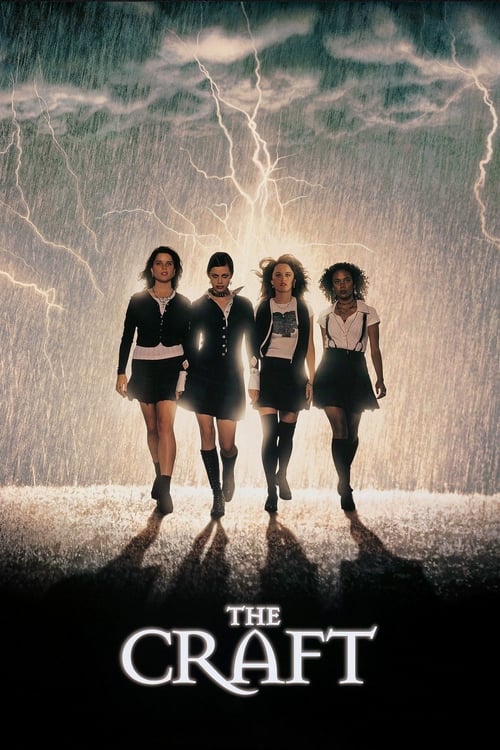
The most reproduced image in the film — the four girls walking abreast down a corridor or a street in slow motion, coats moving, camera tracking — is a piece of straightforward, confident studio craft that has been quoted so widely in film, television, music video, and advertising that its origin is often forgotten.
Editing
Jeff Freeman cuts the film for accumulation. The first act is patient, almost a school drama; the middle section moves into montage as the spells begin to work, compressing weeks of transformation into a rhythm set by the soundtrack; the last act accelerates into rapid, disorienting intercutting as Sarah's house becomes a hostile space. The film's most economical trick is its handling of consequence: a spell is cast, the film cuts away, and the result arrives later in an ordinary scene without an effects flourish. The horror is delayed and deadpan.
Mise-en-scène / staging
The production design does an enormous amount of characterization. Nancy's trailer-park home, with its water-damaged ceiling and abusive stepfather, is set against Sarah's comfortable middle-class house; the school uniform is the great leveler the girls each deform in a personal direction. Costume tracks power directly — as the coven consolidates, the girls' clothes darken, tighten, and converge, and Nancy's transformation is signaled almost entirely through hair, makeup, and silhouette before any effect appears on screen.
The film's iconography is deliberately practitioner-accurate: an athame, candles at the four quarters, a physical circle drawn on the ground, offerings. This is the Devin contribution, and it registers as authority even to viewers who could not name any of it.
Sound
Graeme Revell's score is the film's most underrated element. Revell came out of the Australian–New Zealand industrial group SPK, and he brings that background here: wordless female choral lines, processed and layered vocals, metallic percussion, and drones that sit low under dialogue. It is closer to his work on The Crow (1994) and Strange Days (1995) than to conventional horror scoring, and it gives the ritual sequences a religious weight rather than a spooky one. Around the score, the sound design works in textures — insects, wingbeats, wind, the specific dry rattle of snakes — that carry effects the image only implies.
Performance
Fairuza Balk's Nancy Downs is the performance the film is remembered for, and it is genuinely strange: Balk plays escalation not as villainy but as intoxication, with a jagged physicality and vocal register that keeps tipping between glee and grievance. She had been Dorothy in Return to Oz (1985) as a child, and there is something of that film's unsettled quality in her. Robin Tunney plays Sarah as a deliberately recessive center — watchful, guarded, marked by a suicide attempt the film treats without sentiment. Neve Campbell's Bonnie and Rachel True's Rochelle are given less room but both find specificity: Bonnie's transformation from concealment to exhibition, Rochelle's exhausted composure under racist harassment. Campbell and Skeet Ulrich would both move directly from this film into Scream seven months later.
Narrative & dramatic mode
Structurally this is a group-transgression tragedy in the Flatliners mold, but its emotional grammar is that of a friendship film. The genuine pleasure of the first half — four lonely girls finding each other — is what makes the second half hurt. The film is careful to make each wish sympathetic before making it monstrous: Rochelle wants a racist tormentor to stop; Bonnie wants to stop hiding scarred skin; Nancy wants out of a violent home; Sarah wants a boy to like her. None of these is a sin. The film's cruelty is that the mechanism, not the motive, is what corrupts.
The love spell is the sharpest of these. Chris, magically compelled to want Sarah, becomes obsessive and then attempts to assault her — the film making the consent logic of the love spell explicit and refusing the genre's usual romantic cover for it. That the film then has Nancy kill him complicates rather than resolves the point.
The ending is where the film divides its audience. Sarah binds Nancy, who ends institutionalized and raving, and the social order of the school is restored with Sarah in possession of power she was born to. It is a resolution that punishes the poorest and angriest girl most severely, and hands authority to the one who inherited it. Whether the film knows this is the central interpretive question about it.
Genre & cycle
The Craft arrived in a gap. The slasher cycle had exhausted itself; the post-Scream teen-horror boom was still seven months away. The film belongs instead to a mid-90s teen-gothic strain running alongside the teen-comedy revival of Clueless (1995), sharing that revival's attention to cliques, costume, and social ranking but reading them through horror. Its immediate genre ancestors are the high-school-revenge supernatural film and the coven film, and it functions as a hinge between them.
Its commercial success also helped demonstrate, ahead of Scream, that teenage audiences — specifically teenage girls — would turn out for horror in numbers. That lesson was learned industry-wide over the following three years.
Authorship & method
Fleming's method here is fundamentally that of a character director working in genre. He gives the ensemble long stretches of low-stakes interaction before deploying any horror, and lets the actors play comedy — "we are the weirdos, mister," delivered to a nervous bus driver, is a line of dialogue that has outlived most of the film's set pieces. His collaboration with Gruszynski, carried over from Threesome, produces a picture that looks like a studio teen film until it decides not to.
The decisive authorial choice, though, was structural rather than stylistic: hiring Pat Devin as consultant and building the rituals to her specifications. Fairuza Balk's own connection to occult practice — she became the owner of a Los Angeles occult shop around this period — reinforced the film's texture from inside the cast. Revell's score and the soundtrack supervision complete the authorship: the film's identity is as much sonic as visual.
Movement / national cinema
This is American studio filmmaking of a kind that has since largely disappeared — a mid-budget, star-free genre picture, made for adults' money and teenagers' attention, sold on concept and soundtrack rather than IP. Sony/Columbia's willingness in 1996 to make an original occult drama at this scale reflects a mid-90s equilibrium in which video and cable revenue made moderate theatrical performance sustainable. The equivalent film today would be a streaming release or a Blumhouse micro-budget.
Era / period
The Craft is legible as a 1996 document in almost every register: post-grunge alternative rock as the default youth soundtrack; MTV-era montage grammar; a resurgent interest in the occult and New Age practice in American popular culture; and a media environment newly attentive to girls' anger, inflected by riot grrrl and by the moral panic literature about teenage alienation. It is also pre-internet in a way that now reads as historical — the girls find their knowledge in a bookshop and from an older woman, not online.
Themes
Power and its distribution is the film's true subject. Magic here is a redistribution mechanism: it gives power to four people the school has organized itself to deny it to, along axes of class (Nancy), race (Rochelle), body (Bonnie), and gender (all four). The film is unusually direct about the racism Rochelle faces, staging it as ordinary and repeated rather than exceptional.
Against this runs the theme of consent — the love spell, the glamours, the binding — and the question of what one is entitled to do to another person's mind. The threefold law functions as the film's moral physics, and the film applies it unevenly, which is either a flaw or a critique of how consequence actually falls on the poor.
Finally, friendship as a form of power and betrayal as its inverse. The coven is a found family; its collapse is staged as a breakup, not a monster reveal.
Reception, canon & influence
Contemporary reviews were mixed to moderately positive, with widespread agreement that Balk was the standout and frequent complaints that the last act traded character for effects. It was not treated as a significant film in 1996.
Its backward influences are legible. Carrie (1976) is the load-bearing ancestor — telekinesis as adolescent rage, the school as arena, the collapse of a house at the climax. Heathers (1989) supplies the clique-as-conspiracy structure and the tonal license to be funny about cruelty. Rosemary's Baby (1968) underwrites the treatment of the occult as bureaucratically ordinary. Heavenly Creatures (1994) is the nearest recent relative for the intensity of a shared invented world between girls. The 1978 television film The Initiation of Sarah is a striking antecedent — a telekinetic outsider named Sarah, a rival clique, an older mentor — though it is best described as an antecedent rather than a demonstrated source. The witch-as-glamour tradition of I Married a Witch (1942) and Bell, Book and Candle (1958) survives in the film's love-spell material, inverted into horror.
Forward, the film's footprint is very large. Buffy the Vampire Slayer (from 1997) shares its premise that high school is where the supernatural and the social meet, and developed its own witch material across seven seasons. Charmed (1998) took the film's coven-as-sisterhood template and its soundtrack's signature song outright. Practical Magic (1998), Jawbreaker (1999), The Covenant (2006, a male-cast restaging), and eventually The Chilling Adventures of Sabrina (2018) all descend from it. The corridor walk has become stock visual grammar. A continuation, The Craft: Legacy, directed by Zoe Lister-Jones, arrived in 2020 with Balk appearing at its close.
Beyond film, its most remarkable legacy is real: the film is regularly credited by practitioners and by scholars — notably Helen Berger and Douglas Ezzy's Teenage Witches (2007) — as a significant entry point for a generation of young people into Wicca and contemporary paganism, an effect the Devin consultancy made possible. The film's aesthetic returned again through 2010s internet witch culture.
Its critical standing has also been revised on grounds of race. Rachel True has spoken publicly about being excluded from convention and press appearances associated with the film for years, and that account has reframed how the picture's treatment of Rochelle — both onscreen and in the industry around it — is discussed. That reassessment is now part of the film's record, and belongs in any serious account of it.
Reception
Critics in '96 shrugged it off as teen-horror fluff even as it opened at #1 and became a sleeper hit; decades later it's been fully reclaimed as a foundational goth-girl text, with the 2020 sequel only confirming the original's cult standing.
How The Craft was received, from release to now →
How to watch The Craft: what to notice on a first viewing
- Watch the four girls walk in slow motion, coats swinging. Fleming and Gruszynski track the coven abreast down hallways and streets in slow motion, coats moving as one, an image the film returns to as their bond grows. The synchronized walk shows four outcasts becoming a single body, power made visible before any spell is shown.
- Notice the light turn blue and green during rituals. Gruszynski keeps the Catholic school flat and bright, then floods ritual and horror scenes with blue and green gels, smoke, and low raking light as the coven's power grows. The color shift tracks how far each ritual pulls the girls from the ordinary, daylight world of school.
- Listen for wordless female voices under the ritual scenes. Graeme Revell layers processed vocals, metallic percussion, and low drones under the rituals, giving them a religious weight instead of a conventional horror sting. The score treats the coven's magic as devotion, not spectacle, matching the film's practitioner accurate rituals.
- Track how the girls' clothes change as the coven grows. Each girl deforms the plain school uniform her own way, and as the four consolidate into one coven, their clothes darken, tighten, and start to match. Costume becomes the visible record of belonging and how much power each girl has taken on.
- Watch Fairuza Balk's face when Nancy's spells start working. Balk plays Nancy's rising power as intoxication rather than menace, tipping between glee and grievance instead of settling into a villain's calm. It keeps Nancy sympathetic even as she goes furthest, so what happens to her reads as loss rather than punishment.
The whole guide to watching The Craft, with the keys for a rewatch →
Influences: the films it descends from and the films it influenced
- Carrie (1976) — De Palma fixed the editing grammar of telekinesis — cut to the object, cut to the girl's held stare, then the delayed consequence — which is precisely The Craft's cutaway rhythm, right down to closing on a house coming apart around its inhabitant.
- Rosemary's Baby (1968) — Polanski plays occult practice as neighborly bureaucracy — herbs, house calls, paperwork-adjacent favors — establishing the register that licenses The Craft to stage invocation as ordinary procedure rather than spectacle.
- The Wicker Man (1973) — Shaffer and Hardy built ceremony from documented folk-ritual sources instead of invented movie occultism, the direct precedent for Fleming hiring Pat Devin and shooting the calling of the four watchtowers to a practitioner's specification.
- Suspiria (1977) — Argento and Tovoli made saturated gel light the signature of a coven's presence; Gruszynski's blue-green ritual gels are that scheme cooled down and smuggled into a studio teen picture.
- The Initiation of Sarah (1978) — A near-blueprint telefilm — telekinetic outsider named Sarah, rival house of girls, older initiating mentor, ritual reversal at the climax — supplying the structural furniture The Craft rearranges.
- Bell, Book and Candle (1958) — Supplies the love spell as a discrete staged set piece (candle, personal object, murmured incantation, immediate infatuation); The Craft preserves the staging exactly and inverts its outcome into a study of violated consent.
- Heathers (1989) — Lehmann and Waters index clique rank through color-coded costume and let cruelty carry comic timing — the model for The Craft's escalating uniform customization and its long comic first act.
- Heavenly Creatures (1994) — Jackson shoots two girls' shared invented world with full subjective conviction, the camera adopting the fantasy rather than framing it as pathology — the permission that lets The Craft's rituals be played straight instead of ironized.
- Reservoir Dogs (1992) — The slow-motion line-abreast walk cut to a needle-drop, a device for converting a group into an icon of itself, is what The Craft repurposes for the corridor walk that became stock teen-film grammar.
- The Crow (1994) — Graeme Revell's orchestral-industrial score paired with a chart-driving alt-rock compilation established the two-track sonic authorship — score and soundtrack album as co-equal instruments — that Revell and the music supervision run again here.
- Threesome (1994) — The immediate Fleming–Gruszynski unit: long low-stakes ensemble scenes inside a closed friend group, shot warm and roving, which The Craft reproduces wholesale before the palette turns cold.
- The Lost Boys (1987) — Inherits the package rather than the plot — costume and styling as legible subculture membership, plus a soundtrack album of licensed alt-rock cut as montage, the marketing-and-scoring hybrid The Lost Boys proved could outsell the film.
- Buffy the Vampire Slayer (1997) — Takes the school corridor as the arena where the supernatural and the social collide, and extends the ritual-as-procedure staging into Willow's spellwork — circle, ingredients, spoken invocation shot literally — across seven seasons.
- Charmed (1998) — Adopts the coven-as-sisterhood unit and the Book-of-Shadows prop logic outright, and lifts Love Spit Love's 'How Soon Is Now?' straight off The Craft's soundtrack as its theme.
- Practical Magic (1998) — Rebuilds the love spell as narrative engine and keeps the curdling structure — wish granted, consequence returning — while relocating the ritual to a kitchen table shot with the same ingredient-by-ingredient literalism.
- Jawbreaker (1999) — Restages the slow-motion four-abreast walk to a needle-drop as a title-sequence signature, importing the clique-as-conspiracy structure and costume-as-rank index intact.
- The Covenant (2006) — A male-cast restaging that retains the gel-lit ritual palette and the mechanic of power exacting an escalating physical cost on whichever member overuses it.
- The Craft: Legacy (2020) — Direct continuation preserving the four-cornered circle, the compass-point invocation and costume-as-power index, and closing by returning Balk's Nancy in person.
- Ginger Snaps (2000) — Converts female adolescent alienation into literal supernatural power inside a drab suburban high school, the outcast-girls-vs-conformity staging Ginger Snaps darkens.
- Jennifer's Body (2009) — Supplies the pop-soundtrack-scored teen-girl occult clique that maps high-school social hierarchy onto supernatural power, the small-town-Americana staging Kusama inherits.
- Talk to Me (2023) — Ritual as adolescent social capital: the object confers status, the circle polices who gets to hold it, and the outsider's escalation is a bid for belonging rather than for power.
- The Love Witch (2016) — Biller researched actual Wiccan and Thelemic practice to build her ritual iconography, as Devin did for Fleming, and constructs the entire film around The Craft's unresolved question of what a love spell does to consent.
Similar films
- Carrie (1976) — influence & lineage
- Heathers (1989) — influence & lineage
- Suspiria (1977) — influence & lineage
- Jennifer's Body (2009) — shared sensibility
- The Virgin Suicides (2000) — shared sensibility
- The Exorcist (1973) — shared sensibility
- Ginger Snaps (2000) — shared sensibility
- Incantation (2022) — shared sensibility