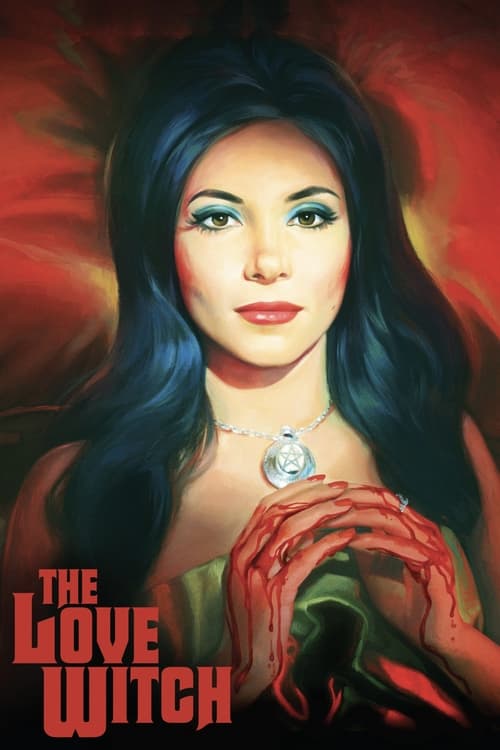
The Love Witch
2016 · Anna Biller
When you want something gorgeous and strange to sink into — a film to chew on for days, best approached as a mood piece rather than a thrill ride.
What it's about
Elaine, a beautiful young witch recovering from her husband's death, moves to a small Northern California town with one goal: to be loved. She brews potions, performs rituals, and constructs herself into every man's fantasy — and it works, catastrophically. The men who fall for her are undone by the force of their own need, and bodies begin to accumulate alongside the bouquets.
The experience
Hypnotic and deliberately artificial — a candy-colored dream that drifts at its own unhurried pace, veering between deadpan comedy, genuine unease, and moments of real sadness. It's funny and poisonous at once, and it lingers.
Performances
Samantha Robinson plays Elaine with an eerie, mask-like poise that is the film's whole hypnotic effect — you can never quite tell where the performance of femininity ends and the person begins.
The craft
Anna Biller wrote, directed, produced, and edited the film, and also designed its sets and costumes — a nearly single-handed recreation of lush 1960s Technicolor melodrama, shot on 35mm with painted backdrops, hand-sewn gowns, and ravishing color. Every frame is composed like a vintage postcard; it's one of the most purely beautiful films of its decade and rewards the biggest, richest screen you have.
Why it matters
An instant cult object that put Biller's total-authorship method on the map and became a touchstone for conversations about femininity, fantasy, and style as substance in modern genre film.
Snapshot
The Love Witch is Anna Biller's second feature. It is a horror-comedy about Elaine Parks (Samantha Robinson), a young witch who, after the death of her husband, drives from San Francisco to a small Northern California town. There she uses potions, rituals and a carefully built appearance to make men fall in love with her. Each one is overwhelmed by the emotional need she draws out of him, and the men start dying. On its surface the film is a meticulous recreation of late-1960s and early-1970s Technicolor-style melodrama and low-budget occult cinema. Underneath, it is a feminist study of how women learn to perform male fantasy and what that performance costs. Biller wrote, directed, produced and edited the film, designed its sets and costumes, and wrote part of the score. That makes it one of the most fully single-authored American features of its decade. It premiered at the International Film Festival Rotterdam in early 2016, was released in the United States by Oscilloscope Laboratories that November, and has since become a cult object. Its look became a reference point in fashion, online aesthetics and the revival of witch-themed horror that ran through the late 2010s.
Industry & production
The film was independently financed and made outside any studio system. Biller has described a long production process, measured in years rather than months, mostly because she made so many of the physical elements herself. Costumes, props and set dressing were produced by hand under her direction. The best-known example is the pentagram rug in Elaine's apartment, which Biller hooked herself. The production's exact budget has not been reliably documented in public, so this account gives no figure.
Most of the film was shot in Northern California, around Humboldt County (Eureka and Arcata), with other work in the Los Angeles area. A Victorian tea room, a burlesque club, a professor's woodland cottage and a Renaissance-faire style gathering are among the settings. Each was dressed to look like a version of the past that never quite existed, rather than a specific period.
Distribution followed the standard path for an American art-house title. The film played on the festival circuit through 2016 (Rotterdam, then further festivals including AFI Fest), went to a limited theatrical release through Oscilloscope, and then reached home video and streaming. That later afterlife is where much of its audience found it.
Technology
The film's technical identity rests on Biller's refusal to shoot digitally. The Love Witch was shot on 35mm film by cinematographer M. David Mullen, ASC. Biller insisted on photochemical origination, and she and Mullen have both discussed in interviews how much that mattered to the look: the grain, the colour separation and the way skin tones and saturated fabrics behave on negative stock. The film was also distributed in 35mm prints for some exhibitions, which was rare for a new independent release in 2016, when digital projection dominated.
The aim was not to use an obsolete process. Three-strip Technicolor dye-transfer printing was no longer available as an origination route. Instead, the aim was to approximate the impression of mid-century Technicolor through lighting, production design and colour choices on modern stock. Strong, often hard key lighting, coloured gels used for specific dramatic beats, and highly saturated costumes and sets all worked toward that goal. Driving scenes use rear projection, a deliberately old-fashioned technique that marks the film's artifice openly instead of hiding it.
Technique
Cinematography
Mullen's photography follows the lighting conventions of classical Hollywood and 1960s European genre cinema rather than contemporary naturalism. Faces, especially Robinson's, are modelled with glamour lighting: a strong key, controlled fill, and an emphasis on the eyes and on heavy, theatrical eye makeup. Coloured light shows up for moments of magic or heightened emotion, and Elaine is sometimes bathed in a single hue during rituals or seductions. This echoes the expressive colour of Italian gothic horror and of Hitchcock's colour films.
Compositions are usually frontal and formally balanced, framing Elaine as an image to be looked at. This is the film's main argument carried out in camera style. The camera often adopts the male gaze that the narrative takes apart, so viewers are put in the same position as the men Elaine seduces. Exteriors, especially the forest scenes around Wayne's cabin and the sunlit open-air gatherings, use bright, almost postcard-like daylight. The goal is a storybook quality rather than menace.
Editing
Biller edited the film herself, and the cutting follows classical continuity with an unhurried pace. Many scenes run long on purpose. Conversations play out in full, with stiff exchanges of dialogue, and the editing rarely uses the compression or rapid cutting typical of contemporary horror. This patience is central to the film's tone: it makes the melodrama and the comedy register together, since the audience is given time to notice how artificial the conventions are. The running time, close to two hours, was one of the points critics most often raised about the film. Some found the length indulgent; others saw it as essential to the immersive, slightly hypnotic effect.
Montage is mostly reserved for ritual and fantasy sequences, where dissolves and superimpositions recall the optical effects of 1960s occult films.
Mise-en-scène / staging
Production design is the film's most celebrated feature, and almost all of it is Biller's own. Elaine's apartment is a gallery of occult kitsch: tarot imagery, candles, painted murals and the handmade pentagram rug. The Victorian tea room, done in pinks and pastels and populated only by women in hats and gloves, is one of the film's defining images. It is a space of feminine ritual that the film treats with affection and with irony at once.
Costume is part of the storytelling. Elaine's wardrobe of saturated dresses, lingerie, capes and wigs is presented as a deliberate set of tools, chosen to match each man's fantasy. Contemporary objects (cars, mobile phones) sit alongside period-styled décor without comment. The film is never quite set in the 1960s or 1970s. It takes place in a present that looks like a past, which unsettles any easy reading of it as pastiche.
Staging is often tableau-like. Actors are posed within the frame and frequently face the camera or one another in frontal arrangements, which supports the film's references to stage melodrama and to the stylised blocking of older genre cinema.
Sound
The soundtrack mixes original music by Biller with licensed cues from older Italian film scores, including work by Ennio Morricone. Bringing in existing genre music ties the film directly to the European horror and erotic-thriller traditions it draws on. The music is lush and romantic, often in counterpoint with the deadly events on screen. Organ, harpsichord and choral textures carry an occult, ceremonial tone during ritual sequences.
Dialogue is delivered with a clarity and formality that recall dubbed or post-synchronised European genre films and studio-era Hollywood line readings. How much of the dialogue was re-recorded in post-production is not well documented in public sources. Either way, the effect of a slightly detached, presentational vocal track is clearly intended.
Performance
The acting is pitched in a deliberately stylised register, and this has been both the film's most praised and most debated feature. Samantha Robinson's Elaine is the centre of the film: poised, softly spoken, theatrically seductive, and in her direct-address voiceovers both naïve and chilling. Robinson plays Elaine's beliefs about love and men with complete sincerity, never winking at the audience. That sincerity is what lets the film's satire work without turning her into a joke.
The supporting cast plays in a similar heightened key: Laura Waddell as Trish, the friend whose marriage Elaine disrupts; Gian Keys as Griff, the detective investigating the deaths; Jeffrey Vincent Parise as Wayne, the literature professor who is Elaine's first victim in town; Robert Seeley as Trish's husband Richard; and Jared Sanford as Gahan, leader of Elaine's coven. Biller has said she wanted performances modelled on classical Hollywood and 1960s genre acting rather than modern naturalism. The resulting stiffness, which some first-time viewers mistake for amateurism, is a conscious formal choice.
Narrative & dramatic mode
The story is episodic, built around a series of seductions. Elaine arrives in town, settles into an apartment owned by a friend from her coven, and goes after men in sequence: first Wayne, then Richard, then Griff. With each, the pattern repeats. Magic and seduction produce intense attachment, and the man's resulting emotional collapse (his "weakness," in the film's sour joke) leads to his death or destruction. Running alongside this is Griff's police investigation, which shifts toward romance as Elaine targets him and he begins to see her as both suspect and partner.
The dramatic mode is a hybrid of melodrama, horror and satire. The film treats Elaine's inner life, revealed through voiceover and flashback, with genuine seriousness. Fragments of her past include her father's emotional cruelty, her marriage, and the death of her husband, Jerry, which the film suggests she caused. At the same time the film puts her worldview on display for the audience to examine. This double register is what makes the film distinctive. It is neither straight parody nor straight homage. It is a melodrama that knows its own conventions are worth questioning, and still feels their emotional pull.
The climax brings the film's fantasies of romance together. A staged mock wedding at a Renaissance-style gathering, followed by the threat of a mob and Elaine's final, violent act against Griff, push the romantic fantasy to its end point. In the closing moments Elaine withdraws into a fantasy image of the love she has pursued throughout.
Genre & cycle
The Love Witch belongs to several overlapping traditions. Most directly, it revives the occult and witchcraft film of the late 1960s and early 1970s. That cycle included explicitly feminist or semi-feminist low-budget works like George A. Romero's Season of the Witch (1972), a wave of exploitation films about covens and sex magic, and, more distantly, the studio version of the witch-as-romantic-figure in Bell, Book and Candle (1958). It also draws on Technicolor melodrama, the erotic thriller and the gothic.
In its moment, the film was part of a broader renewal of witchcraft as a subject in horror and art cinema. Robert Eggers's The Witch (2015) appeared the previous year, and later titles such as Luca Guadagnino's Suspiria remake (2018) continued the trend. The Love Witch stands apart in that cycle through its comedy, its explicit focus on gender performance, and its retro surface. In that last respect it aligns with an equally strong tendency of 2010s cinema: the knowingly retro, archive-literate genre film.
Authorship & method
Anna Biller's control of the film is close to total. Besides writing, directing, producing and editing, she was production designer and costume designer, and she wrote original music for the score. This concentration of roles shapes the film's coherence. Every object, garment and line of dialogue comes from a single sensibility, and Biller has been outspoken that she sees craft and handmade objects as central to her authorship.
Biller trained as an artist (at UCLA and CalArts) before turning to film. Her earlier work already explored the same themes through retro forms: the short A Visit from the Incubus (2001), a horror-western musical, and her first feature, Viva (2007), a pastiche of 1970s sexploitation set during the sexual revolution, in which Biller herself played the lead. Taken together, these works show a consistent method. She reconstructs historical film styles in fine detail and uses them to investigate female sexuality, desire and how women are shown on screen. In her writing and interviews, Biller has repeatedly distinguished her approach from ironic pastiche. She has argued that she takes the forms seriously and uses them because they offer a language for women's inner lives that contemporary naturalism lacks.
Key collaborators:
- M. David Mullen, ASC (cinematographer) brought deep technical knowledge of film stocks and classical lighting, which made the Technicolor-inspired look possible on modern 35mm.
- Ennio Morricone (via licensed cues) and other Italian genre composers supplied part of the score, alongside Biller's original compositions.
- Samantha Robinson, in the lead role, is effectively a central creative collaborator. Her performance is widely seen as essential to the film's success.
Biller has since published a novel, Bluebeard's Castle (2022), which continues her interest in gothic romance and the dangers of heterosexual love from a woman's perspective.
Movement / national cinema
The film belongs to American independent cinema, but not to any of its dominant 2010s modes, such as mumblecore, prestige indie drama or "elevated horror." It sits in a smaller strand of American filmmaking defined by a strongly authored, artisanal approach to genre and by close engagement with film history. Biller's work is related in spirit to feminist experimental filmmaking and to theoretical writing on the gaze, most obviously Laura Mulvey's argument about visual pleasure in narrative cinema. The difference is that Biller works through popular genre forms rather than against them.
Its formal reference points are largely European as well as American. It draws on Italian gothic horror and giallo colour, on the erotic and occult films of 1960s and 1970s European exploitation cinema, and on Jacques Demy's saturated musical melodramas. The result is an American film made in a transnational visual idiom.
Era / period
The film was made in the mid-2010s and released in November 2016, the same month as the U.S. presidential election. That timing shaped some of the early critical discussion of its gender politics. It arrived as digital projection had all but replaced film, which gave its 35mm origination and print presentation added significance as a statement of craft.
It also came out as online visual culture was turning strongly toward retro aesthetics and toward witchcraft as a symbol of feminist and countercultural identity. Contemporary interest in tarot, astrology and witchcraft as lifestyle and fashion gave the film an audience well beyond horror fans. Its images circulated widely as still frames and GIFs on social media platforms.
Themes
- The performance of femininity. Elaine has absorbed, as completely as any character in American cinema, the belief that a woman's power lies in becoming what men want. She describes giving men what they want as her strategy for winning love. The film shows the strategy succeeding on its own terms and failing catastrophically on every other level.
- Male fragility. The men cannot cope with the emotions Elaine draws out of them. The film flips the familiar trope of the hysterical, needy woman: here it is the men who become clingy, weeping and destroyed by love.
- Witchcraft as metaphor and practice. The coven, its rituals and its sex magic are shown in some detail. The film touches on the complicated relation between witchcraft as a space of female empowerment and as a structure that can reproduce patriarchal hierarchy. Gahan's leadership and the coven's emphasis on sexuality as a route to power raise this question without resolving it.
- Fantasy and romance. The film is about the romantic fantasy in its purest form: the dream of perfect love modelled on fairy tales and Hollywood. Its ending suggests that the fantasy can survive only when separated from reality.
- Trauma and its legacy. Fragments of Elaine's past suggest a father's emotional abuse and a pattern of rejection behind her quest for love. This gives her a psychological depth that keeps the film from becoming simple satire.
- The gaze. The film builds Elaine as a spectacle and then asks the viewer to think about what it means to look at her that way. It enacts and questions the male gaze in the same images.
Reception, canon & influence
Critical reception. Reviews were broadly enthusiastic. Critics praised the production design, the photography and Robinson's performance, and many treated the film as one of the year's most original independent releases. It appeared on numerous year-end lists. Discussion focused on the boldness of Biller's handmade aesthetic and on the feminist reading under its surface. Reservations centred on its length and the deliberate stiffness of its performances, which some reviewers found wearing or hard to read in tone. The film's commercial run was modest, in line with its limited release. Its reputation has kept growing through home video, streaming and repertory screenings.
Influences on the film (backward). Biller has openly cited classical Hollywood melodrama and Technicolor colour, Alfred Hitchcock (especially his colour films about troubled women), and European genre cinema of the 1960s and 1970s. The film also draws on the occult cinema of that era, including the low-budget witch films that treated sorcery as a form of sexual liberation, and on fairy-tale and Bluebeard imagery that recurs across Biller's work. More broadly, it engages with the tradition of exploitation cinema, as Viva did before it, taking its forms seriously while challenging their politics.
Legacy (forward). The film's main legacy has been cultural and aesthetic as much as cinematic. Its images became a common reference in fashion photography, online "witch" aesthetics and design culture, and Elaine became a recognisable icon well beyond horror fandom. Within film, it has become a key title in discussions of feminist horror and of the late-2010s witch cycle. It is regularly programmed with films such as Season of the Witch and The Witch. It has also served as a prominent example in arguments for shooting on celluloid and for craft-heavy, artisanal independent filmmaking.
How directly it shaped later films is harder to document than its cultural spread. Retro-styled, colour-saturated, woman-centred horror (Ti West's Pearl, 2022, is often mentioned in the same breath) shares its sensibility. But there is little documented evidence of direct influence, and such comparisons are better read as kinship than descent. What is clear is that The Love Witch established Anna Biller as one of the most distinctive authorial voices in American independent cinema, and that its reputation has risen steadily since release, from festival curiosity to cult classic.
Influences: the films it descends from and the films it influenced
- Leave Her to Heaven (1945) — Leon Shamroy's three-strip Technicolor puts a lethal, possessive woman in saturated costume against bright pastoral settings, and Elaine is built on that same pairing of a femme fatale with an emotionally coded colour palette.
- Marnie (1964) — Biller copies its openly artificial painted backdrops and rear projection, and its use of colour to signal a damaged woman's mind, using them as expressive devices rather than flaws to hide.
- Vertigo (1958) — Its idea of a woman remade by costume, hair and colour into a man's fantasy, shot with soft-focus glamour close-ups, is the visual grammar Elaine turns against the men who look at her.
- Written on the Wind (1956) — Sirk and Russell Metty's high-key Technicolor melodrama, with its colour-coded sets and presentational, near-camp acting played in earnest, models the film's 'sincere stylisation' of performance.
- Black Narcissus (1947) — Jack Cardiff's expressionist Technicolor and studio-painted exteriors show colour used to express repressed female desire, which is the lineage Mullen's lighting reconstructs.
- The Umbrellas of Cherbourg (1964) — Demy matched the heroine's dresses to the wallpaper and décor, and Biller's own production and costume design pursues the same total colour coordination between woman and room.
- Season of the Witch (1972) — Its low-budget plot, in which a suburban woman takes up witchcraft as a way out of male control, is the occult-liberation template that The Love Witch restages and critiques.
- Belladonna of Sadness (1973) — It is a 1970s witchcraft film that treats sorcery as female sexual awakening through dense, ornamental, handcrafted imagery, the same erotic-occult equation Biller builds into her tableau compositions.
- Daughters of Darkness (1971) — Delphine Seyrig plays a supernatural seductress styled as a classical Hollywood glamour icon, posed in frontal, languorous tableaux, which is the European art-horror mode behind Elaine's poised, slow-paced seductions.
- Blood and Black Lace (1964) — Bava's saturated gel lighting and fetishised female display in Italian genre cinema of the 1960s provide the giallo colour vocabulary, matched on the soundtrack by period Italian score cues.
- Viva (2007) — Biller's first feature set the method she perfected here: total authorial control of design, costume and music, used to rebuild 1970s sexploitation form with seriousness rather than irony.
- Pearl (2022) — It applies Technicolor-melodrama colour and lush symphonic underscoring to a woman's performed fantasy turned murderous, extending the retro-saturated, woman-centred horror sensibility (kinship rather than documented influence).
- Last Night in Soho (2021) — Its period-pastiche colour lighting and mirrored doubling dramatise a woman forced to perform a male-centred glamour fantasy, carrying the Mulvey-informed critique into a retro horror register.
- Far from Heaven (2002) — Ed Lachman's careful rebuilding of Sirk's lighting and colour schemes on modern film stock is the closest precedent for Mullen's Technicolor emulation as reconstruction rather than parody.
- Amer (2009) — It rebuilds giallo's colour gels, extreme close-ups and recycled Italian score cues on celluloid to explore female sexual subjectivity, a parallel project in reviving a genre's forms.
- The Duke of Burgundy (2014) — Strickland takes the soft-focus, dissolve-heavy grammar of 1970s Euro-erotica and uses it, without irony, to study women's performed desire, the same pastiche-as-sincerity stance Biller argues for.
- In Fabric (2018) — A handmade, retro-styled occult film built around a cursed garment, with deadpan presentational dialogue and fixation on texture and costume, close kin to Biller's object-centred witchcraft.
- A Girl Walks Home Alone at Night (2014) — Female-authored reclamation of the genre-monster as an agent of desire and power, executed through hyper-controlled retro pastiche and image-forward staging.
- Lisa Frankenstein (2024) — Sibling in its meticulously artificial retro-pastel production design and painterly period pastiche deployed to stage female desire and the monstrous-feminine as candy-colored spectacle.
- The Craft (1996) — Biller researched actual Wiccan and Thelemic practice to build her ritual iconography, as Devin did for Fleming, and constructs the entire film around The Craft's unresolved question of what a love spell does to consent.
Similar films
- Blood and Black Lace (1964) — influence & lineage
- Last Night in Soho (2021) — influence & lineage
- Teenage Sex and Death at Camp Miasma (2026) — shared sensibility
- The Ugly Stepsister (2025) — shared sensibility
- "Wuthering Heights" (2026) — shared sensibility
- The Witch (2016) — shared sensibility
- The Ice Tower (2025) — shared sensibility
- Crimson Peak (2015) — shared sensibility