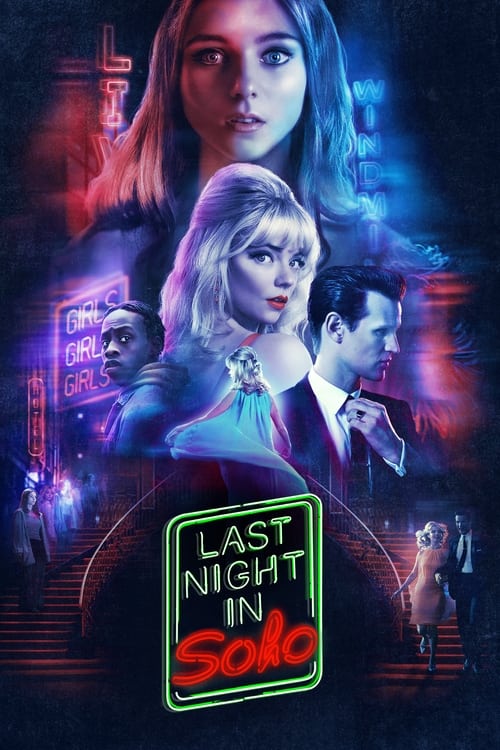
Last Night in Soho
2021 · Edgar Wright
When you want horror with glamour — a stylish, needle-drop-heavy nightmare rather than raw brutality. Good for a night when you're in the mood to be dazzled first and unsettled after.
What it's about
A shy fashion student moves from rural Cornwall to London and finds herself slipping, in her sleep, into the Soho of the Swinging Sixties — living inside the nights of a dazzling aspiring singer she comes to idolize. But the glamour of that world starts to rot at the edges, the past bleeds into her present, and the dream turns into something she can't wake up from.
The experience
Seductive before it's scary — the film gets you drunk on neon, pop records, and sixties style, then twists that same intoxication into mounting dread. It's woozy, stylish, and increasingly nightmarish, a mystery that tightens as the two eras blur.
Performances
Anya Taylor-Joy is magnetic as Sandie, all ambition and shine curdling into something desperate, while Thomasin McKenzie makes the wide-eyed observer role genuinely fragile — the film runs on the current between them.
The craft
Edgar Wright rebuilds mid-sixties Soho as a hallucination — mirror tricks let the two women trade places mid-shot, the neon-soaked photography is gorgeous, and the wall-to-wall sixties soundtrack does real storytelling work. It's a film to see big and hear loud; the craft is the intoxication the story then weaponizes.
Why it matters
Wright's first true horror film and his first built around a female protagonist, it stands as one of the era's most vivid statements on nostalgia itself — the argument that romanticizing a mythologized past means ignoring who got hurt in it.
Horror · Psychological horror · Giallo. A neon-lit dream of sixties Soho with sixties pop on the soundtrack turns slowly into a feverish giallo nightmare you can't wake from.
Snapshot
Last Night in Soho is Edgar Wright's first outright horror film and the first he built around a female protagonist, a psychological thriller that folds a contemporary coming-of-age story into a hallucinatory reconstruction of mid-1960s London. Eloise "Ellie" Turner (Thomasin McKenzie), a fashion student newly arrived in the city from rural Cornwall, begins slipping in her sleep into the London of the Swinging Sixties, where she inhabits and observes the life of Sandie (Anya Taylor-Joy), an aspiring singer whose glamorous ascent curdles into exploitation and violence. The film's structuring gambit is the collision of nostalgia and horror: the same aesthetic apparatus that makes the past intoxicating — neon, pop records, couture silhouettes — becomes the vehicle for dread. It is at once a love letter to a mythologized London and an argument about the rot beneath its glamour, particularly the sexual predation faced by young women in the entertainment economy. Critically it landed as a divisive work — widely admired for its craft and its two central performances, more contested on the terms of its screenplay and its third-act reversals — and it carries additional cultural weight as the final screen appearance of Diana Rigg.
Industry & production
The film was produced by Working Title Films — Tim Bevan and Eric Fellner's long-running British production house within the Universal orbit — with Wright and Nira Park among the producers, and released by Focus Features in North America and Universal internationally. It premiered at the Venice Film Festival in September 2021 and opened theatrically in October 2021. Its release therefore fell squarely inside the disrupted, pandemic-shadowed theatrical market, when audience returns for adult-skewing, non-franchise titles were fragile; the film is generally understood to have underperformed commercially, though I'll refrain from citing specific grosses. The project also represented a particular moment in Wright's career: coming off the stylized heist musical Baby Driver (2017), and having previously exited Ant-Man over creative differences with Marvel, he used Soho to move into a darker, more auteurist register while retaining studio backing. The screenplay was co-written with Krysty Wilson-Cairns, the Scottish writer then rising on the strength of 1917, whose involvement is often credited with sharpening the film's female interiority — a corrective Wright himself acknowledged the material needed.
Technology
Documentation of the film's exact capture format is one of the places where the public record is thinner than one would like, and I won't assert a specific camera or gauge with false precision. What is well established is the film's commitment to in-camera and practical solutions over digital compositing wherever feasible. The signature time-slip sequences — in which Ellie and Sandie occupy the same mirrored space, trading places as reflections — were engineered largely through choreography, body doubles, and mirror rigs rather than face-replacement VFX, a deliberate throwback to older trick-film craft. Wright has spoken about wanting the audience to feel the physical reality of the illusions. The production also leaned heavily on practical lighting effects, especially the pulsing red-and-blue signage of Soho, to motivate its color transformations optically rather than in the grade alone. Digital tools were used, but the film's technological ethos is one of concealment: making the seams invisible so the artifice reads as haunting rather than as spectacle.
Technique
Cinematography
The film was shot by Chung-hoon Chung, the Korean cinematographer best known for his long collaboration with Park Chan-wook (Oldboy, Thirst, Stoker, The Handmaiden). His work here is the film's most consistently praised element: a saturated, high-contrast palette in which Soho's neon does expressive labor, bathing faces in reds and blues that shift with emotional temperature. Chung stages elaborate developing shots and reflection-based compositions, using mirrors, glass, and windows both as tools for the body-swap conceit and as a running visual motif of doubled and fractured identity. The 1960s passages are rendered in a heightened, jewel-toned glamour that the film gradually poisons, so that the same lighting scheme that first reads as seductive later reads as feverish. It is a cinematography of controlled excess, disciplined by the horror architecture underneath.
Editing
Paul Machliss, Wright's regular editor since Scott Pilgrim vs. the World and the credited cutter on The World's End and Baby Driver, edited the film. Wright's cinema is famously music-driven, and Soho extends the tight sound-to-image synchronization of Baby Driver into a different key: cuts, camera moves, and performance beats are keyed to period records so that the editing becomes a form of choreography. The mirror-dance sequences in particular depend on frame-precise matching to sell the swap between McKenzie and Taylor-Joy. As the film descends, the editing grows more fragmentary and disorienting, mirroring Ellie's collapsing grip on which timeline she occupies.
Mise-en-scène / staging
Production designer Marcus Rowland (a longtime Wright collaborator) and costume designer Odile Dicks-Mireaux reconstruct a 1960s Soho of clubs, dance halls, and bedsits that is meticulous and pointedly seductive — the film wants you to fall for the period before it turns on you. Costume carries thematic weight given Ellie's vocation as a fashion student: Sandie's transformation is charted through her clothes, and Ellie's design work becomes literally haunted by what she witnesses. The contemporary London is staged as comparatively drab and alienating, so the past's saturation reads as both dream and trap. The staging repeatedly places Ellie as a spectator pressed against the membrane of the past — behind glass, in mirrors, at thresholds — visualizing the film's concern with looking and complicity.
Sound
Sound is central rather than decorative. The score is by Steven Price, the Oscar-winning composer of Gravity who also scored Baby Driver, and it braids original music with a dense soundtrack of period pop. Anya Taylor-Joy performs a version of Petula Clark's "Downtown," and the film draws on the girl-group and British-Invasion-adjacent pop of the era — the character name Sandie itself nods to Sandie Shaw — deploying these songs first as pleasure and later as menace. The sound design uses the intrusion of past voices, footsteps, and music into Ellie's present as a mechanism of haunting, so that hearing becomes as unreliable as seeing.
Performance
The film rests on its two leads. Thomasin McKenzie plays Ellie as fragile, watchful, and increasingly unmoored, carrying the film's point of view; Anya Taylor-Joy plays Sandie with luminous confidence that is systematically stripped away, and does much of her own singing. Matt Smith is the manager-pimp figure Jack, weaponizing period charm. The supporting cast is layered with icons of British cinema whose casting is itself a citation: Terence Stamp, an emblem of 1960s British film, appears as an ambiguous older man; Rita Tushingham, star of the kitchen-sink landmark A Taste of Honey, plays Ellie's grandmother; and Diana Rigg, in her final role as the landlady Ms. Collins, anchors the film's climactic turn. The film is dedicated to Rigg, who died in 2020.
Narrative & dramatic mode
The film operates as a psychological horror-mystery with an unreliable, subjective mode of narration anchored almost entirely in Ellie's perception. Its dramatic engine is the dream-intrusion device: nightly descents into the past that begin as wish-fulfillment and progressively become possession and haunting, until the boundary between eras dissolves and the past bleeds into the present as physical threat. Structurally it moves from coming-of-age realism through immersive fantasy into full horror, before pivoting on a late reversal that recodes the mystery — a whodunit about a woman's fate that reframes victimhood, guilt, and vengeance. This third-act turn is the film's most contested design decision, admired by some as a genre subversion and faulted by others as a tonal and thematic wrench; the disagreement is itself part of the film's reception history.
Genre & cycle
Last Night in Soho sits at a busy intersection of cycles. It is a haunted-city horror and a female-centered psychological thriller in the lineage of the "woman losing her grip in a hostile metropolis" film. It participates in the 2010s–20s wave of "nostalgia-horror," works that interrogate rather than simply indulge period longing, using retro aesthetics to expose historical violence. It is also, self-consciously, a British genre film that reaches back to the nation's horror traditions. Within Wright's own filmography it marks a genre pivot: where his earlier work refracted genre through comedy (the Cornetto Trilogy), Soho commits to horror's affective machinery in earnest, retaining his formalist, music-locked style but abandoning the comic frame.
Authorship & method
The film is a strongly authored Edgar Wright work — formally precise, saturated with cinephilia, structured around music — but its method here is notably collaborative in ways that shape its meaning. Co-writing with Krysty Wilson-Cairns was, by Wright's own account, essential to grounding a story about young women's experience; the screenplay's attention to female subjectivity is often traced to that partnership. Chung-hoon Chung's cinematography imports a Park Chan-wook–adjacent sensibility — lush, mirror-obsessed, morally uneasy — that inflects the film's look well beyond Wright's prior collaborations. Steven Price's score and the curated needle-drops extend Wright's signature integration of music and image. Longtime collaborators Paul Machliss (editing), Marcus Rowland (production design), and producer Nira Park provide continuity with Wright's established working ensemble. The authorship is thus best read as Wright's vision routed through a specific set of collaborators who pulled the material toward darkness, glamour, and interiority.
Movement / national cinema
This is emphatically a British film, and part of its project is a dialogue with British cinema history. It is a Working Title production working London as both subject and myth, and it stitches itself into a specifically British lineage through casting (Stamp, Tushingham, Rigg) and through its engagement with the Swinging Sixties — the very period when "British cinema" became an international brand of youth, fashion, and pop. It also converses with the British horror tradition and with the London-set psychological horror exemplified by Michael Powell and Roman Polanski's British-made Repulsion. The film's national-cinema stance is critical as much as celebratory: it exhumes the exploitation and misogyny that the "Swinging London" image tended to gloss.
Era / period
Two eras are held in tension. The narrative present is a broadly contemporary London — precariously gentrified, alienating, and haunted — while the film's obsessive attention goes to the mid-1960s. Its reconstruction of that period is dense and knowing, but the film's argument is precisely about the danger of period fetishism: Ellie's romance with a decade she never lived is the wound the horror exploits. In production terms it belongs to the disrupted early-2020s theatrical era, a context that arguably shaped its commercial trajectory more than its content. Its "pastness," in other words, is thematized rather than incidental.
Themes
The film's central theme is the peril of nostalgia — the seduction of an idealized past and the historical violence that idealization conceals. From that flow its other concerns: the sexual exploitation of young women in the entertainment and nightlife economy, then and now; the porousness of trauma across time and its transmission between women; the ethics and dangers of spectatorship, encoded in the film's relentless motif of mirrors, glass, and watching; and identity as something doubled, borrowed, and invaded. Fashion and performance run through the film as arenas where female self-expression and female objectification are inseparable. The late reversal complicates the film's own thesis, opening questions about victimhood, complicity, and revenge that critics have read in sharply divergent ways — some as a bold complication, others as a muddying of the film's feminist intentions.
Reception, canon & influence
Critical reception was mixed-to-positive and markedly split along a fault line: near-consensus praise for Chung's cinematography, Price's music and the soundtrack, Wright's formal control, and the McKenzie–Taylor-Joy performances, set against substantial reservations about the screenplay's structure and especially its third-act revelations, which several critics felt undercut the film's stated concern with women's exploitation. The film also drew poignant attention as Diana Rigg's final performance, to whom it is dedicated.
Influences on the film (backward): the most cited touchstones are Roman Polanski's Repulsion, the London psychological-breakdown film par excellence; Nicolas Roeg's Don't Look Now for its haunted, precognitive editing; the British-horror tradition and the giallo, particularly the neon-and-color expressionism associated with Dario Argento; and the Powell–Pressburger legacy, with Peeping Tom especially resonant as a British film about the violence of looking. Its casting deliberately cites the 1960s British cinema of Terence Stamp and Rita Tushingham, and its music invokes the girl-group and British-pop soundscape of the era. Wright has been open about the film as a work of cinephile homage, and critics readily identified these lineages.
Legacy (forward): as a relatively recent film, its downstream influence is still emerging, and I won't overstate it. Its clearest place in the culture is within the ongoing nostalgia-horror conversation — films and series that use lovingly reconstructed period aesthetics to interrogate rather than simply indulge the past — where it is frequently invoked as a prominent, ambitious, and instructively divisive example. It further consolidated Anya Taylor-Joy's stardom during her breakout period and marked a significant genre expansion in Edgar Wright's authorship. Its longer-term canonical standing remains unsettled, which is an honest reflection of the record rather than a hedge: the film is likely to be remembered as much for the debate it provoked about nostalgia, gender, and the ethics of its own twist as for any single stylistic innovation.
A Deleuzian reading
A girl stands at a mirror in a Soho club in 1965 and the girl looking back is not her.
The full Deleuzian reading of Last Night in Soho →
Reception
Premiered at Venice 2021 to notably mixed reviews and then underperformed at the box office — a rare stumble for Edgar Wright. It hasn't had a full flop-to-classic redemption, but horror fans have steadily reclaimed its first two acts, its needle-drops, and its two lead performances.
How Last Night in Soho was received, from release to now →
How to watch Last Night in Soho: what to notice on a first viewing
- Watch the mirrors before anything happens in them. Chung Chung-hoon builds compositions out of glass, windows and mirrored walls. A reflection stops being a copy and starts trading places with the thing it reflects, and the camera keeps switching which woman it is with. You lose track of whose life you are inside while it is happening, which is the only honest way to film this story.
- Notice the reds and blues washing across faces. Soho's neon does the emotional work. Chung saturates and pushes contrast, and the color shifts with the temperature of a scene rather than with any lamp you could point at in the room. The same jewel-toned scheme that seduces you early reads as fever later. Nothing about the palette changes except what it is doing to you.
- Watch the dance and try to catch the cut. Paul Machliss keys cuts, camera moves and performance beats to period records. The swap between McKenzie and Taylor-Joy was built with choreography, doubles and mirror rigs rather than digital face replacement. A practical swap is something you lose track of live. A digital one would be something you decode afterward.
- Listen for footsteps and songs from a room that isn't there. Steven Price threads original score through a dense run of period pop, and the sound design pushes voices and records from 1965 into present-day London. Ellie's ear arrives in the past before her eyes do. The film never announces that she is unmoored. It desynchronizes her senses and lets you work it out.
- Count how often Ellie watches from behind glass. Wright keeps putting her at a membrane. Behind a window, inside a mirror, standing in a doorway at the edge of a room where something is happening to somebody else. Most horror runs on running away. This one runs on watching in detail something you cannot reach.
The whole guide to watching Last Night in Soho, with the keys for a rewatch →
Influences: the films it descends from and the films it influenced
- Repulsion (1965) — The template for externalizing a young woman's psychic collapse as architectural hallucination — grasping wall-hands, warping rooms — so that subjective breakdown is staged through distorting domestic/urban space rather than exposition.
- Peeping Tom (1960) — The British film that implicates camera and viewer in predatory looking; Soho's spectatorship-and-looking theme and its ethics-of-the-gaze descend from Powell's turning the apparatus of vision into the instrument of violence.
- Suspiria (1977) — Source of the neon-color-expressionism Chung reproduces — horror lit in unmotivated saturated primary gels (aggressive reds and blues) detached from any realist light source.
- Deep Red (1975) — Giallo built on a mirror-concealed clue and reflective surfaces that hide the killer in plain sight, feeding Soho's mirror-reflection staging and its frame-precise mirror-match cuts.
- Don't Look Now (1973) — Precognitive associative match-cutting where a color motif (red) and premonition bleed across time; the model for Soho's haunted, non-linear subjective editing.
- Blow-Up (1966) — Established the mod Swinging-London milieu Wright reconstructs and paired it with a plot literally about scrutinizing images — the mid-1960s-London look and the looking-as-evidence theme both trace here.
- Persona (1966) — Two women's faces and identities merge via superimposition and mirroring; the formal template for Soho's dual-lead body-swap and its fused-reflection compositions.
- Vertigo (1958) — Obsessive remaking of an idealized woman through a male gaze, rendered in hallucinatory subjective color and doubling — the ur-text for a plot where spectatorship, desire and a haunting past collapse into one figure.
- The Red Shoes (1948) — Technicolor-expressionist dream sequence in which a young performer is consumed by her own ambition — the Powell–Pressburger lineage of stylized color and performance-as-peril Wright openly cites.
- Baby Driver (2017) — Within Wright's own authorship, the fullest prior statement of music-locked cutting — action edited frame-precisely to the needle-drop — a method Soho carries directly into its period-pop score.
- Stoker (2013) — Chung Chung-hoon carrying the Stoker toolkit forward: motivated neon and lamp practicals as the sole color source, mirror-and-reflection blocking that swaps two women within a single unbroken move, and a young woman's haunting staged as a perception problem rather than an apparition.
- The Love Witch (2016) — Its period-pastiche colour lighting and mirrored doubling dramatise a woman forced to perform a male-centred glamour fantasy, carrying the Mulvey-informed critique into a retro horror register.
- X (2022) — Uses a lovingly reconstructed period aesthetic to interrogate stardom, desire and looking rather than merely indulge nostalgia — squarely the nostalgia-horror conversation Soho helped foreground.
- The Running Man (2025) — Wright and Chung's two-tier scheme, a naturalistic base exposure invaded by saturated motivated light from signage and screens, is carried over wholesale as the studio-versus-street lighting split.
- Mulholland Drive (2001) — Two women — an aspirant performer and an established figure — undergo dream/nightmare identity collapse in a glamour city, sharing Soho's unreliable-subjective structure and destabilizing third-act reversal.
- Black Swan (2010) — A performer's psyche fractures through mirror-doubles and reflections that animate independently of her, the same marriage of mirror-reflection horror and dual-identity performance.
- The Neon Demon (2016) — Neon-saturated color expressionism deployed as an argument about a beauty industry devouring a young woman — kin to Soho in both palette and the exploitation-of-women theme.
- Berberian Sound Studio (2012) — A contemporary British cinephile homage that rebuilds giallo craft from the inside — the same mode of reverent formal reconstruction of Italian horror technique that Wright pursues.
- Malignant (2021) — A deliberate giallo revival using neon lighting and a body/identity twist — a parallel modern reanimation of Argento's palette and reveal mechanics arriving the same year.
- MaXXXine (2024) — Deploys giallo neon lighting, mirror-doubling and screen-refracted staging in a nostalgic period reconstruction, the same pastiche-as-argument about a woman navigating an exploitative showbiz past.
- Censor (2021) — Released in the same year, it uses the same device of a young woman's present-day realism dissolving into neon, gel-lit pastiche of a past media era, with period glamour and violence turning into hallucination.
Similar films
- Suspiria (1977) — influence & lineage · same viewing thread
- Peeping Tom (1960) — influence & lineage
- The Neon Demon (2016) — influence & lineage
- Blow-Up (1966) — influence & lineage
- Mulholland Drive (2001) — influence & lineage
- Repulsion (1965) — influence & lineage
- The Red Shoes (1948) — influence & lineage · same viewing thread
- Deep Red (1975) — influence & lineage · same viewing thread
All the films related to Last Night in Soho →
Watch it with: curated runs of related films
- Drunk on Design — Watch these together for the rush of maximalist, color-drenched cinema where a woman is made, remade, or consumed by an art form — ballet, fashion, gothic desire — and the production design does half the storytelling.
- Black Gloves, Bright Blood: Giallo and Its Heirs — A run from the Italian giallo's masked killers and witnesses who half-saw the crime, through De Palma's American versions, to the recent films that still borrow its gloves, colour and voyeurism. Watch them close together and you can see where each trick came from.