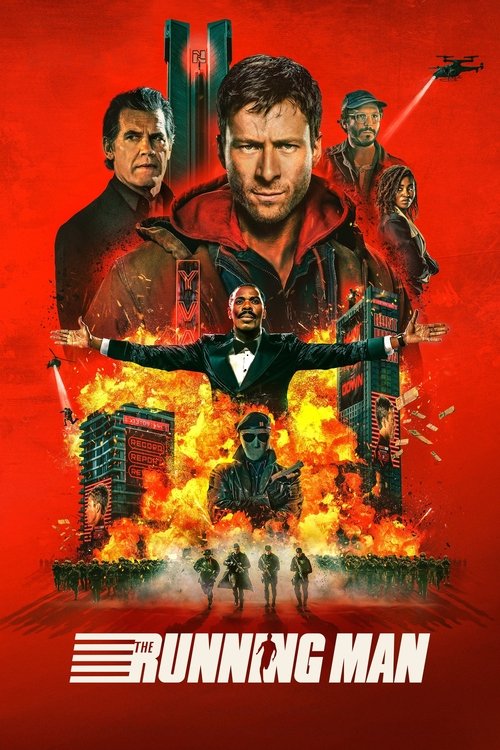
The Running Man
2025 · Edgar Wright
When you want pure adrenaline that doesn't insult your intelligence — a big, loud Friday-night action ride that leaves you a little uneasy about what you just cheered for.
What it's about
In a near-future America run on broadcast spectacle, Ben Richards — a blacklisted working-class man desperate to pay for his sick daughter's medicine — signs up for The Running Man, a national game show that hunts contestants to the death for ratings. What was supposed to be a doomed thirty-day manhunt goes sideways when his defiance makes him a fan favorite, and a threat to the people running the show.
The experience
A propulsive, breathless chase movie with a furious streak of satire — the pace barely lets up, but the anger at media manipulation and manufactured spectacle keeps landing between the set pieces. It's a crowd-pleaser with its teeth bared.
Performances
Glen Powell carries the film with scrappy, sweat-soaked movie-star charisma, Josh Brolin brings cold menace to the producer, and Colman Domingo is electric as the host selling the hunt to the nation.
The craft
Edgar Wright brings his kinetic editing and whip-smart visual comedy to a continent-spanning manhunt, and this adaptation actually attempts the plot of Stephen King's ferocious 1982 novel rather than the arena of the earlier film. It's built for a big screen and loud speakers — the momentum is the point.
Why it matters
The second screen take on King's bleakest pulp novel and the first faithful one, arriving as studio filmmaking's biggest swing yet at the story's satire of a nation entertained by televised death — and a scale-up moment for Wright as a blockbuster director.
Snapshot
Edgar Wright's eleventh-hour arrival at Stephen King's bleakest paperback produces one of the stranger objects in recent studio filmmaking: a big-budget star vehicle whose source material is a cheap, furious 1982 Bachman novel about a man who is hunted to death for ratings. Released by Paramount in mid-November 2025, The Running Man is the second screen adaptation of the book and the first to attempt its actual plot — a thirty-day, continent-wide manhunt rather than the gladiatorial arena of the 1987 Arnold Schwarzenegger picture. Glen Powell plays Ben Richards, a blacklisted industrial worker who sells himself to the Games Network to pay for his daughter's medicine; Josh Brolin plays the producer who buys him, and Colman Domingo the host who sells him to the audience. The film is simultaneously a legacy-IP remake, a fidelity project, a movie-star audition, and a satire whose target — an audience that cannot stop watching — is sitting in the room. Its commercial performance and its critical reception were both divided, and the film's ultimate standing remains unsettled at the time of writing.
Industry & production
The property has been a studio asset since the 1980s. King published The Running Man in 1982 under the Richard Bachman pseudonym, having written it, by his own account, in roughly a week in 1971; the novel is set in 2025, a coincidence the 2025 release exploited in its marketing. Paramount's 1987 version, scripted by Steven E. de Souza and directed by Paul Michael Glaser after Andrew Davis was fired days into shooting, retained the title, the premise of a televised execution, and almost nothing else — it relocated the hunt to a fenced arena and turned the Hunters into costumed "Stalkers," with Richard Dawson, a working game-show host, playing the emcee-villain. That film's success as a Reagan-era action comedy effectively buried the novel's structure for a generation.
Paramount had a remake in development through the 2010s. Wright came aboard at the start of the 2020s, co-writing with Michael Bacall, whose prior collaboration with Wright was Scott Pilgrim vs. the World; the production was mounted through Wright and Nira Park's Complete Fiction alongside Simon Kinberg's Genre Films. Principal photography ran through the winter of 2024–25 on a UK-anchored shoot with additional location work abroad. Beyond that outline, the granular production record — stage assignments, schedule changes, the specifics of reshoots — is thin and largely confined to trade briefs and press-tour anecdote; it should not be treated as settled.
The economic logic is worth naming. This is an expensive, R-rated, non-franchise action film built around a star whose bankability was still being tested after Anyone But You, Hit Man, and Twisters. Paramount released it into the November corridor with IMAX and premium-format bookings, betting that a recognizable title plus an ascendant lead could do what original action rarely does in the 2020s. It opened softly and was widely reported as an underperformer against its cost. Specific budget and gross figures circulated in the trades; they are unstable enough across sources that they are better cited from a box-office database than repeated here.
Technology
The film's subject is a media technology. King's Free-Vee — a compulsory, state-subsidized screen in every dwelling, broadcasting the Games Network's menu of lethal contests — is preserved largely intact, and the production's design work is essentially an exercise in imagining what that apparatus looks like after fifty years of consumer electronics history the novel could not foresee. The result is a deliberately unglamorous stack: cathode-ray bulk and plastic housings alongside ubiquitous camera coverage, civilian phones that double as informant devices, and a network control gallery that renders the hunt as a multi-window live feed.
The novel's most prescient device — Richards is required to mail videocassettes twice daily, and the Network edits them into propaganda before broadcast — lands differently in 2025 than in 1982. What King imagined as splicing and dubbing is now trivially achievable synthesis, and the film updates the falsification accordingly, making the manipulability of the recorded image a plot mechanism rather than a metaphor. This is the adaptation's sharpest technological argument: the danger is no longer that the state controls the transmitter, but that no image reaching the audience can be assumed to have happened.
On the production side, Wright and cinematographer Chung Chung-hoon pursued a photochemical, largely practical aesthetic in keeping with Wright's established preferences, and the marketing emphasized in-camera stunt work over digital replacement. Precise capture-format claims vary between interviews and press materials and are not documented here with confidence.
Technique
Cinematography
Chung Chung-hoon, who shot Last Night in Soho for Wright and whose formative work is with Park Chan-wook (Oldboy, Stoker, The Handmaiden), brings a hard, saturated palette and a willingness to let the frame become openly graphic. The film's visual system is built on a split: the Network's world is high-key, glossy, and symmetrical — light that flatters and flattens — while Richards's passage through the collapsing periphery is handheld, underlit, and grimed. Chung's habit of the aggressive push-in and the sudden, motivated rack focus is used here to translate surveillance into grammar: the camera repeatedly adopts the posture of something looking for Richards rather than merely at him. Wide-format staging keeps the Hunters legible as bodies in space during pursuit, an old-fashioned virtue in a genre that has largely abandoned it.
Editing
Paul Machliss, Wright's editor since Scott Pilgrim, is arguably the film's decisive collaborator. Wright's cutting signature — the elliptical match, the percussive smash cut, action beats locked to a rhythmic grid — is redeployed here from comedy into dread. The device that carries the most weight is the cut between the event and its broadcast: an action is shown, then immediately shown again as the Network's version of it, edited to mean the opposite. The joke structure of Wright's earlier films (setup, hard cut, inverted payoff) becomes the film's ideological engine. Whether the sheer velocity of that grammar serves King's grinding, exhausted novel is the central critical dispute the film has generated.
Mise-en-scène / staging
Marcus Rowland, production designer on every Wright feature since Shaun of the Dead, builds a retrofitted dystopia rather than a futurist one: a world of deferred maintenance, where the studio floor is the only surface with money spent on it. The Games Network stage is the film's organizing space — a hot, branded, audience-facing arena from which everything else recedes into unlit infrastructure. Staging consistently opposes two geometries: the show's proscenium, always frontal and addressed to camera, and the chase, which is lateral, cluttered, and obstructed. Costume and makeup reinforce the class reading, with Richards's deterioration tracked as a visible cost against the hosts' unchanging polish.
Sound
Steven Price, who scored The World's End, Baby Driver, and Last Night in Soho and won an Academy Award for Gravity, supplies a score that leans industrial and percussive rather than orchestral-heroic, frequently letting the Network's own sonic branding — stings, applause cues, countdown beds — colonize the non-diegetic track until the distinction erodes. Wright's career-long practice of cutting to music is present but subordinated; the more characteristic gesture here is the abrupt removal of sound, dropping a sequence into the unmediated noise of breathing and footfall to mark the difference between the hunt as lived and the hunt as programmed.
Performance
The casting is a systematic argument. Powell, whose established register is easy charm, plays Richards as a man whose charm is a weapon he resents having to use — the performance works by showing the effort of ingratiation and the contempt underneath it. Domingo, as host Bobby Thompson, takes the function Richard Dawson consolidated in 1987 and refines it into something more modern and more disturbing: warmth as a professional product. Brolin's Dan Killian is the producer as bureaucrat, restoring the novel's split between the person who designs the cruelty and the person who sells it — a division the 1987 film collapsed into one figure. Lee Pace's lead Hunter is played as a competent professional rather than a costumed grotesque. The most pointed casting choice is Michael Cera as Elton Parrakis, a character the novel describes as physically imposing; the inversion recodes the underground resistance as ordinary and fragile rather than heroic. Emilia Jones, as the hostage Amelia Williams, carries the film's audience-surrogate arc — the citizen who discovers what watching has made her.
Narrative & dramatic mode
The film restores the novel's clock-driven structure: Richards is given a head start, a hundred New Dollars for every hour survived, thirty days to reach a payout no one has ever collected, and a daily obligation to produce footage of himself. This turns the picaresque chase into a countdown, and the countdown into a broadcast schedule — narrative time and programming time are the same time. Dramatically, the mode is closer to the paranoid fugitive thriller of the 1970s than to contemporary action: Richards survives by moving, lying, and depending on strangers whose motives are uncertain, and each safe house is a temporary node rather than an escalation in a boss ladder.
Wright layers onto this a satirical second track — the Network's commentary, ad breaks, and audience reaction — so that the film is continually cutting away from its protagonist to the machine consuming him. The tonal management of that alternation is the film's main formal risk. The ending is where the adaptation most conspicuously negotiates with its source; the novel closes on an image of annihilating self-sacrifice that has been discussed for decades, and the film's resolution departs from it. Accounts of how that decision was arrived at are anecdotal and contested, and are not reliably documented.
Genre & cycle
The Running Man sits at the intersection of two long lineages. The first is the hunted-human story running from The Most Dangerous Game (1932) through The Tenth Victim (1965), Death Race 2000 and Rollerball (both 1975), Das Millionenspiel (1970) and Le Prix du Danger (1983), Series 7: The Contenders (2001), Battle Royale (2000), The Hunger Games cycle, and Squid Game. The second is media satire proper: Network (1976), Videodrome (1983), Verhoeven's RoboCop (1987) and Starship Troopers (1997), The Truman Show (1998).
The 2025 film's problem is that it arrives late to a premise its descendants have already industrialized. Where the 1987 version could treat televised execution as outlandish, the 2025 version must contend with an audience for whom competitive humiliation is an established genre and livestreamed violence is a real category. The film's response is to shift emphasis from the spectacle itself to the audience's participation in it — the dramatized public is the antagonist as much as the Hunters. Structurally, it also functions as a fugitive thriller in the First Blood / The Fugitive mold, which is what distinguishes it most sharply from the arena films it resembles on paper.
Authorship & method
Wright's authorship is unusually legible at the level of technique: exhaustive pre-visualization and storyboarding, editing conceived at the script stage, music-locked action, and a cinephile's habit of quotation. The core unit — Wright, Bacall, Chung, Machliss, Price, Rowland — has been stable across multiple films, and the continuity shows in how confidently the film executes its transitions.
The interesting authorial question is one of temperament. Wright's earlier work, including the horror-inflected Last Night in Soho and the documentary The Sparks Brothers, is fundamentally affectionate — its irony rarely curdles. King's Bachman books are not affectionate; The Running Man is a novel written from the position of someone with no money and no expectation of rescue. Adapting it required Wright to suppress the reflex toward delight, and critics divided almost exactly on whether the suppression was complete. The most defensible reading is that Wright uses his comic grammar deliberately against itself: the film is entertaining in precisely the manner it is indicting, which is either the point or the failure depending on how much credit one extends.
Movement / national cinema
Wright is the central figure of the post-Spaced generation of British popular filmmakers who moved from television comedy into international genre cinema without abandoning a specifically British formal density — fast, allusive, built on editing rather than spectacle. The Running Man is an American story told with that British craft apparatus, made largely in the UK by a crew Wright has carried from the Cornetto trilogy forward, and it belongs to the substantial category of Hollywood tentpoles produced inside Britain's studio-and-tax-credit economy. The film's outsider view of American media populism — the gun-and-flag iconography of the Network's broadcasts, the specific cadence of its patriotism — reads as observed rather than inhabited, which is arguably an asset.
Era / period
The film is a 2025 artifact in ways that go beyond its setting coinciding with the novel's. It addresses an attention economy in which engagement metrics govern distribution, a media environment in which synthetic video has made authentication a live problem, and a political register in which grievance is a programming category. Its economic premise — that a parent would risk death to cover a child's medical costs — requires no futurist scaffolding to read as contemporary in the United States. It also arrives at a specific industrial moment: theatrical exhibition dependent on event scale, original mid-to-large-budget action increasingly rare, and studios attempting to manufacture movie stars on a compressed timeline. The film is both a critique of spectacle economics and a product of them.
Themes
The governing theme is the conversion of desperation into content. Richards is not conscripted; he volunteers, and the film insists on that consent as the system's real achievement — coercion has been fully internalized as choice. From this follow the novel's other preoccupations, most of which survive: the class structure that makes the poor both the contestants and the audience; environmental harm distributed downward, which in King's book is the secret Richards uncovers and which the film retains as a motif; the falsifiability of the image and the political consequences of an unreliable record; and, most acutely, co-option — the system's capacity to metabolize rebellion by making it popular. Richards becomes dangerous not when he resists but when resistance rates well, and the film is at its best when it holds that paradox open rather than resolving it. Running beneath all of it is the oldest version of the argument: bread and circuses, with the observation that the circus has learned to charge admission to the bread line.
Reception, canon & influence
Critical response on release was genuinely split. The most consistent praise went to Powell's physical commitment and to the film's craft — the pursuit staging, Chung's photography, Domingo's host — and to the simple fact of an adaptation that finally attempts the book. The most consistent objections were that the satire is blunter than its targets, that Wright's kinetic idiom flattens the novel's exhaustion into momentum, and that the ending's departure from King sacrifices the source's one unanswerable gesture. Reviews aggregated to a mixed-to-moderately-positive consensus; audience response ran somewhat warmer than the critical average, a familiar pattern for star-led action.
The backward influences are traceable and largely acknowledged: King's novel first; the 1970s dystopian-sport cycle and Network for its media politics; Verhoeven's American satires for the strategy of embedding advertising inside the film's own texture; the paranoid chase thrillers of the same decade for structure; and, inevitably, the 1987 film as the version the 2025 picture defines itself against. Wright's own catalogue supplies the grammar.
The forward legacy cannot honestly be assessed this close to release. The film's commercial disappointment makes it unlikely to spawn a cycle on its own, and its most plausible afterlife is the one that befell its predecessor — reappraisal on home formats, where the fidelity to King and the density of the craft may register more clearly than they did in a crowded November. Whether it becomes the definitive screen Running Man or a well-made footnote between the Schwarzenegger artifact and some future attempt is, at the time of writing, an open question rather than a judgment available to be made.
A Deleuzian reading
A man does something on a dark street.
The full Deleuzian reading of The Running Man →
Reception
Landed in November 2025 to mixed-to-decent reviews and a soft box office that stung given Glen Powell's hot streak and Wright's fanbase — and the 'this one's underrated, give it time' posts started almost immediately.
How The Running Man was received, from release to now →
Influences: the films it descends from and the films it influenced
- The Most Dangerous Game (1932) — Establishes the hunted-human set piece as a pre-mapped board — bounded terrain with named landmarks and a clock announced before the run begins — so suspense comes from the audience knowing the geography in advance, the staging logic behind Wright's zone-by-zone pursuit design.
- Network (1976) — Lumet and Owen Roizman lit the picture on a programmatic scale, each reel closer to television's flat sheen until the film's own image is indistinguishable from broadcast — the direct precedent for the two-tier lighting that keeps studio and street in separate exposures.
- The Parallax View (1974) — Gordon Willis's fugitive geometry — a lone figure pinned low in wide, top-heavy architectural frames, with a corporate-assembled film-within-the-film carrying the exposition — supplies both the paranoid-fugitive compositional grammar and the media-artifact insert.
- Rollerball (1975) — Covers the arena in the language of live sports broadcast — fixed rink-side camera positions, PA announcement, crowd reverse-angles — so the violence reads as a finished television product; Wright's proscenium half of the proscenium-versus-chase scheme is built on the same coverage rules.
- Death Race 2000 (1975) — Runs in-world announcers as a continuous commentary track laid over the kills, making broadcast voice the film's de facto narration and letting the satire live in the sound mix — the model for the diegetic branding bleed.
- The Warriors (1979) — Breaks one night's pursuit into discrete territorial set pieces, each with its own antagonist crew, color key and exit, so the chase advances in chapters rather than one escalation — the episodic gauntlet architecture behind the hunt's segmentation.
- The Running Man (1987) — The version defined against: its Killian-studio proscenium, stalker introductions cut as trading-card packages, and audience-reaction cutaways are the exact grammar Wright inverts by refusing to let the broadcast cut and the event cut share a visual register.
- RoboCop (1987) — Verhoeven cuts fully produced in-world commercials into the feature at the same image quality as the drama, making advertising a structural unit of the edit rather than set dressing — the strategy for embedding branding inside the film's own texture.
- The Truman Show (1998) — Systematically distinguishes hidden-camera 'as broadcast' images — vignetted, off-axis, button-cam flare — from the film's own camera and cuts between the two, the literal precedent for the event-versus-broadcast cut.
- Oldboy (2003) — Chung-hoon Chung's signature long-lens push-in, closing on a face in one unbroken move and holding past comfort, is the device he carries into the contestant close-ups here.
- Gravity (2013) — Steven Price wrote score as sound design — music and effects occupying one continuous field — and used total silence as structural punctuation rather than absence, the method behind the abrupt silences that bracket the set pieces.
- Scott Pilgrim vs. the World (2010) — Treats counters, captions and graphic overlays as diegetic image layers that can be whip-panned and match-cut through, with Marcus Rowland's sets built to receive them — the ancestry of the broadcast HUD sitting inside the frame.
- Hit Man (2023) — Where Glen Powell developed the technique of playing a persona visibly assembled outward from an ordinary man — the constructed-self performance the against-type casting here recruits rather than the star charm.
- The Long Walk (2025) — The other Bachman adaptation of the same year, it preserves the source's attritional clock by refusing to accelerate its cutting — the precise structural choice Wright's kinetic idiom declines in favor of momentum.
- The Hunger Games (2012) — Cross-cuts the arena against a visible control room authoring hazards in real time, so the producers' edit becomes a second narrative layer running alongside the event — the same event-versus-broadcast division worked at studio scale.
- Sorry to Bother You (2018) — Carries its satire in in-world media product — a hit show cut in at broadcast quality, ad copy seeded into the sound field — rather than in dialogue, the same texture-embedded approach to branding bleed.
Similar films
- RoboCop (1987) — influence & lineage · same viewing thread
- The Long Walk (2025) — influence & lineage
- The Hunger Games (2012) — influence & lineage
- Good Luck, Have Fun, Don't Die (2026) — same viewing thread
- No Other Choice (2025) — shared sensibility
- The Smashing Machine (2025) — shared sensibility
- The Pig, the Snake and the Pigeon (2023) — shared sensibility
- Final Destination Bloodlines (2025) — shared sensibility
All the films related to The Running Man →
Watch it with: curated runs of related films
- Rogue Heroes, Rigged Systems — A run of slick, propulsive 21st-century spectacle — spies, super-soldiers, sci-fi survivors, and dystopian rebels all squaring off against some vast machine or shadowy apparatus — best watched back-to-back when you want momentum, style, and a lone figure taking on the whole board.