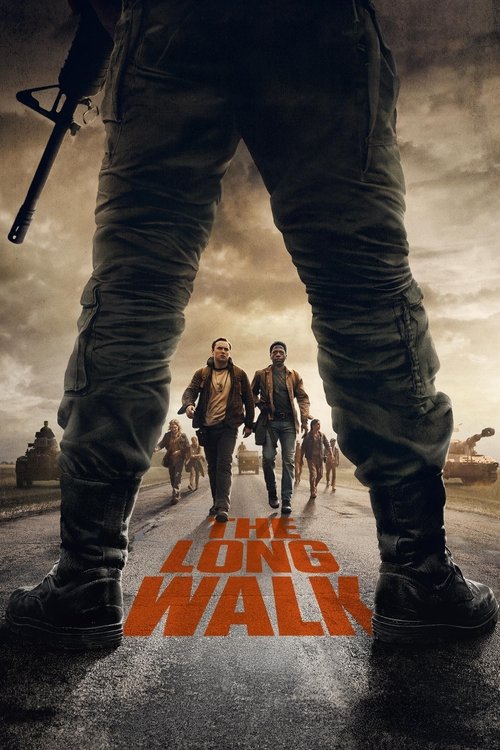
The Long Walk
2025 · Francis Lawrence
For when you want to be wrung out — a bleak, gripping watch that trades thrills for mounting dread and real emotional weight. Not a comfort film; reach for it when you're ready to sit with something heavy.
What it's about
In an alternate, authoritarian 1970s America, fifty teenage boys volunteer for an annual national contest: walk down a highway without stopping, never dropping below the required pace. Fall behind and you get warnings; run out of warnings and soldiers shoot you. There's no finish line — the Walk ends when one boy is left — and along the miles, strangers become friends even as the rules guarantee they can't all survive. Adapted from Stephen King's first-written novel.
The experience
A slow-crushing vise of a film — the horror isn't jump scares but arithmetic, as fatigue and friendship collide with a rule that never bends. It's tense, sorrowful, and genuinely hard to shake, with the boys' gallows humor making the dread cut deeper.
The craft
The film commits to the premise's terrible simplicity: one road, forward motion, no relief, with the violence staged matter-of-factly enough to keep its horror intact. The discipline of the structure — tension built from pace, footsteps, and countdown warnings rather than spectacle — is the craft achievement.
Why it matters
It brings to the screen a story that predates and arguably seeded the entire deadly-competition genre, finally filmed decades after King wrote it as a college student.
Horror · Suspense & terror · Psychological horror. Fifty boys walk a highway with no finish line, and soldiers shoot anyone who falls behind: slow, crushing dread with real grief.
Snapshot
The Long Walk adapts Stephen King's 1979 novel — written under his Richard Bachman pseudonym, and by most accounts the first novel King ever completed, drafted while he was a college student in the late 1960s. The premise is brutally simple: in an alternate, authoritarian mid-century America, a large cohort of teenage boys sets out on foot down a New England highway. They must never drop below a fixed walking pace. Fall behind, and after a set number of warnings, soldiers shoot you dead. There is no finish line in space, only in attrition — the Walk ends when one boy is left alive, and he receives "The Prize." Francis Lawrence, the director most associated with the Hunger Games franchise, directs from a screenplay by JT Mollner. The film is, in effect, the screen arrival of a source text that predates and arguably seeded the entire modern death-game genre it now joins — a progenitor reaching cinemas decades after its own descendants. Its distinctive gambit is formal austerity: a single, relentless forward motion, a road that only goes one way, and a horror that accrues through endurance rather than incident.
Industry & production
The film's most remarkable production fact is how long it took to arrive. The Long Walk spent decades in development limbo, a property circled by major genre figures without ever reaching a camera. George A. Romero was attached to an adaptation for years, and Frank Darabont — himself a definitive King interpreter through The Shawshank Redemption and The Green Mile — held the rights at various points; more recently André Øvredal was linked to the project. That the book resisted adaptation for roughly four decades is itself part of its story: its single-location, single-action structure offers none of the incident-rich set-piece variety that makes most dystopian properties commercially legible.
The realized film was produced for and distributed by Lionsgate, the studio that built the Hunger Games into a franchise pillar, and released theatrically in 2025. The pairing is not incidental — Lionsgate and Francis Lawrence together represent institutional expertise in exactly this register of dystopian genre filmmaking. I cannot reliably cite the production budget or box-office performance from the historical record, and will not invent figures; what can be said with confidence is that the material's constrained premise lends itself to a comparatively contained production relative to the effects-heavy tentpoles that dominate the space.
Technology
The core technical problem of The Long Walk is the inverse of most contemporary genre spectacle: the challenge is not to stage more, but to sustain movement. A story in which the camera must accompany a walking column for its entire length demands mobile capture — vehicle-mounted rigs, tracking platforms, and stabilized systems moving continuously alongside and among the walkers. Absent reliable documentation of the specific camera and lens packages used, I will not assert particulars, but the premise all but requires a production built around dollies, camera cars, gimbals, and Steadicam rather than static coverage. The 1970s-inflected setting also implies a controlled digital-to-look pipeline — color and grain shaped in post to evoke period film stock — rather than reliance on large-scale digital environment work. This is a film whose "technology" is logistical as much as photographic: crowd management, continuity of a moving set across long stretches of road, and the endurance of the performers themselves.
Technique
Cinematography
The visual grammar is dictated by the walk. The camera's fundamental relationship to its subjects is lateral and forward — traveling with the boys, matching their pace, occasionally falling back to reveal the diminishing column or the trailing military vehicles. Francis Lawrence's long-standing cinematographer is Jo Willems, who shot his Hunger Games entries, and the film's look is consistent with that collaboration, though readers should treat the specific crediting as something to confirm against the finished titles. The period palette leans toward desaturated, overcast New England naturalism — asphalt, tree line, gunmetal sky — a deliberate flattening that refuses the heightened production design of most dystopias. The horror is delivered less through composition than through duration and proximity: the camera stays close enough that each execution registers as an intimate rupture in an otherwise monotonous forward glide.
Editing
The editing faces a structural paradox: a plot with almost no plot, only accumulation. Rhythm has to be generated from repetition — the metronomic tick of steps, warnings issued, and the periodic violence that punctuates the tedium. Effective cutting here works against event-driven momentum, instead modulating the audience's sense of elapsed time and mounting exhaustion. I cannot confirm the editor's identity with certainty from the record and will not guess; the discipline the material demands, however, is legible in the concept itself — the cut must make endurance feel like structure.
Mise-en-scène / staging
Staging is the film's deepest craft problem and its signature. The "set" is a moving road, the ensemble a line of bodies that must be choreographed to read as individuals within a mass. Blocking becomes characterization: who walks at the front, who drifts to the shoulder, who pairs off, who lags. The military presence — the halftrack, the soldiers, the officer figure known as The Major — frames the boys as both contestants and conscripts. The period 1970s dressing (uniforms, vehicles, roadside Americana) grounds the allegory in a recognizable, near-past America rather than a fantastical elsewhere, which is central to the source's political charge.
Sound
Sound is arguably the film's most important expressive channel. In a story stripped of spectacle, the sonic field carries the dread: footfalls, labored breathing, the mechanical presence of the trailing vehicle, and — decisively — the reports of gunfire that end each walker. The contrast between ambient monotony and sudden violence is where the horror lives. I do not have reliable information on the composer or the score's specific character and will not attribute it; the honest note is that the film's aural design, more than any musical signature I can verify, is the load-bearing element.
Performance
Performance is where the adaptation stakes its claim. The film is anchored by Cooper Hoffman as Raymond Garraty and David Jonsson as Peter McVries, whose evolving bond is the emotional spine — a friendship formed in the knowledge that only one of them, at most, survives. Mark Hamill appears as The Major, the authoritarian face of the contest, a piece of against-type casting that trades on his iconography. The ensemble of young actors — among them performers such as Charlie Plummer, Ben Wang, Garrett Wareing, Tut Nyuot, and Roman Griffin Davis — must convey physical deterioration in real time, a performance of exhaustion sustained across the runtime. (Specific role attributions beyond the leads should be verified against the finished credits.) The demand on the cast is unusual: to act tiredness, fear, and camaraderie while literally walking, with the body itself as the primary instrument.
Narrative & dramatic mode
Dramatically, The Long Walk operates as a chamber piece disguised as a survival thriller. Its mode is existential rather than plot-driven: the "action" is a countdown by subtraction, and suspense derives from when, not whether, each character will fall. This makes it closer to the tradition of the endurance drama and the war-attrition film than to the escalating-obstacle structure of most dystopian adventure. The dramatic engine is relational — the conversations, confessions, and alliances that form among boys who know their intimacy is terminal. Death is not a climax but a rhythm, and the film asks the audience to sit inside the moral vertigo of rooting for a survivor while grieving the arithmetic that requires everyone else to die.
Genre & cycle
The film sits at a fascinating chronological pivot in the death-game cycle. King's novel (1979) is one of the genre's foundational texts, yet the film arrives after the cycle it helped inspire has fully matured — after Battle Royale (2000), after The Hunger Games (which Francis Lawrence himself shaped on screen), after Squid Game redefined the form for a global streaming audience. The Long Walk is therefore both ancestor and latecomer: audiences will inevitably read it through conventions its source predates. It also belongs to a specific Bachman/King lineage of state-spectacle dystopia alongside The Running Man, and to the broader horror-adjacent survival tradition. Crucially, it resists the genre's usual escalation and worldbuilding sprawl, hewing instead to a single mechanic — which positions it as a corrective or purist entry in a cycle that had grown baroque.
Authorship & method
Francis Lawrence brings a coherent authorial through-line: across I Am Legend, Constantine, and four Hunger Games films, he has specialized in dystopian and genre premises rendered with studio polish and a sober, controlled tone rather than stylistic flamboyance. The Long Walk extends that body of work while stripping it down — the same preoccupation with young people crushed by systems of organized violence, now without the spectacle apparatus that the Hunger Games provided. Screenwriter JT Mollner, coming off the formally aggressive Strange Darling, is an intriguing choice for material this restrained; the adaptation's fidelity to King's minimalist structure is itself an authorial statement. Among key collaborators, Jo Willems is Lawrence's established cinematographer and the most confidently attributable craft partner; the composer and editor I cannot name reliably and decline to invent. The governing method here is subtraction — the deliberate refusal of the genre's accumulated grammar in favor of the source's original austerity.
Movement / national cinema
The film is a product of contemporary American studio genre filmmaking, specifically the King-adaptation industry that has flourished in the streaming and franchise era (It, Doctor Sleep, and the ongoing Mike Flanagan cycle among them). It does not belong to a formal "movement" so much as to an industrial current: mid-budget, prestige-adjacent genre cinema aimed at both theatrical and downstream platform audiences. Its Americanness is thematically essential — the Walk is a road-movie inversion staged on the highways of a mythic United States, turning the iconography of American open-road freedom into a corridor of state-administered death.
Era / period
Two time frames matter. Diegetically, the film is set in a dystopian, authoritarian America coded to the 1970s — a choice that preserves the novel's Vietnam-draft resonance, the marching of young men toward sanctioned death. Historically, the film arrives in 2025, into a moment saturated by Squid Game's cultural dominance and a robust appetite for King adaptations. That doubled temporality — a Vietnam-era allegory, conceived by a 1960s college student, realized for a 2020s audience — is the film's defining contextual tension. Its themes of conscription, endurance, and the spectacle of expendable youth read differently now than they would have on release of the novel, and the film's period setting invites the audience to hold both eras at once.
Themes
At its core the film is about mortality made mundane and continuous — dying not as event but as process. Its richest theme is male friendship under a death sentence: intimacy formed precisely because it cannot last. It is a work about the state's power to conscript and consume the young, its 1970s framing making the draft allegory explicit — bodies marched to death by an authority that treats the slaughter as ordinary civic ritual. Endurance, will, and the body's limits are literalized as plot. And running beneath it is a meditation on complicity and spectacle: the roadside crowds who watch, the contest's status as sanctioned entertainment, and the audience's own uneasy position as spectators of suffering. Unlike the televised spectacle of the Hunger Games, the Walk's horror is more anonymous and existential — closer to a war of attrition than a game show.
Reception, canon & influence
Backward — influences on the film. The film's primary inheritance is King's Bachman novel and its Vietnam-era anxieties, filtered through the endurance-cinema and war-film traditions. It also inevitably inherits the visual and narrative vocabulary of the death-game films that intervened between novel and adaptation — most directly Francis Lawrence's own Hunger Games work, which conditions how a modern audience reads a state-run lethal contest. The long shadow of prior King adaptations, and the aborted Romero/Darabont versions, form part of its lineage as well.
Reception. By the general critical record, the film was received as a serious and well-regarded entry in the King canon, with particular praise directed at its performances and its emotional weight, and interest in its formal discipline. I cannot responsibly quote specific reviews, aggregate scores, or box-office totals from memory, and will not fabricate them; the safe summation is that it was treated as one of the more substantive King adaptations of its period rather than a disposable genre release.
Forward — legacy. Its longer significance is best understood as a completion rather than an inauguration: the death-game genre finally receiving its foundational text on screen, allowing critics and audiences to trace the whole cycle — Battle Royale, The Hunger Games, Squid Game — back to a source that had been waiting in adaptation limbo for forty years. What it may shape is a countercurrent toward austerity within the genre: proof that the form can work through subtraction, relationship, and duration rather than escalating spectacle. As with any recent release, its durable influence remains to be seen, and the honest scholarly position is to mark that as genuinely open.
A Deleuzian reading
A boy drifts toward the shoulder of the road.
The full Deleuzian reading of The Long Walk →
Reception
Dropped in September 2025 as the sleeper of the fall — a Stephen King adaptation that critics immediately ranked among the best ever made from his books, a bar King movies famously fail to clear. Too new for a reappraisal arc; its first impression was the rave.
How The Long Walk was received, from release to now →
How to watch The Long Walk: what to notice on a first viewing
- Watch the camera walk beside the boys and then fall back. Willems keeps the camera lateral and forward, matching the pace. When it drops behind you see the column thinning and the military vehicle trailing it. The palette is desaturated asphalt, tree line, gunmetal sky. The camera is enrolled in the walk. You never get to stand still and observe, and the frame has nowhere to go but forward.
- Listen for the shot that comes from behind the camera. Footfalls, labored breathing, the drone of the halftrack. Then a report from a vehicle nobody is looking at. You hear a boy stop walking more often than you watch it happen. Sound carries the dread in a story with no spectacle. Monotony and sudden noise are the only two registers the film uses.
- Watch who walks at the front and who drifts to the shoulder. The set is a moving road and the ensemble is a line of bodies. Position tells you everything: who pairs off, who lags, who holds the middle. The halftrack and the soldiers frame the column from behind. Nobody has to announce a relationship here. Where a boy puts himself in the line is the characterization.
- Watch the boys' feet and posture change hour by hour. Hoffman and Jonsson have to play deterioration in real time while actually walking. Blisters, a limp, the shortening stride, the drop in the shoulders. The body is the only instrument the cast is given. The performance is physical before it is verbal. You can track how long a boy has left by how he carries himself.
- Count the warnings and notice how the rhythm repeats. Steps, a warning called out, a stretch of nothing, then violence. The cut has to build rhythm from repetition instead of from events. Long passages advance no story at all. The stretches where nothing happens are load-bearing. Most thrillers cut them out. This one turns endurance into the structure.
The whole guide to watching The Long Walk, with the keys for a rewatch →
Influences: the films it descends from and the films it influenced
- The Hunger Games: Catching Fire (2013) — Lawrence and DP Jo Willems had already built the grammar of a state-run televised lethal contest here; The Long Walk reuses their director/DP partnership but subtracts the arena spectacle apparatus down to a single road.
- Battle Royale (2000) — Established the death-game's core editing rhythm — periodic eliminations announced by an offscreen authority — that structures the Walk's ticking cadence of warnings and gunfire.
- Stand By Me (1986) — The template for adapting King's boys-walking-a-linear-track structure, where forward motion along a fixed path (a railroad) is the armature for confessional male-friendship dialogue.
- Gerry (2002) — Pioneered the durational walking two-hander shot in long lateral and trailing tracks, proving a film can run on bodies moving through space rather than plot — the subtraction method the Walk inherits.
- Come and See (1985) — Model for the endurance-cinema face held past comfort as a boy is marched through escalating horror, the subjective duration that turns walking into war allegory.
- The Deer Hunter (1978) — Supplies the ritualized game-of-death (Russian roulette) staged before complicit spectators as a Vietnam-era conscription allegory bound to male friendship.
- The Wages of Fear (1953) — Built the suspense engine of a forced forward journey where each individual step risks sudden death, generating tension from progress itself rather than antagonists.
- Elephant (2003) — Its Steadicam that trails walking subjects from behind for uninterrupted takes, foregrounding footfalls on the soundtrack, prefigures the Walk's tracking-with-subjects camera and footstep-and-gunfire sound design.
- All Quiet on the Western Front (1930) — The foundational disillusioned-conscription war film of young men marched to slaughter by an indifferent state, the anti-recruitment tradition the death-game literalizes.
- I Am Legend (2007) — Lawrence's earlier exercise in dystopian austerity around a lone protagonist under systemic doom, the sober controlled-tone subtraction he refines here.
- 1917 (2019) — Shares the device of perpetual forward motion through a lethal landscape as the narrative engine, with the camera locked to the walking body via mobile rigs.
- Children of Men (2006) — Extended handheld tracking that stays physically bound to characters moving through danger, indicting the surrounding spectacle-state's complicity from inside the frame.
- The Hunger Games (2012) — The other screen incarnation of a state-run youth death-contest, using shaky mobile capture rigs following contestants — the spectacle mode the Walk deliberately refuses.
- Squid Game (2021) — Extends the death-game cycle with childhood-game framing and elimination-by-gunfire rhythm, the escalating-spectacle countercurrent the Walk answers with austerity.
- The Running Man (2025) — The companion Bachman death-contest text reaching the screen in the same cycle, extending King's dystopian-competition lineage in the maximalist register the Walk inverts.
- Nickel Boys (2024) — Binds the camera to characters' embodied point of view as they endure an oppressive institution, the subjective staging that makes duration and complicity felt rather than shown.
Similar films
- Stand by Me (1986) — influence & lineage · often watched together
- The Running Man (2025) — influence & lineage
- The Hunger Games (2012) — influence & lineage
- The Hunger Games: Catching Fire (2013) — influence & lineage
- Battle Royale (2000) — influence & lineage
- Children of Men (2006) — influence & lineage · same viewing thread
- The Maze Runner (2014) — same viewing thread
- The Hunger Games: The Ballad of Songbirds & Snakes (2023) — same viewing thread
All the films related to The Long Walk →
Watch it with: curated runs of related films
- Young Under a Darkening Sky — Watch these in a run as the frame darkens — the institutions built to shelter the young (a school, a walled glade, a nation, a highway) curdle into deadly contests and regimes they have to outlast.