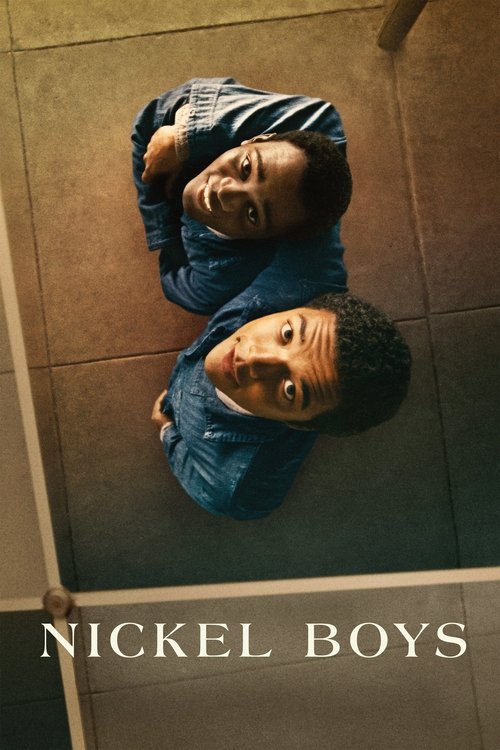
Nickel Boys
2024 · RaMell Ross
Nickel Boys' first-person camera made "can you adapt trauma through POV" the formalist debate of its season; celebrated as proof that radical form can reach the Best Picture lineup.
For when you want to be genuinely challenged and moved — a film to sit with in silence afterward and chew on for days. Not a casual background watch; save it for a night you can give it everything.
What it's about
Two Black teenagers form a deep friendship inside a brutal Florida reform school in the Jim Crow South — an institution modeled on the real Dozier School for Boys, whose unmarked graves were exhumed decades after it closed. Adapted from Colson Whitehead's Pulitzer-winning novel, it follows idealistic Elwood and wary Turner as they try to survive a place designed to break them.
The experience
Unlike anything else in recent American film — you see almost everything through the boys' own eyes, so a grandmother's embrace or sunlight through Spanish moss lands with startling intimacy. It's tender and devastating at once, and it asks for your full attention, then repays it.
Performances
Aunjanue Ellis-Taylor brings enormous warmth and gravity to the grandmother whose love anchors the film.
The craft
Director RaMell Ross, who came from photography and documentary, shoots nearly the entire film in first-person point of view with cinematographer Jomo Fray — the frame holds only what Elwood or Turner sees. What could have been a stunt becomes an ethic: a history of racial terror registered through attention and tenderness rather than spectacle. It rewards a big screen and total quiet.
Why it matters
One of the most formally daring American films to reach the awards conversation in years, it pushed the boundaries of how a studio-adjacent drama can tell a story of historical atrocity.
RaMell Ross came to fiction from photography and the Oscar-nominated documentary Hale County This Morning, This Evening, and he adapted Colson Whitehead's Pulitzer-winning novel about a Florida reform school — modeled on the real Dozier School for Boys, whose unmarked graves were exhumed decades after it closed — with an audacity almost no American studio-adjacent film attempts. With cinematographer Jomo Fray, Ross shoots nearly everything through the eyes of his two young protagonists: the frame holds only what Elwood or Turner sees — a grandmother's embrace, an orange rolling across a table, sunlight through Spanish moss. What might have been a stunt becomes an ethic, insisting that a history of racial terror be registered through attention and tenderness rather than spectacle, the texture of Black life in the Jim Crow South accruing shot by shot. Archival fragments — rocket launches, newsreels, photographs — drift in like involuntary memory. A Best Picture nominee, it stands as one of the decade's genuine formal reinventions of the prestige drama, and the rare literary adaptation that answers a great novel with an equally radical grammar of its own.
A Deleuzian reading
An orange rolls across a table toward you.
The full Deleuzian reading of Nickel Boys →
Reception
It topped critics' year-end lists in 2024 and landed a Best Picture nomination, but won nothing and barely registered at the box office — the classic critics-adored, audience-eluded release that already feels destined for a long second life.
How Nickel Boys was received, from release to now →
Influences: the films it descends from and the films it influenced
- Lady in the Lake (1947) — The earliest feature to sustain a strict first-person subjective camera for its whole length, with the protagonist glimpsed only in mirrors — the exact optical premise Ross revives for Elwood and Turner.
- The Diving Bell and the Butterfly (2007) — Locks the lens to one character's literal eyeline — including blinks, tears, and out-of-focus blur — modeling how a bodily point-of-view can carry a whole narrative of confinement.
- Hale County This Morning, This Evening (2018) — Ross's own documentary grammar of elliptical time, ground-level embodied framing, and the Black Southern gaze as lyric rather than reportage is the direct method he adapts into fiction here.
- Daughters of the Dust (1991) — Non-linear ancestral memory rendered through tableau composition and voice-over that speaks across generations — a template for treating Black Southern history as remembered image rather than plot.
- The Tree of Life (2011) — Roving low-angle handheld that hovers at a child's height, whispered interior voice, and memory assembled as impressionistic fragments — the subjective-camera lyricism Fray and Ross openly extend.
- Killer of Sheep (1978) — Neorealist observational poetry that finds meaning in the incidental textures of Black working-class life, establishing the durational, unhurried attention Ross applies to Nickel Academy.
- La Jetée (1962) — Builds memory and trauma almost entirely from static images and montage, the essay-film logic behind Ross's interpolation of still and archival material into the fiction.
- Medium Cool (1969) — Splices staged drama into real documentary footage of civil unrest, the archival-montage seam Ross uses to bind Jim Crow reality to his invented characters.
- Sans Soleil (1983) — An essayistic weave of found imagery, memory, and second-person narration that legitimizes montage as a way of thinking about history rather than illustrating it.
- If Beale Street Could Talk (2018) — A lyrical, close-up-driven adaptation of a major Black literary source that pushes Jenkins's humane, gaze-centered mode into a radical first-person subjective POV.
- A Thousand and One (2023) — Extends the grainy, sensory Black-life realism and a withheld-truth narrative structure whose reveal recontextualizes everything before it.
- All Dirt Roads Taste of Salt (2023) — Shot by the same DP, Jomo Fray, sharing his tactile skin-close sensory framing and fragmented, non-linear approach to Black Southern memory.
- Moonlight (2016) — Jenkins (a producer here) pioneered the direct-to-lens gaze and saturated intimate close-up that Nickel Boys pushes to a full first-person address.
- Enter the Void (2009) — Governs its entire form with a disembodied floating first-person POV, proving the subjective camera can be a structural principle rather than a gimmick shot.
- 12 Years a Slave (2013) — Adapts a first-person testimony of racial captivity using unbroken durational takes that force the viewer to hold the gaze on violence — a kindred ethics of looking.
- Under the Skin (2013) — Constructs a non-human subjectivity purely through formal camera restriction and altered perception, the same reinvention-of-viewpoint project Ross undertakes.
- Beasts of the Southern Wild (2012) — Anchors its Southern world to a child's-eye handheld POV and mythic voice-over, sharing Nickel Boys' ground-level embodied perspective on a young Black protagonist.
- The Inspection (2022) — Also lensed by Jomo Fray, it applies his intimate, expressionistic close-quarters camera to institutional dehumanization of a young Black man.
- The Long Walk (2025) — Binds the camera to characters' embodied point of view as they endure an oppressive institution, the subjective staging that makes duration and complicity felt rather than shown.
- Sing Sing (2024) — Renders a carceral institution almost entirely through aperture-bound, body-adjacent framing and refuses conventional coverage of its violence, arriving from the opposite formal extreme at Sing Sing's decision to keep the system's brutality offscreen.
Similar films
- Moonlight (2016) — influence & lineage
- 12 Years a Slave (2013) — influence & lineage
- Mudbound (2017) — shared sensibility
- Waves (2019) — shared sensibility
- The Hate U Give (2018) — shared sensibility
- Close (2022) — shared sensibility
- BlacKkKlansman (2018) — shared sensibility
- Sing Sing (2024) — shared sensibility
All the films related to Nickel Boys →
Watch it with: curated runs of related films
- True Stories of Quiet Defiance — A run of recent fact-based dramas to watch when you want one person's stubborn dignity set against a system built to grind it down — a teacher, a student, a boy, a woman, each refusing the verdict handed to them.