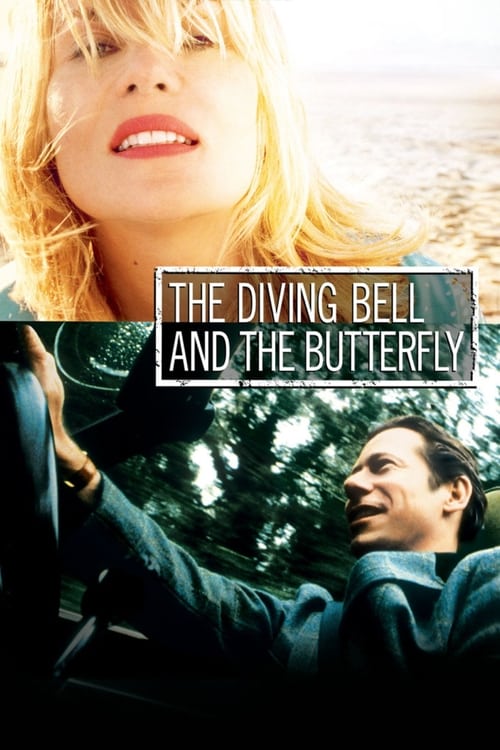
The Diving Bell and the Butterfly
2007 · Julian Schnabel
For when you want a film to chew on for days — one that makes you feel the weight of an ordinary afternoon, a taste, a conversation. Emotionally demanding but ultimately uplifting; the opposite of background viewing.
What it's about
Jean-Dominique Bauby, the worldly editor-in-chief of French Elle, suffers a massive stroke at 43 and wakes into locked-in syndrome: a fully alert mind sealed inside a paralyzed body, able to communicate only by blinking his left eye. With a therapist reciting the alphabet letter by letter, he sets out to dictate an entire memoir one blink at a time. Based on the true story and the book that resulted from it.
The experience
It begins claustrophobic — you're trapped behind his eye with him — and then, improbably, becomes buoyant, funny, and sensually alive as his imagination and memory take flight. It's the rare film about catastrophe that leaves you feeling grateful rather than wrecked.
Performances
Mathieu Amalric plays Bauby from both inside and out — voicing the racing, sardonic inner monologue while his body can offer almost nothing — and makes a nearly motionless man vividly, wittily present.
The craft
Schnabel's audacious choice is to put the camera inside Bauby's skull for the first act: blurred wakings, doctors looming into frame, an eyelid closing over the lens. Janusz Kamiński's swimming, light-drunk cinematography turns subjective limitation into visual freedom, and the film rewards a screen big enough to drown in.
Why it matters
A festival triumph that collected major directing honors and multiple Oscar nominations, it became the benchmark for first-person subjective filmmaking and confirmed painter-turned-director Schnabel as a serious filmmaker.
Snapshot
The Diving Bell and the Butterfly (Le Scaphandre et le papillon) is Julian Schnabel's adaptation of the 1997 memoir dictated, letter by letter, by Jean-Dominique Bauby, the editor-in-chief of French Elle who at 43 suffered a catastrophic brainstem stroke and awoke into "locked-in syndrome": a fully conscious mind sealed inside an almost wholly paralyzed body, able to communicate only by blinking his left eye. The film's central and defining formal wager is to place the camera inside Bauby's skull. For roughly its first act we see, hear, and think from within his single functioning eye — the blurred surfacings from coma, the doctors leaning into frame, the terror of realizing no one can yet tell he is present. From this claustrophobic premise Schnabel builds a paradoxically buoyant work about the two faculties the stroke could not touch: memory and imagination, the "butterfly" set against the "diving bell." It is at once an art film about perception and a broadly humane drama, and it became one of the most acclaimed films of 2007, winning Schnabel the Best Director prize at Cannes.
Industry & production
The film is a French production, spoken in French, but arrived through an unmistakably transatlantic pipeline. It was produced by Kathleen Kennedy — the Spielberg-associated Hollywood producer — together with Jon Kilik (a frequent collaborator with Spike Lee and with Schnabel), under Pathé Renn Productions with France 3 Cinéma, and released by Pathé in France and Miramax in the United States. Bauby's memoir had been a European literary sensation on publication in 1997, its aura intensified by the fact that its author died just days after it appeared; the film rights and their route to Schnabel passed through more than one configuration. It is well documented that the project was at one stage conceived as an English-language film with Johnny Depp attached to play Bauby; scheduling and the shift toward a French-language production ended that iteration, and the change proved decisive — the film's texture is inseparable from its Frenchness and from its largely French cast. Ronald Harwood, fresh from his Oscar for The Pianist, wrote the screenplay in English, which was then rendered into French for the shoot. Principal photography took place in France, notably at the naval hospital at Berck-sur-Mer on the northern coast where Bauby was actually treated, lending the interiors and the wide, cold seafront their documentary authority. Beyond these load-bearing facts the granular production record — budget, precise schedule, day-to-day logistics — is thinly reported in English-language sources, and I will not invent figures.
Technology
The film is a late-celluloid production, shot photochemically on 35mm by a cinematographer, Janusz Kamiński, whose entire aesthetic vocabulary is grounded in the behavior of film emulsion and anamorphic glass rather than digital capture. Its most consequential "technology" is optical and in-camera: the subjective passages depend on lens tricks — rack focus pushed to abstraction, split-diopter and distorting elements, smeared and iris-shaped framings, deliberate flare and defocus — to simulate a damaged, monocular, half-shuttered field of vision. The film's single most discussed image, the surgical suturing of Bauby's failing right eyelid seen from inside as the needle and thread close over the lens, is a practical, in-camera conceit rather than a digital effect, and it announces the film's commitment to rendering subjectivity through the physical apparatus of the camera. Where digital intervention exists it is in service of that same illusion — subtle manipulation of focus fields and framing — rather than as spectacle. The production also exploited real locations and natural coastal light as a technological resource, with the hospital and shoreline supplying an authenticity no set dressing would.
Technique
Cinematography
Kamiński's camerawork is the film's signature achievement and the reason it is studied. The opening reel is a sustained exercise in radical point-of-view: the frame is Bauby's eye, waking, blinking (the image blacks out with each lid-fall), struggling to focus, unable to turn away from faces that crowd too close. The camera lurches, swims, and fogs; sound and image are deliberately unmoored from the stable, "objective" grammar of classical cinema. As the film progresses and Bauby's inner life reasserts itself, Kamiński gradually releases the camera from the eye-socket, cutting to third-person views of the paralyzed body and to luminous, saturated flashbacks and fantasies — beaches, a woman's hair, historical reverie — shot with a warmth and freedom that stand in pointed contrast to the trapped POV. The tension between the imprisoned subjective camera and the liberated imaginative camera is the film's whole visual argument. It is worth noting the collaboration's pedigree: Kamiński is Steven Spielberg's regular director of photography (Schindler's List, Saving Private Ryan), and here he applies that virtuosity to avant-garde, first-person ends.
Editing
Juliette Welfling's editing performs the film's dialectic between confinement and flight. Within the locked-in passages the cutting is patient, even oppressive, holding on the smeared image and letting the labor of a single blink acquire duration and weight. Against this she interleaves flashback, fantasy, and free association with sudden, lyrical mobility, so that the film breathes in and out of Bauby's skull. Crucially, the editing dramatizes the memoir's method of composition: the transcription scenes, in which a helper recites a frequency-ordered French alphabet and Bauby blinks to select each letter, are cut to make an agonizingly slow act legible and even suspenseful, turning the mechanics of communication into drama. Welfling's work was recognized with an Academy Award nomination for editing.
Mise-en-scène / staging
Staging is organized around Bauby's fixed vantage. Because for long stretches he cannot move his head, the world must come to him: characters must position themselves within his narrow cone of sight, lean in, and speak to a face that cannot answer. Schnabel and Kamiński exploit this geometry so that the crowding of visitors, therapists, and doctors into the frame carries the charge of both intimacy and violation. The hospital at Berck grounds the film in a specific, unglamorous institutional reality — corridors, a window onto the gray Channel, a wheelchair pushed along the seafront — while the interior/imaginative sequences open onto expansive, sensuous spaces (the sea, snow, a lavish meal, historical tableaux) that visualize the "butterfly" of the title. Schnabel, a painter by primary vocation, treats these imaginative interludes with a painterly attention to color, surface, and light.
Sound
Sound design is as subjective as the image. In the POV passages we are given Bauby's interior monologue in voice-over — the fluent, wry, articulate self that no one around him can hear — set against the muffled, sometimes distorted external world. The gap between his rich inner voice and the silence others perceive is the film's cruelest and most moving effect, achieved almost entirely through sound. The soundtrack pairs Paul Cantelon's original score with an eclectic selection of pre-existing songs; the film's use of popular and classic recordings (including tracks by U2 and the standard "La Mer," among others) to color memory and desire is characteristic of Schnabel's music-forward sensibility, though listeners should consult the film's cue sheet for the exact placements rather than rely on recollection.
Performance
Mathieu Amalric's performance as Bauby is a feat of constraint: for much of the film he acts with one eye and a voice-over, his face otherwise slack and immobilized, yet he conveys wit, panic, lust, grief, and eventually a hard-won equanimity. The role inverts every ordinary tool of screen acting and Amalric meets it with precise micro-expression and vocal shading. Around him is a deep ensemble of French performers: Emmanuelle Seigner as Céline, the mother of his children; Marie-Josée Croze and Anne Consigny as the therapists whose patience makes the memoir possible; Patrick Chesnais as his physician; and Max von Sydow, in a brief and widely praised turn, as Bauby's aged father, "Papinou," reduced to weeping on the telephone to a son who cannot speak back — a scene many critics singled out as the film's emotional apex.
Narrative & dramatic mode
The film's dramatic mode is subjective memoir made cinematic. It largely abandons conventional plot for a structure of consciousness: present-tense entrapment in the hospital, punctured by memory (a marriage, affairs, children, a self-absorbed pre-stroke life) and by imagination (fantasies of escape, historical reverie, the butterfly and the diving bell as recurring figures). The through-line is not "will he recover" — the tragedy is fixed — but "can he make a self, and a book, from what remains." The narration is confessional and self-aware, often ironic about the vain, philandering man Bauby had been, and the arc bends toward the act of authorship itself: the dictation of the memoir becomes the film's plot, its climax the completion and publication of the book, its coda the fact of his death. It is, in the deepest sense, a film about writing as survival.
Genre & cycle
Nominally a biographical drama and, per its classification, a historical drama, the film sits within several overlapping cycles. It belongs to the disability-and-consciousness subgenre — films that attempt to render an interior state medicine can describe but cinema must feel — and to the "writer's life / making of a book" tradition. It also belongs to a distinctly 2000s cycle of adaptations of European memoirs of extremity and survival, and it shares with Schnabel's own earlier films a recurring subject: the artist (painter, poet, now memoirist) who transmutes suffering and marginality into creation. What distinguishes it from conventional inspirational illness dramas is its formal radicalism; it refuses the genre's usual reassurances of recovery and instead stakes everything on point-of-view.
Authorship & method
The Diving Bell and the Butterfly is the third feature in Julian Schnabel's cycle of films about creative lives — after Basquiat (1996) and Before Night Falls (2000) — and the clearest statement of his authorial project: to make the interior life of an artist visible through painterly, subjective, non-naturalistic image-making. Schnabel came to film from a major career as a Neo-Expressionist painter, and he directs like one, privileging texture, color, and sensation over narrative economy. His method here was profoundly collaborative and dependent on a few key hands. Ronald Harwood's screenplay, adapted from Bauby's memoir, supplies the wit and structural clarity that keep the experiment legible. Janusz Kamiński's cinematography realizes the first-person concept. Juliette Welfling's editing calibrates the rhythm between imprisonment and reverie. Paul Cantelon provides the original score within Schnabel's characteristically curated soundtrack. The decision — reportedly Schnabel's own — to make the film in French with French actors rather than in English is itself an authorial choice, rooting the work in the specific culture of Bauby's Paris and his Elle. The result is unusually unified for so collaborative a medium: every department bends toward the single idea of showing us the world as Bauby saw it.
Movement / national cinema
The film is best understood as a hybrid of French national cinema and international auteur art cinema. Its language, cast, setting, financing (Pathé, France 3), and cultural milieu are French, and it draws on France's deep bench of screen actors; yet its director, its lead producer, its cinematographer, and its screenwriter are all figures of the Anglo-American film world, and its formal ambition aligns it with a transnational tradition of subjective-camera art cinema rather than with any single national school. It does not belong to a named movement so much as to the personal auteurism of Schnabel himself.
Era / period
The film is a product of the mid-2000s, the twilight of the photochemical era, when a filmmaker could still command anamorphic 35mm resources for an art-house drama and when the specialty divisions of major studios (here Miramax in the U.S.) actively distributed prestige foreign-language work to awards audiences. It reflects a moment in which auteur cinema and the awards ecosystem were unusually hospitable to formally daring, non-English drama. Its subject — a media insider from the glossy magazine culture of late-1990s Paris — also fixes it to a specific pre-digital publishing world that its very existence memorializes.
Themes
The governing metaphor gives the film its themes: the diving bell of the paralyzed body and the butterfly of an imagination and memory that remain free. From this spring the film's meditations on consciousness and the irreducible interiority of a self that others cannot reach; on communication as both the most basic human need and, when reduced to a blinking eye, an act of heroic labor; on memory and imagination as forms of freedom and even of escape; on vanity, mortality, and the belated moral reckoning of a man who had lived shallowly; and, above all, on creation as redemption — the conviction that to make a book, even one letter at a time, is to assert a self against annihilation. Fatherhood and the fear of failing one's children (crystallized in the von Sydow phone scene) run beneath the surface throughout.
Reception, canon & influence
Critically, the film was among the most celebrated of its year. Schnabel won the Best Director prize at the 2007 Cannes Film Festival; the film went on to win Golden Globes for Best Director and Best Foreign Language Film, and earned Schnabel and his collaborators a BAFTA for Adapted Screenplay. At the Academy Awards it received four nominations — Director, Adapted Screenplay, Cinematography, and Editing — a striking haul, and one whose omission of Best Picture is itself a much-noted quirk of category eligibility for a French-language film. Reviews singled out Kamiński's cinematography, Amalric's performance, and von Sydow's supporting turn, while a minority of critics found the subjective conceit more brilliant in its first act than sustainable across the whole.
Backward, the film's influences are legible: Bauby's memoir supplies its substance; Schnabel's own Basquiat and Before Night Falls supply its method of visualizing the artist's inner life; and behind its subjective camera lies a long avant-garde and art-cinema lineage of first-person and consciousness-driven filmmaking, filtered through Kamiński's Spielberg-honed craft. Forward, its legacy rests less in a school of imitators than in its standing as the reference point for cinematic renderings of locked-in syndrome and radically subjective point-of-view — the film critics and filmmakers now cite when a work attempts to shoot from inside a character's damaged perception. It consolidated Schnabel's reputation as a serious film director rather than a painter dabbling in cinema, and it remains a fixture in discussions of adaptation, of subjective camera technique, and of how film can dramatize the act of writing. Precise measures of its commercial performance are not something I will cite from memory; its cultural afterlife, however, is secure.
A Deleuzian reading
A surgeon leans in with a needle and thread and begins sewing an eyelid shut.
The full Deleuzian reading of The Diving Bell and the Butterfly →
Reception
A Cannes 2007 sensation — Best Director for Schnabel, four Oscar nods, instant 'best of the year' consensus — and unlike many awards darlings it hasn't faded: it's still routinely cited as a high point of 2000s cinema and, for many, the last time Schnabel was untouchable.
How The Diving Bell and the Butterfly was received, from release to now →
How to watch The Diving Bell and the Butterfly: what to notice on a first viewing
- Notice the picture blacking out every time he blinks. Janusz Kaminski makes the frame Bauby's one working eye. It swims, smears, flares, loses focus at the wrong moment and irises down. The eyelid sewing shut early on was done in camera with glass, not software. A camera has no lid and never tires of a face. Kaminski gives it every weakness an eye has instead of the strengths a lens has.
- Listen to his voice while nobody in the room hears it. The voice-over is quick, funny, vain and entirely intact. The world outside it arrives muffled and slightly wrong. Everyone leaning over the bed is hearing silence. The gap between a full inner voice and the silence others get is the film's cruelest effect, and it is made entirely in the mix.
- Watch how close people put their faces to his. He cannot turn his head, so the world has to come to him. Doctors, therapists and visitors crowd into a narrow cone of sight, lean in and talk at a face that cannot answer. The same geometry produces tenderness and violation. Nobody can approach him without also trapping him.
- Count how long a single blink is allowed to take. Juliette Welfling holds the locked-in passages past comfort, letting the labor of one small movement fill real screen time. Nothing advances during those stretches and nothing is meant to. Duration is the only way to make you feel what a minute costs him. Her cutting was Oscar nominated for exactly this.
- Watch what Amalric does with one eyelid. His face is slack and fixed for most of the film. What is left is an eye and a voice-over, and he gets wit, panic, appetite and grief out of both without any of the usual tools. Screen acting is normally built on a moving face. This performance is built on subtraction.
The whole guide to watching The Diving Bell and the Butterfly, with the keys for a rewatch →
Influences: the films it descends from and the films it influenced
- Un Chien Andalou (1929) — The film's clinical stitching-shut of Bauby's failing eye is a direct in-camera echo of Buñuel's razored eyeball — the Surrealist assault on the organ of vision as the gateway to a subjective, dream-logic image stream.
- Lady in the Lake (1947) — The foundational experiment in sustaining an entire narrative through a first-person camera that literally stands in for the protagonist's eyes — the sight-line conceit Kamiński radicalizes by adding blinks, blur, and a single functioning lid.
- Dark Passage (1947) — Its opening reels lock the camera inside the hero's skull so the world is only ever glimpsed through his gaze — the same 'trapped behind one point of view' staging Diving Bell holds from a fixed vantage on the hospital bed.
- Johnny Got His Gun (1971) — The template for locked-in cinema: a sensorily amputated man whose only life is interior-monologue voiceover set against objective reality, cutting between the sealed present and reverie/flashback exactly as Welfling's editing does.
- Hiroshima mon amour (1959) — Resnais's braiding of murmured interior-monologue voiceover with associative parallel flashbacks established the French art-cinema grammar of memoir-as-memory that structures Bauby's reveries and the toggling between now and remembered.
- Persona (1966) — The casting of Bergman veteran Max von Sydow is a deliberate summoning of Nordic art-cinema interiority, where the face held in extended close-up becomes the landscape of a consciousness that cannot or will not speak.
- Sisters (1972) — De Palma's signature split-diopter — one lens half keeping foreground and deep background simultaneously razor-sharp — is the specific optical device the film borrows to bind Bauby's immobile face to the distant world he can no longer reach.
- Basquiat (1996) — Schnabel's own first attempt to render an artist's inner vision through painterly, non-naturalistic inserts rather than exposition — the method he refines here into a fully subjective camera.
- Before Night Falls (2000) — The immediate precursor in Schnabel's creative-lives cycle: an imprisoned writer whose interior life and act of composition are visualized through voiceover and lyrical, texture-driven imagery, the exact authorial project Diving Bell completes.
- Schindler's List (1993) — Kamiński's Spielberg-honed craft — flaring practical light sources, restless handheld subjectivity, and expressive photochemical contrast — is the technical vocabulary he imports to make Bauby's damaged perception feel physiologically real.
- The Sea Inside (2004) — A contemporaneous portrait of a bedbound quadriplegic whose imagination flies free of the body — the same strategy of intercutting the immobile fixed vantage with soaring imagined escape that lets Diving Bell's butterfly answer its diving bell.
- Love Is the Devil: Study for a Portrait of Francis Bacon (1998) — Builds the protagonist's impaired sight into the apparatus via subjective, optically blurred and distorted POV camera — the heir to Maybury's principle of translating a way of seeing into the lens itself.
- Enter the Void (2009) — Noé pushes the first-person conceit to its limit — a POV camera that blinks, drifts, and even dies with its host — explicitly building on Diving Bell's demonstration that a whole film can be shot from inside a single failing point of view.
- Amour (2012) — Haneke confines a stroke-ravaged woman and her witness to a single apartment, dramatizing post-stroke locked-in decline through restricted vantage and interior stillness — the reference point for which is Bauby's sealed room.
- At Eternity's Gate (2018) — Schnabel returns to the identical method — subjective handheld POV, blurred and split-field lenses distorting Van Gogh's literal sight — making it the direct sequel-in-technique to Bauby's damaged vision within his creative-lives cycle.
- The Theory of Everything (2014) — A prestige biographical drama of progressive physical entrapment that leans on Diving Bell's model for finding cinematic expression of a brilliant mind sealed inside an immobilized body.
- Sound of Metal (2020) — Builds an entire sensory POV of impairment from the inside — camera and sound locked to one damaged perception — the same first-person embodiment strategy Marder uses for deafness.
- Nickel Boys (2024) — Locks the lens to one character's literal eyeline — including blinks, tears, and out-of-focus blur — modeling how a bodily point-of-view can carry a whole narrative of confinement.
- Room (2015) — Makes the camera the boundary of a single consciousness, the subjectivity-first principle Danny Cohen adapts so nearly every shot is limited to what one mind can perceive.
- Maudie (2016) — Models art-as-survival generated from inside a radically confined, disabled body — creativity as the one freedom available within physical constraint, the theme Maudie translates into painting from a single room.
- A Twelve-Year Night (2018) — Builds an entire aesthetic of confined subjectivity — POV camera, imagination and memory as the only escape from an immobilized body — the interiorized 'hallucination as survival' technique the isolated cells demand.
- Knife: The Attempted Murder of Salman Rushdie (2026) — Janusz Kamiński's subjective optics — smeared focus, blinking mattes, a lid sutured shut in POV — make the damaged eye the camera's own condition, the fiction solution Knife answers documentarily with the wounded face held in close-up.
- The Tree of Life (2011) — Malick's privileging of texture, light, and sensory fragment over narrative economy extends the same painter's-eye, non-naturalistic subjectivity Schnabel pursues — image as felt consciousness rather than plot delivery.
- Big World (2024) — Subjective camera locked inside an immobilized body renders disability as interiority rather than spectacle — the POV-of-the-confined-self device Big World echoes to access its protagonist's mind.
Similar films
- At Eternity's Gate (2018) — influence & lineage · often watched together
- The Sea Inside (2004) — influence & lineage
- Before Night Falls (2000) — influence & lineage
- Amour (2012) — influence & lineage
- Basquiat (1996) — influence & lineage
- Hiroshima Mon Amour (1959) — influence & lineage · often watched together
- Talk to Her (2002) — often watched together
- Babel (2006) — shared sensibility
All the films related to The Diving Bell and the Butterfly →