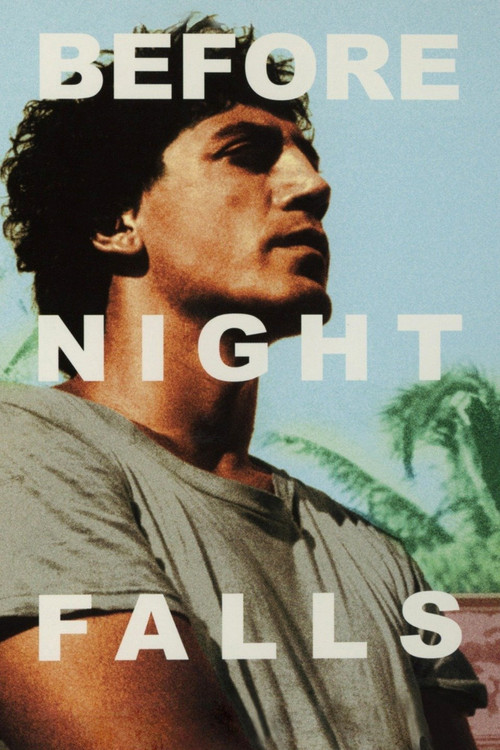
Before Night Falls
2000 · Julian Schnabel
For when you want a serious, beautiful film about a real life — something that stirs outrage and admiration in equal measure. Emotionally demanding rather than cozy; choose it when you're ready to feel something.
What it's about
The life of Cuban poet and novelist Reinaldo Arenas, from a barefoot childhood in the countryside to literary promise in revolutionary Havana — and then persecution, imprisonment, and silencing as an openly gay writer under Castro's regime. It follows his refusal to stop writing, his desperate attempts to get his words out of the country, and his eventual exile to New York. A biography of an artist whose whole existence became an act of defiance.
The experience
Sensuous and harrowing by turns — it moves like memory, drifting between lyrical beauty and real brutality, carried by a voice that refuses self-pity. It leaves you moved and a little shaken, with a fierce sense of what writing can cost.
Performances
Javier Bardem, in his first major English-language role, is extraordinary as Arenas — playful, wounded, defiant — a transformation that earned him an Oscar nomination, the first ever for a Spanish-born actor.
The craft
Painter-turned-director Julian Schnabel composes the film like canvases — tropical light, dream passages, textures you can almost touch — while keeping Arenas's own words at the center. Adapted from Arenas's posthumous memoir, it treats a writer's inner life as something you can see and hear.
Why it matters
It announced Javier Bardem to international audiences and confirmed Schnabel as a filmmaker of substance, becoming a landmark portrait of artistic and gay life under an authoritarian state.
Snapshot
Before Night Falls is painter-turned-director Julian Schnabel's second feature, a biographical portrait of the Cuban writer Reinaldo Arenas (1943–1990) adapted from Arenas's posthumously published memoir of the same name. It follows Arenas from a dirt-poor rural childhood in Oriente province, through his arrival as a young literary talent in revolutionary Havana, into the persecution, imprisonment, and forced silence he endured as an openly homosexual writer under Fidel Castro, and finally to his exile via the 1980 Mariel boatlift and his death from AIDS in New York. Javier Bardem's central performance — his first major English-language role — anchors the film and earned him an Academy Award nomination for Best Actor, the first ever for a Spanish-born actor. The film premiered at the Venice Film Festival, where it took the Grand Special Jury Prize. More than a conventional biopic, it is a sensory, painterly meditation on art-making under tyranny, structured less as a chronology than as a collage of remembered images, recited prose, and bodily sensation.
Industry & production
The film was an independent, internationally financed production that grew directly out of Schnabel's standing in the New York art world rather than out of the studio system. Schnabel — a leading figure of 1980s Neo-Expressionist painting — had directed only one prior feature, Basquiat (1996), and approached Before Night Falls as an artist's project, optioning Arenas's memoir and co-developing the screenplay over several years. A crucial collaborator was Lázaro Gómez Carriles, Arenas's real-life friend and literary executor, who shares screenplay credit and served as a living bridge to Arenas's biography and to the texture of exile life.
Production was modestly budgeted by Hollywood standards and shot largely in Mexico — principally in and around Veracruz — which stood in for pre-revolutionary and Castro-era Cuba, since filming in Cuba itself was not feasible. The Mexican locations, with their tropical decay, colonial architecture, and Caribbean light, allowed Schnabel to evoke Havana and the Cuban countryside convincingly. The casting reflected Schnabel's cross-pollination of art, music, and film circles: alongside Bardem, the film features Olivier Martinez as Lázaro, Andrea Di Stefano as Pepe Malas, and two startling cameos by Johnny Depp — one as the transvestite prisoner Bon Bon and another as the predatory Lieutenant Victor — plus a small role for Sean Penn. The exact financing structure and budget figures are not part of the well-documented public record, and I will not invent them; what is clear is that the film was assembled outside the studio mainstream and depended heavily on Schnabel's personal network and the prestige of the source material.
Technology
Before Night Falls was produced and finished on photochemical film, consistent with turn-of-the-millennium independent practice. Its most distinctive technical choice is the deliberate mixing of image sources and textures: dramatized scenes are intercut and overlaid with archival and pseudo-archival material, grainy stocks, and degraded textures meant to mimic period documentary footage and home movies. This heterogeneity of format is itself the "technology" of the film — Schnabel treats celluloid as a tactile surface, embracing scratches, light leaks, hand-held instability, and shifts in grain as expressive elements rather than flaws. The result is closer to collage or assemblage, the techniques of his painting, than to the seamless transparency of mainstream cinematography. Precise details of cameras and stocks used are not part of the widely available record, and I won't fabricate them.
Technique
Cinematography
The cinematography is credited to Xavier Pérez Grobet and Guillermo Rosas. Their work is characterized by saturated tropical color, intimate handheld framing, and an attention to surface and skin that reflects Schnabel's painter's eye. The camera lingers on textures — peeling walls, water, foliage, sweat, paper — and frequently adopts a subjective, sensory proximity to Arenas's body and gaze. Light is treated as a near-tactile substance, and several sequences move toward abstraction, dissolving the literal into pattern and color. This is a markedly anti-classical visual approach for a biopic: rather than establishing geography and chronology with clean coverage, the film privileges fragmentary, impressionistic images that approximate memory and the act of poetic perception.
Editing
Edited by Michael Berenbaum, the film is structured associatively rather than strictly linearly. It proceeds in episodic movements that correspond to chapters of a life, but within and between them the cutting follows emotional and thematic logic — juxtaposing dramatized action with archival inserts, freeze-frames, and passages of recited prose. The editing repeatedly suspends forward narrative momentum to dwell on images or to let Arenas's words (delivered in voiceover) play over loosely connected visuals. This montage sensibility reinforces the sense that we are inside a writer's remembering consciousness rather than watching an external record of events.
Mise-en-scène / staging
Schnabel's staging foregrounds physicality, sensuality, and the body in space. Crowded Havana interiors, prison cells, rooftops, the sea, and the makeshift spaces of clandestine literary and sexual life are rendered with a feel for lived-in density and decay. The director stages homosexual desire and its repression with frankness, treating bodies as sites of both pleasure and political vulnerability. Period detail is evocative rather than fastidiously archival; the goal is atmosphere and sensation over museum-grade reconstruction. Schnabel's background as a visual artist is everywhere in the compositions, which often resemble framed paintings — balanced, color-keyed, and attentive to the picture plane.
Sound
The sound design integrates Arenas's own writing as a near-constant presence: passages of his poetry and prose are spoken in voiceover, weaving literature directly into the film's texture. Cuban music and ambient tropical sound establish place, while Carter Burwell's score (see below) provides the dramatic underpinning. Language itself is part of the sound strategy — the film is performed largely in accented English, a pragmatic choice for an international production that nonetheless keeps Spanish-language song and speech audible in the mix, preserving a Cuban sonic identity.
Performance
Bardem's performance is the film's center of gravity and its most celebrated element. He charts Arenas across roughly four decades, from exuberant young writer to broken, dying exile, modulating physicality, voice, and bearing without recourse to heavy prosthetic transformation. Critics singled out the performance's interiority — the sense of a creative intelligence persisting under degradation. The supporting performances are deliberately heightened: Depp's dual cameos function almost as theatrical apparitions (the seductive Bon Bon and the menacing Lieutenant Victor are pointedly played by the same star), and Martinez and Di Stefano provide the emotional and erotic counterweights to Bardem's Arenas.
Narrative & dramatic mode
The film operates in a lyrical-biographical mode that resists the rise-and-fall arc of the standard biopic. It is organized as a series of life-chapters, but its dramatic engine is less plot than the friction between a sensual, irrepressible artistic temperament and a state apparatus determined to control it. Voiceover drawn from Arenas's memoir and poetry frames the film as first-person testimony, an act of self-authorship that mirrors the way the dying Arenas dictated and wrote his own life. The mode is elegiac and confessional; key turning points — childhood, literary awakening, arrest, imprisonment, the Mariel exodus, exile, illness — are presented as remembered sensations rather than as causally tight dramatic beats. The ending, framed around Arenas's death, gives the whole the shape of a deathbed recollection.
Genre & cycle
Before Night Falls belongs to the biographical drama and, more specifically, to the cycle of artist biopics — a form to which Schnabel has been singularly devoted, bookended by Basquiat (the painter Jean-Michel Basquiat) before it and The Diving Bell and the Butterfly (2007), about the paralyzed writer Jean-Dominique Bauby, after it. All three are portraits of creators in extremity. The film also sits within the cycle of queer cinema and AIDS-era narratives that gained prominence in the 1990s and early 2000s, and within the broader tradition of films about writers and political dissidents under authoritarian regimes. It self-consciously departs from the genre's conventions by adopting an experimental, painterly aesthetic in place of prestige-biopic polish.
Authorship & method
The film is unmistakably an auteur work, shaped by Schnabel's identity as a painter who imports the methods of visual art — collage, texture, color, surface — into cinema. His method is intuitive and image-driven; he treats the biopic as an occasion for sensory portraiture rather than dutiful chronology, and he repeatedly casts friends and figures from the art and music worlds. Key collaborators extend that authorship: cinematographers Xavier Pérez Grobet and Guillermo Rosas realize the film's tactile, color-saturated look; editor Michael Berenbaum builds its associative rhythm; composer Carter Burwell — best known for his long partnership with the Coen brothers — supplies a restrained, emotionally precise score that contrasts with the film's visual heat. The screenplay is credited to Cunningham O'Keefe, Lázaro Gómez Carriles, and Schnabel, adapting Arenas's memoir; Gómez Carriles's direct connection to Arenas lends the writing biographical authority. Arenas himself functions as a kind of posthumous co-author, since his prose constitutes much of the film's narration.
Movement / national cinema
The film is difficult to assign to a single national cinema, which is part of its identity. It is an American-led, internationally financed production, shot in Mexico, about Cuban history, performed largely in English by a Spanish lead and a multinational cast. In that sense it is a transnational, exile-themed work — fitting for a story about a writer expelled from his own country. It connects to the tradition of Cuban-exile and Latin American testimonial narrative through its source material, while formally it owes more to the gestural, art-world avant-garde sensibility Schnabel brought from New York painting than to any established film movement. It can be read as part of a turn-of-the-millennium American independent cinema that prized directorial signature and hybrid form.
Era / period
Made in 2000, the film arrived at the end of a decade in which queer stories and AIDS narratives had moved closer to the cultural mainstream, and in which independent and art-house cinema enjoyed considerable prestige. Its production coincided with a period of relative openness for unconventional, director-driven biopics. The film's subject matter — Castro's Cuba from the 1959 revolution through the 1980 Mariel boatlift — also gave it a political resonance, recovering a history of state persecution of homosexuals (including the notorious UMAP labor camps of the 1960s) at a moment when that history was still under-narrated in mainstream cinema. Bardem's nomination at the 2001 Academy Awards marked a small but notable moment in the internationalization of Hollywood's acting honors.
Themes
The film's governing theme is the irreconcilable conflict between artistic and erotic freedom and authoritarian control. Arenas's homosexuality and his writing are inseparable expressions of the same ungovernable vitality, and the Cuban state persecutes both as threats. Related themes include: the act of writing as survival and resistance (Arenas continues to produce and smuggle out work even when forbidden to publish); the body as a contested political territory, subject to both desire and punishment; exile and statelessness, and the bitter discovery that freedom abroad brings its own forms of loss; memory and self-authorship, as the dying writer composes his own life; and the entanglement of beauty with suffering. The sea recurs as an image of both longing and escape. Underlying all of it is a meditation on how a regime that claims to liberate can become an engine of repression, and on the cost exacted from those who refuse to be silenced.
Reception, canon & influence
Critically, the film was widely admired, with near-universal praise reserved for Bardem's performance, which transformed his international standing and opened his subsequent English-language career. Its festival reception was strong: it took the Grand Special Jury Prize at the Venice Film Festival, and Bardem's work there was singled out for acclaim, presaging his historic Academy Award nomination for Best Actor — the first for a Spanish actor. Reviews generally credited Schnabel with a distinctive, sensuous visual approach while some noted that the film's impressionistic structure and accented-English performances could feel diffuse or distancing; opinion on the painterly method versus narrative clarity was genuinely divided, and I won't overstate a consensus that didn't fully exist.
Looking backward, the film's influences are layered. Most directly it draws on Arenas's own memoir and poetry, and on the testimonial tradition of writers documenting life under dictatorship. Schnabel's formal vocabulary descends from his Neo-Expressionist painting and from the New York downtown art and music milieu, and his prior film Basquiat established the template of the sensory artist-biopic he refined here. Looking forward, Before Night Falls consolidated Schnabel's identity as a serious filmmaker and led directly to The Diving Bell and the Butterfly (2007), with which it forms a loose trilogy of portraits of creators under physical and political duress; the later film's celebrated subjective camerawork extends the experiments begun here. The film also helped certify Javier Bardem as a major international actor, a trajectory that culminated in his own Oscar wins in later years. Within queer film history and the cinema of exile, it remains a significant, if not universally canonized, work — valued especially for restoring Reinaldo Arenas and the persecution of homosexuals in revolutionary Cuba to cinematic memory. Claims about its precise box-office performance and longer-tail commercial legacy are not something I can document reliably, so I leave them aside rather than invent them.
A Deleuzian reading
By the end Reinaldo Arenas is dying in a cold New York apartment, dictating the sentences we have been hearing all along.
The full Deleuzian reading of Before Night Falls →
Reception
It arrived garlanded — Grand Jury Prize at Venice, an Oscar nod for Bardem — and it's still respected, but it's settled into being 'the middle panel' of Schnabel's artist-biopic run, overshadowed in memory by The Diving Bell and the Butterfly.
How Before Night Falls was received, from release to now →
Influences: the films it descends from and the films it influenced
- Basquiat (1996) — Schnabel's own debut established the painter-director's template he refines here — building a biopic as sensory portraiture of an artist rather than chronology, and casting friends from the downtown art-and-music world in supporting roles.
- Caravaggio (1986) — Jarman, himself a painter, models the queer artist-biopic as a series of painterly tableaux-vivants lit and composed like the subject's own canvases, with frank anachronism standing in for documentary fidelity.
- Lust for Life (1956) — Pioneers using saturated, expressive color and surface as a direct externalization of the painter's psychological state, the chromatic-heat strategy Schnabel inherits via Grobet's tactile palette.
- Mishima: A Life in Four Chapters (1985) — Interweaves a writer's own prose/fiction with a non-chronological biography so the author's texts narrate his life — the literary-voiceover-as-posthumous-coauthorship method Schnabel uses with Arenas's words.
- Andrei Rublev (1966) — Episodic, lyrical portrait of an artist working under tyranny, prizing tactile texture and associative rhythm over plot causality — the 'art under duress' structure rendered as sensory experience.
- Memories of Underdevelopment (1968) — The foundational Cuban first-person essay-film, collaging fiction with documentary fragments and an intellectual's interior voiceover over Havana — the testimonial montage idiom Schnabel draws on for the Cuban material.
- The Last of England (1987) — Builds meaning from degraded Super-8 celluloid collage and free associative montage rather than narrative continuity, the anti-classical celluloid-texture grammar Berenbaum's editing echoes.
- Death in Venice (1971) — Languorous, sensual staging of the desiring artist's gaze on the human body, where beauty and bodily decay are filmed as the subject's aesthetic obsession.
- Kiss of the Spider Woman (1985) — Carries forward the transnational Latin-American story of queer political imprisonment where art and imagination are the means of psychic survival.
- The Diving Bell and the Butterfly (2007) — Completes Schnabel's trilogy of creators under physical/political duress and pushes the subjective-camera experiments begun here into a fully first-person POV trapped inside the subject's body.
- At Eternity's Gate (2018) — Extends the painter-biopic method to Van Gogh via restless handheld, split-focus optics and physical paint-handling, dramatizing how the artist literally sees rather than narrating his career.
- Frida (2002) — Another painter-director-sensibility biopic that dissolves the boundary between life and canvas, animating the artist's paintings into the diegesis as Schnabel imports painterly surface into film.
- I'm Not There (2007) — Carries the impressionistic, non-chronological lyrical-biography form further, treating a creator's life as fragmented associative portraiture rather than a single coherent timeline.
- Pain and Glory (2019) — A sensual, first-person autobiographical portrait of an artist in which color, the body and memory fragments stand in for chronology — extending the lyrical, testimonial artist-self-portrait into Spanish-language cinema with Bardem-era star intimacy.
- Pollock (2000) — A same-year painter biopic centered on the tactile physical process of making the work — the drip, the body's gesture — privileging the act of creation over biographical milestones.
- Love Is the Devil (1998) — Renders Francis Bacon's vision through distorting lenses, mirrors and warped optics so the camera itself paints like the subject — a queer painter-biopic translating canvas into image-distortion.
- Strawberry and Chocolate (1993) — The landmark Cuban film on the persecution of homosexuals under the revolution, sharing the first-person testimonial framing of gay artistic dissent within the same Havana milieu Schnabel reconstructs.
Similar films
- Pain and Glory (2019) — influence & lineage
- At Eternity's Gate (2018) — influence & lineage
- The Diving Bell and the Butterfly (2007) — influence & lineage
- Basquiat (1996) — influence & lineage
- Caravaggio (1986) — influence & lineage
- Memories of Underdevelopment (1968) — influence & lineage
- Biutiful (2010) — shared sensibility
- The Sea Inside (2004) — shared sensibility