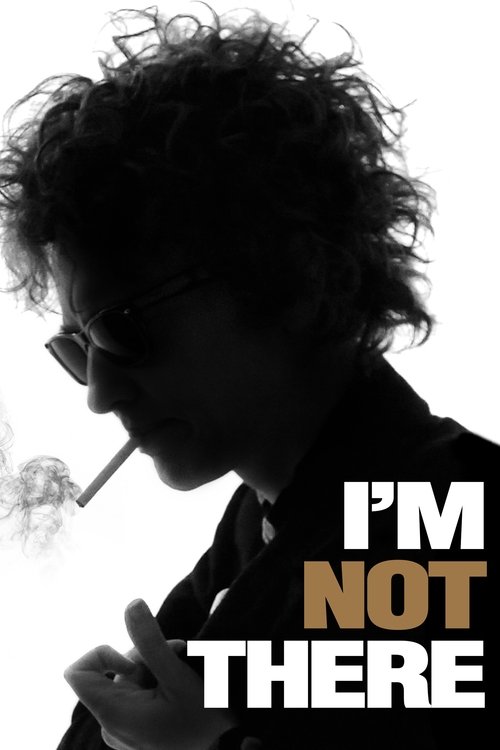
I'm Not There
2007 · Todd Haynes
For when you want a film to chew on for days — a puzzle-box you put together yourself, best when you're up for a challenge rather than comfort. Loving Dylan helps but isn't required; loving the idea that no one is just one person is enough.
What it's about
Six actors — among them a woman, a Black eleven-year-old, and an aging outlaw — each play a different persona of Bob Dylan, none of them named Dylan. The film jumps between their lives: a boy riding freight trains calling himself Woody Guthrie, an earnest protest singer who finds religion, a movie star whose marriage is coming apart, and a wired provocateur going electric while the press circles. Together they trace how one musician kept shedding his skin, and what that cost the people around him.
The experience
Playful, restless, and deliberately disorienting — it swings from dreamy Americana to sharp black-and-white satire to aching domestic drama, sometimes within minutes. You don't follow a plot so much as chase a moving target, and the songs carry you when the story fragments. It leaves you buzzing rather than settled.
Performances
Cate Blanchett is the showstopper as Jude Quinn, the electric-era provocateur — a jittery, uncanny embodiment that goes far beyond impression. Heath Ledger brings real bruised weight to the crumbling-marriage strand, and young Marcus Carl Franklin is effortlessly winning.
The craft
Todd Haynes shoots each persona in its own visual language — grainy black-and-white for the media-circus years, sun-warmed color for the outlaw West, faded home-movie tones for the marriage — so the film feels like six eras of moviemaking stitched into one. The soundtrack is wall-to-wall Dylan, and the whole thing rewards a good sound system as much as a big screen.
Why it matters
It redrew the map for the music biopic, proving you could honor an artist by refusing to pin them down, and it cemented Haynes's reputation as one of the boldest American directors of his generation. Blanchett's Jude Quinn became instantly iconic.
Snapshot
I'm Not There is Todd Haynes's polyphonic anti-biopic of Bob Dylan, built on a deceptively simple structural conceit: six actors, none named "Bob Dylan," embody six refracted personas drawn from different stages of the songwriter's life and myth. Marcus Carl Franklin plays an eleven-year-old Black boy calling himself Woody Guthrie, riding the rails through a folk-Americana dreamscape; Ben Whishaw is Arthur Rimbaud, giving cryptic testimony to an unseen tribunal; Christian Bale is Jack Rollins, the earnest protest-folk star who later resurfaces as the born-again Pastor John; Heath Ledger is Robbie Clark, a film actor whose marriage charts Dylan's domestic life; Cate Blanchett is Jude Quinn, the amphetamine-quick, electric-going, mid-1960s media provocateur; and Richard Gere is Billy the Kid, an aged outlaw hiding out in a mythic frontier town. The film never reconciles these figures into a single self. Instead it treats Dylan as a site of perpetual reinvention and self-erasure — the title, borrowed from an unreleased 1967 Basement Tapes recording, doubles as the film's thesis. It is among the most formally radical films ever made about a living popular artist, and it remains a touchstone for how cinema might represent identity as performance rather than essence.
Industry & production
The film was produced through Christine Vachon's Killer Films, Haynes's longtime production home, with international co-financing that included German sources — a common structure for ambitious American independents of the period seeking to assemble budgets outside the studio system. It was distributed in the United States by The Weinstein Company, then a major force in specialty distribution and awards campaigning. A frequently cited piece of the film's origin is that Haynes secured the rights to Dylan's music by submitting a written statement of his concept to Dylan's representatives, who granted approval; the precise contents and process are not fully documented in the public record, and the safest claim is that Dylan's camp licensed the songs and did not interfere creatively. The casting coup — six name actors, several of them stars — was central to both the film's financing logic and its conceptual payload, since the recognizability of each performer reinforces the idea of Dylan as a series of public masks. Co-written by Haynes and Oren Moverman (who would go on to direct The Messenger), the screenplay was developed over several years of research into Dylan's biography, interviews, and the surrounding critical literature.
Technology
I'm Not There was made at the tail end of the photochemical era for art cinema, and it is emphatically a film shot on film. Cinematographer Edward Lachman, a committed celluloid practitioner, used multiple formats and gauges to differentiate the six narrative strands, exploiting the distinct grain structures, contrast curves, and color renditions of various stocks rather than simulating those looks in post. This is a film whose technological choices are inseparable from its meaning: each Dylan is rendered in a different photographic "language," and the physical materials of capture — high-contrast black-and-white for the Jude Quinn sequences, warmer color emulsions for the Western and domestic strands — carry the burden of period and mode. Digital intermediate finishing was becoming standard by 2007, which would have aided the matching and grading of disparate sources, though the creative emphasis remained resolutely on in-camera, analog texture.
Technique
Cinematography
Lachman's work is the film's most celebrated technical achievement after the performances. The Jude Quinn material is the showpiece: shot in stark, grainy black-and-white with restless handheld framing, it openly evokes D.A. Pennebaker's verité documentary Dont Look Back and the European art cinema Dylan was steeped in — Fellini's 8½ above all, with its harried artist besieged by acolytes and journalists. The Billy the Kid sequences adopt the dusty, golden widescreen palette of 1970s revisionist Westerns, a pointed reference given Dylan's own appearance in and scoring of Peckinpah's Pat Garrett and Billy the Kid. The Woody Guthrie strand is bright and storybook-mythic, the Robbie/Claire domestic drama is keyed to the naturalistic grain of New Hollywood relationship films, and the Rimbaud testimony is shot in cool, fixed, interrogation-room compositions. Shifting aspect ratios and lighting grammars make the film a compendium of mid-century and 1970s visual styles, each chosen as historical citation rather than decoration.
Editing
Jay Rabinowitz — whose credits include Aronofsky's Requiem for a Dream and Jarmusch's Dead Man — cut the film associatively rather than chronologically. The six strands are interwoven by rhyme, echo, and thematic adjacency: a gesture, a lyric, a color, or an idea in one persona's story triggers a cut to another. The editing refuses the cause-and-effect spine of conventional biography, so that the "life" emerges as a constellation rather than a line. This is the structural engine that makes the conceit legible; the cutting teaches the viewer how to read parallel selves without expository hand-holding.
Mise-en-scène / staging
Each world is built as a self-contained period reconstruction. The Jude Quinn sequences stage the famous 1965–66 collisions — the electric betrayal felt by folk purists, the adversarial press conferences, the entourage — with art-cinema theatricality, including surreal interpolations (a Beatles-like idyll, an executioner's imagery) that externalize Dylan's mythology. The Billy the Kid town of "Riddle" is a frontier never-never-land populated by Americana grotesques, where Halloween costumes and a flooding river give the Basements-era retreat a fairytale-apocalyptic charge. Production and costume design across the strands function as historical argument, locating each Dylan in a precise cultural moment.
Sound
The soundtrack braids Dylan's own recordings with newly commissioned covers, the latter overseen by Hal Willner and performed by a roster of contemporary artists; Dylan's original recording of "I'm Not There" surfaces over the end credits, closing the film with the actual unmasked voice it has spent two hours circling. Needle drops are used as period markers and as commentary, while passages of mock-documentary voiceover and direct address (especially in the Jack Rollins strand) thread an interpretive narration through the fragments.
Performance
Cate Blanchett's Jude Quinn is the film's gravitational center and its most discussed element — a cross-gender impersonation that captures Dylan's mid-60s physical vocabulary (the coiled posture, the deflecting wit, the sunglasses-and-cigarette hauteur) without lapsing into mere mimicry. The performance was widely honored. Marcus Carl Franklin's young Woody is disarming and sly; Bale traces a two-stage arc from protest sincerity to evangelical fervor; Gere brings weathered melancholy to the outlaw in retreat; Ledger gives the most conventionally dramatic, emotionally exposed turn as the failing husband; and Whishaw supplies the aphoristic Rimbaud who functions as a kind of chorus. Supporting players — Charlotte Gainsbourg as Claire, Julianne Moore as a Joan Baez–like folk elder, David Cross as a Ginsberg figure — anchor the personas in a recognizable cultural milieu.
Narrative & dramatic mode
The film is non-linear, fragmented, and polyphonic. It abandons the biopic's organizing fiction of a coherent developing self in favor of six parallel, intercut narratives operating in different registers — verité satire, Western elegy, domestic realism, folk fable, poetic testimony. Several strands are framed as documentary or testimony, foregrounding unreliability: we are watching mediated accounts, legends, and self-fashionings rather than transparent truth. The dramatic mode is essayistic and allusive, demanding that the viewer assemble meaning across the gaps. This refusal of unity is not a flaw to be overcome but the film's central proposition about its subject.
Genre & cycle
I'm Not There is a musical biopic that systematically dismantles its own genre. It arrived in the immediate wake of a 2000s wave of prestige music biopics — most prominently Ray (2004) and Walk the Line (2005) — whose formula of rise, fall, and redemptive recovery had become an awards-season template (later parodied directly by Walk Hard, released the same year as Haynes's film). Haynes's film reads as a deliberate negation of that formula: no birth-to-glory arc, no single embodied star, no epiphany. It belongs instead to a smaller cycle of deconstructive or fragmented biographical films and connects directly to Haynes's own earlier pop-music experiments.
Authorship & method
The film is a near-perfect distillation of Haynes's career-long preoccupations. From Superstar: The Karen Carpenter Story (1987), which staged a pop biography with Barbie dolls, through Velvet Goldmine (1998), a glam-rock fantasia explicitly modeled on Citizen Kane's fractured-portrait structure, Haynes has repeatedly treated the pop biography as impossible — identity as costume, authenticity as another performance. I'm Not There extends that thesis to its most rigorous form. His method is pastiche-as-criticism: each strand quotes a film tradition (Pennebaker, Fellini, Peckinpah, New Hollywood) so that style itself becomes the analytic instrument. Key collaborators are essential to the result and recur across his work: cinematographer Edward Lachman (also of Far from Heaven and later Carol), producer Christine Vachon and Killer Films, and co-writer Oren Moverman. Editor Jay Rabinowitz gives the conceit its rhythmic coherence, and music coordinator Hal Willner curates the sonic dimension. Haynes's authorship lies precisely in orchestrating this distributed, citational approach into a single argument.
Movement / national cinema
The film sits within American independent cinema and the specialty-distribution ecosystem of the 2000s, financed and released outside the studios proper but with substantial resources and stars. Haynes is among the central figures of New Queer Cinema, the early-1990s movement his Poison (1991) helped define, and although I'm Not There is not a queer film in subject, its interest in fluid, performed, non-essential identity — crystallized in Blanchett's gender-crossing — carries that movement's intellectual DNA. As a production it was a US–German co-financed venture, reflecting the transnational assembly typical of ambitious American indies of the era.
Era / period
Released in 2007, the film belongs to a late-celluloid moment of the American auteur working within prestige independent distribution, here under The Weinstein Company's awards machinery. Its formal audacity was enabled by the conjunction of a well-known director, bankable stars willing to take small fragmentary roles, and a distributor positioned to campaign a difficult film. It is also a period piece about the 1960s made with the retrospective knowledge of how thoroughly that decade had been mythologized — a film about memory and legend as much as about events.
Themes
The governing theme is identity as a series of reinventions, with no stable core to recover — Dylan as a man who escapes every category (folk savior, electric apostate, recluse, convert) the moment it threatens to define him. Surrounding this are the film's enduring concerns: authenticity and its impossibility in a mediated culture; the relationship between the artist and the audiences and movements that lay claim to him; political commitment versus withdrawal (the protest singer who refuses to be a spokesman); fame as a machine that demands and devours personas; and the persistent American mythologies — the frontier, the open road, the self-made man — that Dylan both inhabited and exploded. The casting of a child, a woman, and a Black boy among the Dylans makes explicit that the "real" figure is a cultural construction available for endless reauthorship.
Reception, canon & influence
The film premiered at the Venice Film Festival in 2007, where Cate Blanchett won the Volpi Cup for Best Actress, and traveled the prestige festival circuit. Critical reception was strong if divided: many reviewers praised its ambition, Lachman's cinematography, and especially Blanchett's performance, while some found the fragmentary structure cold or alienating — a reasonable split for a film that withholds the emotional throughline audiences expect from biography. Blanchett's turn drew the widest acclaim, earning a Golden Globe and an Academy Award nomination for Best Supporting Actress, a notable recognition for a cross-gender performance. (Precise box-office figures are not summarized here; the film was a specialty release rather than a wide commercial play.)
In terms of influences on the film, the lineage is unusually legible because Haynes makes it visible: Pennebaker's Dont Look Back, Fellini's 8½, Peckinpah's Pat Garrett and Billy the Kid, the conventions of the 1960s protest-folk documentary, and — at the level of structure — the Citizen Kane model of a subject approached through multiple irreconcilable testimonies, which Haynes had already adapted in Velvet Goldmine. Looking forward, the film's clearest legacy is conceptual: it stands as the definitive demonstration that the music biopic can be deconstructed rather than dutifully fulfilled, and it sharpened the critical vocabulary of the "anti-biopic." Subsequent biographical films that introduced overt fantasy, fractured chronology, or anti-realist devices — the musical-fantasy framing of Rocketman, the deliberately destabilized portraiture of Blonde — operate in a space I'm Not There helped legitimize, though direct lines of causation are difficult to prove and should be treated as kinship rather than documented influence. Within Haynes's own filmography it is widely regarded as a major statement, the fullest realization of the identity-as-performance thesis that runs from Superstar through Velvet Goldmine, and it remains a frequent reference point in scholarship on biography, adaptation, and the limits of cinematic representation of a self.
A Deleuzian reading
Start with the lie that opens the film: a credit telling you this is inspired by the music and many lives of Bob Dylan, and then two hours in which the name "Bob Dylan" is never once spoken.
The full Deleuzian reading of I'm Not There →
Reception
Critics swooned in 2007 (and Blanchett collected trophies) while plenty of casual viewers walked out baffled — but its stock has only risen, and every time a paint-by-numbers music biopic drops, this gets held up as the road not taken. The A Complete Unknown discourse of 2024 practically resurrected it as Exhibit A.
How I'm Not There was received, from release to now →
Influences: the films it descends from and the films it influenced
- Citizen Kane (1941) — Supplies the structural template Haynes splinters: a subject reconstructed through multiple irreconcilable witness testimonies rather than a single authoritative arc, here exploded into six discrete personae.
- 8½ (1963) — The Jude Quinn strand reproduces Fellini's reflexive artist-besieged surrealism — the harried celebrity fleeing press and hangers-on through dreamlike, fourth-wall-aware tableaux.
- Dont Look Back (1967) — The Blanchett strand directly reenacts Pennebaker's handheld direct-cinema vérité — grainy B&W, press-conference sparring, the touring musician filmed fly-on-the-wall.
- Pat Garrett and Billy the Kid (1973) — The Billy/Richard Gere strand borrows Peckinpah's elegiac slow-motion New Hollywood Western register — the aging outlaw in a vanishing frontier (Dylan himself scored Peckinpah's film).
- Mishima: A Life in Four Chapters (1985) — Splits a biography into formally distinct chapters each shot in its own visual register, the multi-mode portrait Haynes radicalizes by assigning each mode a different actor.
- 32 Short Films About Glenn Gould (1993) — Renders a musician's life as discrete, tonally varied vignettes rather than a continuous causal arc — fragmentation as the honest form for an elusive artist.
- F for Fake (1973) — Essayistic interrogation of authenticity, forgery, and the constructed self that underwrites Haynes's authenticity-as-performance thesis.
- Superstar: The Karen Carpenter Story (1987) — Haynes's own pop-biography-as-impossible, staging a star's interior life through a deliberately non-literal proxy (Barbie dolls) instead of mimetic impersonation.
- Velvet Goldmine (1998) — Haynes's earlier glam-rock biography explicitly built on Kane's fractured-portrait structure, using invented surrogate personae to evade a real subject's likeness rights and literalism.
- A Hard Day's Night (1964) — Source of the B&W pop-documentary kineticism and jump-cut wit the Blanchett strand pastiches as period idiom.
- 24 Hour Party People (2002) — Reflexive, fourth-wall-breaking music biography that openly ironizes the genre's truth-claims and the unreliability of the legend being told.
- Almost Famous (2000) — Deconstructed rock biography that extends Almost Famous's core problem—who has the authority to narrate a musician's story—by fracturing the single perspective into six; Haynes pushes the period-documentary visual simulation (16mm stocks, archival formats) further and more self-consciously than Crowe's warmer nostalgic treatment allows.
- Love & Mercy (2014) — Splits a single musical subject across two actors and two eras with discontinuous chronology, extending the one-life/many-bodies device into the mainstream biopic.
- Rocketman (2019) — Abandons literal realism for overt musical-fantasy set-pieces, operating in the anti-realist biopic space I'm Not There legitimized.
- Blonde (2022) — Destabilized star-portraiture mixing aspect ratios, B&W and color, and dream logic to refuse a stable biographical truth about its subject.
- Steve Jobs (2015) — Biography built as a fractured triptych that refuses cradle-to-grave continuity, dramatizing the self through repeated stylized confrontations rather than linear record.
- A Complete Unknown (2024) — Haynes's formal device of fragmenting Dylan's biography across six actors is the theoretical limit ACU navigates against — both films share the thesis that Dylan's identity is constitutively evasive, but Mangold's classical unity of character is meaningful only against Haynes's experimental dispersal.
- Latin Blood – The Ballad of Ney Matogrosso (2025) — Splinters a single musician into multiple embodied registers of self, treating performance itself as the narrative rather than a chronological life — the model for Latin Blood building story out of Matogrosso's stage personae.
- Control (2007) — Same-year music biopic using stark, photographer's monochrome to mythologize a singer — a contrasting case where style, not casting, becomes the interpretive instrument.
- Wonderstruck (2017) — Haynes/Lachman multi-format celluloid taken further — intercutting a B&W silent-era strand with a color 1970s strand, each in its period's film stock and grammar.
- Walk the Line (2005) — A deliberate anti-biopic riposte to the Ray/Walk the Line formula, fracturing one musician across six actors to reject the linear rise-fall structure Mangold embraced.
Similar films
- Velvet Goldmine (1998) — influence & lineage
- Superstar: The Karen Carpenter Story (1987) — influence & lineage
- A Complete Unknown (2024) — shared sensibility
- TÁR (2022) — shared sensibility
- Nashville (1975) — shared sensibility
- Carol (2015) — shared sensibility
- One Battle After Another (2025) — shared sensibility
- Babel (2006) — shared sensibility