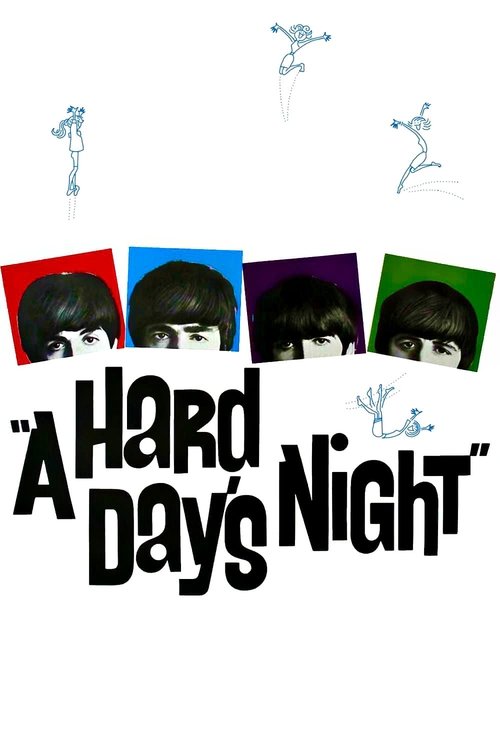
A Hard Day's Night
1964 · Richard Lester
For when you need a shot of pure happiness — a light, funny watch that leaves you grinning and humming. Total comfort, zero homework.
What it's about
One frantic day with The Beatles at the peak of the 1964 madness: John, Paul, George and Ringo dodge screaming fans, fend off the press, and try to make it to a live television broadcast in one piece. Complicating everything is Paul's grandfather, a very clean-looking old troublemaker who stirs up chaos wherever the band leaves him unattended. It plays like a documentary of a day that never happened — trains, hotel rooms, press conferences, and stolen moments of escape.
The experience
Fast, cheeky, and endlessly quotable, it moves like the music — all forward motion and deadpan one-liners. Even sixty years on it feels young, and the songs land with a jolt of pure joy.
Performances
The Beatles play themselves with startling natural wit — John Lennon's needling sarcasm and Ringo Starr's woebegone solo wander are genuinely fine comic acting, not just star presence. Wilfrid Brambell steals scenes as Paul's anarchic grandfather.
The craft
Richard Lester shoots the band with handheld cameras, jump cuts and playful angles borrowed from the French New Wave, inventing on the fly a visual grammar for pop music on screen. The black-and-white photography is crisp and alive, and the soundtrack — wall-to-wall early Beatles — rewards good speakers as much as any concert film.
Why it matters
It essentially invented the music video's vocabulary and the rock mockumentary, and turned a cash-in exploitation picture into one of the defining films of the 1960s. Its influence runs through every band-on-the-run comedy and pop documentary since.
Snapshot
A Hard Day's Night arrives at the precise intersection of pop-cultural eruption and cinematic restlessness. Shot in six weeks on a modest budget by an American director working in Britain, it was commissioned as an opportunistic exploitation picture and emerged as one of the defining formal documents of 1960s cinema — a film that redefined how music, image, and performance could cohabit on screen. Its black-and-white frames pulse with a borrowed vitality from the French New Wave and British Free Cinema while transmuting that energy into something entirely new: a comedy about celebrity that takes its subjects seriously as comic performers, a documentary that is wholly staged, a pop artifact that doubles as formal experiment. The influence it cast over music video, mockumentary, and the broader grammar of popular-culture cinema remained legible for decades.
Industry & Production
United Artists financed A Hard Day's Night through its London operation, expecting a quick return on Beatlemania before the moment passed. The logic was explicitly exploitative: get a film into theaters while the hysteria was still warm. Producer Walter Shenson negotiated a deal that gave the Beatles a percentage of profits, a provision that would prove enormously lucrative. The budget was minimal — reliably reported in the low six figures in pounds sterling — and the shooting schedule was compressed to approximately eight weeks of principal photography, beginning in late February 1964 and wrapping in late April, with the Beatles shooting around press obligations and personal appearances.
The studio's low expectations paradoxically granted Lester unusual creative latitude. No one at United Artists was invested enough to micromanage a small pop vehicle, so Lester, writer Alun Owen, and cinematographer Gilbert Taylor were left to make the film they wanted within their constraints. Owen, a Welsh playwright best known for television drama, spent time traveling with the Beatles before writing the script, absorbing their speech patterns, their humor, and the texture of their perpetual enclosure — in hotels, trains, backstage corridors — as much as their public performances. The result was a screenplay that sounded genuinely inhabited rather than ghostwritten.
The Scala Theatre in Charlotte Street, London, served as the primary concert and TV studio location. Train sequences were shot on actual British Rail services, lending the film's opening chase a logistical spontaneity that no set could have replicated. Other London locations — Paddington Station, various streets and rooftops — were used with the improvisational pragmatism of the nouvelle vague rather than the controlled geography of the studio system.
Technology
Gilbert Taylor shot the film in 35mm black and white, a choice that was partly economic and partly aesthetic. Lester and Taylor were drawn to the look of newsreel, cinéma vérité, and the handheld grammar of the Free Cinema documentaries, and black and white was the native medium of that vocabulary. Color would have pushed the film toward the slick surfaces of conventional pop entertainment; monochrome kept it tethered to immediacy and grain.
The camera work made extensive use of handheld Arriflex cameras, allowing the crew to follow the Beatles into tight corridors, crowded train carriages, and on-stage amid real-scale chaos. Taylor and Lester also deployed longer telephoto lenses to capture crowd reactions at a remove — a technique borrowed from documentary practice that made the Beatlemania sequences feel genuinely uncontrolled even when they were staged. The famous field sequence, shot at Thornbury Playing Fields in Isleworth to the track "Can't Buy Me Love," used multiple camera positions and fast telephoto work to give the impression of surveillance or reportage rather than choreography.
The sound workflow was equally unconventional by mainstream British film standards. The Beatles' performances were pre-recorded — standard practice for the period — but the lip-sync sequences were cut with unusual precision and rhythmic intelligence. The relationship between the recorded sound and the edited image was treated as a compositional problem rather than a technical one.
Technique
Cinematography
Taylor's cinematography refuses the stable, carefully-lit compositions of British studio cinema of the period. The camera moves frequently without telegraphing its movement — panning, following, pulling back — in a way that suggests reactive observation rather than planned mise-en-scène. Close-ups of the Beatles' faces are held long enough to catch genuine microexpressions: John Lennon's flicker of contempt, Ringo's deadpan bewilderment. The depth of field is often shallow, isolating performers from their environments in a way that reads simultaneously as portraiture and instability. The visual contrast is high, the shadows deep and graphic, at times recalling the German Expressionist lighting that had bled into British thriller cinematography — but used here not for menace but for dynamic energy.
Editing
John Jympson's editing is among the most imitated sequences of work in postwar British cinema. The film cuts with a syncopation derived from the Beatles' own musical phrasing — cuts that land on beats, on chord changes, on the rhythmic accents of Ringo's snare — but also violates that pattern deliberately, introducing jump cuts and ellisions that disrupt the viewer's expectation of continuity. The influence of Godard's A bout de souffle is audible in the editing rhythm even where it isn't visible in any direct quotation. Scenes are entered and exited at unexpected points; dialogue is cut mid-sentence when the dramatic energy has already transferred; the conventional establishing-shot grammar is largely abandoned. The overall tempo has the quality of music itself: it varies, breathes, syncopates.
Mise-en-scène / Staging
Lester's staging is conspicuously anti-theatrical. Rather than blocking performers for camera coverage in the way a stage-trained director might, he tends to place the camera where it can observe rather than frame. Groups form and dissolve naturally; the Beatles are frequently caught mid-gesture, mid-laugh, at the edge of the frame. When the film does stage a formal sequence — the television concert, the press conference — it uses the formality as a foil for anarchic disruption. The press conference scene, in which the Beatles field absurd questions with deadpan non-answers, is staged like a theatrical sketch but shot like a documentary, the camera seeming to catch the comedy as it happens rather than compose around it.
Sound
The sound design distinguishes between the diegetic world — the screaming crowds, the train sounds, the backstage bustle — and the musical numbers with unusual clarity. The songs arrive in the film as interludes of pure formal pleasure, the documentary grammar temporarily suspended in favor of something closer to abstraction. This structural separation, which Lester handles by letting the editing become more openly musical during performance sequences, anticipates the montage logic of the pop promo video. The decision to use recorded playback rather than live performance was standard, but the integration of that playback into a visually mobile aesthetic was not.
Performance
The Beatles were not trained actors, and Lester made no attempt to disguise this — instead, he constructed situations that allowed their natural performance modes to function as acting. Lennon's sardonic detachment, McCartney's easy charm, Harrison's dry deflection, Starr's hangdog gravity: these are not characters built from dramatic technique but recognizable personas shaped by celebrity into legible comic archetypes. Wilfrid Brambell's performance as Paul's grandfather — introduced via the running gag that he is "very clean," an ironic inversion of his persona as the decrepit Steptoe in the BBC sitcom Steptoe and Son — is pitched at a different register, more knowingly theatrical, and functions as a structural counterweight to the Beatles' naturalism. Victor Spinetti's harried television director and Norman Rossington's put-upon road manager Norm similarly provide professional comic scaffolding around the band's looser improvisatory energy.
Narrative & Dramatic Mode
The film adopts the form of a day-in-the-life chronicle, moving from a morning train journey to London through rehearsals, attempted escapes, a brief imprisonment of Ringo, and a climactic live television broadcast. This narrative arc is minimal — not much happens in a causal sense — and the film uses that thinness deliberately. The plot exists to move the Beatles through a succession of situations that expose their public identities to comic pressure. It is closer to the picaresque or to variety-show structure than to conventional dramatic narrative: a sequence of scenes in which the same characters encounter different obstacles, with each scene complete in itself.
The dramatic mode oscillates between satire and celebration. The film is aware of the absurdity of Beatlemania — the pursuing fans, the commercial machinery, the confinement that celebrity imposes — but it is never cruel about it. The Beatles are shown as simultaneously in command (wit, intelligence, solidarity) and imprisoned (unable to move freely, always performing). This ambivalence gives the film a melancholy undertow that its frenetic surface periodically reveals.
Genre & Cycle
A Hard Day's Night sits at the intersection of several genre traditions without belonging entirely to any. It draws on the British musical comedy tradition of Gracie Fields and the Ealing comedies; it participates in the pop-exploitation cycle that ran from early rock-and-roll pictures through American International Pictures releases; it borrows the form of the rockumentary before that form fully existed; and it inaugurates what might be called the pop-star picaresque, a genre of films in which the internal life of celebrity is made legible through comic incident.
The film is also a direct contributor to the British New Wave cycle, though it arrived after the cycle's acknowledged masterworks (Room at the Top, Saturday Night and Sunday Morning, This Sporting Life) and registered as something adjacent rather than central to that movement. Its use of working-class authenticity, location shooting, and improvisatory performance placed it in dialogue with that tradition even as its genre affiliations pulled it elsewhere.
Authorship & Method
Richard Lester was born in Philadelphia and trained at the University of Pennsylvania, arriving in Britain in the early 1950s to work in television. His short film The Running Jumping & Standing Still Film (1959), made with Peter Sellers and Spike Milligan, was nominated for an Academy Award and demonstrated his facility with anarchic physical comedy and anti-narrative form. A Hard Day's Night confirmed him as a major directorial talent and led directly to Help! (1965), also with the Beatles, and The Knack...and How to Get It (1965), for which he won the Palme d'Or at Cannes.
Alun Owen's screenplay is one of the most important contributions to the film. Owen was a careful observer of social class and regional identity, and his dialogue captures the Beatles' Liverpool vernacular without condescension or exoticism. The script's humor operates through non-sequitur, deflation, and absurdist logic — the press conference scene is a direct demonstration of Owen's technique — and it created a model for how pop performers could be written without losing either comedy or credibility.
Gilbert Taylor subsequently photographed Polanski's Repulsion (1965) and, much later, Star Wars (1977), but his work on A Hard Day's Night represents one of the most influential applications of documentary visual grammar to a fiction film in British cinema. Editor John Jympson's contribution to the film's rhythmic identity is substantial, and his subsequent career suggests he understood what he had participated in.
George Martin served as musical director and arranger for the film's soundtrack. His contribution cannot be overstated: the recordings capture the Beatles at a moment of unforced vitality, and Martin's production choices — dry, close, present — suited both the acoustic properties of the musical performances and Lester's visual aesthetic of proximity and movement.
Movement / National Cinema
A Hard Day's Night occupies a complex position within British cinema of the 1960s. It is formally in dialogue with the British New Wave — its location photography, its interest in working-class experience (albeit celebrity working-class), and its improvisatory surface all echo the Free Cinema documentaries and the Woodfall Film productions — but its commercial origins and pop-cultural subject matter placed it outside the critical framework within which those films were received and evaluated.
More accurately, the film belongs to a specific mid-1960s London current that included the Boulting Brothers' satirical comedies, the Carry On series (which it gently parodies), and the emergent youth cinema associated with producers like Michael Klinger and directors who had moved between television and film. Lester's American training and his absorption of French New Wave technique made his British films a kind of cultural hybrid: neither the heritage cinema nor the kitchen-sink drama, but something faster, more irreverent, and more globally legible.
Era / Period
The film was made in and documents a very specific cultural moment: early 1964, immediately after the Beatles' first American tour and appearance on The Ed Sullivan Show, at the height of first-wave Beatlemania and before the pressures of that fame had begun to show. The energy of the film — its sense of running, of things happening too fast, of joy and exhaustion coexisting — reflects this moment's particular texture. Within a year, the Beatles would stop touring. The film thus functions as a document of an unrepeatable condition.
The mid-1960s context also situates the film's formal restlessness. The French New Wave was barely four years old; the British New Wave was still producing major works; cinema had not yet processed what television was doing to its audience. A Hard Day's Night participated in an active renegotiation of what film style could be and whom it could address.
Themes
The film's most sustained thematic concern is the relationship between performance and selfhood under conditions of extreme celebrity. The Beatles are never not being watched — by fans, press, television cameras, the audience within the film and outside it — and the film investigates what survives of individual identity under that surveillance. The field sequence, in which the Beatles escape their handlers to run and play to "Can't Buy Me Love," reads as a fantasy of unobserved selfhood: briefly, they are not performing. That the sequence is entirely staged — the most choreographed in the film — is the joke and the point simultaneously.
A secondary thematic current concerns the machinery of entertainment and its dehumanizing tendencies. The television director, the press, the tour managers: all impose structures on the Beatles that reduce them to product. The film is aware of this critique even as it participates in and profits from the same process. Ringo's subplot — he wanders into London alone, is arrested, and is briefly lost to the performance apparatus — is the film's most overtly melancholic examination of this theme.
There is also a persistent satirical attention to class. The Beatles' wit functions as a weapon against those who condescend to them (the suited businessman on the train, the TV producer), and the film consistently rewards irreverence toward institutional authority.
Reception, Canon & Influence
Critical reception: Reviews on release were largely enthusiastic and often surprised. Bosley Crowther in the New York Times acknowledged the film's vitality and Lester's formal inventiveness, though American critical frameworks of the period were not always equipped to evaluate what the film was doing. British critics were warmer, and some recognized immediately that the film had done something formally significant. Over subsequent decades, the critical consensus has moved from admiration to canonization: the film now routinely appears on lists of essential British cinema and is consistently cited as the founding text of the music video aesthetic.
Influences on the film (backward): The debt to Godard's À bout de souffle (1960) is clearest in the editing rhythm and the use of jump cuts. Lester and Taylor were also in dialogue with the British Free Cinema documentaries — Humphrey Jennings's lyrical non-fiction, Lindsay Anderson's O Dreamland, Karel Reisz's We Are the Lambeth Boys — particularly in the interest in observational texture and the documentary surface. The physical comedy owes something to Buster Keaton and to the Goon Show tradition of anarchic British radio humor. The film's treatment of enclosure and celebrity also anticipates, but more likely shares common sources with, Fellini's 8½ (1963), which was released one year earlier and similarly concerned the texture of creative and public life under pressure.
Legacy and forward influence: The most direct and far-reaching legacy of A Hard Day's Night is the music video. The field sequence to "Can't Buy Me Love" is conventionally cited as the first music video in the modern sense — a self-contained visual interpretation of a song that exists independently of narrative function. The film's overall approach — cutting musical performance to the rhythm of the music, using the images to amplify the song's emotional register — provided the template that MTV would eventually industrialize.
The film's influence on the mockumentary tradition is equally substantial. Bob Rafelson and Bert Schneider explicitly modeled The Monkees television series on A Hard Day's Night, and the 1968 Monkees film Head (which Rafelson directed) can be read as a direct, more psychedelically distorted riposte. D.A. Pennebaker acknowledged the film's influence when making Don't Look Back (1967), his observational documentary of Bob Dylan's British tour; the two films are in sustained dialogue, Pennebaker's documentary borrowing from Lester's fiction the grammar of celebrity surveillance. This Is Spinal Tap (1984) is unthinkable without A Hard Day's Night, and the entire subsequent tradition of music-world mockumentary — from The Rutles (1978) onward — descends from it.
Richard Lester's own subsequent career was shaped by the methods developed here: the quick-cut editing, the use of physical comedy within location realism, the anarchic relationship to narrative. The Knack and How to Get It (1965) and Petulia (1968) extended these techniques into more explicitly dramatic contexts, and Lester remained one of the most formally distinctive directors working in English-language cinema through the 1970s.
The Criterion Collection's restoration and release of the film placed it definitively within the canon of world cinema; the Library of Congress added it to the National Film Registry. Its standing as both a pop-cultural artifact of extraordinary historical specificity and a film of genuine formal intelligence has, if anything, grown over time.
A Deleuzian reading
The fire door bangs open and the four of them spill out into an open field.
The full Deleuzian reading of A Hard Day's Night →
Reception
Everyone expected a quickie cash-in on a pop fad; instead critics swooned — Andrew Sarris famously called it 'the Citizen Kane of jukebox musicals' — and sixty years on it's canonized as the film that taught pop music how to look on screen.
How A Hard Day's Night was received, from release to now →
Influences: the films it descends from and the films it influenced
- À bout de souffle (1960) — Jympson's jump cuts and mid-dialogue ellipses derive directly from Coutard and Godard's editorial grammar: cuts that exit scenes before their dramatic logic resolves, violating continuity to transfer rhythmic energy rather than narrative information, a technique AHDN absorbed and synchronized to musical phrasing.
- Primary (1960) — Drew, Leacock, and Pennebaker established the handheld celebrity-in-transit grammar — following subjects through hotel corridors, cars, backstage corridors, and crowd gauntlets — that Lester and Taylor appropriated wholesale as AHDN's fictional documentary register.
- Momma Don't Allow (1956) — British Free Cinema's application of black-and-white handheld observational grammar to youth music subculture — a jazz club shot with available light and non-actor participants — is the aesthetic and sociological template Gilbert Taylor and Lester directly inherited for AHDN's anti-theatrical staging.
- Lonely Boy (1962) — This NFB cinema vérité portrait of Paul Anka is the genre precursor AHDN fictionalized: handheld backstage observation, celebrity-confinement framing, the gap between public performance and corridor exhaustion — all the structural elements of AHDN's rockumentary mode documented with actual vérité rather than staged simulation.
- Jazz on a Summer's Day (1959) — Stern's multi-camera concert documentation — telephoto lenses intercutting performer close-ups against crowd reaction shots, treating the audience as a visual subject equal to the stage — pioneered the visual syntax AHDN applied to its performance sequences and the Thornbury field shoot.
- The Running Jumping & Standing Still Film (1959) — Lester's own eleven-minute Goon comedy established his anti-theatrical physical grammar — action over dialogue, spatial absurdism, performers as autonomous bodies rather than dramatic conduits — that AHDN scaled to feature form, including the anarchic field sequence that reproduces its logic at pop-spectacle size.
- A Night at the Opera (1935) — Builds the Beatles' screen personae on the Marx ensemble scheme — one fixed comic type per member, a deadpan authority figure as foil, confined-compartment gags on a train — with songs integrated as set pieces inside the plot rather than as stops in it.
- Help! (1965) — Directly extends AHDN's non-actor-persona performance mode — the Beatles playing themselves as stable comic archetypes — and its music-synced jump-cut editing into Technicolor and larger production design while retaining identical editorial rhythm and the diegetic-performance-separation sound strategy.
- Monterey Pop (1968) — Extends AHDN's multi-camera handheld telephoto grammar — intercut crowd reaction shots against performer close-ups — to an actual rock festival, developing the concert film's visual language from the template AHDN synthesized out of Stern and Drew.
- Gimme Shelter (1970) — Deploys the handheld telephoto crowd documentation and performer/audience intercutting grammar AHDN institutionalized, but reframes the identical syntax: what coded collective joy in AHDN codes menace and evidence here, demonstrating how completely the visual grammar had become the rock-event documentary standard.
- The Rutles: All You Need Is Cash (1978) — The parody operates by precisely replicating AHDN's specific visual codes — handheld black-and-white, backstage telephoto, fake Beatlemania crowd footage, non-actor-persona performance — as the comedic mechanism; the joke requires the audience to recognize AHDN's grammar as grammar.
- This Is Spinal Tap (1984) — Extends AHDN's staged-as-documentary grammar — handheld backstage observation, celebrity-in-transit framing, the gap between performed public persona and corridor reality — into explicit mockumentary form, with comedian-as-rock-star non-actor performance replacing musician-as-actor as the engine.
- Stop Making Sense (1984) — Extends AHDN's founding editorial insight that image-to-musical-phrase is a compositional problem: Demme's single-performance film treats every cut as a musical decision derived from the Talking Heads' rhythmic structure, expanding AHDN's syncopated edit-to-beat from a pop-promo sequence to a feature-length structural principle.
- 24 Hour Party People (2002) — Deploys AHDN's non-actor-persona mode — Steve Coogan plays Tony Wilson as a comedian performing a real person who is performing a persona — alongside fake-archival footage, direct address, and jump-cut picaresque to apply AHDN's post-Free Cinema grammar to post-punk Manchester celebrity mythology.
- The Blues Brothers (1980) — Created the musician-in-character-role template with editing that cuts within musical phrase rather than against it, and a picaresque structure of actual musicians moving through sketch-comedy encounters—the formal organization Blues Brothers scales up and Americanizes.
- Petulia (1968) — Lester's own prior film establishes the rapid-cut satirical montage that Petulia inherits and darkens: consumer spectacle (screaming fans, press conferences, television) deployed as environmental noise rather than background, a technique Lester transports intact to San Francisco's charity fundraisers and hotel lobbies, but strips of comic release so the same formal energy produces unease instead of exhilaration.
- American Graffiti (1973) — Fused kinetic cutting to a continuous pop-music spine, proving editing could be choreographed to records rather than orchestral underscore — the rhythmic pop-radio energy Graffiti builds its montage on.
- I'm Not There (2007) — Source of the B&W pop-documentary kineticism and jump-cut wit the Blanchett strand pastiches as period idiom.
- Withnail & I (1987) — Pioneers the loosely episodic British comic ensemble scored to pop records, and via George Harrison seeds the HandMade Films production house that financed Withnail.
- The Knack ...and How to Get It (1965) — Lester's concurrent London film deploys identical jump-cut picaresque grammar, anti-theatrical staging, and street-location handheld work on non-musical material, confirming that AHDN's formal vocabulary was a director's method rather than a genre convention tied to the Beatles.
- Don't Look Back (1967) — Inverts AHDN's staged-as-documentary conceit with genuine cinema vérité: Pennebaker follows Dylan through the same British hotel rooms, press corridors, and backstage enclosures using the same handheld observational grammar, making the celebrity-confinement structure documentary rather than fictional while exposing the persona gap AHDN merely implied.
- Head (1968) — Directly deconstructs AHDN's pop-band-film formula using the Monkees' non-actor-persona mode as raw material, then disassembles it through more radical elliptical editing, direct fourth-wall address, and anti-narrative digression — pushing the jump-cut picaresque to breakdown rather than exuberance.
- Billy Liar (1963) — Shares the kinetic, score-driven editing energy and jaunty irony of the moment British realism turned playful and pop, akin to Bennett's jazz-inflected scoring of Billy.
Similar films
- Gimme Shelter (1970) — influence & lineage
- Primary (1960) — influence & lineage
- Breathless (1960) — influence & lineage
- 24 Hour Party People (2002) — influence & lineage
- American Graffiti (1973) — shared sensibility
- Yellow Submarine (1968) — shared sensibility
- The Great Muppet Caper (1981) — shared sensibility
- Easy Rider (1969) — shared sensibility
All the films related to A Hard Day's Night →