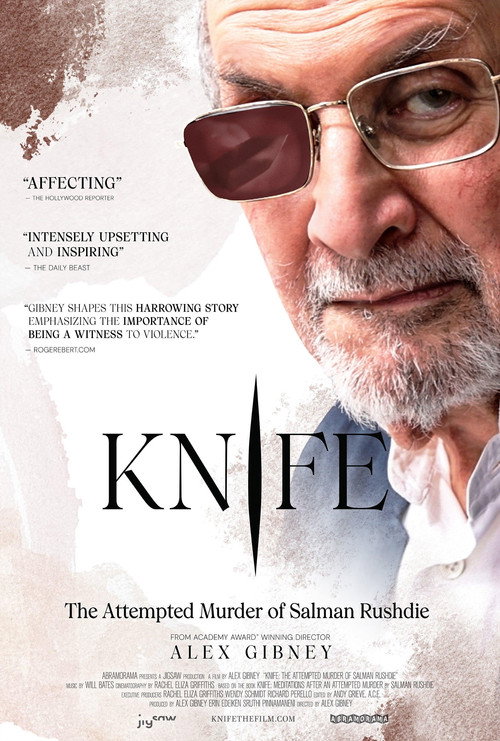
Knife: The Attempted Murder of Salman Rushdie
2026 · Alex Gibney
For when you want a serious, moving evening — something that confronts real darkness and comes out on the side of resilience. Emotionally demanding, but you leave with hope rather than dread.
What it's about
In August 2022, Salman Rushdie walked onstage in western New York to speak about America as a refuge for writers — and was attacked in front of the audience, stabbed repeatedly in less than half a minute. This documentary follows what came after: his fight to survive, his long recovery, and his return to life and work, told largely through intimate footage his wife, the poet and photographer Rachel Eliza Griffiths, began recording almost immediately.
The experience
Harrowing at the outset and then unexpectedly tender — less a true-crime account than a close-up portrait of a marriage and a mind refusing to be extinguished. It leaves you shaken but genuinely lifted.
The craft
Alex Gibney, one of the most prolific documentarians of his generation, builds the film around footage no outside crew could have gotten: domestic recordings made by Griffiths from inside the recovery itself. That intimacy, rather than archive or reconstruction, is the film's engine, and it gives the storytelling an unguarded, diary-like texture rare in films about public figures.
Why it matters
A document of one of the most shocking attacks on a writer in living memory, and part of the larger conversation about free expression and the decades-long threat Rushdie has lived under.
Snapshot
On 12 August 2022, at the Chautauqua Institution in western New York, Salman Rushdie walked onstage to discuss the United States as a refuge for writers in exile — he was to appear alongside Henry Reese, co-founder of Pittsburgh's City of Asylum — and was attacked before he could begin. By his own reckoning in the memoir that gives this film its title, the assault lasted twenty-seven seconds and delivered fifteen wounds. He was airlifted to a trauma center in Erie, Pennsylvania. He survived, at the cost of the sight in his right eye and, for a long stretch, the use of a hand.
Alex Gibney's film takes that interval as its wound and its structure. Its distinguishing material is not archival but domestic: Rushdie's wife, the poet, photographer and novelist Rachel Eliza Griffiths, began recording almost immediately, producing a convalescence diary of a kind Gibney has never before had at his disposal. The film therefore sits at an unusual junction in his corpus — between the investigative machine he has run since Enron and the first-person illness film descended from Jonas Mekas and Tom Joslin.
A necessary caveat: this is a very recent release, and the granular production record — crew credits, festival routing, distribution terms — is not something I can verify. Where I describe technique below, I distinguish between Gibney's documented working method and claims about this specific film.
Industry & production
The film's industrial logic is legible even where its paperwork is not. Gibney's Jigsaw Productions has operated for two decades as something closer to a nonfiction studio than an auteur's shop: it sustains multiple simultaneous features and series, carries supervising producers who run projects in parallel, and has maintained long institutional relationships — most durably with HBO, which released Mea Maxima Culpa: Silence in the House of God (2012), Going Clear: Scientology and the Prison of Belief (2015), Crazy, Not Insane (2020) and The Crime of the Century (2021), and with streamers including Netflix, for whom Jigsaw made the Dirty Money series (2018). This is a filmmaker who has delivered, in some years, three features. The consequence for authorship is discussed below; the consequence for production is that a project like this one can be greenlit on the strength of a single access relationship and a publication date.
That publication date matters. Rushdie's Knife: Meditations After an Attempted Murder appeared in April 2024, and the film shares its title. Documentary financing in the mid-2020s has contracted sharply from the 2018–2022 acquisition boom, and the surviving commissioning logic favors exactly this profile: a globally recognized subject, a pre-sold literary property, a legal record that resolves cleanly, and privileged footage no competitor can obtain. The Griffiths material is the asset that makes the film unrepeatable.
The legal timeline also shaped what could be shown and when. The man charged in the attack was convicted of attempted murder in a New York state court in February 2025 and sentenced in May of that year to the maximum term available; a separate federal terrorism prosecution followed. Documentaries about pending criminal matters routinely wait, and a 2026 release sits naturally downstream of that resolution.
Technology
The film's central technical problem is heterogeneity, and it is worth stating precisely because it is a problem of the 2020s specifically. Four incompatible image regimes converge here.
First, the 1989 register: standard-definition broadcast video and film news footage of the fatwa period — interlaced, 4:3, color-degraded, now routinely restored and, more contentiously, machine-upscaled to 4K. Second, the attack itself, which exists — to the extent it exists at all for a filmmaker — as bystander smartphone capture and institutional recording: vertical framing, heavy compression artifacts, blown highlights, clipped audio. Third, Griffiths' convalescence footage, shot by a non-cinematographer on whatever was to hand, in hospital rooms and domestic interiors with mixed fluorescent and window light. Fourth, contemporary interview material, which in a Gibney production means large-sensor digital cinema cameras, controlled negative fill, and shallow focus against dark grounds.
Nothing in the post-2020 toolkit solves this; it can only be negotiated. Text-based editing — transcript-driven assembly, now standard in Premiere and Avid workflows — has made feature documentaries with hundreds of hours of verbal material tractable in ways they were not a decade ago, and a recovery diary generates exactly that kind of bulk. HDR delivery, meanwhile, widens rather than narrows the gap between a phone clip and an Alexa interview. The honest reading is that the disparity is not a defect to be smoothed but the film's evidentiary texture: each image class carries its own claim to having been there.
Technique
The following describes Gibney's established grammar and the specific demands of this material. I have not been able to confirm shot-level choices in this film.
Cinematography
Gibney's interview idiom has been stable since Taxi to the Dark Side (2007), shot by Maryse Alberti: the subject placed against depth rather than a flat backing, keyed hard enough to model the face, the director off-camera and audible. Recent Jigsaw features have leaned on a small rotating group of documentary DPs working in that register. The Rushdie material complicates it in one irreducible way — the face being lit is a face that was cut, and the right eye behind the darkened lens is an absence the camera must decide how to treat. There is no neutral choice available between the close-up that inspects and the framing that averts.
Editing
The cut is where Gibney's films are authored. His characteristic move is the rhyme between document and image: a scrolling memo, a redacted page, a screen capture set against testimony that either confirms or contradicts it. Here the governing editorial question is arithmetic — twenty-seven seconds of real time against roughly two hours of screen time. A film can withhold the event and pay it off; it can state it in the first minute and spend the rest on aftermath; or it can return to it in fragments, each pass admitting a little more. Each is a different film. The presence of a survivor who has already written his own account in prose adds a second constraint: the edit must decide whether to follow the memoir's architecture or to argue with it.
Mise-en-scène / staging
Two spaces carry the film's meaning. The amphitheater stage is a site of catastrophic exposure — an open platform, an unscreened audience, a writer who had been told the danger was historical. The hospital room and the home are the counter-spaces: enclosed, tended, filmed by someone with standing to be there. Gibney's reconstructions, when he uses them, are abstract rather than illustrative — the hooded figure in Taxi, the signed testimony voiced by actors in Mea Maxima Culpa. Literal re-enactment of a stabbing would be a rupture with that practice.
Sound
Gibney is a music-forward documentarian, and his recent features have relied heavily on scores built from sustained tone and pulse rather than melody. Sound is also where an unshowable event can be rendered without being displayed — the Chautauqua audio exists, and the crowd's reaction is arguably the more legible document than the video. The other sonic fact is Rushdie's voice: articulate, mordant, and, in the memoir's telling, temporarily lost to intubation. A film about a writer who nearly stopped speaking has an obvious organizing principle available in the grain of that voice.
Performance
In nonfiction, performance means self-presentation, and Rushdie's has been public and polished for four decades — the wit, the argumentative relish, the third-person distancing of Joseph Anton (2012). He has also literally performed himself onscreen, in Bridget Jones's Diary (2001) among others. The interest here lies in the seam between that practiced persona and the unguarded footage a spouse takes at a bedside. Griffiths occupies a doubled position — author of the images and person within them — which is a documented ethical crux of the domestic-diary form, not a novelty.
Narrative & dramatic mode
The film operates under a suspense problem: the outcome is known before the first frame. Survival cannot be the question. What remains available is a reversal of the usual documentary clock — not will he live but will he write again, and beneath that, will he consent to be defined by the attack. This relocates the drama from event to disposition.
The likeliest structure is two-stranded: 1989 and 2022 braided, so that the attack reads as a delayed detonation of a device planted thirty-three years earlier. Gibney has used this doubled chronology before, most conspicuously in The Armstrong Lie (2013), where a film begun as one story was rebuilt around a later revelation. The memoir supplies a further formal temptation — its imagined dialogue with the attacker, whom Rushdie designates only as "the A." A film can stage that as address, as voiceover, or refuse it; the refusal would itself be a statement.
Genre & cycle
Three cycles intersect. The first is the memoir-adaptation documentary, in which a published book supplies both structure and voice. The second is the attack-on-expression film, whose clearest precedent is the French documentary work around Charlie Hebdo — Daniel Leconte's It's Hard Being Loved by Jerks (2008) and L'Humour à mort (2015), made before and after the 2015 killings, a pairing that captures the same terrible before/after the Rushdie case spans. The third is the convalescence diary: Silverlake Life: The View from Here (1993), Notes on Blindness (2016), Kirsten Johnson's Dick Johnson Is Dead (2020), Garrett Bradley's Time (2020).
The film's most consequential generic decision is what it refuses. The material is fully available to true crime — an assailant, a weapon, a trial — and the apparatus of that genre would displace the writer with his attacker. Every indication in Gibney's filmography, which is preoccupied with institutions rather than deviants, points away from that.
Authorship & method
Gibney's authorship is real but unusual. He is a producer-director whose signature is a set of procedures: exhaustive document work, adversarial interviewing conducted from off-camera, first-person narration delivered in his own voice (Taxi to the Dark Side, We Steal Secrets, The Armstrong Lie, Zero Days), and a willingness to make his own compromised position part of the argument. The Armstrong Lie remains the key text — a film about being lied to by one's own subject, released with the deception inside it.
His collaborators recur without forming a fixed unit. Maryse Alberti shot Taxi to the Dark Side; editors including Sloane Klevin and Andy Grieve have cut major titles; Will Bates has scored a substantial run of the recent features. Producers associated with Jigsaw's features have included Stacey Offman, Richard Perello and Alexandra Johnes. I cannot confirm which of these, if any, worked on this film, and readers should not assume continuity.
The method's risk, in this case, is proximity. Gibney's strongest films are prosecutorial; this one's defining asset was created by the subject's spouse and is unavailable to any adversarial reading. The film is structurally an authorized portrait. Whether it acknowledges that — as The Armstrong Lie acknowledged its own — is the fair test of its authorship.
Movement / national cinema
Rushdie is a cinematic novelist in a specific sense: The Satanic Verses (1988) opens with two men falling from an exploded aircraft, one of them a Bombay film star, and its imagination is saturated with Hindi popular cinema. He wrote the BFI Film Classics monograph on The Wizard of Oz (1992), and co-wrote and narrated Deepa Mehta's adaptation of Midnight's Children (2012). Any serious account of him is also an account of a diasporic Indian-British-American imagination formed partly at the movies.
The film itself belongs to Anglo-American liberal documentary, and the friction between those positions is unavoidable. The Rushdie affair generated a large critical literature on blasphemy, secularism and postcolonial politics, much of it skeptical of the framing in which a formerly colonized writer becomes the West's emblematic defender of free speech. A film made in New York for an English-language market inherits that argument whether or not it engages it.
Era / period
Two clocks run. The long one begins on 14 February 1989, with Ayatollah Khomeini's fatwa, and runs through the murder of the Japanese translator Hitoshi Igarashi in 1991, the stabbing of the Italian translator Ettore Capriolo the same year, the shooting of the Norwegian publisher William Nygaard in 1993, and the 1998 understanding under which the Iranian government said it would not act on the decree — a diplomatic settlement that decisively did not end the danger.
The short one is the 2020s: a decade of book bans and curricular purges in the United States, of renewed argument over who may say what in public, and of documentary itself under credibility pressure from synthetic audio and image. Rushdie was president of PEN American Center from 2004 to 2006 and helped found its World Voices Festival; the lecture he never delivered was about American sanctuary. That a film about the failure of that sanctuary arrives now is not incidental to how it will be read.
Themes
Survival as a problem rather than a resolution. The memoir's insistence on the ordinary — food, physiotherapy, marriage — as the actual substance of recovery, against the grandeur the story invites. Language as the contested property: the attack was on a body, but the target was a book, and the film's subject is whether sentences can be resumed. Sight, literally and as metaphor, with an unforgiving directness. The fatwa's thirty-three-year latency, which recasts security as a fiction with an expiry date nobody announces. And love as counter-narrative — the Griffiths footage exists because someone decided that this would be recorded as a shared life rather than as an atrocity.
Reception, canon & influence
I cannot report on this film's critical reception; that record is not available to me, and inventing it would be worse than admitting the gap. What can be described is the terrain reviewers will occupy. Gibney is a critically established but critically contested figure — admired for scope and access, faulted for narrative efficiency that can flatten ambiguity, and reliably scrutinized for prolificacy. Expect the central question to be whether the film's intimacy earns its restraint or purchases its deference.
Backward. The film's debts are traceable. Within Gibney: the doubled chronology of The Armstrong Lie, the institutional patience of Going Clear, the surrogate-testimony ethics of Mea Maxima Culpa. Beyond him: Resnais' Night and Fog (1956) for the founding problem of whether atrocity footage may be shown; Marker's Sans Soleil (1983) for narrating an image one cannot fully look at; Morris' The Thin Blue Line (1988) for reconstruction as argument; Joshua Oppenheimer's The Act of Killing (2012) and The Look of Silence (2014) for the perpetrator as presence rather than absence — the nearest cinematic analogue to Rushdie's imagined conversation with "the A."; Kapadia's Amy (2015) for the portrait built from non-professional footage; and Kirsten Johnson's Cameraperson (2016) and Dick Johnson Is Dead for the camera held by someone who loves the subject. Notably, there is no substantial theatrical documentary on the Rushdie affair itself in the canon; television journalism covered it heavily, but the film has little direct precedent to answer to.
Forward. Any claim of legacy for a 2026 release would be fabrication. What can be identified are plausible lines of consequence: it may consolidate the writer-under-threat film as a working subgenre at a moment when the subject is not scarce; it will put pressure on the credit and ethics of the spouse-as-cinematographer, a position the form has not yet settled; and it enters the archive as the authorized account of an event whose alternative account is a criminal docket. Which of those becomes its actual afterlife is not yet knowable, and the atlas should mark this entry as open.
A Deleuzian reading
The lens over his right eye is dark.
The full Deleuzian reading of Knife: The Attempted Murder of Salman Rushdie →
Reception
How Knife: The Attempted Murder of Salman Rushdie was received, from release to now →
Influences: the films it descends from and the films it influenced
- Night and Fog (1956) — Establishes the atrocity-image problem as a formal decision rather than a taste question — colour tracking shots of the present-day site alternated with monochrome archive while the commentary keeps announcing what the frame will and will not show — which is the structure behind Knife's heterogeneous image regimes and its refusal to screen the stage footage.
- Sans Soleil (1983) — Perfects narration that describes an image instead of illustrating it, the voice reporting what was witnessed while the cut declines to supply it — the device Knife uses to speak the twenty-seven seconds over material that cannot depict them.
- The Thin Blue Line (1988) — Reconstruction as argument: the violent instant re-staged in variant takes, each keyed to a contradictory account, laid over Philip Glass's held-tone minimalism — the joint source of Knife's timed re-cutting of an interval and its sustained-tone score.
- The Diving Bell and the Butterfly (2007) — Janusz Kamiński's subjective optics — smeared focus, blinking mattes, a lid sutured shut in POV — make the damaged eye the camera's own condition, the fiction solution Knife answers documentarily with the wounded face held in close-up.
- Taxi to the Dark Side (2007) — Maryse Alberti's interview setup places subjects well forward of a deep, legible background rather than a collapsed backdrop, and Gibney speaks his own first-person narration — the two house procedures Knife's interview-against-depth inherits directly.
- Man on Wire (2008) — Demonstrates that suspense survives a known outcome if the film converts the event into arithmetic — heist grammar imposed on a documented act so the audience counts down an interval whose ending it already knows, precisely Knife's twenty-seven-second engine.
- Mea Maxima Culpa: Silence in the House of God (2012) — Gibney's solution for testimony that cannot speak in its own register — signed accounts given to actors' voices, with the substitution declared — is the ethics of surrogate utterance Knife reuses for Rushdie's imagined interrogation of his attacker.
- The Act of Killing (2012) — Converts the perpetrator from an absence in a legal record into a performing presence who restages his own act on camera, the formal permission Knife needs to admit 'the A.' as a speaking position rather than a defendant referred to.
- The Armstrong Lie (2013) — The braided two-clock cut — the film as first shot, folded inside the film made after the rupture — plus the director's on-record disclosure of his own compromised access, is the exact template for Knife's chronology and for whether it names itself an authorized portrait.
- Citizenfour (2014) — Trent Reznor and Atticus Ross's unbroken low drone running under procedural real time shows how a sustained tone, rather than cutting rhythm, carries dread through an event the audience has already read about — the scoring logic Knife adopts.
- The Look of Silence (2014) — Adi's optometry frame — swapping lenses before a killer's eyes while questioning him — welds the confrontation scene to the examined eye, the same coupling of injured sight and direct address to the attacker that organizes Knife.
- Amy (2015) — Builds a full-length portrait from footage shot by intimates on consumer cameras and strips every interview to disembodied audio floated over that found material — the precedent for a film whose defining images were made by someone inside the subject's household.
- Tower (2016) — Rebuilds a campus shooting on a strict minute-by-minute clock while cutting between incompatible image regimes — rotoscope, broadcast archive, present-day interview — to hold one short interval open across a feature, the nearest structural analogue to the twenty-seven-second arithmetic.
- Notes on Blindness (2016) — Constructs a convalescence diary from the subject's own audio record of losing his sight, with lip-synced reconstruction and image regimes that keep failing to match the narration — a working model for filming the loss of an eye from inside the loss.
- Dick Johnson Is Dead (2020) — Stages a beloved subject's deaths with the loving family member's own camera and keeps the ethics of that love inside the frame rather than in a disclaimer — the closest resolution yet of the credit problem Knife's spouse-shot footage raises.
- Navalny (2022) — Literalizes the dialogue with one's own assassin — the recorded call in which the target calmly interrogates the man sent to kill him, shot as a single sustained take of the listening face — the documentary precedent for staging Rushdie's address to his attacker.
Similar films
- The Voice of Hind Rajab (2025) — shared sensibility
- Peter Hujar's Day (2025) — shared sensibility
- Black Box Diaries (2024) — shared sensibility
- Black Bag (2025) — shared sensibility
- Kill (2024) — shared sensibility
- A Moment of Innocence (1997) — shared sensibility
- Boiling Point (2021) — shared sensibility
- Caché (2005) — shared sensibility
All the films related to Knife: The Attempted Murder of Salman Rushdie →