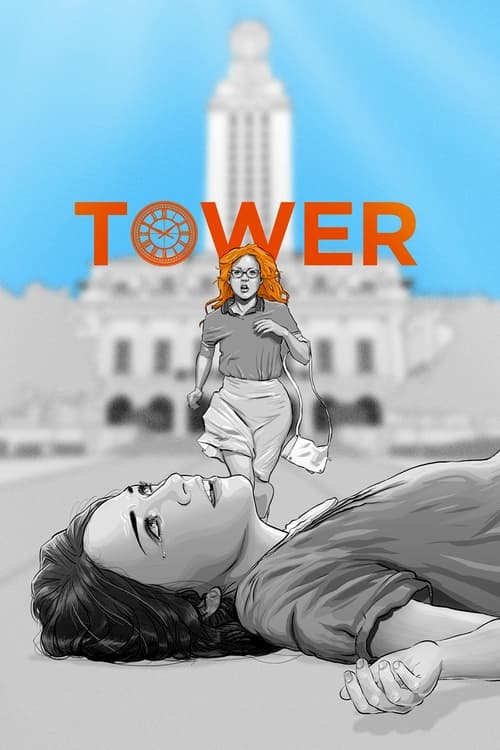
Tower
2016 · Keith Maitland
For when you want a documentary that hits like a thriller and earns its emotion — demanding but deeply humane, the kind you press on people afterward.
What it's about
On August 1, 1966, a sniper opened fire from the University of Texas clock tower in Austin, and for ninety-six minutes the campus below became a battlefield. This documentary reconstructs that day entirely from the ground: the students, the wounded, the police officers and bystanders who ran toward the gunfire. The shooter is barely named; the film belongs to the people under the tower.
The experience
Gripping and immersive — the rotoscoped animation puts you inside the memories as they unfold, so the suspense is real even though the event is history. It's harrowing, but the accumulating acts of ordinary courage make it ultimately about the best in people, not the worst.
The craft
The signature move is rendering survivors' memories — performed by young actors, then rotoscoped into painterly animation — so the past is inhabited rather than narrated, before the film shifts into live-action present-day interviews. The blend of archival footage, animation, and sound design creates an urgency few documentaries attempt.
Why it matters
It reframed how documentaries can treat mass shootings — centering witnesses and helpers instead of psychologizing a gunman — and stands as a landmark of animated nonfiction.
Snapshot
Tower reconstructs the ninety-six minutes of August 1, 1966, when a sniper fired from the observation deck of the University of Texas Main Building tower in Austin, killing and wounding dozens of people crossing the campus below in what is commonly cited as the first mass shooting on an American college campus. Director Keith Maitland refuses the conventional true-crime frame: the gunman is scarcely named and never psychologized, while the film's attention falls entirely on the witnesses, the wounded, and the ordinary people who intervened. Its signature formal decision is to render the memories of survivors—performed by young actors and then rotoscoped into painterly animation—so that the past is inhabited rather than merely narrated, before the film modulates, in its final movement, into live-action present-day interviews with the real survivors as older adults. The result is at once a work of oral history, a real-time thriller, and a meditation on trauma, memory, and civic courage. It premiered at SXSW in Maitland's home city of Austin, won that festival's top documentary honors, went on to a Peabody Award and an Academy shortlisting, and has since become a touchstone for animated-documentary practice.
Industry & production
Tower is a work of American independent nonfiction filmmaking produced largely within Austin's tight-knit documentary community. It grew out of Pamela Colloff's 2006 Texas Monthly oral-history article "96 Minutes," which assembled survivor testimony into a minute-by-minute account; that piece supplied the film's structure and much of its interview base. Maitland produced through his Austin-based company, Go-Valley, alongside producers including Megan Gilbride and Susan Thomson. The film was financed through the customary independent-documentary patchwork of grants, private equity, and public-media support, and its association with public broadcasting (it later aired on PBS's Independent Lens) is characteristic of how a mid-budget American documentary of this kind reaches audiences. Luke Wilson, an Austin native, is credited among the film's executive producers, lending the project local pedigree. Kino Lorber handled the U.S. theatrical release in late 2016. Specific budget and box-office figures for Tower are not part of the reliably documented public record, and I will not invent them; like most feature documentaries, its commercial life was modest and its cultural impact ran through festivals, awards, education, and broadcast rather than the multiplex.
Technology
The production's defining technological choice is rotoscoping—animation traced or interpolated over live-action reference footage. Maitland shot actors performing the survivors' recollections, then had that material animated in a hand-painted, high-contrast style, digitally. This lineage runs directly through Austin filmmaking: Richard Linklater's Waking Life (2001) and A Scanner Darkly (2006), also made in Austin, popularized digital rotoscoping and created the local talent pool and technical vocabulary Tower draws on. The film also depends on the survival and digitization of 1966 archival media—black-and-white news film, radio broadcasts, and photographs—which are woven into and against the animation. The seam between traced animation, restored archive, and eventual live-action interview is itself a technological argument: the film uses each medium's texture to signal a different relationship to time and truth.
Technique
Cinematography
Credited to Sarah Wilson, the live-action cinematography operates on two registers. The reference photography that underlies the animation had to be staged and lit so that faces, gestures, and blocking would read clearly once abstracted into rotoscope, favoring legible compositions and expressive close-ups. The present-day interview cinematography, revealed late in the film, is comparatively plain and unadorned—aging faces in ordinary rooms—so that the shift from stylization to documentary realism lands as an emotional unveiling rather than a mere stylistic change. The animated Austin of 1966, with its heat-blanched pavement and the tower looming at the frame's edge, is built from these controlled setups.
Editing
Editor Austin Reedy shapes the film around a near-real-time chronology, cross-cutting among multiple witnesses scattered across the campus so that the ninety-six minutes accrue suspense despite the outcome being historically known. The editing braids animation, archival footage, and radio audio into a single forward-driving timeline, then executes the film's most discussed structural move: the gradual, then complete, transition from animated reenactment to live-action interview, which reframes everything that preceded it as remembered rather than seen. The rhythm is that of a thriller disciplined by the ethics of testimony.
Mise-en-scène / staging
Maitland stages the event horizontally and at ground level—the perspective of people pinned down, crawling, hiding behind low walls, unable to see the shooter clearly. The tower is a constant vertical threat but rarely the subject; the drama is in the pavement, the shade, the exposed stretches of open plaza. Period detail (dress, cars, campus architecture) is rendered with enough specificity to anchor 1966 while the animation's abstraction keeps the imagery from tipping into gore. Central tableaux—Claire Wilson lying wounded in the open sun beside her dead boyfriend, a stranger crawling out to lie beside her and keep her talking—are composed as sustained, almost still, moral set-pieces.
Sound
Sound is arguably the film's most powerful documentary anchor. Contemporaneous radio broadcast—most notably the on-air reporting from the scene—runs through the film as a live, present-tense voice, collapsing the distance between 1966 and the viewer. The gunfire is used sparingly and often off-screen, its threat conveyed through reaction, silence, and the crack of unseen shots. The interplay of remembered voice-over (survivors recounting) and archival audio (the event as it was transmitted) builds the film's layered sense of time.
Performance
Young actors perform the survivors' younger selves, delivering testimony drawn from interviews as embodied, emotionally present scenes rather than reenactment pantomime. Because their work is filtered through rotoscope, performance registers in voice, cadence, and gesture. The film's most affecting "performances," however, are ultimately the real survivors themselves, whose live-action faces in the final act carry the accumulated weight of a lifetime lived after the event. Precise cast attributions beyond the principals are not something I will assert from memory; the design of the film deliberately subordinates individual actors to the testimony they carry.
Narrative & dramatic mode
Tower is structured as a real-time ensemble survival drama grafted onto oral history. Rather than a top-down explanatory documentary, it is built from the ground-level, first-person recollections of many witnesses, cut together so that their separate ordeals unfold simultaneously across a single unbroken timeline. The dramatic engine is suspense-of-testimony: we know a shooting is occurring, but each character's survival, choice, and act of courage remains open moment to moment. The film withholds analysis and context (the shooter's biography, the autopsy, the policy aftermath) almost entirely from its main body, delivering only spare present-day reflection at the end. This is a deliberate inversion of the true-crime mode—perpetrator-blank, victim-and-rescuer-centered—that gives the film its ethical spine.
Genre & cycle
The film sits at the intersection of the documentary, the animated film, and the crime/historical-event reconstruction, and its billing across all three genres is apt. Within documentary, it belongs to the animated-documentary cycle that gained international prominence with Ari Folman's Waltz with Bashir (2008) and continued through films like The Green Wax tradition of memory-animation and, later, Flee (2021); Tower is a significant American entry in that lineage. It also participates, uneasily and self-consciously, in the American cultural reckoning with mass shootings—arriving in a period when such reckonings had become tragically recurrent—by returning to the event often called the origin point of that entire grim genre of national experience.
Authorship & method
Keith Maitland, an Austin-based director with roots in narrative and documentary work, is the film's clear authorial center; Tower reflects a method of granting testimony the dignity of dramatization while refusing to sensationalize violence or elevate its perpetrator. His key collaborators are essential to that method: Pamela Colloff, whose Texas Monthly oral history "96 Minutes" furnishes the film's source and structure; cinematographer Sarah Wilson; editor Austin Reedy, who architects the real-time cross-cutting and the late live-action turn; and composer Osei Essed, whose score underpins the film's suspense and elegiac register without overwhelming the archival soundscape. The animation team—working in the Austin rotoscope tradition—translates performed testimony into the film's painterly visual language; I'll avoid naming individual animators where I cannot verify credits precisely. Maitland's authorship is best understood as curatorial and ethical: selecting whose memory to inhabit, and how far to abstract suffering so that it can be borne.
Movement / national cinema
Tower is a distinctly American, and specifically Texan, film. It belongs to the Austin independent-film ecosystem—an environment shaped by the University of Texas film program, SXSW, and the local rotoscope tradition established by Linklater's collaborators—and it could hardly have been made elsewhere, given its subject, its archive, and its technical inheritance. More broadly it aligns with a transnational movement in nonfiction cinema that treats animation as a legitimate documentary tool for representing memory, trauma, and events that cannot be filmed directly.
Era / period
The film occupies two eras at once. Its subject is 1966: mid-century Austin, a moment before "active shooter" was a category, when institutions, police, and bystanders improvised a response to something without precedent. Its making, in 2016, falls squarely within a decade in which American mass shootings had become a recurring public trauma, and the film's fiftieth-anniversary return to the UT tower inevitably reads as commentary on that continuity. The gap between the two periods—and the film's insistence on staging it—is part of its meaning.
Themes
The film's governing themes are courage and moral choice under lethal pressure: strangers crawling into open fire to comfort the wounded, students and civilians acting where systems had not yet learned to. Closely bound to this is the theme of memory—how survivors carry, narrate, and are transformed by the event across fifty years, which the animation-to-live-action structure literalizes. A third theme is the ethics of attention: by nearly erasing the shooter, the film argues against the culture of perpetrator fascination and for the primacy of victims and rescuers. Underlying all of these is trauma and its long afterlife, and a quiet civic humanism—Maitland's insistence that "the worst in one man brought out the best in so many others," to paraphrase the film's own framing.
Reception, canon & influence
Critically, Tower was widely praised and is generally regarded as one of the strongest American documentaries of its year, singled out for the emotional and formal power of its animation strategy and for its refusal of true-crime conventions. It premiered at SXSW 2016, where it won both the Grand Jury and Audience awards in the documentary competition, and it went on to receive a Peabody Award and to be shortlisted for the Academy Award for Best Documentary Feature (it was not among the final nominees). It reached a broad audience through Kino Lorber's release and a PBS Independent Lens broadcast, and it has been used extensively in educational and commemorative contexts.
Its influences run backward to two clear sources: the Austin rotoscope tradition of Richard Linklater's Waking Life and A Scanner Darkly, which made the film's animation both technically and aesthetically thinkable; and the international animated-documentary breakthrough of Waltz with Bashir, which legitimized animation as a vehicle for traumatic memory. Its structural DNA comes from Colloff's oral-history journalism, which supplied the polyphonic, real-time testimony model.
Looking forward, Tower helped consolidate animated documentary as a respected mode within American nonfiction and stands as a frequently cited precedent for later memory-driven animated docs; it anticipates the mainstream acclaim that would greet Flee (2021). It also modeled an ethical template for representing mass violence—perpetrator-minimized, survivor-centered—that has informed subsequent conversations about how such events should be depicted on screen. Within the specific history of the UT tower shooting, it has become the definitive cinematic account, shaping public memory of the event on its fiftieth anniversary and beyond.
Reception
An instant SXSW 2016 sensation — it took both the Documentary Grand Jury and Audience awards — and then became one of that year's notorious Oscar stories when it made the Best Documentary shortlist but missed the final five. A decade on, it's a fixture of 'the Academy blew it' lists and a quiet canon entry for animated documentary.
How Tower was received, from release to now →
Influences: the films it descends from and the films it influenced
- Waking Life (2001) — Established the Austin interpolated-rotoscope pipeline (Bob Sabiston's Rotoshop) that Tower adopts wholesale, painting over live-action performance to create a hand-worked, shimmering surface.
- A Scanner Darkly (2006) — Proved the same rotoscope process could sustain feature-length dramatic narrative rather than essayistic vignette, giving Tower the technical precedent for rotoscoping performed testimony across a whole reconstructed event.
- Waltz with Bashir (2008) — Legitimized animation as the vehicle for traumatic memory, animating recorded interview testimony so that unbearable violence could be witnessed at one remove—the exact ethical logic of Tower's abstraction.
- The Thin Blue Line (1988) — Modeled the stylized, repeated dramatic reenactment built directly from conflicting first-person interviews, refusing true-crime sensationalism—the reconstructed-testimony method Tower inherits.
- Rashomon (1950) — Supplies the polyphonic architecture of reconstructing a single violent event from multiple subjective first-person accounts, the structure Colloff's '96 Minutes' and Tower's crosscut testimonies both rely on.
- Shoah (1985) — Defined the survivor-centered oral-history documentary that structures a mass-atrocity account entirely around witness voices while refusing to aggrandize or psychologize perpetrators—Tower's perpetrator-blank ethic.
- Bus 174 (2002) — Reconstructs a single eruption of public violence in ticking-clock real time from archival media plus recreation, dilating one event into civic portrait.
- Flee (2021) — Reconstructs a survivor's traumatic memory in animation drawn from recorded testimony, and mixes in archival live-action—the animated-memory-doc mode and animation-to-footage turn Tower anticipated and helped legitimize in American nonfiction.
- Chris the Swiss (2018) — Interweaves rotoscope-adjacent animation with live-action archival investigation of a violent death, deploying Tower's animation-to-live-action pivot to move from imagined reconstruction into documentary fact.
- Another Day of Life (2018) — Hybridizes stylized animation of a reporter's war experience with live-action interviews of the real witnesses, using the animated/live-action seam Tower pioneered to authenticate memory.
- Eternal Spring (2022) — Animates participant testimony to reconstruct a single real act of civic defiance against state violence, extending Tower's survivor-centered, courage-honoring template into animated nonfiction.
- United 93 (2006) — Shares the real-time, ground-level ensemble reconstruction of a mass-casualty event, cross-cutting scattered participants and deliberately withholding interior access to the attackers.
- The Arbor (2010) — Uses actors performing to verbatim recorded oral-history audio—the same performed-testimony device Tower rotoscopes, actors embodying real survivors' recorded words.
- Persepolis (2007) — Uses graphic, high-contrast 2D animation of first-person memoir to render political violence bearable, abstracting suffering into a stylized visual language as Tower does.
- Is the Man Who Is Tall Happy? (2013) — Builds an entire documentary from hand-drawn animation laid over a recorded interview, animation functioning as illustration and mediation of authentic spoken testimony.
- American Insurrection / 20 Days
- Knife: The Attempted Murder of Salman Rushdie (2026) — Rebuilds a campus shooting on a strict minute-by-minute clock while cutting between incompatible image regimes — rotoscope, broadcast archive, present-day interview — to hold one short interval open across a feature, the nearest structural analogue to the twenty-seven-second arithmetic.
Similar films
- The Thin Blue Line (1988) — influence & lineage
- Flee (2021) — influence & lineage
- Waltz with Bashir (2008) — influence & lineage
- United 93 (2006) — influence & lineage
- The War Game (1966) — same viewing thread
- Titicut Follies (1967) — same viewing thread
- Our Land (2026) — shared sensibility
- Bowling for Columbine (2002) — shared sensibility
All the films related to Tower →
Watch it with: curated runs of related films
- The Machinery of Catastrophe — A run of hour-by-hour reconstructions and unblinking documentaries that watch disaster as procedure — ice warnings, intercepted cables, evacuation drills, ward routines — and refuse to sentimentalize what the systems grind out.