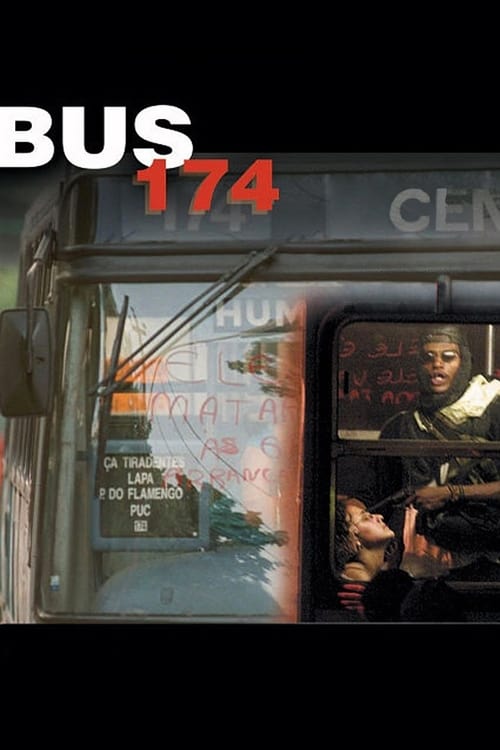
Bus 174
2002 · José Padilha
For when you want a documentary that hits like a heavyweight — not comfort viewing, but the kind of true story you'll be arguing about and thinking through for days.
What it's about
On June 12, 2000, a young man boarded a city bus in Rio de Janeiro with a revolver and took its passengers hostage — and every Brazilian TV network carried the siege live, for hours, uncut. This documentary rebuilds that afternoon from the broadcast footage while asking a harder question: who was the man holding the gun? The answer traces his life from the streets, through Brazil's failures of policing and childhood poverty, back to the bus.
The experience
Gripping and genuinely upsetting — the hostage footage plays with the tension of a thriller, while the life story underneath keeps turning your fear into something closer to grief. It ends in real tragedy, and it stays with you.
The craft
The construction is the achievement: raw live-TV footage of the standoff is intercut with interviews — hostages, police, street kids, family — so the media spectacle and the invisible life behind it unfold in parallel. The real-time material is almost unbearably tense precisely because nothing is staged.
Why it matters
It became a landmark of Brazilian documentary, forced a national conversation about street children and police failure, and launched José Padilha toward a career built on the collision of crime and the state.
Snapshot
Bus 174 (Ônibus 174) is a Brazilian documentary that reconstructs, almost in real time, the events of June 12, 2000, when a young man named Sandro do Nascimento boarded a city bus on a busy thoroughfare in Rio de Janeiro's affluent Jardim Botânico district, drew a revolver, and held its passengers hostage through an afternoon-long siege that was carried live, uninterrupted, on Brazilian television. The standoff ended in catastrophe: a hostage, the schoolteacher Geísa Gonçalves, was shot dead in the chaos of the climactic moments, and Sandro himself, subdued by police, was asphyxiated to death in the back of a police car before he could reach a station. Out of this single broadcast spectacle José Padilha builds a dual structure. The film's foreground is the hijacking itself, assembled from the television coverage that millions of Brazilians watched as it happened; its background, excavated through interview and investigation, is the biography of the hijacker — an orphan and street child who had witnessed his mother's murder, survived the 1993 Candelária massacre in which police killed sleeping street children, and passed through the brutalizing circuits of juvenile detention and the Brazilian prison system. The two strands converge into an argument: that the terrified, theatrical young man on the bus was not an aberration but a product, and that the society watching him had spent his whole life refusing to see him. Padilha's debut feature became one of the most acclaimed Brazilian documentaries of its era and a defining work of the country's early-2000s cinematic resurgence.
Industry & production
Bus 174 was produced through Zazen Produções, the Rio de Janeiro production company associated with José Padilha, with Padilha and the photographer and producer Marcos Prado credited among its producers. It was an independent, nationally financed documentary made in the context of Brazil's Cinema da Retomada — the "rebirth" of Brazilian filmmaking through the 1990s and early 2000s after the near-collapse of the industry at the start of the 1990s, a recovery enabled in large part by tax-incentive laws that channeled private money into national production. The film arrived in 2002, the same year as Fernando Meirelles and Kátia Lund's City of God, and the coincidence is significant: two Brazilian films released in the same moment, both seizing international attention by confronting the violence and social abandonment of Rio's poor, one through fiction and one through documentary.
The project's central production fact is its reliance on pre-existing material it did not shoot. The siege had been recorded for hours by multiple Brazilian television crews who had rushed to the scene; that footage, broadcast live, constitutes the film's spine. Padilha's production therefore became as much an act of acquisition, selection, and assembly as of origination — securing the television archive and then conducting an extensive campaign of original interviews to surround and explain it. Those interviews reach across the entire social field of the event: surviving hostages, the BOPE special-operations police officers and negotiators who were present, Sandro's relatives and the aunt who raised him, former street children who had known him, prison inmates, social workers, and analysts of public security. The breadth of access — including frank testimony from police and from the marginalized people the state tends to render invisible — is itself an achievement of the production. Internationally the film was picked up for distribution beyond Brazil, reaching art-house and festival audiences in North America and Europe and establishing Padilha as a filmmaker of note before he had made a single fiction feature.
Technology
Bus 174 is, technologically, a film of the early digital-video documentary moment, and its form is inseparable from the broadcast technology that made its subject possible in the first place. The siege became a national event precisely because of live television: lightweight electronic news-gathering cameras and live satellite/microwave transmission allowed Brazilian networks to carry the standoff continuously, turning a street crime into mass real-time spectacle. The film is in a real sense built out of that television apparatus — its rawest and most arresting images are the very broadcast frames the public saw, with all the grain, instability, long lenses, and helicopter-and-curbside vantages of live news coverage.
The original material Padilha's team added — the sit-down interviews and contextual footage — belongs to the standard early-2000s documentary toolkit of video acquisition, conducted in homes, prisons, and offices. The juxtaposition of these two image regimes is the film's defining technical condition: the degraded, urgent, public texture of the live feed against the composed, intimate texture of the interview. The record offers no indication of unusual technical innovation in the production beyond this, and it would be invention to claim otherwise; the film's power comes not from novel apparatus but from the editorial intelligence with which existing television technology's output is recontextualized.
Technique
Cinematography
The film's "cinematography" must be understood in two registers. The dominant visual material is appropriated television footage, and its qualities are those of live news: telephoto compression that flattens the bus and its surrounding crowd into a tense tableau, jostling handheld framing, the periodic intrusion of reporters and onlookers, and the queasy immediacy of images captured without the luxury of composition. Padilha treats this footage as found document, exploiting rather than disguising its rawness; the visible fact that we are watching what the nation watched is part of the film's meaning. The originally shot interview cinematography, by contrast, is conventionally composed and lit, placing subjects in stable, frequently dark or neutral frames that throw emphasis onto faces and testimony. Specific cinematographer credits for the original photography are not something I can attribute with confidence from the available record, and rather than guess I note the gap; what is certain and central is the deliberate collision of broadcast image and interview image as the film's organizing visual strategy.
Editing
Editing is the film's true authorial instrument, and the work was overseen by Felipe Lacerda, who is credited as the film's editor and co-director — a billing that correctly identifies the cutting room as the place where Bus 174 was authored. The fundamental editorial gesture is the interweaving of the chronological, suspense-driven account of the siege with the excavated backstory of Sandro's life, so that the live event is repeatedly interrupted and deepened by the history that produced the man holding the gun. As the standoff escalates toward its terrible end, the editing withholds and then delivers the convergence: the figure on the bus and the abandoned child of the biography are revealed to be the same person, and the documentary's accumulated context lands as tragic inevitability rather than mere information. The pacing exploits the inherent tension of the real-time footage — the hours of waiting, the flashes of panic — while the inserted material supplies the analytical and emotional dimension the live coverage, by its nature, could not. It is a structure that turns reportage into argument.
Mise-en-scène / staging
A documentary built largely from found footage does not "stage" its central event, and the integrity of Bus 174 depends on that fact: the bus, the crowd, the police cordon, and the surrounding city are the unmanipulated mise-en-scène of an actual emergency. What Padilha controls is the staging of the testimony and the framing of the recovered images. The film makes a recurring visual and conceptual motif of the bus as a stage — a glass-sided box, ringed by police, cameras, and spectators, in which a desperate man performs threats partly for an audience he knows is watching. This theatrical reading of the event, the siege as involuntary spectacle, is one of the film's most penetrating ideas, and the staging of the archival material foregrounds it: the ring of onlookers, the press, the helicopters, all the apparatus of a society watching itself. Against this public stage the interviews are placed in private, interior spaces, and the contrast between the exposed glass box and these enclosed rooms underlines the film's thesis about visibility and invisibility.
Sound
The film's sound derives substantially from its archival source: the ambient roar of the crowd and traffic, the voices of reporters narrating the standoff live, and the chilling shouts and threats exchanged around the bus, all carrying the documentary authority of having actually been broadcast. Layered over and between this are the recorded interview voices, calm and reflective, that supply analysis and grief. I am not able to attribute the original musical score to a specific composer with confidence from the available record, and I will not invent a credit; what can be said is that the film uses scoring and sound design to bind its disparate footage into a single, mounting tension and to inflect the raw television material with a tragic gravity it did not originally carry. The interplay of the event's own chaotic, public soundscape with the controlled, intimate register of testimony mirrors the film's larger formal dialectic.
Performance
As a documentary, Bus 174 has no performances in the fictional sense, but it is acutely concerned with performance as a theme — Sandro's conduct on the bus is repeatedly framed as a kind of terrified theater, a young man staging menace and identity for the cameras he knows are trained on him, even reportedly invoking the Candelária massacre to the crowd as if seizing a stage to be seen at last. The film's most powerful "performances" are the testimonies it gathers: the wrenching accounts of relatives and former street children, the self-justifying and sometimes defensive recollections of police, the analytical voices of those who study Brazilian violence. The candor and emotional exposure of these interviewees, and Padilha's evident skill in eliciting them, give the film its human weight. Sandro himself, present only through archival footage and the accounts of others, emerges as a fully realized and pitiable figure precisely because he never speaks to the filmmakers directly — he is reconstructed entirely from image and memory.
Narrative & dramatic mode
The film operates in a hybrid documentary mode that fuses real-time crisis suspense with investigative biography. Its surface narrative is a ticking-clock thriller assembled from the live coverage — a hostage standoff whose outcome the contemporary Brazilian audience experienced as suspense and whose ending the film treats as tragedy. Beneath and around this, Padilha constructs a second, slower narrative: the life story of the hijacker, told retrospectively through those who knew him, which functions as an explanatory counter-melody. The dramatic engine of the film is the gradual fusion of these two lines, so that the anonymous "armed young man" of the news broadcast acquires, scene by scene, a name, a face, a murdered mother, a massacre survived, a childhood spent invisible on the streets and inside abusive institutions. This is the mode of the social autopsy: the film uses the irresistible forward pull of the siege to carry an essentially analytical argument about cause and consequence. Its dramatic climax is also its moral one — the death of the hostage and the killing of Sandro in police custody — and the film refuses catharsis, ending not with resolution but with indictment.
Genre & cycle
Bus 174 sits at the intersection of the crime documentary and the social-issue documentary, and it belongs to a broader cycle of early-2000s Brazilian cinema preoccupied with urban violence, the favela, the police, and the abandoned young. Its closest sibling is City of God (2002), with which it shares a release year, a city, and a concern with the lethal consequences of social exclusion — the one a stylized fiction of the favela's drug economy, the other a documentary of a single eruption of that world into the wealthy heart of Rio. Within the documentary tradition it participates in the lineage of films built from media and archival footage to interrogate spectacle and the state, and in the true-crime mode that reconstructs a notorious event while widening its lens to social cause. It also inaugurates what would become, in Padilha's own subsequent work, a sustained cycle of films about Rio's policing and security apparatus. The film's generic significance lies in its refusal to remain within crime reportage: it converts the sensational hostage story into a structural critique, using genre's grip to deliver social analysis.
Authorship & method
Bus 174 is the work of José Padilha as director, conceived and produced through his Zazen company, and it establishes the method and the obsessions that would define his subsequent career: a fascination with the mechanics of violence in Rio de Janeiro, with the police as both perpetrators and products of a broken system, and with the moral ambiguities that collapse the line between criminal and authority. Padilha's method here is investigative and accretive — assembling a vast body of broadcast footage and then surrounding it with an exhaustive program of interviews across every party to the event, refusing the comfort of a single villain and implicating the watching society itself. The film's authorship is genuinely shared with Felipe Lacerda, credited as co-director and editor, whose shaping of the material in the cutting room gave the film its dual structure and its tragic momentum; in a documentary built so substantially from found footage, the editor's role approaches that of co-author. The producer-photographer Marcos Prado was a key collaborator within the Zazen orbit. I cannot reliably attribute the original cinematography or the musical score to named individuals from the available record, and I decline to invent those credits; the documented creative center of the film is the Padilha–Lacerda partnership, director and editor, working over an archive of the nation's own television memory. Notably, among the film's analytical voices was the security scholar Luiz Eduardo Soares, whose study of Rio's policing would later feed directly into Padilha's fiction work.
Movement / national cinema
The film is a significant document of the Cinema da Retomada, the revival of Brazilian filmmaking that gathered force through the late 1990s and early 2000s after the industry's near-extinction at the start of the decade. This was a cinema marked by a renewed appetite for confronting national realities — social inequality, urban violence, the legacy of dictatorship, the condition of the poor — and Bus 174, with its unflinching anatomy of how Brazilian society manufactures and then destroys its discarded children, is among its most pointed nonfiction statements. The film belongs specifically to a Rio de Janeiro school of filmmaking obsessed with the city's geography of inequality, where the favela and the asphalt, the marginalized and the police, exist in permanent, violent proximity. As national cinema it spoke to and about Brazil in a moment of intense public debate over public security, and its international circulation helped carry that conversation, and the new Brazilian cinema generally, to a global audience.
Era / period
Bus 174 is rooted in a precise historical moment: Rio de Janeiro at the turn of the millennium, a city defined by extreme inequality, endemic street crime, an overwhelmed and frequently violent police apparatus, and a vast population of abandoned street children. The hijacking it documents took place in June 2000, but the film insists on reaching back to anchor that event in the 1993 Candelária massacre — the killing of street children by police outside a church in central Rio — which Sandro survived and which the film presents as a foundational trauma both for him and for the nation's conscience. The era's defining condition, as the film frames it, is the social invisibility of the urban poor: a class of people the society passes daily without seeing, who become visible only in the instant they erupt into spectacle and threat. The film also captures a specific media-historical moment, in which live television had reached the point of being able to broadcast a street crisis to the entire nation in real time, making the public both spectator and participant. It is an artifact of a Brazil reckoning, often reluctantly, with the human cost of its inequalities.
Themes
The film's governing theme is social invisibility — the argument that Sandro and the street children like him are systematically unseen by Brazilian society, granted attention only when, weapon in hand and surrounded by cameras, they force the nation to look. Closely bound to this is the theme of the cycle of violence and institutional failure: the film traces a continuous line from a murdered mother, to a childhood on the streets, to the Candelária massacre, to abusive juvenile detention and a dehumanizing prison system, presenting Sandro's act not as inexplicable evil but as the predictable terminus of a society's neglect and cruelty. A third theme is spectacle and the media — the siege as theater, the role of live television in shaping the event, the way the crowd, the press, and the watching public became part of the drama. A fourth is the indictment of policing: the film documents police incompetence in the handling of the standoff and, more damningly, the extrajudicial killing of Sandro in custody, presenting the state's agents as themselves enmeshed in the violence they are meant to contain. Running beneath all of these is a profound compassion that never excuses the harm Sandro did — a hostage died — but insists on understanding its origins, holding the viewer in the uncomfortable space between the man's victimhood and his guilt.
Reception, canon & influence
Bus 174 was received as a major work on its release, earning wide critical praise both in Brazil and internationally for the intelligence of its structure, the breadth of its reporting, and the moral seriousness of its argument; it circulated extensively on the international festival and art-house circuit and gathered a substantial body of documentary honors, helping to bring the new Brazilian cinema's preoccupations to audiences abroad. (Specific award citations should be checked against the festival record before being asserted in detail.) It is widely regarded as one of the most important Brazilian documentaries of its generation and a benchmark for the use of archival broadcast footage in nonfiction filmmaking.
Influences on the film run backward to the traditions of investigative and observational documentary and to the compilation-film practice of building meaning from found footage, fused with the structural ambition of the social-issue exposé. Its immediate context — the same-year emergence of City of God and the broader Cinema da Retomada concern with Rio's violence — situates it within a wave of Brazilian work confronting inequality and the favela, even as its method (real-time broadcast event reframed through investigation) is distinctively its own.
Its influence forward is most concretely visible in José Padilha's own career, where Bus 174 functions as the documentary seed of everything that followed. The film's immersion in Rio's policing, its fascination with the BOPE special-operations units, and its interrogation of the moral world of the police led directly to Padilha's internationally successful fiction features Elite Squad (Tropa de Elite, 2007) and Elite Squad: The Enemy Within (2010), works that dramatize the same security apparatus the documentary had examined; the involvement of security scholar Luiz Eduardo Soares across this body of work underscores the continuity. Padilha's later trajectory into international and English-language production — including the Netflix series Narcos and the 2014 RoboCop remake, as well as the Brazilian political series O Mecanismo (The Mechanism) — extends the concerns with violence, institutions, and corruption that Bus 174 first crystallized. The 2000 hijacking and the documentary's account of it also informed a subsequent Brazilian fiction film, Bruno Barreto's Last Stop 174 (Última Parada 174, 2008), which dramatized Sandro's story. More broadly, Bus 174 stands as an influential model of how a single televised event can be opened up into a sweeping social portrait, and it retains a secure place in the canon of contemporary Latin American documentary.
A Deleuzian reading
The image you keep is a long-lens one.
The full Deleuzian reading of Bus 174 →
Reception
Acclaimed from the start on the 2002 festival circuit, it's since hardened into a fixture of the documentary canon — and gained a second life as the origin point of José Padilha's career, the film that led straight to Elite Squad and eventually Hollywood.
How Bus 174 was received, from release to now →
Influences: the films it descends from and the films it influenced
- The Thin Blue Line (1988) — Establishes the template of reopening a crime as investigation by interviewing every party and reconstructing a media-reported event, treating documentary form as forensic argument rather than observation.
- The Atomic Cafe (1982) — Compilation-film method that builds a sustained critical argument entirely out of recontextualized archival broadcast footage, the found-footage-assembly logic Lacerda applies to Brazilian TV news.
- Night and Fog (1955) — Montage that sets the archival visual record against present-tense narration/testimony — the 'archival-vs-testimony' dual register Bus 174 organizes its whole structure around.
- The Battle of Chile (1975) — Latin American political documentary that captures an unfolding live event as actuality and dilates it into a structural autopsy of state and society.
- Dog Day Afternoon (1975) — Stages a hostage standoff as live-television spectacle with a watching crowd, pioneering the 'bus/bank-as-stage' and spectacle-and-visibility dynamic the documentary anatomizes for real.
- Medium Cool (1969) — Implicates the telephoto TV-news camera in the very street violence it records, the live-news-telephoto, complicit-spectator regime Bus 174 reframes.
- Pixote (1981) — Traces an abandoned Brazilian street child back to the carceral and welfare institutions that manufacture him — the social-autopsy causality Padilha rebuilds for Sandro.
- Hôtel Terminus (1988) — Accretive, exhaustive interviewing of every witness and antagonist to a single case, refusing a lone villain and implicating a whole society — Padilha's investigative method.
- Elite Squad (2007) — Padilha dramatizes the BOPE special-operations world and the criminal/authority moral collapse first examined in the documentary, with scholar Luiz Eduardo Soares carrying over.
- Elite Squad: The Enemy Within (2010) — Extends the documentary's institutional analysis upward into political corruption, completing the police-as-product-of-a-broken-system thesis.
- Last Stop 174 (2008) — Directly fictionalizes Sandro's biography from the same 2000 hijacking, converting the documentary's reconstructed life story into dramatic narrative.
- Garapa (2009) — Continues Padilha's observational social-autopsy method, holding on systemic deprivation (hunger) as the unglamorous structural cause behind a visible crisis.
- Senna (2010) — Constructs a propulsive narrative purely from assembled broadcast/archival footage with off-camera voices only — the no-talking-heads found-footage assembly Bus 174 helped legitimize.
- Tower (2016) — Reconstructs a single eruption of public violence in ticking-clock real time from archival media plus recreation, dilating one event into civic portrait.
- LA 92 (2017) — Feature built entirely from recovered broadcast-news footage of one violent civic eruption, narration-free — the live-television-broadcast compilation lineage at full scale.
- City of God (2002) — Same-year Cinema da Retomada landmark rendering Rio favela violence as a systemic, generational cycle rather than individual pathology.
- The Act of Killing (2012) — Builds its argument from perpetrators' performance and involuntary theater before the camera, the same exposure of self-dramatizing violence Bus 174 reads in Sandro's hostage 'staging.'
- Capturing the Friedmans (2003) — Assembles a contested event from archival home/broadcast video cross-cut with multi-party testimony, letting the same footage carry opposed readings.
- Carandiru (2003) — Padilha's testimonial documentary indicting Brazilian carceral and police violence by reconstructing a marginalized man's life-history, the same evidence-from-biography method applied to state atrocity.
- Marighella (2021) — Established the Brazilian idiom of live broadcast as dramatic material — the seizure of the airwaves as the insurgent's real weapon, cut against the operation on the ground — which Marighella restages in the radio-station takeover and its jammed, distorted transmission mix.
Similar films
- City of God (2002) — influence & lineage · same viewing thread
- Elite Squad (2007) — influence & lineage
- Elite Squad: The Enemy Within (2010) — influence & lineage
- Pixote (1980) — same viewing thread
- Carandiru (2003) — same viewing thread
- Souleymane's Story (2024) — same viewing thread
- Manila in the Claws of Light (1975) — same viewing thread
- La Haine (1995) — same viewing thread
All the films related to Bus 174 →
Watch it with: curated runs of related films
- Cinema of the Dispossessed — A run of slum-and-favela dramas — Rio, Mexico City, Mumbai, the Paris banlieue — where children survive by their wits and the city itself is the antagonist.