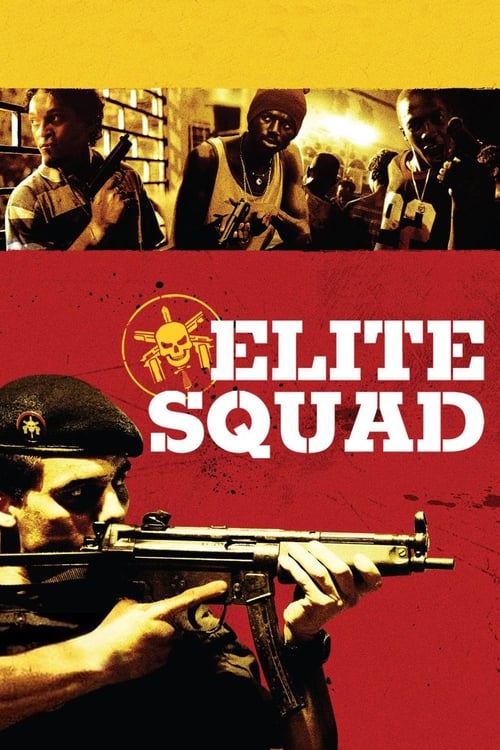
Elite Squad
2007 · José Padilha
For when you want something hard, fast, and confrontational — a film to argue about afterward, not to relax with. Definitely challenge, not comfort.
What it's about
Rio de Janeiro, 1997: with the Pope coming to visit, a hillside favela near his lodgings has to be 'pacified,' and the job falls to BOPE, the city's black-uniformed special police battalion. Captain Nascimento, burning out and about to become a father, must find and train a successor from a corrupt regular police force while waging a brutal war on drug traffickers. It follows two idealistic rookie cops as they're pulled toward the machine that will remake them.
The experience
Relentless — handheld, narrated at machine-gun pace, and morally queasy by design. It plays like an action film but keeps implicating you, daring you to cheer for tactics it's simultaneously showing you are monstrous.
Performances
Wagner Moura's Captain Nascimento is a ferocious piece of acting — a man held together by adrenaline and ideology, so charismatic that audiences split over whether he's the hero or the warning.
The craft
Documentarian José Padilha shoots the favela raids with jolting, embedded realism, and the propulsive voice-over structure drops you inside a worldview rather than describing it from outside. It's visceral filmmaking that hits hardest loud and undistracted.
Why it matters
A genuine cultural detonation in Brazil — watched by millions on pirated discs before release, winner of the Golden Bear at Berlin, and the center of a national argument about police violence that hasn't ended.
Snapshot
Elite Squad (Tropa de Elite) is a Brazilian crime drama that plunges the viewer into the perspective rarely centered in favela cinema: the militarized police. Set in Rio de Janeiro in 1997, ahead of a papal visit that requires a hillside slum be "pacified," it follows Captain Nascimento (Wagner Moura) of BOPE — the Batalhão de Operações Policiais Especiais — as he searches for a successor while burning out under the strain of the drug war and impending fatherhood. Directed by documentarian José Padilha and adapted from a nonfiction book co-authored by a former BOPE officer, the film became a cultural detonation in Brazil, seen by millions on pirated discs before its official release, and went on to win the Golden Bear at the Berlin International Film Festival. It is simultaneously an adrenalized action picture and a deeply contested political object, accused by some of glamorizing torture and by others of anatomizing the rot of a system with unusual candor.
Industry & production
Elite Squad emerged from the same fertile early-2000s Brazilian production ecosystem that produced City of God (2002), and it shares personnel and a producer lineage with that landmark. It was produced by Zazen Produções — Padilha's own company — in partnership with Universal Pictures and other Brazilian financiers, positioning it as a domestically driven film with international distribution ambition. Padilha had come to the material through his documentary work; his acclaimed Bus 174 (2002) examined a real Rio hostage crisis and steeped him in the machinery of police, media, and urban violence.
The screenplay adapts Elite da Tropa, a book co-written by anthropologist and former national public-security secretary Luiz Eduardo Soares together with former BOPE officers André Batista and Rodrigo Pimentel. Pimentel's insider testimony gave the production procedural authority — the training regimens, the operational tactics, the internal culture of the battalion — that few fictional police films command. The screenwriting credit is shared among Bráulio Mantovani (who had written City of God), Padilha, and Pimentel, a combination of dramatic craftsmanship and lived experience.
The film's most extraordinary industrial fact is its distribution history: a workprint or near-final cut leaked and circulated on pirated DVDs across Brazil months before the theatrical premiere. By widely reported estimates, several million Brazilians had already seen it before it opened commercially — an unprecedented piracy phenomenon that arguably amplified rather than cannibalized its cultural impact, turning Nascimento's catchphrases and the "pede pra sair" ("ask to quit") training mantra into national vernacular. Precise viewership figures for the pirated version are inherently unverifiable and should be treated as estimates rather than hard data.
Technology
Elite Squad was shot in the mid-2000s, at the tail end of the era when serious feature filmmaking still defaulted to celluloid, and its documentary-inflected aesthetic depends on lightweight, mobile capture. The film's handheld immediacy, tight interiors, and run-and-gun favela sequences reflect a production built for agility in real and difficult locations rather than controlled soundstages. The precise camera and stock specifications are not prominently documented in the accessible record; what is evident onscreen is a deliberate embrace of grain, available or naturalistic light, and the kinetic instability of the operator's body rather than the smoothness of dolly and crane. This is technology deployed to erase the seam between fiction and reportage.
Technique
Cinematography
Lula Carvalho's photography is the film's engine of verisimilitude. The camera behaves like an embedded witness — jostled, reactive, frequently whip-panning to catch action already in progress — extending the observational grammar Padilha had absorbed as a documentarian. Handheld framing dominates; the operator seems to be discovering events rather than staging them. In the favela raids the image tightens claustrophobically around bodies and alleys, while the training and interrogation sequences use hard, unflattering light that refuses to aestheticize brutality even as the cutting energizes it. The visual register is grimy, desaturated, and urgent, aligning the spectator's eye with the tactical tunnel-vision of the men carrying the guns.
Editing
Daniel Rezende — the editor of City of God — cuts Elite Squad with propulsive, rhythm-forward energy, and the collaboration is central to the film's grip. The editing braids Nascimento's relentless first-person voiceover to the imagery, using narration to compress exposition, leap across time, and editorialize on the action, so that the cutting operates as argument as much as continuity. Action set pieces are assembled for velocity and disorientation; procedural passages are clipped and elliptical. The voiceover-plus-montage structure lets the film cover a sprawling institutional landscape — corruption, training, two rookie cops' diverging paths — without losing momentum, though it also concentrates the film's point of view almost entirely inside Nascimento's head.
Mise-en-scène / staging
The staging privileges authenticity of place: actual hillside communities, cramped police interiors, the ritual spaces of BOPE training. The battalion's iconography — the black uniforms, the skull-and-crossed-pistols/knife insignia — is foregrounded until it becomes a visual thesis about the death's-head identity the unit cultivates. Violence is staged with procedural specificity rather than choreographed spectacle; interrogations and the notorious "plastic bag" and beating sequences are composed to be uncomfortable and close. The favela geography is rendered as a vertical maze, its topography inseparable from the tactical problem the police confront.
Sound
Sound design leans into the concussive and the enveloping — gunfire, radio chatter, the acoustic chaos of raids — to keep the viewer inside the operation. Nascimento's voiceover is the dominant sonic element, a hard, sardonic, sometimes contemptuous narration that frames everything the audience sees. Regarding the musical score, the accessible record is thinner than for the film's other craft categories; the film uses percussive, tension-building underscoring and Brazilian source music, but I will not attribute the composition to a specific credited composer here without confidence in the record. What is clear is that music is used sparingly relative to the sheer weight of diegetic noise, keeping the tone documentary-adjacent rather than operatic.
Performance
Wagner Moura's Captain Nascimento is one of the defining performances of 2000s Brazilian cinema — a coiled, exhausted, morally compromised man whose weariness and rage the actor makes magnetic rather than merely repellent. Moura carries the voiceover and the drama simultaneously, and the role launched him to national stardom and, eventually, international recognition. André Ramiro as the idealistic, law-studying Matias and Caio Junqueira as the hotheaded Neto anchor the film's moral spectrum as the two rookies Nascimento eyes as possible replacements. The supporting ensemble, including Milhem Cortaz among the police ranks, sustains the naturalistic, lived-in texture, with performances calibrated to the handheld realism rather than to melodrama.
Narrative & dramatic mode
The film's dramatic mode is confessional and retrospective: Nascimento narrates the story as a man looking back on the period when he was desperate to leave BOPE and find someone to take his place. This framing device — the burnt-out insider addressing the audience directly — gives the film its distinctive fusion of procedural, character study, and polemic. The plot braids three strands: Nascimento's personal crisis (impending fatherhood, panic attacks, the wish to quit); the parallel arcs of Neto and Matias as they wash out of the corrupt regular police toward BOPE; and the operational spine of clearing the drug gangs before the pope's visit. The mode is aggressively subjective — everything is filtered through Nascimento's judgments, including his contempt for corrupt cops, complicit middle-class drug consumers, and NGO idealists — which is precisely what makes the film both compelling and ideologically slippery.
Genre & cycle
Elite Squad sits at the intersection of the police procedural, the war film, and the Latin American favela-crime cycle. It belongs to the wave of gritty urban-violence films that City of God internationalized, but it deliberately inverts that film's vantage: where City of God looked outward from the favela's residents and hustlers, Elite Squad looks down the barrel from inside the state's most lethal instrument. Its training-and-initiation structure aligns it with the war-movie subgenre of boot-camp films, and its cynical narration and institutional corruption place it in dialogue with the dark police cinema tradition. The film effectively opened a Brazilian police-action cycle that its own sequel would extend and complicate.
Authorship & method
José Padilha is the film's authorial center, and his method is legible in every frame: a documentarian's insistence on procedural fidelity and access, wedded to a provocateur's appetite for moral confrontation. Having examined institutional failure through nonfiction in Bus 174, he approached fiction as another instrument for dissecting the systems that produce Rio's violence. His key collaborators form a distinguished chain: cinematographer Lula Carvalho supplied the embedded, handheld eye; editor Daniel Rezende brought the propulsive, voiceover-driven cutting he had honed on City of God; and screenwriter Bráulio Mantovani, again post-City of God, structured the sprawling material into a driving narrative, working alongside Padilha and the insider knowledge of ex-officer Rodrigo Pimentel. The presence of Soares and Pimentel as source authors makes the film unusually accountable to real institutional testimony, even as the dramatization amplifies it. Padilha would go on to remake RoboCop (2014) and to create the Netflix series Narcos, extending his career-long fascination with policing, drug economies, and state power.
Movement / national cinema
The film is a signal work of the retomada-descended renaissance of Brazilian cinema — the revitalization that gathered force through the late 1990s and 2000s and reached global visibility with City of God. It is emphatically a national cinema object: rooted in Rio's specific geography and politics, cast largely with Brazilian actors, and engaged with debates internal to Brazilian society about public security, class, and the militarization of policing. At the same time, its Berlin Golden Bear win marked the international art-cinema circuit's embrace of this Brazilian wave, positioning Elite Squad as both a domestic phenomenon and a festival-canonized export.
Era / period
Made in the mid-2000s but set in 1997, the film occupies a doubled temporality. Its historical setting predates the "pacifying police unit" (UPP) policy era, capturing a Rio in which the drug war was fought through episodic incursions rather than sustained occupation. Its production era, however, is saturated with post-City of God debates about how Brazilian cinema represents favela violence — whether such films illuminate or aestheticize suffering. Arriving in 2007–2008, Elite Squad landed amid intensifying national anxiety about crime, corruption, and police conduct, and its reception was inseparable from that political moment. The sequel would push directly into contemporary politics, but the first film already reads its 1997 setting as a diagnosis of enduring structures.
Themes
The film's central theme is the corrosion of the individual within a corrupt and violent system: Nascimento's psychological disintegration is the human cost of a war with no clean actors. It interrogates institutional corruption at every level — the graft of the regular police, the moral compromises of BOPE's "cleaner" but brutal methods, and the complicity of middle-class recreational drug users whom the film pointedly indicts. Torture and state violence are examined without the comfort of clear condemnation, which is the source of the film's most heated controversy. Initiation and masculinity structure the training passages, where recruits are broken down and remade. And beneath it all runs an argument about the impossibility of clean solutions in a system where every institution — police, traffickers, universities, NGOs — is implicated. The film refuses easy heroes, though critics divide sharply over whether it ultimately endorses or merely depicts Nascimento's worldview.
Reception, canon & influence
Critical reception was polarized in a way that has become part of the film's identity. Its Golden Bear at the Berlin International Film Festival conferred major prestige, yet the award and the film drew accusations from some critics — including at Berlin — that it was fascistic or an apologia for police brutality, a charge Padilha and defenders rejected, arguing the film exposes rather than celebrates the system. In Brazil the film was a genuine mass-cultural event, its dialogue and imagery entering everyday speech, powered in part by the extraordinary pre-release piracy that seeded its audience.
Looking backward, the film's influences are clear: the observational grammar and institutional focus of Padilha's own documentary Bus 174; the aesthetic and industrial template of City of God, with which it shares editor, screenwriter, and much of its favela-cinema idiom; and the nonfiction testimony of the source book, which grounded its procedural realism. Looking forward, its legacy is substantial. Elite Squad: The Enemy Within (2010) extended the story into the machinery of political corruption and became one of the most commercially successful Brazilian films of its time domestically (exact figures should be checked against box-office records rather than asserted here). Wagner Moura's stardom and eventual international career trace back to Nascimento, and Padilha's Hollywood and Netflix work — RoboCop, Narcos — carries forward the same preoccupations with policing and the drug economy. More broadly, the film sharpened an enduring debate about the ethics of representing state violence onscreen, and its skull-insignia iconography and hard-edged cop's-eye perspective have reverberated through subsequent Latin American crime cinema. Elite Squad endures as both a canonical entry in the modern Brazilian wave and a permanent provocation about what it means to look at the drug war from behind the badge.
A Deleuzian reading
A hillside at night.
The full Deleuzian reading of Elite Squad →
Reception
On release it was a lightning rod — Variety infamously branded it 'a recruitment film for fascist thugs' even as Brazilian audiences turned Captain Nascimento into a folk hero — and then it won the Golden Bear at Berlin 2008. Today it's settled in as a cornerstone of modern Brazilian cinema, with the argument over what it's actually saying now treated as part of its power.
How Elite Squad was received, from release to now →
How to watch Elite Squad: what to notice on a first viewing
- Watch the camera whip-pan to catch action already starting. Carvalho's handheld camera behaves like an embedded witness, jostled and reactive, as if it is discovering events rather than staging them in advance. The camera's own uncertainty puts you inside the operation instead of watching it from outside.
- Listen to Nascimento's voiceover judge everyone on screen. His narration is hard, sardonic, and constant, framing corrupt cops, drug users, and idealists alike through his own contempt before you can form your own opinion. You are never given a neutral version of events, only his.
- Look at the skull-and-crossed-weapons patch on every uniform. BOPE's insignia is foregrounded again and again until it reads as the unit's whole identity, printed openly on every chest. One patch states the battalion's death's-head self-image before a single mission does.
- Notice the favela shot as a vertical maze. Carvalho tightens the frame around alleys and bodies until the hillside's geography becomes the tactical problem itself, not just a backdrop for it. The place is staged as an obstacle the police have to physically solve.
- Watch Moura play exhaustion as much as authority. Nascimento is coiled and worn down at once, a commanding presence whose fatigue and rage the film makes magnetic instead of simply hard to watch. His tiredness is as much the character as his authority is.
The whole guide to watching Elite Squad, with the keys for a rewatch →
Influences: the films it descends from and the films it influenced
- City of God (2002) — Shares editor Daniel Rezende and screenwriter Bráulio Mantovani, and hands down the propulsive voiceover-anchored montage grammar — chaptered, time-jumping favela narration — that Elite Squad reroutes through a cop's perspective.
- Bus 174 (2002) — Padilha's own documentary supplies the observational, embedded procedural fidelity and the institutional-failure lens (police pathology, carceral abandonment) that he re-tools as fiction here.
- Full Metal Jacket (1987) — Provides the boot-camp-film architecture — a sadistic instructor systematically dismantling and reassembling recruits — that Elite Squad transplants directly into the BOPE training sequences and their dehumanizing hazing rituals.
- Goodfellas (1990) — Models the sustained first-person voiceover of a morally compromised insider who narrates the operational mechanics of a violent institution, guiding the viewer's complicity through confessional narration.
- The Battle of Algiers (1966) — Establishes the newsreel-handheld idiom and the clinical, procedural staging of state torture as counterinsurgency method — presented as tactics rather than editorializing, which is exactly the ambiguity Elite Squad exploits.
- Z (1969) — Pioneers the kinetically cut political thriller that dramatizes institutional corruption as an investigative procedure, using accelerated editing to convert bureaucratic rot into momentum.
- Pixote (1981) — Sets the Brazilian realist template of nonprofessional/street authenticity mobilized as an indictment of state institutions, a lineage the Retomada favela cinema inherits.
- Training Day (2001) — Supplies the corrupting-mentor cop procedural — a hardened veteran initiating a rookie into extralegal policing over a compressed span — the exact mentor/initiate axis Nascimento occupies with Neto and Matias.
- Carandiru (2003) — Extends the Carandiru cycle's brutal procedural realism about Rio's police and carceral apparatus into hard-edged fiction, continuing the public reckoning with state violence.
- Brainstorm (2001) — Carries the Retomada institution-critique forward with an embodied male lead and immersive, subjective first-person immersion into a dehumanizing Brazilian state apparatus — the machine-swallows-the-individual structure Brainstorm modeled.
- Elite Squad: The Enemy Within (2010) — Directly extends Nascimento's first-person voiceover POV outward from street operations into the electoral and political-corruption machinery, scaling the same narrating-cop device to systemic critique.
- Narcos (2015) — Carries forward the cop's-eye, voiceover-driven reconstruction of the drug economy and documentary-inflected archival texture into serialized television.
- RoboCop (2014) — Reworks the same preoccupation with policing as privatized state violence, retaining Padilha's institutional-critique frame inside a studio genre remake.
- The Man from the Future (2011) — Builds Wagner Moura's intense dramatic star persona as Capitão Nascimento, the exact prior stardom that O Homem do Futuro's casting-against-type comic lead reads as an intertextual gesture against.
- Bingo: The King of the Mornings (2017) — Lula Carvalho's saturated, propulsive, high-contrast handheld cinematography was honed on this franchise and reappears as Bingo's kinetic visual energy and its bright-versus-grimy dual-image regime.
- Sicario (2015) — Deploys desaturated handheld and a law-enforcement-insider POV moving through drug-war moral ambiguity, withholding judgment so the procedural surface itself becomes the provocation.
- Zero Dark Thirty (2012) — Stages torture as institutional method within a granular procedural, refusing editorial cushioning — and drew the identical 'is this endorsement?' controversy that trailed Elite Squad's Golden Bear.
- The Hurt Locker (2008) — Uses embedded, multi-camera handheld to render the adrenalized field POV of an armed unit at work, prioritizing tactile procedure over exposition.
- Gomorrah (2008) — Dissolves crime drama into observational documentary texture through embedded handheld and ambient diegetic sound, the parallel European branch of the same favela/periphery realism.
- A Prophet (2009) — Runs a boot-camp-style institutional formation narrative — the prison as training ground that forges its subject through disciplined violence — mirroring Elite Squad's recruit-into-instrument arc.
- Slumdog Millionaire (2008) — Padilha extends the City of God favela-kineticism — handheld pursuit, voiceover frame, bleach-bypass grit — sharing the Brazilian realist lineage Slumdog drew from.
- Marighella (2021) — The toolkit Moura inverts from inside: embedded handheld that stays at shoulder height with the shooters, concussive close-mic'd gunfire mixed dry and overloading the track, and raids built as step-by-step tactical procedure — here turned from the state's squad to the people the state hunts.
Similar films
- Elite Squad: The Enemy Within (2010) — influence & lineage
- City of God (2002) — influence & lineage
- Bus 174 (2002) — influence & lineage
- Training Day (2001) — influence & lineage
- The Secret Agent (2025) — shared sensibility
- Pixote (1980) — shared sensibility
- Marighella (2021) — shared sensibility
- Carandiru (2003) — shared sensibility