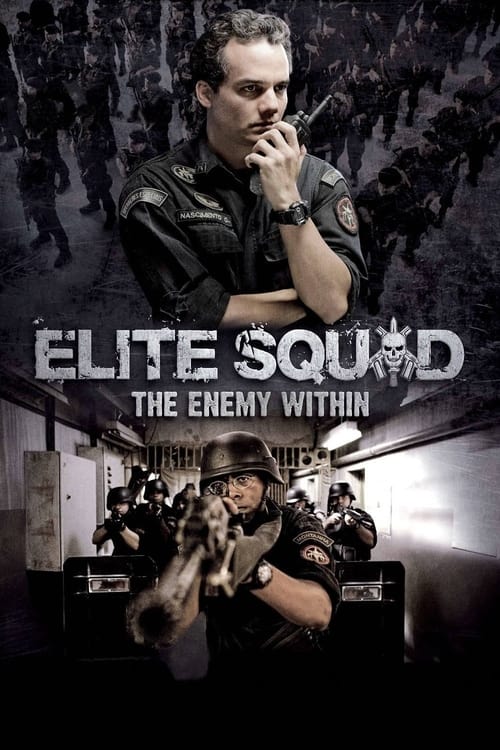
Elite Squad: The Enemy Within
2010 · José Padilha
When you want a hard-hitting crime thriller with a political brain — something closer to a punch than an escape. Not comfort viewing; it's a film that wants you outraged.
What it's about
After a prison rebellion ends in bloodshed, BOPE commander Roberto Nascimento is kicked upstairs into Rio de Janeiro's intelligence apparatus — where he discovers the real enemy isn't the drug traffickers he spent his career fighting. As paramilitary militias of corrupt cops seize the favelas the traffickers leave behind, and politicians and media profit from the whole arrangement, Nascimento finds himself at war with the system he serves, alongside the human-rights activist who was once his fiercest critic.
The experience
Relentless — a furious, propulsive thriller narrated with cold anger, cutting between gunfights, backroom deals, and legislative theater at a pace that never lets you settle. It's gripping as pure action and infuriating as an exposé, and the anger lingers after the credits.
Performances
Wagner Moura is magnetic as Nascimento, hardening a career-defining character into a man whose certainties are being dismantled in real time — the weariness and fury read in his face even when the narration goes quiet.
The craft
José Padilha shoots with a war reporter's urgency — handheld cameras, percussive editing, and combat sequences staged with documentary credibility — while the script has the architecture of an investigative exposé, mapping how police, militias, media, and elections interlock. Loud, kinetic, and built for good speakers.
Why it matters
It became a cultural event in Brazil, smashing domestic box-office records and forcing a national conversation about militias and political corruption. It also cemented Padilha's and Moura's international careers, feeding directly into the style of the crime sagas they made afterward.
Snapshot
Tropa de Elite 2: O Inimigo Agora É Outro — released internationally as Elite Squad: The Enemy Within — is José Padilha's sequel to his 2007 breakout Tropa de Elite, and it functions less as a continuation than as an argument. Where the first film narrowed to the moral corrosion of a single BOPE officer inside Rio de Janeiro's drug war, the second pulls the camera back to indict the whole machine: police, politicians, media, and the paramilitary militias that move into the favelas once the traffickers are pushed out. Its subtitle — "the enemy is now another" — is a thesis statement. Wagner Moura returns as Lieutenant Colonel Roberto Nascimento, promoted out of the field and into a subsecretariat of intelligence, where he discovers that the state apparatus he serves is the deeper rot. The film became a genuine cultural phenomenon in Brazil, widely reported as the country's highest-grossing domestic production to that date, and it converted the franchise's ambivalent tough-cop iconography into a scathing structural critique. It is at once a thriller, a procedural, and a piece of political cinema in the tradition of Costa-Gavras.
Industry & production
The film was produced by Zazen Produções, Padilha's own company (co-founded with Marcos Prado), in a Brazilian industry that in the late 2000s was still consolidating around the retomada generation — the post-1990s revival funded through incentive laws and increasingly capable of large-scale commercial genre work. The first Tropa de Elite had a famously fraught release history: it circulated massively as a bootleg before its official 2007 opening and then won the Golden Bear at the 2008 Berlinale, establishing Padilha and the property as a national event. That success gave the sequel unusual commercial confidence for a Brazilian film. Universal Pictures handled distribution in Brazil, signaling the scale of the release.
The sequel opened in Brazil in October 2010 and, by essentially every account in the trade and press record, drew an enormous domestic audience — figures commonly cited put theatrical admissions above eleven million, making it the most-attended Brazilian film of the modern era at the time of release. I flag that the precise admissions and gross vary across sources and inflation adjustments, so the safe claim is that it was a record-setting domestic hit rather than any single exact number. Brazil selected it as its official submission for the Academy Award for Best Foreign Language Film for the 84th ceremony; it made the field of submissions but was not among the final nominees.
Technology
The production was shot digitally, part of the broader late-2000s migration of ambitious mid-budget features away from film stock. The choice suited the material: digital acquisition enabled the handheld, low-light, run-and-gun coverage that the franchise's action grammar depends on, and it kept the production nimble across the real and recreated favela, prison, and institutional locations the story required. Beyond that, the film's "technology" is largely conventional for a 2010 action-drama; it does not foreground visual-effects innovation. Where it is technically distinctive is in the coordination of large, kinetic set pieces — the opening prison-rebellion assault above all — staged for cameras that move with the operators rather than on stabilized rigs. I have no reliable detailed record of the specific camera or lens packages used, and would rather not invent them.
Technique
Cinematography
Lula Carvalho photographed the film, and his work is the technical spine of its realism. The camera is predominantly handheld, close, and reactive — it discovers action rather than pre-composing it, snapping toward violence a beat late in a way that reads as documentary reflex. This is consistent with Padilha's own background in nonfiction (his Bus 174 was built from surveillance and news footage), and the aesthetic borrows the vocabulary of reportage: available-feeling light, desaturated urban palettes, the grain and jostle of a crew embedded in a real event. The prison-riot sequence that opens the film is the showcase — a sustained, disorienting descent into a space the audience cannot fully map, which is precisely the point. Carvalho would go on to a substantial international career, and his work here is an early demonstration of the muscular handheld style he became known for.
Editing
The cutting is fast, propulsive, and tightly bound to the voiceover, which the film uses to compress large amounts of institutional exposition — how a militia launders territory into votes, how a security budget becomes a patronage machine — into digestible momentum. Action is assembled for impact and legibility of consequence rather than balletic clarity; the violence is meant to feel abrupt and morally ugly. The first film's editing was handled by Daniel Rezende (the City of God editor), and the sequel maintains that lineage of rhythmic, narration-driven construction; I would not want to over-attribute specific cutting choices without firmer credit detail than I can verify here. What is unmistakable is the structural editing logic: the film keeps widening its frame of accusation, each act revealing that the previous act's villain was a symptom, not the disease.
Mise-en-scène / staging
Padilha stages institutions as physical spaces of power. The BOPE's operational rooms, the governor's offices, the legislative assembly, the militia-controlled favela, the prison — each is a set of the state, and the drama repeatedly turns on who controls a given room. The staging insists on hierarchy and surveillance: men in uniform arrayed around principals, backroom deals framed to emphasize proximity and complicity. The favela sequences are shot in real and recreated locations to preserve the vertical, labyrinthine geography that the franchise treats almost as a character. The recurring visual motif is the pressroom and the television screen — the film stages the manufacture of public narrative as deliberately as it stages a raid.
Sound
Pedro Bromfman composed the score, continuing his collaboration with Padilha (a partnership that would extend to the director's later work). The music leans on driving percussion and electronic textures that push the action forward without romanticizing it; it is a functional, adrenal score rather than a lyrical one, and it recedes during the film's dialogue-heavy political passages to let the argument land. Sound design privileges the concussive, close, chaotic register of the action — gunfire and crowd noise mixed for overwhelming immediacy — against the quieter, wiretap-and-corridor textures of the intelligence-work half of the film.
Performance
Wagner Moura's Nascimento is the film's engine and its moral instrument. Moura plays him aged and worn — his old certainties as a war-fighter curdling into a bewildered, then furious, recognition that the enemy has changed shape. Much of the performance is delivered through the character's voiceover, a hardboiled interiority that lets Moura carry the film's argument while his face carries its disillusion. Irandhir Santos, as the human-rights advocate and later politician Diogo Fraga, gives the film its dialectical counterweight — the figure the first film's fans were primed to despise, reframed here as principled and ultimately correct. André Ramiro returns as Matias. The ensemble is populated by recognizable faces from the retomada's deep bench of theatrical and screen actors; the overall performance register is naturalistic and intense, matched to the handheld camera's demand for behavior over presentation.
Narrative & dramatic mode
The film's dominant mode is the first-person confessional thriller. Nascimento narrates, and that narration is both the film's accessibility device and its rhetorical weapon: it lets a mass-audience action film deliver a systemic political analysis. Structurally, the story is a widening spiral. It begins with a discrete crisis — a botched prison operation and the political fallout — and then follows the consequences outward, promotion by promotion, until the protagonist realizes he has been made a functional part of the corruption he thought he was fighting. It is a tragedy of instrumentalization: the good soldier discovers that his effectiveness is exactly what the system needs to sustain itself. The emotional throughline is domestic and generational — Nascimento's estranged relationship with his son, who is drawn into Fraga's orbit — which grounds the macro-political argument in a family. The dramatic irony is total by the end: the audience, and Nascimento, understand the machine, but understanding is not power.
Genre & cycle
The Enemy Within sits at the intersection of the police thriller, the political conspiracy film, and the socially engaged crime drama. It belongs to a specific Brazilian cycle — the favela/urban-violence film that City of God (2002) crystallized for global audiences and that Tropa de Elite pushed toward the perspective of the police. But the sequel deliberately breaks from that cycle's usual terrain: it largely leaves the drug war behind to dramatize the militia phenomenon and the institutional corruption above it, effectively arguing that the favela-shootout genre had been telling the smaller story. In doing so it aligns itself with the international conspiracy-thriller lineage — Costa-Gavras's Z, the 1970s American paranoia film — more than with the street-level realism of its predecessor.
Authorship & method
Padilha is the clear author, and the film is legible as a continuation of his method across documentary and fiction: build from journalistic research, adopt the point of view of an insider, and use that intimacy to expose a structure. His nonfiction background (Bus 174, and the documentary Garapa) informs the film's evidentiary texture. The screenplay is credited to Padilha with Bráulio Mantovani, the screenwriter of City of God and the first Tropa de Elite — a crucial collaboration, since Mantovani is a central architect of this whole strand of Brazilian screen storytelling and of the voiceover-driven structure the films use. The key craft collaborators — cinematographer Lula Carvalho and composer Pedro Bromfman — give the film its sensory identity, and Wagner Moura's authorship-by-embodiment of Nascimento is inseparable from the film's meaning. Padilha's method here is polemical: he does not pretend to neutrality; the film is built to make an accusation and to make it entertaining enough to reach eleven million people.
Movement / national cinema
The film is a landmark of the Brazilian cinema da retomada and its maturation into commercially formidable, internationally legible genre cinema. It carries forward the concerns of Cinema Novo — Brazilian cinema's long preoccupation with violence, inequality, and the state — but translated into a mass-market thriller idiom rather than an avant-garde one. It stands, with City of God and the first Tropa de Elite, as one of the defining works of 2000s Brazilian cinema's global moment, and it demonstrated that a Brazilian film addressing Brazilian institutional politics in granular detail could nonetheless become the country's biggest domestic hit.
Era / period
Made and set in the late-2000s Rio de Janeiro, the film is inseparable from its moment: the years in which the militia problem — off-duty and ex-police controlling territory and extracting rents — was becoming the recognized successor to (and sometimes partner of) drug-gang control, and the years just before Rio's Olympic-era "pacification" push. The film reads as a direct intervention in a live public debate, released when its subject was front-page news. Its skepticism toward triumphalist security politics is very much of that pre-2014 Brazilian mood.
Themes
The film's central theme is that the enemy is systemic, not individual: corruption is not a few bad actors but the operating logic of an interlocking system of police, politics, and media. Related themes include the co-optation of violence by the state (the "good" war-fighter as the system's most useful tool); the militia as capitalism-by-other-means, converting territorial control into political power; the manufacture of consent through media spectacle; and disillusionment as a form of clarity. Running beneath the politics is a generational and paternal anxiety — the fear that the son will inherit either the violence or the naïveté of the father. The film is notably self-critical about its own franchise: it takes the audience that cheered Nascimento's brutality in the first film and confronts them with where that brutality leads.
Reception, canon & influence
Critically and commercially, the film was received as a major event. In Brazil it was a record-setting box-office success and a lightning rod for public debate about policing, corruption, and militias. Internationally it drew strong reviews and comparisons to the political thriller tradition, and Brazil advanced it as its Oscar submission for Best Foreign Language Film, though it was not nominated. It is generally regarded as at least the equal of, and by some critics superior to, the Golden Bear–winning original.
The influences on the film run backward to Padilha's own documentary practice, to City of God and its Mantovani-scripted storytelling model, and to the international conspiracy-thriller lineage of Costa-Gavras and the American paranoia cinema of the 1970s. Its influence forward is substantial. Domestically it cemented the favela/police-corruption thriller as Brazil's flagship export genre and raised the ceiling for what a politically engaged commercial film could achieve at home. For its principal creators it was a launching pad: Padilha moved to Hollywood to direct the RoboCop remake (2014) and then created and produced Netflix's Narcos, carrying his structural, research-driven crime storytelling to a global streaming audience; Wagner Moura's Nascimento made him a star and led to his defining international role as Pablo Escobar in Narcos; and Lula Carvalho and Pedro Bromfman built international careers partly on this foundation. The film endures as a reference point in discussions of Brazilian cinema, of the police thriller as political form, and of how a sequel can retroactively reframe — and sharpen — the meaning of the film that preceded it.
Reception
A record-shattering phenomenon in Brazil on release — it became the most-watched Brazilian film ever at home — and time has only firmed up the consensus that this is the rare sequel that outdoes the original, sharpening the first film's chaos into a systemic indictment.
How Elite Squad: The Enemy Within was received, from release to now →
How to watch Elite Squad: The Enemy Within: what to notice on a first viewing
- Watch how the camera catches action a beat after it starts. Carvalho shoots handheld and close, snapping toward violence a little late in a way that reads like documentary reflex rather than staged coverage. The camera feels like it is discovering the story, not composing it for you.
- Listen for how much explaining happens in voiceover, not dialogue. Nascimento's narration compresses large amounts of institutional detail, how a budget becomes patronage, how territory becomes votes, into fast, digestible momentum. The voice is doing the work of a textbook while the images keep moving fast.
- Notice how each new institution gets its own distinct room. Padilha stages BOPE headquarters, the governor's office, and the legislature as separate sets of state power, and the drama keeps turning on who controls a given room. You can track who actually holds power just by watching which room a scene happens in.
- Watch how tired and worn Nascimento looks compared to before. Moura plays him aged and worn, his old certainties as a fighter curdling into bewilderment and then fury as the enemy changes shape. His face carries the disillusionment his voiceover is still too proud to fully admit.
- Listen for how the score pushes scenes forward without glorifying them. Bromfman's driving percussion and electronic textures push the action forward but recede during the dialogue-heavy political passages to let the argument land. The music knows when to get out of the way of the film's actual argument.
The whole guide to watching Elite Squad: The Enemy Within, with the keys for a rewatch →
Influences: the films it descends from and the films it influenced
- Elite Squad (2007) — The direct predecessor establishes Nascimento's clipped, accusatory first-person voiceover as the film's structural spine and Wagner Moura's authorship-by-embodiment, which the sequel inherits and turns outward from the favela onto the state apparatus.
- Bus 174 (2002) — Padilha's own documentary supplies the evidentiary method — journalistic reconstruction from an insider vantage that indicts the institution around the subject — later ported into the fiction's forensic, research-built texture.
- City of God (2002) — Bráulio Mantovani's screenplay model — braided, voiceover-narrated favela chronicle with handheld available-light kineticism — is the storytelling architecture Mantovani then carries directly into the Tropa scripts.
- Pixote (1981) — Its naturalistic, near-documentary casting and available-light street realism about Brazil's carceral/police underclass sets the Cinema Novo-legacy template for staging institutions (reformatories, precincts) as spaces of power the Tropa films adopt.
- The Battle of Algiers (1966) — Pontecorvo's handheld, newsreel-grain verité staging of counter-insurgency as a procedural of the security apparatus is the formal grammar Lula Carvalho's camera echoes in the raid and interrogation sequences.
- Z (1969) — The propulsive political-conspiracy-thriller form — an investigation that widens from a single act to expose an entire compromised state structure while keeping thriller momentum — is the Costa-Gavras engine Padilha explicitly runs on.
- State of Siege (1972) — Its cool, semi-documentary anatomy of state security, torture, and para-institutional violence models the film's 'expose the machine, not the man' polemical structure.
- Serpico (1973) — Lumet's blueprint of the honest cop discovering that corruption is systemic rather than individual — dramatized through an intense, naturalistic lead performance in real precinct spaces — underwrites Nascimento's disillusionment arc.
- Prince of the City (1981) — Its confessional cop-drama spiral, where one insider's testimony implicates ever-higher tiers of the institution, is the widening-spiral narrative shape the sequel escalates toward the legislature.
- The Parallax View (1974) — Pakula's 1970s paranoia grammar — institutions as opaque architectural power-spaces and a protagonist swallowed by a conspiracy larger than he can see — feeds the film's manufacture-of-consent framing.
- All the President's Men (1976) — The procedural, research-as-drama method of following a paper trail up through the system supplies the film's investigative-thriller register in which each disclosure reframes the last.
- Central Station (1998) — A flagship of Cinema da Retomada, its naturalistic non-professional textures and available-light realism reestablished the internationally exportable Brazilian social-realist mode the Tropa films commercialize.
- Narcos (2015) — Padilha and composer Pedro Bromfman carry the exact toolkit forward — insider voiceover narration, research-driven crime chronicle, percussive-electronic scoring — scaling the Tropa method to a global streaming series.
- RoboCop (2014) — Padilha's Hollywood debut transplants the Tropa preoccupation — militarized policing and privatized institutions manufacturing consent — into studio genre, retaining the cop-as-instrument-of-a-corrupt-system thesis.
- Sicario (2015) — Villeneuve and Jóhann Jóhannsson's dread-driven, percussive electronic score over procedural tactical-raid staging, following an idealist drawn into an amoral institutional machine, extends the same politicized police-thriller craft.
- Traffic (2000) — Soderbergh's mosaic drug-war thriller — desaturated, handheld available-light shooting and a widening spiral that binds street enforcement to political complicity — is a parallel deployment of the same systemic-corruption structure.
- Zero Dark Thirty (2012) — Bigelow's available-light, handheld procedural anatomy of a state security apparatus — dramatizing institutional method (surveillance, interrogation, the raid) as the true subject — is a parallel realist-thriller treatment of manufactured consent.
Similar films
- Elite Squad (2007) — influence & lineage
- City of God (2002) — influence & lineage
- Bus 174 (2002) — influence & lineage
- Sicario (2015) — influence & lineage
- Z (1969) — influence & lineage
- Marighella (2021) — shared sensibility
- The Raid 2 (2014) — shared sensibility
- Brainstorm (2001) — shared sensibility